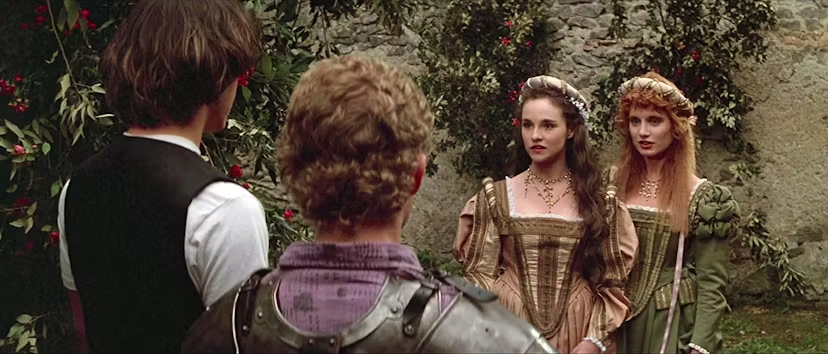
The scene from the 1989 film Bill & Ted’s Excellent Adventure, which I quote for the reference to historical babes
GIRLS OF HISTORY: TOP 10
“Bill: We gotta go, this is a history report, not a babe report!
Ted: But Bill, those are historical babes!”
That’s right – once again, I can find Fantasy Girls in anything.
Similarly to my Girls of Mythology, this is something of a personal novelty list, as my Girls of History don’t tend to have the same art or cosplay as my usual Fantasy Girls in popular culture – the holy trinity of comics, video games and anime of course, but also animation or fantasy and SF.
Although you may be surprised at the name recognition of the more distinctive girls of history and perhaps even more surprisingly, at the extent to which they do feature in popular culture, notably comics, film or television.
Also, comics artist Simon Bisley has done an awesome art collection of women from history, which features quite a few of my top ten entries. You can find it on his official website but I don’t feature any of it here, with one exception tightly cropped for fair use under copyright and because the full image is too racy, the same reasons that I don’t feature anything else from the collection.
While on the subject of art, there’s also a surprisingly prolific subculture of historical comics art on X or Twitter, usually featuring historical babes, by artists such as Gambargin, Centuriichan (a name shared with her signature female Roman legionary character), and Anonhistory (who likes to tease Centuriichan with a Pictish witch character, naked but for blue woad tattoos).
Ted: Oh, you beautiful babes from England, for whom we have traveled through time… will you go to the prom with us in San Dimas? We will have a most triumphant time! [princesses giggle]
Bill: Way to go, dude!
Sadly, Princesses Elizabeth and Joanna from Bill & Ted’s Excellent Adventure won’t be featuring in my Top 10 Girls of History – but here’s who does!
B-TIER (HIGH TIER)

Scene from the 2006 film Marie Antoinette, starring Kirsten Dunst as the titular French queen (fair use)
(10) MARIE ANTOINETTE (1755-1793)
Let them eat cake?
And yes, I know that statement being attributed to Marie Antoinette as demonstrating her ignorance of the plight of her subjects – as her answer to their protest that they had no bread to eat – is apocryphal at best and fictional propaganda at worst.
History’s most famous aristocratic party girl, albeit that fame may owe more to how the party ended for her.
Born an Austrian princess – okay, archduchess but basically the same thing – she became Queen of France through her marriage to Louis XVI as well as the target of those opposed to the monarchy, culminating with her being beheaded by guillotine along with her husband as part of the Reign of Terror during the French Revolution.
“Long after her death, Marie Antoinette remains a major historical figure linked with conservatism, the Catholic Church, wealth and fashion. She has been the subject of many books, films, and other media. Politically engaged authors have deemed her the quintessential representative of class conflict, western aristocracy and absolutism. Some of her contemporaries, such as Jefferson, attributed to her as a cause of the French Revolution.”
RATING:
B-TIER (HIGH TIER)

Lucrezia Borgia as portrayed by Holliday Grainger in The Borgias TV series 2011-2013 from her profile in the fan wiki (fair use)
(9) LUCREZIA BORGIA (1480-1519)
Basically a Renaissance mafia princess.
I just have a soft spot for the ‘bad girls’ of history, albeit that adjective is a matter of historical perspective. You can make arguments for my preceding entry as a bad girl – or indeed pretty much all my entries as bad girls – but we’re much more in bad girl territory with Lucrezia Borgia, if only through her family.
After all, she was the illegitimate daughter of Rodrigo Borgia in his reign as Pope Alexander VI, and it doesn’t get much more bad than popes having kids – except perhaps her brother Cesare, the model for Machiavelli’s Prince, who was arguably even worse than their father. . .
Her family arranged several marriages for her among the Italian aristocracy that advanced their own political position, lending itself to “notorious tales about her family” that “cast Lucrezia as a femme fatale, a controversial role in which she has been portrayed in many artworks, novels, and films”. That role extended to the role of black widow for one of her husbands (even if through her brother Cesare) and poisoning or murder in general, such as the rumor that she had a hollow ring that she used to poison drinks.
“Lucrezia was described as having heavy blonde hair that fell past her knees, a beautiful complexion, hazel eyes that changed colour, a full, high bosom, and a natural grace that made her appear to “walk on air”.
RATING:
B-TIER (HIGH TIER)

Tomoe Gozen as portrayed by Sayaka Akimoto in the Japanese 2022 TV drama The 13 Lords of the Shogun
(8) TOMOE GOZEN (1157-1247)
I had to get a ninja girl (or kunoichi) in there somewhere – even if the closest I could get was a female samurai (or onna-musha) and a possibly legendary one at that.
Tomoe Gozen is perhaps the best known female samurai by name, mentioned in The Tale of the Heike but not otherwise in any primary accounts of the Genpei War, a civil war between rival clans in Japan. She was famed as a swordswoman and archer, serving under the samurai lord Minamoto no Yoshinaka.
RATING:
B-TIER (HIGH TIER)
A-TIER (TOP TIER)

Promotional poster for the Zenobia: Queen of the East film in production (fair use)
(7) ZENOBIA (240-274)
The first of three rebels against Rome in my Top 10 Girls of History, Septimia Zenobia ruled what has become known to posterity as the Palmyrene Empire – Roman client state gone rogue and conquering most of the Roman East, culminating with the conquest of Egypt as the jewel in its crown and threat to Rome’s grain supply as the breadbasket of the Roman Empire.
First wife and then widow of Odaenathus, the king who had elevated the city of Palymra to its supreme power in the Roman East, she effectively became the de facto ruler as regent of her son. She “remained nominally subordinate to Rome” but Palmyrene predominance in the eastern part of the empire was too much of a threat for Rome to tolerate and so Emperor Aurelian led a campaign against her to restore her realm to the empire. That forced her reaction to declare her son emperor with herself as empress, as well as Palmyra’s independence from Rome. That did not turn out well for either Palmyra or her.
It is disappointing that she does not the same iconic status and mystique as Cleopatra, as Zenobia achieved what Cleopatra only dreamed – a genuine rival state to Roman power in the eastern empire with real prospects of success – and was at least as hot, by the account of Edward Gibbon – at least by the account of Edward Gibbon, that she was considered “most lovely,” and “equalled in beauty her [claimed] ancestor Cleopatra”.
“Zenobia has inspired scholars, academics, musicians and actors; her fame has lingered in the West, and is supreme in the Middle East…a heroic queen with a tragic end…Harold Mattingly called Zenobia one of the most romantic figures in history.”
RATING:
A-TIER (TOP TIER)

Art by comics artist Simon Bisley from his Famous Women from History collection of Boadicea cropped to her face with frenzied battle expression for copyright fair use as well as the rest of the image being a litte too racy (although not as racy as it would be if she was fighting “sky clad” as is recorded of the Britons against the Romans)
(6) BOADICEA (? – 61)
You know her name, or maybe you don’t since it is one of many variants – Boudica or Boudicca in the Celtic language of Byrthonic connoting victory (so that she might also have been called Victory or Victoria) and Boadicea or Boudicea in Latin chronicles. There’s also a variant in Welsh as Buddug, which just sounds odd.
Anyway, she’s the second of my three rebels against Rome in my Top 10 Girls of History.
Queen of the ancient British Iceni tribe, essentially a client kingdom of Rome, “she led a failed uprising against the conquering forces of the Roman Empire in AD 60 or 61” and hence has become a British national heroine despite her defeat.
Her husband Prasutagus left his kingdom jointly to their two daughters and to the Roman emperor in his will, something which was always going to go badly as the Roman Empire in such dealings often resembled Darth Vader – “I have altered the deal. Pray that I don’t alter it further”. In the case of the Iceni, Rome was particularly egregious – ignoring the will, annexing the kingdom, and according to Tacitus, flogging Boadicea and sxually abusing her daughters.
Boadicea led the Iceni and other British tribes in revolt, initially successful to the point that emperor Nero considered withdrawing from Britain, but ultimately defeated by the Roman legions under governor Paulinus in an admittedly impressive feat of arms despite being heavily outnumbered.
She evolved into a national icon from the English Renaissance to the Victorian period, not coincidentally with Britain’s female monarchs in those periods, Elizabeth and Victoria.
RATING:
A-TIER (TOP TIER)

Anne Bonney as depicted in starring role in the first issue of the Image Comics series A Man Among Ye by writer Stephanie Phillips and artist Craig Cermak released 17 June 2020. She was featured in some smoking art in that comics series – and in her depictions in comics in general (fair use)
(5) ANNE BONNY (? – 1733)
I mean, you knew I had to have a pirate girl in my top ten and Irish pirate girl Anne Bonny eclipses the other female pirates, including her fellow pirate Mary Read
Enter some sort of pun on crossbones here – actually now that I think of it, most pirate lingo seems to double up as entendres…
Although, she was only a pirate for 61 days. 61 days?! She basically just had a couple of months Caribbean cruise as a pirate!
She joined the crew of John Rackham, alongside fellow female pirate Mary Read, for her brief, piratical career before being captured. My respect for her increases as she had her execution stayed – as did Read – on the basis of claiming to be pregnant. That worked out better for Bonny – Read died in imprisonment but Bonny was likely let go at some point, as she died a dozen years later or so.
“Amongst the few recorded female pirates in the Golden Age of Piracy, she has become one of the most recognized pirates of the era, as well as the history of piracy in general…Despite a career of only 61 days, Anne Bonny is among the most famous pirates in recorded history, primarily due to her gender. Within a decade, Bonny-inspired characters were already appearing in contemporary culture…An 1888 cigarette card depicted Bonny as a redhead, a trait that continues to this day despite no evidence supporting it. Swashbuckling cinema often included a dashing redhaired woman or female pirate companion, occasionally directly naming Bonny…By the 21st century, Bonny has appeared in hundreds of books, movies, songs, stage shows, TV programs, and video games. Almost every female pirate character, is in some form, inspired by Anne Bonny.”
RATING:
A-TIER (TOP TIER)

Elizabeth Bathory as depicted in one of her appearance in comics – on the cover of a Dynamite series The Blood Queen Part 1: Reign in Blood released June 2014, art by Jay Anacleto and Ivan Nunes (fair use)
(4) ELIZABETH BATHORY (1560-1614)
And now we get to my biggest bad girl of history – I mean, you also knew I was going to get a vampire girl in there somewhere, even in my girls of history.
Of course, she wasn’t an actual vampire but essentially became one, literally bathing in blood as an icon of folklore, fantasy and horror – arguably second only to Dracula himself as iconic vampire, hence epithets as Countess Dracula or Blood Countess. Ironically, she was from Hungarian, neighbor to Dracula’s Transylvania and contesting that territory with Romania.
“Countess Elizabeth Báthory was a Hungarian noblewoman and alleged serial killer from the powerful House of Bathory, who owned land in the Kingdom of Hungary (now Slovakia). Báthory and four of her servants were accused of torturing and killing hundreds of girls and women from 1590 to 1610. Bathory and her cohorts were charged for 80 counts of murder and were convicted. Her servants were put on trial and executed, whereas Báthory was imprisoned…until she died in her sleep in 1614.”
My favorite folklore of her is that her spree started from her observation that her skin seemed fresher or younger from a servant’s girl blood after an accidental injury and she started bathing in the blood of virgins to retain her youth, hence her iconography as vampire or vampiric in nature (contrary to contemporary historical records and only evolving as a legend a century after her death).
I can’t feature Elizabeth Bathory without reference to my favorite fantasy art of her – the posthumous fantasy depiction by artist Olivier Ledroit in Requiem Vampire Knight by Pat Mills. (Posthumous that is, in that it is set in the afterlife – but not any afterlife you’d like to find yourself in, unless you were someone like Elizabeth Bathory).
RATING:
A-TIER (TOP TIER)
S-TIER (GODDESS TIER)

Photo of Marilyn Monroe while filming The Seven Year Itch on the streets of New York. She apparently stopped at some point during the shooting of the famous “skirt scene” and posed for the reporters and photographers who were covering the film shoot. Photograph taken by Sam Shaw and published by Corpus Christi Caller-Times-photo from Associated Press (public domain)
(3) MARILYN MONROE (1926-1962)
Few modern celebrities have transcended their celebrity to become as historically iconic and none quite like her. Her image and name are instantly recognizable, indeed enduring as a valuable advertising brand, licensed to hundreds of companies.
Born Norma Jeane Mortenson, she became the Hollywood blonde bombshell – as well as emblematic of Hollywood itself, Playboy (as the literal face of the first edition of the magazine on its cover and in its centerfold), and “the era’s sxual revolution”, perhaps also the American Dream (or at least the American dream girl).
“According to The Guide to United States Popular Culture, as an icon of American popular culture, Monroe’s few rivals in popularity include Elvis Presley and Mickey Mouse… no other star has ever inspired such a wide range of emotions—from lust to pity, from envy to remorse…Art historian Gail Levin stated that Monroe may have been “the most photographed person of the 20th century”.
RATING:
S-TIER (GODDESS TIER)

Joan of Arc depicted on the cover art of The Mission of Joan of Arc collected edition by Philip Kosloski, Alexandre Nascimento and Jesse Hansen published by Voyage Comics, a Catholic comics publishing company (fair use)
(2) JOAN OF ARC (1412-1431)
The Maid of Orleans – teenaged military leader and patron saint of France, surprisingly prolific in cultural depictions showcasing her enduring popularity.
“Joan of Arc…is a patron saint of France, honored as a defender of the French nation for her role in the siege of Orleans and her insistence on the coronation of Charles VII of France during the Hundred Year’s War. Stating that she acted under divine guidance, she became a military leader who gained recognition as a savior of France.”
Much of her religious originated from her claims of visions from angels or saints, but she walked the walk as much as she talked her talk, leading the French to victories “paving the way for their final triumph in the Hundred Years War several decades later’.
However, her divine fortune ran out with two unsuccessful sieges as well as being captured and handed over to her English opponents, Famously, they tried her for heresy and executed her by burning at the stake – which only served to increase her French religious mystique as martyr.
“After the French Revolution, she became a national symbol of France. In 1920, Joan of Arc was canonized by Pope Benedict XV and, two years later, was declared one of the patron saints of France. She is portrayed in numerous cultural works, including literature, music, paintings, sculptures, and theater…Joan is one of the most studied people of the Middle Ages, partly because her two trials provided a wealth of documents.Her image, changing over time, has included being the savior of France, an obedient member of the Catholic Church, an early feminist, and a symbol of freedom and independence.”
She’s also a magnet for alternative historical interpretations or revisionist theories – “theories she was an illegitimate royal child; that she was not burned at the stake; that most of her story is a fabrication; and that she escaped death at the stake”. My favorite of these was Margaret Murray conscripting Joan to Murray’s pagan witch cult thesis – in which Joan “was correctly identified as a witch”, but witchcraft was “a survival of the pagan old religion of pre-Christian Europe”.
RATING:
S-TIER (GODDESS TIER)

Cover of Cleopatra: The Last Great Queen of Egypt, history book for children by Samuel John published in 2025 (fair use)
(1) CLEOPATRA (70/69 BC – 30 BC)
Was there any doubt about the top spot? Although technically it’s Cleopatra VII – or Cleopatra VII Thea Philopator.
“Queen of the Ptolemaic Kingdom of Egypt from 51 to 30 BC, and the last active Hellenistic pharaoh. A member of the Ptolemaic dynasty, she was a descendant of its founder Ptolemy I Soter, a Macedonian Greek general and companion of Alexander the Great. Her first language was Koine Greek, and she is the only Ptolemaic ruler known to have learned the Egyptian language, among several others.After her death, Egypt became a province of the Roman Empire, marking the end of the Hellenistic period in the Mediterranean.”
Also famously the lover of Caesar, whom she aligned herself with to gain the upper hand in the civil war with her co-ruler and brother Ptolemy XIII. Even more famously, she was the lover of Caesar’s ally Mark Anthony in the Roman civil war with Caesar’s heir Octavian – to advance her Ptolemaic interests within Mark Anthony’s control of the eastern part of the empire as against Octavian’s control of the western half. Her alliance with Mark Anthony didn’t turn out well for either of them, with both taking their own lives in the face of their defeat by Octavian’s forces.
“Cleopatra’s legacy survives in ancient and modern works of art, Roman historiography and Latin poetry produced a generally critical view of the queen that pervaded later Medieval and Renaissance literature. In the visual arts, her ancient depictions include Roman busts, painting, sculptures, cameo carvings and glass, Ptolemaic and Roman coinage, and reliefs. In Renaissance and Barosque art, she was the subject of many works including operas, paintings, poetry, sculptures, and theatrical dramas. She has become a pop culture icon of Egyptomania since the Victorian era, and in modern times has appeared in the applied and fine arts, burlesque satire, Hollywood films, and brand images for commercial products.”
And yes – I know the historical Cleopatra wasn’t the bombshell as portrayed by Elizabeth Taylor in the 1963 film
Speaking of Elizabeth Taylor’s Cleopatra, I’ve always liked the cover of Asterix and Cleopatra, which was adapted from that film’s poster and joked about the epic cost of the film’s production – a cost which saw the film flop.
And speaking of Asterix and Cleopatra, Monica Belucci played Cleopatra in the 2002 live-action Asterix film, Mission Cleopatra.
RATING:
S-TIER (GODDESS TIER)

GIRLS OF HISTORY: TOP 10 (TIER LIST)
S-TIER (GODDESS TIER)
(1) CLEOPATRA
(2) JOAN OF ARC
(3) MARILYN MONROE
If Cleopatra and Joan of Arc are my Old Testament of girls of history, Marilyn Monroe is my New Testament.
A-TIER (TOP TIER)
(4) ELIZABETH BATHORY
(5) ANNE BONNY
(6) BOADICEA
(7) ZENOBIA
B-TIER (HIGH TIER)
(8) TOMOE GOZEN
(9) LUCREZIA BORGIA
(10) MARIE ANTOINETTE


