Top Tens – History: Top 10 WW2 Combatant Alternate History Rankings (Special Mention)

Consistent with my running theme, it’s yet another cover for The Man in the High Castle, in this case the Penguin Modern Classics edition (fair use)


But wait – there’s more!

I ranked my Top 10 WW2 combatants by their alternate history scenarios, in terms of historical plausibility, or even more so, in terms of fantasy and SF – because alternate history scenarios for WW2 itself are more prolific or thematic in fantasy or SF than in historical plausibility.


Wait – WW2 alternate history is all German victory scenarios?

Always has been.


Well not quite but Germany took the top spot or god tier, because WW2 alternate history is almost all German victory scenarios, with the other combatants as footnotes – albeit with Britain and the US in top tier, if only because that’s where most WW2 alternate history fiction is written (and set).

So yes – I ranked all the major WW2 combatants, even including France, Italy and China, as well as Poland and Australia thrown in to round out the top ten.

But as I said, there’s more – enough for my usual twenty special mentions per top ten. There’s more WW2 combatants – although to be honest most individual minor WW2 combatants don’t rank highly enough in alternate history for separate special mention, hence this list might be regarded more as WW2 participants.

So there’s combatants but also neutral nations and collective continental or regional entries – as well as my usual weirder and wilder special mentions towards the end, although to be honest all these entries would rank in my wild tier.


(1) VATICAN CITY


“The Pope! How many divisions has he got?”

Quite a few it seems, at least in alternate, counterfactual or speculative history.

Yes, I’m as surprised as you are that the Vatican should rank as highly as my top special mention but there you have it. I was tempted to put it in god-tier because, you know, it’s the Vatican, but I’m afraid I can’t rank it in Germany’s god-tier for WW2 alternate history.

The answer to Stalin’s rhetorical question, if he said it, is of course none, as is intended by the rhetorical question, but the Vatican had the metaphorical divisions of its moral authority which is the focus of alternate, counterfactual or speculative history.

The Vatican was of course neutral in WW2, but its role has been the subject of historical debate – from virtual accusations of alignment with the Axis, through inaction or silence, to aiding the Allied cause or at least opposing the Axis. Alternate or counterfactual history tends to lean into that last one.

Alternate or speculative history kicks into overload with the German occupation of Italy in 1943, with contemporary rumors of a German plot to kidnap the pope. John Grigg approached 1943 from the other side in his book 1943: The Victory That Never Was. Grigg’s thesis is that the Allies should have substituted an invasion of France in 1943 for the one in Italy but also has other criticisms of the latter – including not using Vatican City as a neutral venue to negotiate the Italian surrender.

But the Vatican isn’t winning the war in any alternate history…or is it?

Despite the title of Frederic Mullally’s alternate history H!tler Has Won, it’s the Vatican that wins in the end. Well, to be accurate, it’s more what is in effect a rogue Vatican agent playing his own psyops – which the Vatican officially disowns but secretly applauds.

And that psyops is essentially driving H!tler crazy – feeding his megalomania, already high on the victory of the title from Operation Barbarossa launched early, all the way to heaven with the ultimate hubris of crowning himself pope. His nemesis follows shortly after that – with civil war in Germany and a recovery of Allied fortune. It’s not too plausible but it is a ripping yarn and an absolute hoot to boot.


(2) CANADA


Canada plays a similar role in alternate or counterfactual history as it did in Britain’s contingency plans for the event of German invasion or occupation in actual history – the potential seat of the British government or royalty in exile, aligned with the United States.

Canada is also worth mentioning as a planned front for War Plan Red, one of the US color-coded war plans in the interwar period – in this case for a hypothetical war against the British Empire.


(3) INDIA


India’s position in any alternate or counterfactual history where Germany defeats Britain is more precarious than that of Canada. India was potentially within reach for invasion and occupation, most plausibly by Japan, but potentially Germany in less plausible scenarios – or even the Soviet Union, which is where Germany sought to divert Soviet attention away from Europe during their pact.

A German occupation of India was used by Harry Turtledove in “The Last Article”, essentially as a pretext for the alternate history of how Gandhi’s non-violent resistance would have fared against the Naz!s instead of Britain. Spoiler alert – not well.


(4) FINLAND


While Finland doesn’t pop up often in WW2 alternate history fiction, I still rank it as special mention here.

Firstly, because I’d like to see an alternate history scenario in which Finland somehow emerges as the supreme victor of the war.

Secondly, because Finland meets my usual criteria for alternate history rankings – that the actual outcome seems more unlikely than the alternatives. Not so much Finland being defeated, but Finland being defeated and avoiding Soviet occupation – twice.

Thirdly, Finland was the subject of an alternate history scenario during the war itself – the Anglo-French plans for intervention in the Winter War, via the transit of forces through Norway and Sweden, with the latter often seeming the bigger goal than actually helping Finland. Fortunately but not surprisingly, those plans came to nothing, as Britain and France would have found themselves fighting Germany and the Soviet Union at the same time.


(5) ICELAND


While officially neutral and using the opportunity of the war to declare its independence from Denmark, Iceland was occupied first by British forces and then by American forces. However, Iceland was another subject of an alternate history scenario during the war itself – Operation Ikarus, the planned German invasion of Iceland after the British occupied it in the wake of the German occupation of Denmark. Not surprisingly, they wrote it off as having little prospect of success.

As H.P. Willmott opines, the better option might have been for Germany to plan it at the same time as invading Denmark and Norway. Willmott ranks Germany as having good prospects for taking it, but not so much holding on to it.


(6) IRELAND


Ireland was effectively buffered by Britain as long as the latter held out, so leant towards helping the Allies on the sly while remaining neutral.

Hence Ireland doesn’t pop up too often of itself in alternate history but is obviously in a precarious position in any scenario where Germany defeats Britain, unless perhaps it somehow allied with Germany while avoiding British pre-emptive or retaliatory action prior to Britain’s defeat.

As it was, Ireland was the subject of both German and British planned invasions.


In fairness, the German plans – aptly called Operation Green – was essentially hypothetical, even more so than Operation Sea Lion for the invasion of Britain, such that it is usually thought to have been deception to mislead the British.

The British planned more thoroughly for their Plan W as a response to any German invasion of Ireland and in cooperation with the Irish government rather than an invasion as such – although one wonders if the British would have gone in anyway with or without Irish cooperation.

In fairness to the British, they did propose another alternate history scenario to Ireland, albeit probably something of a poisoned chalice for the Irish government – ending the partition of Ireland and hence a united Ireland if Ireland abandoned its neutrality and joined Britain in the war against Germany and Italy.


(7) SPAIN


The neutral nation of WW2 that arguably had the biggest and most concrete alternate history scenario during the actual war – a key role in the proposed German “Mediterranean Strategy” against Britain, obviously in the western Mediterranean.

It doesn’t get much bigger than H!tler himself meeting with Franco at Hendaye (on the French side of the Spanish-French border) on 23 October 1940 to enlist Spain on Germany’s side – particularly for Germany’s planned Operation Felix to capture Gibraltar, sealing off the western Mediterranean from the British as an “Axis lake”.

While Franco was obviously supportive of the Axis that had effectively won his civil war for him, Spain was still exhausted from that same civil war and lacked the ability to, you know, actually fight in the world war (but for the volunteer “Blue” Division it provided for Barbarossa).

Franco was so obstructive, making such extortionate demands for Spanish participation, that H!tler complained afterwards he’d rather have teeth pulled than speak to Franco again.


(8) MALTA


Independent from 1964 onwards, Malta was a British Crown Colony in WW2. Although it was and remains small, both in area and population – yet curiously exporting a disproportionate number of hot girls to my acquaintance – it punches well above its weight for WW2 alternate history thanks to yet another planned scenario during the actual war.

And that is of course Operation Herkules – the German (and Italian) plans to capture Malta, both to deprive Britain of one of its most significant bases in the Mediterranean and to improve the supply lines to their own forces in north Africa (as those supply lines were diminished by British forces operating from Malta).


(9) TURKEY


From Spain at the western end of the Mediterranean, we go to the other significant neutral nation in the Mediterranean at its eastern end – Turkey. Despite Turkey being an ally of Germany in WW1, it didn’t have the same alternate history scenarios during the actual war as Spain.

It was courted as an ally by both sides, but they and Turkey itself ultimately preferred Turkish neutrality (until Turkey finally declared war on Germany in February 1945). Ironically, Britain’s Churchill was the most enthusiastic in courting Turkey as an ally – which one might infer as a recurring fixation with the Balkans as the road to victory in both world wars, going all the way back to his ill-fated Gallipoli campaign in WW1.

There was also Germany’s planned Operation Gertrude for an invasion of Turkey in 1942 – probably pie in the sky but abandoned in any event


(10) SWITZERLAND


Yeah, Switzerland is not looking too safe in any alternate history German victory scenario, despite its proverbial neutrality. A neighboring nation with German speakers? Germany’s having none of that!

In the actual war, Germany had Operation Tannenbaum, the planned invasion of Switzerland (also with Italy?!) – apparently from France’s surrender onwards, albeit repeatedly putting it on the backburner until it was abandoned altogether.

Interestingly, Switzerland was the neutral nation to escape German occupation in Europe in Robert Harris’ alternate history novel Fatherland – because when the time came round, it was more convenient for Germany and the US in their cold war with each other to exploit Switzerland’s neutrality.


(11) PHILIPPINES


“We’re the battling bastards of Bataan,

No mama, no papa, no Uncle Sam,

No aunts, no uncles, no cousins, no nieces,

No pills, no planes, no artillery pieces,

And nobody gives a damn.”


But could things have turned out differently for Bataan or the rest of the Philippines? That’s essentially the whole reason for this special mention, as I’ve always felt for the American and Filippino defenders, dogged and doomed as they were.


And yeah – probably not too much. They could certainly have done better for a more prolonged defence but that’s about it. War Plan Orange, the American plan for war against Japan (which became part of the larger Rainbow Five Plan as the basis for American strategy in WW2) always anticipated the defenders in the Philippines as a holding force – one likely to fall before the American navy slowly mobilized and fought its way across the Pacific to relieve them (or more likely liberate them), even without the attack on Pearl Harbor.


(12) VIETNAM


This alternate history special mention for Vietnam is not so much for WW2 – where it is difficult to see things going any other way for Vietnam as part of French Indochina taken over by Japan – but for avoiding the Vietnam War afterwards, particularly for the Americans.

What if the Americans had opposed the restoration of French colonialism or supported Vietnamese independence a la OSS officer Archimedes Patti?

What if the United States followed through on FDR offering French Indochina as a territory to Chiang Kai-Shek? It probably would have ended up with China fighting against the Vietnamese – and possibly accelerating the Nationalist defeat in the civil war against the communists – which is why Chiang Kai-Shek declined it. As it was, Chinese forces occupied the northern Vietnam above the 16th parallel (while British forces occupied the southern part below the parallel) as agreed by the Allies.


(13) NORWAY & BALKANS


Look, there’s probably a few WW2 alternate history scenarios for Norway and the Balkans, but this special mention is entirely for them in the actual war as possible substitutes proposed for the Allied landings in France.

Of course, those proposals mostly came from Churchill, while everyone else ignored them or adapted them to deception in Operation Bodyguard for virtually every part of the European coastline except Normandy to mask the true target of Allied landings.

No, seriously, as part of Operation Bodyguard you had Operation Fortitude with the deception of Allied landings in Norway and the Pas-de-Calais, Operation Ironside with the deception of Allied landings in the Bay of Biscay (particularly near Bordeaux), Operation Graffham not really doing much to pretend to target Sweden, Operation Royal Flush pretending to target Spain and Turkey, and Operation Zeppelin doing the same for Greece and southern France.

However, the deception for Allied landings in Norway reflected various genuine proposals by Churchill, of which the most concrete was Operation Jupiter, but consistently rejected by military leaders as a hiding to nothing – with Alan Brooke commenting that they never found out why Churchill “wanted to go back (to Norway) and what he was going to do there”.


Famously, Churchill also proposed allied landings in the Balkans instead of Normandy, again sensibly rejected by everyone else as only marginally more realistic than Norway and likely to be a slog as bad as or worse than in Italy – even if more politically astute to the problems posed by Soviet occupation in eastern Europe.


(14) AFRICA – MADAGASCAR


Special WW2 alternate history mention for Africa in general and Madagascar in particular.

Firstly, Africa.

Africa was of course a battlefield in the actual war – famously in north Africa but also in east Africa which everyone forgets. Africans were also combatants within British forces and perhaps even more so the Free French, with France’s African colonies providing the first rallying point for and nucleus of Free French forces.

Africa’s prospects are usually dire in alternate history scenarios of German victory, typically with Germany (and Italy) taking over European colonies to radically reshape Africa with a vengeance, including the same policies of population extermination as they did in Europe. Again, The Man in the High Castle is the classic example.

Secondly, the Vichy French colony of Madagascar – as it was the subject of two hypothetical plans or scenarios in the actual war.

The most famous is the Madagascar Plan by Germany to relocate the European Jewish population to Madagascar – a plan so obviously ludicrous, even in terms of its own logistics (let alone continued British opposition to Germany) that it is difficult to see it as anything other than a flimsy pretext for the plan they ultimately pursued.

The other was the scenario that prompted Britain to capture Madagascar from Vichy France in 1942 – the Japanese capture of Madagascar or its ports to turn the Indian Ocean into a “Japanese lake”, a scenario that one can’t help but feel was a missed opportunity for Japan.


(15) LATIN AMERICA – PANAMA & URUGUAY


Yeah…Latin America tends to turn out not too differently in WW2 alternate history, except perhaps with more regimes aligned or trading with Germany, but I thought I’d better give it special mention since I’ve mentioned virtually everywhere else.

This reflects that Latin America was on the periphery of the war (except for one naval battle between Britain and Germany fought off the coast of Uruguay), or indeed the interests of any combatant in the war except the United States.

Sure, the nations of Latin America aligned with the United States to declare war against the Axis – with Argentina and Chile coming in last in March and April 1945 – but the only one that actually did anything of substance was Brazil, sending an expeditionary force that fought in Italy (and Mexico sending an air squadron that fought in the Philippines).

That also reflects the lack of any German plans in Latin America beyond intelligence – with the exceptions of its cancelled Operation Pelikan to bomb the Panama Canal and a weird foiled invasion plan to colonize Uruguay before the war.


(16) H0L0CAUST


Yes, we’re no longer looking at combatants as such, but let’s face it – this is the elephant in the room for any WW2 alternate history German victory scenario.

Essentially, such scenarios tend to involve it extending beyond the limits, such as they were, imposed by German defeat in actual history – typically to the extent of German invasion or occupation, potentially even to a global extent. That includes the United States as occupied by Germany in The Man in the High Castle.

In Fatherland, it is largely to the same geographic extent in Europe as it was in actual history, except that they were able to complete it – with the plot revolving around it as a secret hidden afterwards so it doesn’t jeopardize détente in the cold war between Germany and the United States.

It also plays its part in counterfactual alternate history. Probably the biggest question in alternate history is whether it had any impact on the war’s outcome, particularly whether Germany would have won without it. While it is tempting to think that it cost Germany logistics and resources that might been committed elsewhere – as indeed has been argued in books such as H0l0caust vs Wehrmacht by Yaron Pasher – it sadly does not seem clear whether it made a substantial difference. On the other hand, the next biggest question is whether the Allies could have done anything for any substantial difference or impact on its outcome, apart of course from defeating Germany quicker.


(17) ATOMIC BOMB


The mushroom cloud in the room of WW2 alternate history. Typically, any WW2 alternate history German victory scenario involves Germany getting it, if only as a cold war standoff against the United States.

Not as typically but often enough in WW2 alternate history, the nukes start flying. The Big One by Stuart Slade is perhaps the classic example, but Harry Turtledove’s Worldwar series also sees the nukes start flying, just not as much (or as literally). And it’s perhaps an exaggeration to say that the nukes start flying in John Birmingham’s Axis of Time trilogy, but they certainly pop up – as they do in other alternate history.


(18) COLD WAR


The other elephant in the room of WW2 alternate history. Typically, WW2 alternate history substitutes a different cold war involving a victorious Germany – such as the cold war between Germany and Japan in The Man in the High Castle, or the cold war between Germany and the US in Fatherland.

It’s a recurring question in counterfactual alternate history whether the western Allies could have done anything to diminish Soviet occupation in Europe (or Asia) and hence diminish the Cold War – with perhaps the most extreme being planned by the British Chiefs of Staff under Churchill as Operation Unthinkable for war against the Soviets in 1945.


(19) FOURTH REICH


And now we get weird, with the wilder WW2 alternate history German victory scenarios – except not Germany but its successor state in exile or underground (sometimes literally), the proverbial Fourth Reich.

Bonus points if it involves Adolf H!tler somehow escaping Berlin at the end of the war – or cloned (or resurrected, but that’s getting to the next entry as my wildest entry of all).

It has some basis in actual history, in plans for ongoing German resistance, or even more, members of the regime escaping from Germany, most notoriously to South America. Hence South America is a common venue for the Fourth Reich.

Then we get the more exotic venues. Antarctica is commonly proposed and surprisingly mundane compared to others, such as the Hollow Earth or some other subterranean location (often accessed through Antarctica). Perhaps the most amusing are those off Earth entirely, involving Naz! UFOs – such as the far side of the moon in the Iron Sky film.


(20) ALIEN SPACE BATS & TIME TRAVELLERS


The alien space bats always win!

“Alien space bats” (or “ASB”) is the term coined “for plot devices in alternate history to mean an implausible point of divergence” (from our own history)

Not literally alien space bats – well, not usually anyway – but similarly implausible SF or fantasy plot devices. And yes, needless to say, if they’re powerful enough to change history, they usually win.

Not always, however, contrary to my opening quip – sometimes we manage to pull a fast one on them, even when they intend to use us as pawns.

As they pop up surprisingly often in alternate history in general, they also pop up surprisingly often in WW2 alternate history. Indeed, the term was originally coined (by Usenet user Alison Brooks in 1998) as a joke about the implausibility of Germany pulling off Operation Sea Lion, its planned cross-channel invasion of Britain – that Germany could have done it “only if they had the help of alien space bats”.

Time travellers also recur surprisingly often as the alien space bats in alternate WW2 history, albeit not as often as they recur to assassinate or target H!tler.

But hang on, I hear you say, don’t I normally reserve my twentieth and final special mention for whatever kinky entry I can squeeze out of a subject? Even with alien space bats, this doesn’t seem too kinky an entry.

Or is it?

Well, no – but perhaps it might have been with some Naz!sploitation, a short-lived subgenre of exploitation films, of which the most influential and famous was Ilsa, She-Wolf of the SS, a 1974 film about the titular depraved female camp commandant. Of course, such films were usually set against the backdrop of history rather than changing it – I don’t see Ilsa winning the war, as amusing as that might be as an alternate history scenario. Perhaps if she led a whole army of depraved she-wolves…?


Top Tens – History: Top 10 WW2 Combatant Alternate History Rankings

Alternate (heh) cover for The Man in the High Castle (2018 hardcover Gateway edition) – I keep using covers for this book because it and those covers are so representative of alternate history, in general and for WW2 (fair use)


WW2 COMBATANT ALTERNATIVE HISTORY RANKINGS


I ranked my Top 10 Wars by alternative history scenarios, where I ranked WW2 in wild tier – as prolific or thematic in fantasy or SF rather than historical plausibility.

But how do the WW2 combatants rank by their alternate history, whether in historical plausibility or in fantasy and SF?


S-TIER (GOD TIER)


(1) GERMANY


Yes, it’s Germany in god-tier top spot for WW2 combatant alternate history rankings – and it isn’t even close.

WW2 alternate history is Germany. That is, alternate history scenarios for Germany – and particularly German victory – define WW2 alternate history, almost to the exclusion of anything else, albeit in fiction rather than historical plausibility.

You might say that is inherent in the very description as alternate history. After all, alternate history typically involves a different outcome than the actual one, which for WW2 would be Axis rather than Allied victory. Unless of course your alternate history scenarios involve the Allies (or least particular combatants within the Allies) having a better outcome than the one they did, but where’s the fun – or more precisely the dramatic or narrative conflict that is key to fiction – in that?

Alternate history scenarios for German victory in WW2 are the most prolific (and popular) of all alternate history scenarios in fiction, such that it has whole anthologies, tropes and its own entry in the Encyclopedia of Science Fiction (“H!tler Wins”), the latter reflecting its thematic importance within the SF genre.

It would be interesting to calculate what proportion of all alternate history fiction is comprised by alternate history scenarios for Germany or German victory in WW2. I don’t think it would quite be a majority as in half or more, but I suspect it would be close – or at least a very substantial proportion.

Interestingly, alternate history scenarios for German victory in WW2 not only come in science fiction flavors – such as giving them technology ahead of its time, a trope dubbed as Stupid Jetpack H!tler in TV Tropes – but also come in fantasy flavors. The best example of the latter is giving them magic or supernatural allies – the trope dubbed as Ghostapo in TV Tropes, although I prefer the title of the Dennis Wheatley novel, They Used Dark Forces.

Alternate history scenarios for German victory in WW2 also have thematic importance within the fantasy genre, albeit as part of the wider importance of that war and indeed both world wars within the genre, reflected in the entries for each in the Encyclopedia of Fantasy.

From the entry for World War II in the Encyclopedia of Fantasy – “despite the attempts of propagandists on both sides, no wholly evil figure emerges from World War I to occupy the world’s imagination, no one of a viciousness so unmitigated that it seems almost supernatural; H!tler, on the other hand, has all the lineaments of a Dark Lord, and the Reich he hoped to found was a parody of the true Land”

And yet, such alternate history scenarios seem so much less plausible than the actual historical outcome of Allied victory – German victory seems an incredible long shot from the outset, only getting longer the further you go into the war.


A-TIER (TOP TIER)


(2) BRITAIN


Let’s face it – WW2 alternate history is primarily German victory, with all other combatants as footnotes.

Britain tops them but it was a close call with my next entry.

First, Britain is one of the two top sources of WW2 alternate history fiction involving German victory. Heck, British writers were writing it even before the war, albeit as cautionary tales at that point, with Swast!ka Night by Katherine Burdekin in 1937.

Reflecting this, Britain as combatant tends to play a predominant role in any WW2 alternate history German victory scenario – but also it also reflects that the latter usually involves the defeat or at least acquiescence of Britain as Germany’s first enduring major adversary. In the darkest and grimmest versions, that involves German occupation of Britain itself, as encapsulated by the title of Len Deighton’s SS-GB, although I have seen the occasional alternate history in which Britain is still at war or cold war with Germany, with the latter having won against the Soviet Union.

There are also alternate history British victory scenarios. The Man in the High Castle is best known for its German and Japanese victory dividing the United States between them, but everyone forgets the alternate history within the alternate history, The Grasshopper Lies Heavy – which is not our world but another timeline of Allied victory in which a resurgent British Empire emerged as the primary global superpower.

When it comes to historical plausibility rather than fictional depictions, Britain would outrank Germany. Perhaps not so much within the Anglo-French or Anglo-American alliances where Britain obviously had less weight than France or the United States respectively,  or even for Britain alone against Germany where it had little prospect of victory, but more for those spheres of the war where its power of decision had more potential impact – in the Mediterranean, and to some extent in Asia against Japan.

And even more, for alternate history scenarios pre-empting the war itself, primarily contrary to appeasement as foreign policy – which is what scores Britain its top tier ranking. Some histories present as virtually catalogues of turning points for alternate history where Britain “won” by pre-empting war with Germany before it even began – not least Churchill in the first volume of his WW2 history, or indeed, his reference to the Second World War as “The Unnecessary War”.


(3) USA


It was a close call between Britain and the USA for which came next after Germany. Britain just edged out the US because it was more immediate to war with Germany, both in time and space, but the US obviously had more impact as the greater – and some might say decisive – power.

Otherwise, the US is similar to Britain for alternate history rankings.

After Britain, the US is the other of the two top sources of WW2 alternate history fiction involving German victory.

Similarly, the US as combatant tends to play a predominant role in any WW2 alternate history German victory scenario, but as opposed to the defeat or acquiescence usually involved for Britain, the US tends to be eliminated as combatant by its own isolationism or non-interventionism – although thereafter it may be at war or cold war with a victorious Germany.

Sure, one of the most famous WW2 German victory alternate histories, The Man in the High Castle, is not only by an American writer but also has the classic depiction of German and Japanese victory dividing the United States between them. Firstly, it is something of an outlier given the historical improbability of any German (or Japanese) invasion or occupation of the United States – even in the book itself, it has the quality of trippy fantasy. Secondly, its depiction of an occupied and divided United States originated in continued isolationism as a result of President-elect Franklin Delano Roosevelt being assassinated by Giuseppe Zangara in 1933.

Like Britain, the United States also outranks Germany in alternate history when it comes to historical plausibility rather than fictional depictions. There’s the American supreme command of the Anglo-American alliance in the European theater, as well as its overwhelming predominance in the Pacific War – both of which have potential turning points where the United States could have improved upon the historical outcome.

Again, like Britain, there are alternate history scenarios for the United States pre-empting the war itself, abandoning isolationism at an earlier point or eschewing it altogether as foreign policy after the First World War – or alternatively, avoiding war with Japan but continuing to aid the Allies or join them in the war with Germany.


(4) JAPAN


As the next major Axis combatant after Germany, Japan looms large in alternate history victory scenarios.

Potentially, Japan could have its own alternate history victory scenarios separate from those for Germany, but let’s face it, Japan’s almost always a footnote to German victory in alternate history, carried along by Germany’s victory or riding Germany’s coattails to victory.

There are alternate history scenarios for Japanese victory in WW2, but they are usually a consequence or side effect of German victory – often with things looking grim between the two of them after their shared victory, as in The Man in the High Castle, where Germany is planning to attack Japan.

In fairness, that reflects their historical plausibility. While one can certainly find turning points where Japan could have done better than in actual history, ultimately none of them, singly or even in combination, seem to have any realistic prospect of a Japanese victory if Germany was defeated. Indeed, to the extent that Japan had any long-term strategy, it assumed German victory. The only exception would seem to be those alternate history scenarios where Japan “wins” by not going to or avoiding war in the first place, at least against the United States (or on the Axis rather than Allied side).

To that effect, one of the most famous alternate history depictions of German victory in WW2, Fatherland by Robert Harris, had Germany win while Japan was defeated as in actual history – something that is so implausible in reverse as to be close to impossible, except for turning points that verge on fantasy.

I have read only one alternate history which indeed verged on fantasy – a short story where prolonged Japanese resistance to invasion (in the absence of the atomic bomb) and Allied war-weariness impossibly combine not only to turn it around for Japan but also for Germany under Allied occupation to revive its war, with both winning.


B-TIER (HIGH TIER)


(5) USSR


The USSR is the elephant in the room – or rather, the bear in the room – for any alternate history German victory scenario.

After all, if the USSR remains intact or present, then it remains as a potential adversary – and the only viable one on the European continent – to challenge or defeat Germany, no matter how much Germany has been victorious elsewhere.

Hence, alternate history Germany victory scenarios usually involve the elimination of the USSR as combatant through defeat or occupation by Germany, albeit often with a remaining rump state or guerilla partisan movement resisting Germany. However, given the Anglo-American perspective or setting for most WW2 alternate histories, this tends to happen offscreen or as backstory.

There are exceptions, such as in Len Deighton’s SS-GB where both Germany and the USSR have continued their pact with each other.

Similarly to the other allies, the USSR outranks Germany in alternate history when it comes to historical plausibility rather than fictional depictions, albeit perhaps more pre-empting the war or at least invasion by Germany than doing better in its strategic options once invaded – although it obviously could have improved on its performance for the latter.

One such pre-emptive scenario has become the stuff of historiographical debate, although I think there is little substance to it – the so-called Soviet offensive plans controversy, with its hypothesis that the Soviets were planning their attack on Germany in 1941 but were beaten to the punch by the Germans.


C-TIER (MID TIER)


(6) FRANCE


Like other WW2 combatants when it comes to alternate history, France is a footnote to German victory scenarios.

That’s because Germany’s defeat and occupation of France, as occurred in actual history, is assumed as background to any German victory scenario (with the turning point for Germany winning the war itself occurring after that).

After all, Germany’s defeat of France is what made German victory scenarios plausible, in actual history as well as fictional depictions. If the Germans don’t even get that far in any alternate history scenario, then it’s usually an early Allied victory scenario.

Germany’s defeat of France in 1940 was essentially a foregone conclusion, in actual history or in alternate history fictional depictions. France was arguably the only major adversary Germany could defeat, because it was in essence a smaller, weaker version of Germany.

Yes, I know that the western allies in 1940 had material parity or even superiority against Germany in key aspects of their armies, notably in tanks, but I’m referring to France as a power with similar primacy of the army within its armed forces – except inferior in population and industrial base to Germany, and above in all, in military doctrine and psyche.

France made critical mistakes in its preparation, disposition of forces, and strategy for defending itself in 1940 – but unlike the other allies, it lacked the time, space or resources to recover from those mistakes.

Hence, unlike the other Allied combatants so far, France doesn’t really have many viable alternate history scenarios for improving its position, at least after commencement of German offensive operations in 1940.

Yes, France could obviously have improved upon its performance in 1940, whether changing the outcome or not, but that really would have been a matter of better disposition and preparation of its forces prior to German offensive operations – and even that seems unlikely given the accumulation of its flawed military doctrine and its psychological weakness over years.

So, for alternate history scenarios for France improving upon the actual outcome and winning against Germany, we’re really talking France taking pre-emptive action against Germany – contrary to the appeasement as foreign policy it shared with Britain – pre-empting any war or at least the German offensive in 1940.

And for that we’re talking a narrow window of opportunity, certainly from 1933 through to Germany’s remilitarization of the Rhineland in 1936, and potentially afterwards up until offensive action against Germany in 1939 when most German forces were engaged against Poland.

There are also the intriguing alternate history possibilities of France fighting on against the Axis from its colonies with forces in exile from France, particularly its navy – like a latter-day Athens against Persia in the Battle of Salamis. You know, as opposed to actual history, with French colonies or forces outside France consistently caving to Axis pressure and only showing resistance against the Allies.


D-TIER (LOW-TIER)


(7) ITALY


Italy has many alternate history victory scenarios, both separately and contributing to German victory – I’m sorry, I can’t keep that up with a straight face.

As I’ve said previously for alternate history scenarios of Italian victory in WW2…I’ll just leave it here like the joke it is. Come to think of it, the whole Axis set up seems like the rule of three set-up for a joke, with Italy as the punchline – Germany, Japan, and Italy walk into a war…

Don’t laugh too much, Germany – your alternate history victory scenarios aren’t much more plausible either, arising more from their popularity and profile in fictional depictions. As I like to quip, paraphrasing the Cold War witticism that the Soviet Union was just Upper Volta with rockets, Germany was just Italy with rockets in WW2.

But seriously, as the next major Axis combatant in Europe after Germany, Italy obviously does pop up on occasion in alternate history German victory scenarios – although when it does, it’s consistently as a background feature or side effect of German victory.

That’s even more so than Japan, which usually does at least something on its own to contribute to Germany victory. Similarly to Japan, however, things often look grim between Germany and Italy afterwards, but without the buffer of geographic distance that Japan has for itself or competition with Germany over its sphere of influence.

For example, The Man in the High Castle refers to Germany draining the Mediterranean, which I can’t help but think does not bode well for Italy – and that vibe is even more so for the TV adaptation, which omits reference to Italy.

As for Italy’s military performance, obviously there’s much it could do better – arguably pretty much everything – but even if Italy “won” everything it did, it’s difficult to see much impact, with the obvious exceptions of remaining neutral or joining the Allied side.


(8) CHINA


We’re reaching the tail-end here – China doesn’t even really feature as a footnote in German victory alternate history scenarios, except to the extent that is part of the background of any Japanese victory.

That’s perhaps a little unfair, since similarly to the Soviet Union for Germany, China is essentially the elephant in the room for any Japanese victory scenario – as Japan widening the war beyond China was essentially driven by the stalemate in its war with China. Hence any Japanese victory scenario usually involves the elimination or at least minimization of continued Chinese resistance.

While China deserves credit for its endurance in that resistance in actual history, few people propose alternate history or counterfactual Chinese victory scenarios against Japan, reflecting their lack of historical plausibility. Instead, more people seem to propose alternate history scenarios for Nationalist China winning the civil war that resumed afterwards.

China certainly could have done better against Japan, but nothing that would seem to plausibly involve defeating or expelling Japan on its own. Anything close to that would seem to have required much larger scale or longer-term preparation – or radically different points of departure from actual history – that were beyond its means as it lurched from revolution through warlord era to civil war.

On the other hand, Japan would also seem to have lacked the means to decisively defeat China or even maintain its occupation of China in the long term, at least without significant points of departure from actual history. It seems far more plausible for Japan’s war with China to have become something like the Vietnam War on a grand scale – ironically as Japan might also have found itself fighting its own version of the Vietnam War had it won the Pacific War.

It’s not a complete wash for China in alternate or counterfactual WW2 history, as there’s at least one interesting proposition- what if Germany had continued to support China instead of switching to its preference for alliance with Japan from 1936 onwards? Could Germany and the United States effectively had found themselves on the same side in their support for China – and not on opposing sides through a German alliance with Japan? And hence could Germany have avoided finding itself at war with the United States through a Japanese attack on the United States?

I suppose there’s also the alternate history scenario if Chiang Kai-shek had accepted the reported offer by FDR for Chinese control over all Indochina – although that’s really alternate history for another war…


X-TIER (WILD TIER)


(9) POLAND


Wait, what? Poland? Really?

Yes, really. As casus belli of the European war, Poland is indeed the focus of alternate or at least counterfactual history scenarios, albeit mostly not Polish victory scenarios.

At least not at the commencement of the war (in Europe) on 1 September 1939. Such was the material and positional disadvantage of Poland vis-a-vis Germany that Poland was effectively defeated before firing a shot. Poland’s situation went from hopeless to completely hopeless with the involvement of the Soviet Union. There’s no alternate history Polish victory scenario in 1939.

Or is there? Well, maybe not in 1939 but what about a preventive war by Poland against Germany in 1933? It is commonly reported that Poland sounded out France about a pre-emptive strike in concert against the new regime in Germany (although there doesn’t seem to be any reliable source for this) but then switched to signing a non-aggression pact with Germany on 26 January 1934 due to French inaction. Even without the French, I think Poland would have been able to take on Germany on its own – admittedly only in the narrow window of opportunity in that year prior to any substantial rearmament by Germany. Considering how things turned out for Poland from 1939 onwards, it’s hard to see how things could have turned out any worse if they had done so in 1933.

What if Poland had again sought a preventive war in concert with France against Germany after that, with the greatest and probably last opportunity to do so in reaction to the German militarization of the Rhineland?

What if Poland supported Czechoslovakia in 1938, rather than supported Germany against it – to the extent of effectively aligning with Germany to reclaim territory? Historian Paul Johnson observed that Poland was to do the same with the Soviet invasion of Czechoslovakia three decades later in 1968, when in both cases it was in their longer-term interest to support Czechoslovakia. Harry Turtledove used this in the other direction for Poland as the ally of Germany in his alternate history where the war broke out in 1938, although personally I don’t think Poland would have gone that far.

What if Poland had agreed to Soviet forces on their territory as part of an alliance with Britain and France? I mean, as it turned out that happened anyway without any substantial resistance by Poland but in this scenario the Soviets would have at least been their nominal ally rather than that of Germany.

For that matter, what if Poland had agreed to German demands in 1939, including membership of the Anti-Comintern Pact – and the transit of German forces on Polish territory against the Soviet Union? Although frankly, I have my doubts about how sincere such an offer was – and that Poland rightly rejected it as their position would have been precarious as a client state subservient to Germany.

Even in 1939, what if Poland had properly coordinated better defensive lines behind their borders with a genuine French or Anglo-French offensive into Germany rather than the half-a$$ed French Saar Offensive? Although frankly again, I have my doubts whether the French military command was capable of such an offensive.

There are still alternative history scenarios for Poland after 1939.

Historian H.P. Willmott observed that “it has been argued, and not altogether frivolously, that the crucial German mistake of the Second World War was to have behaved atrociously towards Poland and correctly to France, when the reverse may have served German interests to better effect”.

And what if instead of crushing the Warsaw Uprising in 1944, Germany had simply withdrawn to leave it as a thorn in the Soviet side? What if Germany had expanded upon that to revive a genuinely independent Polish state as a buffer against the Soviet advance?

And finally, perhaps the biggest alternate history scenario about Poland doesn’t so much involve Poland but Britain and the historical commencement of the war itself – what if Britain had not made its guarantee to Poland, or at least had not done so unconditionally? After all, without the guarantee being conditional upon Soviet participation, Britain lacked the means to give effect to it, whether to defend Poland, deter Germany, or as it turned out, to successfully wage war against Germany in western Europe – all of which even more so after Germany’s pact with the Soviet Union.


(10) AUSTRALIA


I’m rounding out a top ten of WW2 combatant alternate history rankings with Australia as wild-tier entry in tenth place.

Not that we’re talking any alternate history scenarios where Australia emerges as the supreme victor of WW2, although I’d pay to see that. Instead, Australia tends to play the same support role to Britain and the United States in alternate history as it did in actual history.

Accordingly, things tend to look not too rosy for Australia in any alternate history scenario that involves the elimination of Britain or the United States as combatants – although Australia is remote enough from Britain to avoid the same sort of invasion or occupation by Germany in such scenarios.

Germany’s ally Japan is another matter, such that alternate history Axis victory scenarios often involve Australia’s occupation or at least invasion by Japan – even if in actual history Japan ruled out an invasion of Australia as too tough and instead aimed at isolating it.

The most famous alternate history scenario for the Japanese invasion of Australia was proposed by the wartime Australian government itself in strategic planning, with the so-called Brisbane Line as its line of defense – or more precisely they were accused of such a proposal abandoning half of Australia, as there was no documentation for it.

Some alternate history scenarios involve Australia (and New Zealand) as lone Allied holdouts with the United States and Canada. On that note, I’d like to see alternate history scenarios which propose British royal exile to Australia as opposed to Canada.

Otherwise, there’s probably not too many alternative victory scenarios that might have been achieved by Australian forces in the war. An exception might be the intriguing possibility of whether Australian forces could have successfully defended Malaya and Singapore if Australia had proposed its role to Britain from the outset as keeping its forces to defend against Japan in the Far East rather than deploying them to the Middle East. That seems feasible given the limited army forces Japan could commit to its campaigns in south-east Asia but the decisive factor probably would be the airpower Australia could deploy.

Australia often pops up in alternate history scenarios, including those of invasion by Japan as in The Bush Soldiers by John Hooker in 1984.

Harry Turtledove also featured Australia in his Worldwar series – in which lizard-like aliens invade Earth during WW2 in 1942. Sadly, Australia ends up occupied by the aliens – after they nuked Sydney and Melbourne. Those lizard ba$tards! What’s worse, the nuclear attacks were ostensibly in retaliation for American nuclear attacks on Lizard forces, but the aliens diverted it to Australia’s two biggest cities to make Australia easier to occupy.

Top Tens – History: Top 10 WW2 Combatant Art of War Rankings

iconic poster image of the 1970 film Patton, starring George C. Scott as the titular US general


TOP 10 WW2 COMBATANT ART OF WAR RANKINGS


I’ve ranked my Top 10 Wars by art of war so now it’s time to rank the major combatants in WW2 by their art of war, drawing from my occasionally idiosyncratic application of Sun Tzu’s The Art of War

Just a reminder – I ranked WW2, the top entry when ranking my Top 10 Wars in general, in tenth place for art of war, albeit in wild tier as something of a paradox.

Part of that paradox is that despite being one of most complete victories in military history (and anomalous as such in the modern history), winning the war took a lot of fighting – seemingly contrary to Sun Tzu’s maxim of winning without fighting.

That paradox is deepened in that the major combatants all demonstrated military proficiency at different points or in different ways – hence this ranking of WW2 combatants by art of war.


S-TIER (GOD TIER – OR IS THAT SUN TZU TIER?)


(1) CHINA


On the one hand, it seems apt that China, the homeland of Sun Tzu, should rank in top spot for art of war in WW2, particularly given the irony that, despite its claim to The Art of War, China is one of the most defeated nations in modern history.

On the other hand – what the hell? China as exemplar of art of war? In WW2?!

China – the nation that spent the war wallowing in its persistent defeat by Japan and only avoiding complete defeat because it was simply too big and because Japan was defeated in the Pacific by the United States?

Yes, because there was more than one China in WW2. I’m not talking the primary combatant – Nationalist China, the Kuomintang China under Chiang Kai-shek that is and was usually recognized as the China of WW2.

Yes, that China spent the war being relentlessly pounded into defeat and through no real fault of its own other than being in the wrong place at the wrong time – next to Imperial Japan in the 1930s and 1940s.

No, I’m talking the other major China in WW2 – Communist China under Mao Zedong.

That China went from the verge of complete defeat by Nationalist China – a defeat from which the famed Long March was a desperate retreat – to being a viable contender and ultimately victor in the postwar resumption of the civil war between them.

And it did that by one of the best ways of winning without fighting – having others do the fighting for you, with both its enemies fighting each other and Imperial Japan effectively defeating Nationalist China for it.

Yes, that was more by stroke of good fortune than strategy, but they certainly exploited that good fortune to the fullest once it presented itself.


(2) USA


USA! USA! USA!

But seriously, you must have been expecting this.

The USA was the supreme victor of WW2, emerging as the greater of the two global superpowers after the war with the fewest casualties of any major combatant (at least relative to population, and depending on estimation or through civilian casualties, in absolute numbers).

And it did that through supreme art of war – indeed, WW2 was arguably peak American art of war.

Given that the American art of war in WW2 did involve actively fighting and strategy on its part while the Chinese Communist art of war was essentially fortuitous, I might have ranked the United States in the top spot. The only reason I didn’t was to finally give China some much needed Sun Tzu street cred otherwise missing in its military history – and that where the US ended the war as it started in a position of strength, the communist Chinese were able to reverse a position of weakness to one of strength.

The United States has proved itself in the art of war (at least until recently) by being Batman – fighting wars using money and allies. In the Second World War, the United States was the goddamn Batman of the world, winning through the sheer power of its money or economic production, not to mention its Soviet ally doing most of the actual fighting against Germany. Saving Private Ryan? More like Saving Private Ivan, amirite?

As Stalin is reputed to have said of the victory in the Second World War (and if he didn’t, he should have) – England provided the time, Russia provided the blood and America provided the money. That’s how you win without fighting.

Another classic way of winning without fighting is picking curb stomp battles. Such was the economic strength and resources of the United States in both world wars, that they were really a foregone conclusion after its entry, especially when you throw in the other allies. As the United States swamped Japan with its ships and planes in the Second World War, it did indeed have some actual curb stomp battles, such as the ‘Great Marianas Turkey Shoot’ in June 1944, labelled by American naval aviators for the ease with which they shot down the remnants of Japanese carrier aviation (prompting Japan to resort to kamikaze attacks).

There was also American isolationism – the worst place to be in war is at the front line and the best place to be in war is sitting it out at the sidelines, ideally playing the balance of power and making money through financing or supplying your favored side and entering to tilt the balance of power in your direction (and you know, for your allies to pay you back).

On the other hand, but for American isolationism, the United States might well have preempted the war before it even began, arguably the model way of winning without fighting – or at least emboldened Britain and France to do so.


A-TIER (TOP TIER)


(3) USSR


Wait, what?

Sure, the USSR won – and won big, the other of the two global superpowers after the war and occupying the other half of Europe to that by the United States.

But it also lost big – with the highest casualties of any combatant – and won hard as opposed to the nearly flawless victory of the United States, doing most of the fighting contrary to Sun Tzu’s maxim of winning without fighting.

As Stalin supposedly said, Russia provided the blood and America provided the money – and I know which I’d prefer to provide.

Still, the Allied victory in general and the Soviet victory in particular demonstrates the limitations of Sun Tzu’s pre-modern art of war, which did not anticipate modern firepower or industrial production – with WW historian H.P. Willmot observing for the latter that a modern industrial state can only be defeated by attrition. Not to mention the improvement of defensive firepower during the war – from about 1942-1943 – that goes to explain the endurance and strength of German resistance when the tide turned.

Despite Sun Tzu’s airy-fairy pseudo-pacifist poetry of winning without fighting, sometimes you can’t avoid fighting – and one of those times is when you’re on the other end of the largest invasion in history. That’s when you’d better know how to win with fighting or at least learn quickly.

It is easy to point out Soviet deficiencies in 1941 but seemingly less easy to give the Soviet Union credit for its resilience in avoiding collapse that evaded its predecessor and for that matter its own nascent state against the Germans in the First World War.

Similarly, it’s easy to attribute Soviet victory to brute force, but not so much the considerable skill with which that force was applied. The Soviets had originated the true ‘blitzkrieg’ – the concept of the ‘deep battle’ or ‘deep space battle’, a strategy aimed at destroying enemy command and control centers as well as lines of communication. They just lacked the means to employ this strategy fully until the fourth year of war, when it had sufficient elite or experienced armored and mechanized formations as well as the logistics and mobility to support them. And oh boy, it showed with the Soviet campaigns from Operation Bagration onwards, among the best of the war – or any war.

H.P. Willmott argues for the complete transposition of the German and Soviet armies in terms of military proficiency by 1945, when “the operational and technical quality of the Soviet army was at least the equal of the Wehrmacht at its peak” while “the German army of 1944-45, for all its reputation, had the characteristics so meticulously catalogued when displayed by the Soviet army in 1941”.

The biggest mistake by the Soviets in the art of war was their pact with Germany. By it the Soviets hoped but failed to achieve one of best ways of winning without fighting – having others do the fighting for you, in its adversarial version of having your enemies fight each other, in this case Germany and the western allies.

But wait a minute Stark After Dark, I hear you say – didn’t you place the Chinese communists in top spot for much the same strategy? The difference is that the Soviets failed where the Chinese communists succeeded.

You see, like most things, there’s a catch. The adversarial version of having your adversaries fight each other needs good judgment – in correctly judging that your adversaries will destroy each other, rather than one defeating the other and becoming stronger or more dangerous to you as a result.

In fairness, everyone else was as surprised as the Soviets by the collapse of France – but then, not everyone else was next in the firing line, let alone left alone on the European continent with the nation that hated them. And that brings us to the lapse of judgement that was very much on them – correctly judging your “adversaries” for how adversarial they actually are to you, where clearly Germany was far more adversarial to the Soviets than Britain and France.


B-TIER (HIGH TIER)


(4) BRITAIN


Yes, Britain won but they didn’t win as big as the US or USSR – and like the USSR, they also lost big, not in terms of casualties (which were less than their casualties in WW1) but in global hegemony, which they effectively ceded to the US, as well as the loss of their empire.

Although in fairness that’s probably not as much of a loss as it might seem, as their empire and global hegemony were waning, at least from WW1 but arguably from the late nineteenth century onwards, when their industrial economy that was the foundation for both was eclipsed first by the United States and then by Germany. In reality, the twentieth century was for Britain really just a matter of choice as to which rising power – the United States, Germany, and Russia or the Soviet Union – to align themselves with and their choice to align with the United States is hardly surprising.

When it comes to the art of war in WW2, Britain resembles the US for winning without fighting, only just not as well from reason of being a similar but smaller military power closer to the firing line.

That is, Britain won by allies doing most of the fighting for it, as well through financial or imperial assets and intelligence.

Indeed, when the British did do their own fighting, they were consistently bad at it (until the end of 1942) – which arguably takes their art of war up a notch, to winning even when fighting badly.

WW2 historian Gerhard Weinberg observed that Britain’s consistently poor performance fighting the Germans and Japanese is an issue deserving more attention by historians. Even Churchill observed that the Battle of El Alamein was a turning point for Britain, in that before it they almost never had a victory and after it they almost never had a defeat.

That again just takes their art of war up a notch in my eyes, such that I’ve quipped that in both world wars, the British were lackluster soldiers but excellent diplomats and spies, running rings around their adversaries to win.

Also, fighting in the war may not have involved their traditional “splendid isolationism” but did involve a certain practical isolationism – that is, the practical effect that they sat out most of the fighting in Europe, albeit by fortunate circumstance of their island geography and necessity of being predominantly a naval power. In a sense they improved upon the trench warfare of the first WW1 by sitting behind the bigger trench of the English Channel and accordingly had fewer casualties. Hence their notorious caution and circumspection about opening the second front compared to the Americans.

On the other hand, their biggest mistake essentially involved trying to sit out any military action at all towards Germany prior to the war – appeasement in other words – by which they could readily have preempted the war before it began. Anzar Gat observes a common observation among historians – that the victors of WW1, Britain and France, are unparalleled in forfeiting their overwhelming military advantage that could readily have defeated their German opponent before it even began at effectively no cost to themselves.

That would have been the true art of winning without fighting – and Britain’s failure to do so had to cost it dearly from ranking any higher.


C-TIER (MID-TIER)


(5) CHINA


Yes, it’s the other China – the China that was the primary Chinese combatant in WW2, the China that was (and is) usually recognized as the China of WW2, Nationalist China or Kuomintang China governed by Chiang Kai-shek.

As I observed in my entry for communist China. Nationalist China spent the war being relentlessly pounded into defeat and through no real fault of its own other than being in the wrong place at the wrong time – next to Imperial Japan in the 1930s and 1940s.

I’m still ranking it higher than France.

In fairness, China didn’t do too badly, particularly given it was the weakest of the major combatants, lacking the industrial base of its antagonist Japan or anyone else really.

WW2 historian Gerhard Weinberg thought it a question for historians rivalling that of Britain’s persistent poor military performance as to how China was able to endure as it did.

At least part of it might be attributed to art of war. China was simply too big and populous to fall to Japan, so could resort to what was effectively a passive guerilla strategy, avoiding fighting Japan in open contest (or at all) as much as possible. The result was a stalemate for Japan, forcing Japan into conflict with more powerful nations for the resources to continue the war – nations that would win China’s war for it.

Also, I have to admit blowing up the Yellow River dykes to flood the Japanese out as pretty badass.


D-TIER (LOW TIER)


(6) FRANCE


That’s right, we’ve reached the lowest tier, the losing tier in other words, among the winning side – France.

Put simply, France lost in 1940 and only ranks on the winning side because that defeat was reversed by the victory of the other Allies, liberating it in the process. Sure, some expatriate or exiled French forces fought as part of the Allied forces, as did other defeated European nations. However, the question caustically posed by WW2 historian Gerhard Weinberg remains – why the Vichy French regime or colonial governments submitted so readily to the Germans or Japanese but resisted the Allies.

I suppose you could argue that having other nations liberate your nation and defeat your enemy for you is one way of winning without fighting, but that’s too dependent on their goodwill and strategic interests aligning with yours for it to count in my opinion.

Also, their defeat in 1940 was too big for that, in one blow wiping out French military reputation and substituting the trope of “cheese-eating surrender monkeys”. As military historian H.P. Willmott observed, it poses the questions of “why the German victory was so rapid and one-sided, or in its alternative form, why it was that the French army for three centuries the warrior host of Europe, and for the previous two decades the most prestigious army in the world, collapsed the way it did”.

The only reason I don’t rank France lower is that it did, after all, end up on the winning side. That’s not as flippant as it sounds but reflects that their longer-term strategic instincts were essentially sound in that Germany would not win the prolonged conflict they anticipated. It’s just that they failed their immediate defense and hence to remain an active part of that prolonged conflict which was then won by others, France lacking the resources, space or time that the other major allied combatants had to recover from defeat.

Their biggest mistake was to forfeit their overwhelming military advantage they held over Germany as victor in the First World War by not pre-empting the war before it began. You know, in those two decades as the most prestigious army in the world – when they could have done it by show of force at no cost to themselves as late as the German reoccupation of the Rhineland.


(7) ITALY


And from the losing tier of the winning side, we go to the winning tier of the losing side – Italy, which managed to negotiate a conditional surrender and switch sides to the Allies (with far fewer casualties than Germany or Japan).

That is, apart from Finland, which also managed the impressive feat of extracting itself from the war while avoiding Soviet occupation.

Italy is notorious for its lack of military proficiency – a notoriety that is overstated as Italy was not so much universally bad as it was inconsistent in military performance, an inconsistency that is largely explicable from its underlying weaknesses before and during the war.

However, this is not ranking combatants by military proficiency but by art of war, particularly as it involves winning without fighting.

And for that Italy deserves credit for pulling off its massive bluff of being taken far more seriously as a great power despite its weakness. Italy’s biggest mistake was calling its own bluff by, you know, actually getting involved in the war, although even then it tried to win with as little fighting as possible while preserving its one real strength – its navy.

That goes all the way back to its anachronistic policy of trying to revive the Roman Empire, half a millennium too late after the world economy had moved on from the Mediterranean – which in practice involved attacking countries poorer than itself, Abyssinia and Albania, hence of little benefit to itself even when it won.

The war on Abyssinia was particularly ill-advised, doubling down on anachronism with a revival of the Scramble for Africa – alienating its former WW1 allies Britain and France, while leaving its forces exposed by their isolation if Britain did turn against them, as actually happened in WW2.

Italy’s contribution to the Spanish Civil War was a prewar drain on its military with little benefit to itself – while it did see victory for a fellow idealogue regime, that regime was unable and unwilling to reciprocate the favor to Italy or Germany in WW2.

Italy should have taken a leaf from Spain’s book, the latter proving far wiser in its cautious neutrality despite initial German victory. Italy should have stayed sitting it out at the sidelines rather than making the Mediterranean and ultimately itself a front line.

In other words, playing the balance of power and making money through trading with both sides, which probably would have seen it entering the war, if at all, on the winning Allied side later in the war and without turning itself into a battlefield except perhaps at the Alps.

Ironically, the British Cabinet also considered whether Britain’s situation would be better if Italy remained neutral or entered the war on Germany’s side. They concluded the former – narrowly – but they may have underestimated how much Italy would drag Germany down

I’d like to think that Italy was playing the long game against Germany, professing to support Germany’s war while secretly working against it by deliberate incompetence – much like Admiral Canaris and his Abwehr in Germany – but sadly I can’t quite pull off the mental gymnastics and it was just too self-destructive for Italy even if it was true.


F-TIER (FAIL TIER)


(8) JAPAN


This can’t be a surprise. If this was ranking combatants by fighting or military proficiency, Japan would rank higher. In terms of the art of war or waging war as opposed to fighting, Japan was hopelessly outclassed by the Allies – and indeed outranked by every major combatant except one.

Japan literally defined strategy only in the short term, with the concept of the decisive battle, particularly as held by its navy – that is, that war would be won by fighting and winning a single knockout below. First, Pearl Harbor, then Midway, and then, well, never as it forever receded back to the horizon and Japan ever more desperately sought to conserve their fleet – until it was a kamikaze last-ditch defense to somehow knock out the Americans in the invasion of Japan itself.

Japan’s long-term strategy was incoherent, to the extent that it had any at all beyond wishful thinking that the United States would simply give up or relied upon Japan’s allegedly superior martial qualities to overcome the overwhelming material superiority of the United States.

“There was no plan at all to invade America, knock her out of the war or destroy her capacity to wage it. In short, there was no strategic war-winning plan at all. Instead, there was an optimistic assumption that, at some stage, America (and Britain) would negotiate a compromise peace.”

In one of my favorite anecdotes from popular historian Paul Johnson, “on 3 January 1942, H!tler admitted to the Japanese ambassador, General Hiroshi Oshima, that he did not yet know ‘how America could be defeated'” – “That made two of them: the Japanese did not know either.”

Worse, not only did Japan have no long-term strategy, but it also effectively had two bodies for planning any strategy, almost as much in competition with each other as with their external adversaries, in the worst high command arrangements of any combatant – its army and navy.

Even at the most basic tactical level, Japan “had almost completely neglected submarine warfare, both defensive and offensive” – which meant that it had no means for ensuring supplies for its forces scattered across the Pacific “or, conversely, of inhibiting the Allies from moving their own supplies”, such that “in the long run, Japan could not prevent America from developing a war-winning strategy.”

That was a fatal flaw for an island nation almost entirely reliant on maritime trade or supply lines, going to war in a naval contest that was essentially a competition of industrial production against an opponent of overwhelmingly superior economic and industrial capacity.

In what you may detect to be a running theme among the Axis, Japan’s biggest mistake was going to war at all when it should have done everything possible as an alternative to avoid it – “Japan’s decision to go to war made no sense. It was hara-kiri”.

And that went all the way back to every decision to go to war – or to ally itself with the Axis – after the First World War. The occupation of Manchuria in 1931 simply opened up the potential for wider war with the larger nations bordering it, China and the Soviet Union, as indeed occurred. The wider war with China exceeded Japan’s ability to defeat it or achieve anything other than a stalemate – and the need for resources, particularly oil, to continue waging that war forced Japan to the widest war of all in the Pacific against the United States, that was entirely beyond its means for anything but defeat.


(9) GERMANY


The lowest of low tier – no prizes for guessing Germany as the major combatant ranked lowest for the art of war in WW2.

Japan might otherwise have ranked lower as its strategy was more incoherent, but Germany loses out if only because they pulled this crap twice. As historian H.P. Willmott paraphrased Oscar Wilde, to lose one world war may be regarded as misfortune, to lose both looks like carelessness.

As for Japan, if this was ranking combatants by fighting or military proficiency, Germany would rank higher – some would argue highest. As Willmott opined, Germany’s military genius lay in fighting, not in war. When it came to understanding war and waging it, Germany was hopelessly outclassed by the Allies – a situation shared by Germany’s ally Japan. All Germany managed to achieve in two world wars was its encirclement and attrition by enemies with superior resources.

As H.P. Willmott opined on his “theme of Germany’s defeat as a result of her inability to understand war” – The failure to understand the limits, both of military force in the conduct of war and of German national  power within the international community characterized Germany’s actions in two world wars, almost as if the very success of the one German leader who had understood both – Bismarck – blinded successive generations of Germans to these realities because they saw only his military victories”.

Their biggest mistake in the art of war? You guessed it – going to war in the first place, although as Willmott observed that went all the way back through successive German leaders screwing things up after Bismarck (which could be the subject of its own list).


X-TIER (WILD TIER)


(10) AUSTRALIA


I’m rounding out ten entries for my WW2 combatant art of war rankings with Australia in wild tier, because we all know if I was to rank it anywhere else, it would be in god tier top spot for both military proficiency and art of war.

For military proficiency, Australia was the first to defeat both Germany and Japan on land – with Australia’s Ninth Division stopping Rommel’s Afrika Korps at Tobruk in 1941 and Australian forces stopping the Japanese at Milne Bay in 1942 (as well as along the Kokoda Trail).

And art of war for a small nation (in population) like Australia is essentially a matter of allies – so swapping out Britain for the US as ally in the war against Japan, the only real threat of battle on or invasion of its own home territory that Australia faced in war, is prime art of war.

Rightly so too – Australia has never forgiven Churchill for screwing it over in both world wars, “starting with his habit of borrowing the country’s navy and army whenever world war broke out”. Gallipoli, anyone?

But at least Gallipoli didn’t risk the invasion of Australia itself, as opposed to WW2 where Churchill first sought to retain Australia’s troops in the Middle East, then to divert them to Burma when Australia recalled them to defend itself against Japan.

Top Tens – History (WW2): Top 10 Nazi-Soviet Wars / Nazi-Soviet War Iceberg (Complete)

German advances during the opening phases of Operation Barbarossa from 22 June 1941 to 25 August 1941 – public domain image map by the History Department of the US Military Academy


TOP 10 NAZI-SOVIET WARS / NAZI-SOVIET WAR ICEBERG


The Nazi-Soviet war – fought from commencement of Operation Barbarossa on 22 June 1941 through to German surrender on 8 May 1945 – was the top entry in my Top 10 Second World Wars.

However, the concept behind that list – one of my tongue-in-cheek top ten lists I look at a subject which has a fundamental continuity but which also can be demarcated into distinct parts in their own right – can also be applied to the Nazi-Soviet War given its primacy and scale, as I noted in its entry.

If you prefer, you can think of this as a Nazi-Soviet war iceberg meme. To be frank, it can’t be so clearly demarcated into distinct or effectively separate parts as the Second World War, given the more far-flung scale and span of the latter. The components of the conflict which I identify as ‘wars’ within it for entries in this top ten are mostly much more overlapping and difficult to separate from the conflict as a whole.

Even so, I think looking at them as separate components of or ‘wars’ within the conflict – in the form of this top ten list or iceberg – can be instructive and potentially offer new perspectives on the conflict as a whole.

However, reflecting that most of the entries are much less distinct parts of the conflict as a whole than in my Top 10 Second World Wars, this will be more one of my shallow dip top tens – with shorter entries – than the deep dive of the latter. Essentially, almost all entries have a focus on particular combatants within the war. A few entries effectively repeat entries from my Top 10 Second World Wars so will be mostly abbreviated to links or references to that top ten.


S-TIER (GOD TIER)


(1) NAZI-SOVIET WAR


Well, obviously. My top entry has to be the baseline of the conflict itself as a whole, which I look at in more detail as the top entry in my Top 10 Second World Wars. It might also be considered not just as a baseline but also as the superstructure of war between two ideological regimes – Nazi Germany and the Soviet Union – in the Second World War that overlaid the similar conflict between the two imperial states of Germany and Russia in the First World War.

In many ways, they were similar conflicts or even the same conflict. As German historian Fritz Fischer proposed in the so-called Fischer thesis (or Fischer controversy), Germany had the same fundamental aim in both world wars. That aim was to forge Germany as a world power (and pre-empt the rise of Russia as one) by the German domination of Europe (Mitteleuropa) and the annexation of territory, particularly from Russia itself.

The ideological conflict between the two regimes just added another layer to this German aim in both world wars – in large part heightening the brutality of the conflict (particularly towards civilians) as well as the much higher casualties of the Second World War compared to the First.

Ironically, despite their deadly ideological opposition, the two regimes had many traits in common, as indeed they were to find in their brief rapport with each other that enabled Germany to fight its British and French opponents first – and also which in effect had each regime feed off the other in developing their own regime or power.


A-TIER (TOP TIER)


(2) RUSSO-GERMAN WAR


Wait – what? Didn’t I just do this in my previous entry for the Nazi-Soviet war itself?

Well, not exactly. As I emphasized, that entry reflected the ideological conflict between the two regimes in the Second World War that overlaid the more traditional contest between their two states continuing on from the First. The war between Nazi Germany and the Soviet Union was both a Nazi-Soviet war and a Russo-German war, the latter with a fundamental continuity of purpose and conflict from the First World War.

It also illustrates two important distinctions, one on each side.

Firstly, on the Axis side, Germany was not the only combatant, something which seems to be often forgotten, particularly by those counting up casualties on each side to somehow demonstrate German military “excellence” or “superiority” and usually overlooking the other Axis combatants to only tally up German casualties against all Soviet casualties.

Yes – Germany may have been the predominant combatant on the Axis side, without which the other Axis combatants, with two limited exceptions, could not have fought and did not fight the Soviet Union separately, but it remains that Germany did have other Axis allies fighting alongside it. The most substantial of these essentially comprise other entries in this top ten, although that does not include more minor combatants such as Slovakia or the approximately one million or so foreign volunteers or conscripts fighting with Germany against the Soviet Union – including from the Soviet Union itself, such as dissident ethnic groups or the Russian Liberation Army under General Vlasov.

Secondly, on the Soviet side, Russia itself was only a part, albeit the most substantial part, of all Soviet forces – which also drew, often critically, on the forces from the Soviet republics other than Russia or from the ethnic groups other than Russians within the Russian republic itself.


(3) NAZI-SOVIET PARTISAN WAR


The war between Axis forces and Soviet partisans behind Axis lines deserves to be considered in the highest tier of Nazi-Soviet warfare, even if it remained subordinate to and could not have achieved victory without the primary Soviet war effort.

Although in some cases, partisans were not subordinate to the Soviet war effort, fighting both the Axis and Soviet forces in turn.

And in others, those ethnic groups or Russians that actively allied themselves with Germany against the Soviet Union as noted in my previous entry might effectively be considered partisans on the Axis side, albeit ones that did not so much fight irregular partisan warfare as such but within conventional German military forces.


B-TIER (HIGH TIER)


(4) SOVIET-JAPANESE WAR


Japan is one of the two limited exceptions for Germany’s Axis allies that could and did fight the Soviet Union separately from Germany, albeit not too well.

Indeed, that was the issue for Germany, that its strongest ally Japan fought its strongest enemy, the Soviet Union, entirely separately from Germany itself – before and after Germany’s own war with the Soviet Union (with the former mostly before Germany even invaded Poland to commence the war in Europe).

Hence, Japan was conspicuous in its absence from the Nazi-Soviet war, so the impact of this entry is more one of omission than commission. Not that Germany particularly sought out Japanese involvement in its war against the Soviet Union – at least not until Germany’s initial victories began to wane to the point that Germany considered it might need Japanese involvement after all, by which point it was too little too late.

Japan had signed the Japanese-Soviet Non-Aggression Pact on 13 April 1941, a little over two months before Germany invaded the Soviet Union – reflecting how little Germany had coordinated with or even informed Japan with respect to its intentions.

In large part, that reflected the defeat of the Japanese army by the Soviets in war between them in 1939 that both combatants mostly kept secret from others – a war which also underlay the Soviet reasons to divert war with Germany away by the Nazi-Soviet Pact.

Given the weakness of the Japanese army against the Soviets, particularly in mechanized and armored forces, I am not sure whether any Japanese involvement in Germany’s war against the Soviet Union would have actually made any difference to the outcome, even in 1941 when it was most optimal for Japan or Germany.

Both the Soviet-Japanese war and the war in my next entry were also entries in my Top 10 Second World Wars.


(5) SOVIET-FINNISH WAR – WINTER & CONTINUATION WARS


Finland is the other of the two limited exceptions for Germany’s Axis allies that fought the Soviet Union separately from Germany, although it was more the Soviet Union that was allied to Germany than Finland at the time of the Winter War and it was not Finland’s choice to fight the Soviets as the latter invaded Finland.

The Winter War has quite the notoriety within Second World War history, primarily for the obvious Soviet expectations of a walkover only to be undone by the Finnish underdog against the odds, although ultimately Finland had to negotiate while they still had the means to avoid worse defeat.

That prompted Finland to participate in the German invasion of the Soviet Union in what the Finns called the Continuation War to reverse the losses of the Winter War, although it tried to do so as separately from Germany as possible. Finland held itself aloof from Germany, even to the extent of identifying as co-belligerent rather than ally and not signing the Tripartite Pact. Finland also refused to advance beyond certain points and had to demobilize part of its army from economic necessity in 1942.

Finland was also the first to see the logic of German defeat if Germany could not secure a quick victory, attempting to start peace negotiations with the Soviet Union as early as autumn 1941.

As a result, both of fighting as separately as possible and following the logic of German defeat as well as its successes in its own defence and Allied sympathy, Finland alone of Germany’s allies (and Germany itself) in the wider Nazi-Soviet war avoided occupation.

As noted in my previous entry, not only were the Soviet-Japanese war and the Soviet Finnish war both those two limited exceptions to Germany’s Axis allies fighting the Soviet Union separately, but they were both also entries in my Top 10 Second World Wars.


(6) ROMANIAN-SOVIET WAR


Now we come to the first of three active Axis combatants allied with Germany against the Soviet Union that, unlike the limited exceptions of Finland in the Winter War or Japan, were obviously subordinate to the German war effort and otherwise could not or did not fight the Soviets separately.

At first glance, it is somewhat surprising that Romania was first and foremost of these Axis combatants, given that Italy was Germany’s major ally in Europe. However, the primary theater of combat for Italy was always the Mediterranean, where Romania shared a border with the Soviet Union.

Indeed, the Romanian-Soviet border was a border across which Germany had ceded territorial concessions from Romania to the Soviet Union in the Nazi-Soviet Pact – the Romanian territory of Bessarabia, to which the Soviets also added Northern Bukovina and some islands in the Danube.

It was also a border across which Germany launched a major part of Operation Barbarossa, with Romania as allied combatant against the Soviets – both on land and in naval warfare on the Black Sea. And as combatant, Romania committed more troops to the Eastern Front than all of other Germany’s allies combined – with Romania apparently having the third largest Axis army in Europe (after Germany and Italy) and fourth largest in the world (after Japan as well).

Notably, like Italy and Japan, Romania switched sides from being on the Allied side in the First World War. Indeed, Britain had extended the same guarantee it made to Poland to Romania (and Greece) on 13 April 1939, prompted by the Italian invasion of Albania – such that Romania was effectively a potential ally to Britain until joining the Axis on 23 November 1940.

Romania’s significance in the Nazi-Soviet war and indeed to Germany in the Second World War was not just its military contribution, but also (and probably even more so) its economic contribution – primarily its oil, which saw Romania bombed by the Allies in their strategic bombing offensive against Germany.

Ultimately, as the tide of war turned against Germany, the war came to Romania itself in what has been dubbed the Battle of Romania – where the Soviets defeated German and Romanian forces before Romania surrendered and defected to the Allies, declaring war against Germany after a Romanian royal coup d’etat against the fascist government of Antonescu.

As historian H.P. Willmott observed, the German Sixth Army, reconstituted after the destruction of its predecessor at Stalingrad, eerily found itself replaying that destruction – as it was encircled and destroyed for a second time by Soviet forces when Romanian resistance crumbled (as before on its flanks at Stalingrad).

Romania then committed a substantial number of troops – which suffered substantial casualties – as combatants allied with the Soviets against Germany, not that either prevented the Soviet occupation of and installation of a subordinate communist state in Romania.


(7) ITALIAN-SOVIET WAR


Not surprisingly, as Germany’s major ally and only other Axis claimant to great power status in Europe, however inflated, Italy was also an active combatant allied with Germany against the Soviet Union.

Italy initially committed an expeditionary army corps, subsequently expanded into an army, to Germany’s campaign against the Soviet Union. Both saw action in the southern part of the Eastern Front – most notoriously in the fighting around Stalingrad, where Italian forces covering the German flank at the Don River bore the full brunt of the Soviet offensive to encircle Stalingrad.

Historian H.P. Willmott observed that the Germans considered the Italians the best of their allied combatants on the Eastern Front, although the competition for that accolade was not particularly fierce.

Almost all Italian forces were withdrawn from the Nazi-Soviet war as Italy’s primary theater of operations in the Mediterranean loomed larger with the Allied threat to Italy itself. Ultimately, that saw Italy as the first of Germany’s Axis allied combatants to surrender and defect to the Allies in 1943, although even then some residual Italian forces remained in the Eastern Front (serving on behalf of Germany’s puppet government installed in Italy).


(8) HUNGARIAN-SOVIET WAR


Hungary is the last of what I identify as the substantial Axis combatants allied to and participating in the German war against the Soviet Union – the others being Finland, Romania and Italy. Bulgaria was an Axis ally of Germany, but it was a special case as it did not declare war against the Soviet Union and remained neutral in that part of the Second World War. There were other Axis combatants that fought alongside German forces against the Soviets, but they were either small – at a divisional level or so – or consisted of volunteer forces rather than official participation, or both.

Hungary is also notable enough for its own entry, as it was also the last of Germany’s Axis allies to remain allied with Germany – albeit not so much by its own choice but because it was the subject of Germany’s last successful military occupation of the war in Operation Margerethe.

As such, Hungary itself became one of the last battlefields of the Second World War in Europe, with German and Hungarian forces fighting against the Soviets there into 1945, most notably in the Siege of Budapest. While the Ardennes Offensive or Battle of the Bulge was famously the last substantial German counter-offensive of the war, Germany did launch counter-offensives after that – with the last one that could be described as major in Hungary, the Lake Balaton Offensive in an attempt to secure Germany’s last source of oil and to prevent the Soviets from advancing towards Vienna.


(9) SOVIET-BULGARIAN WAR


And now we have the first of two wars that were effectively separate from the Nazi-Soviet war but connected to it.

Bulgaria was an Axis ally of Germany but was careful not to declare war against the Soviet Union and to remain as neutral as possible in Germany’s war with it, although Bulgaria was very much involved as a Germany ally against Greece and Yugoslavia.

I say as neutral as possible because the Bulgarian navy did participate in Axis convoys in the Black Sea as well as skirmishes with the Soviet Black Sea Fleet. Bulgaria also sent delegations of high-ranking officers, including the Chief of General of the Bulgarian Army, to German-occupied territory in the Soviet Union, as demonstration of its commitment to the alliance.

However, Bulgaria’s stance of official neutrality towards the Soviets did not save them from Soviet occupation or installation of a communist government, despite Bulgaria scrambling at the last moment to declare war against Germany. The Soviet Union declared war on Bulgaria, such that on 8 September 1944 Bulgaria “was simultaneously at war with four major belligerents of the war: Germany, Britain, the USA, and the USSR”.

Of course, of those four belligerents, only one counted – the Soviet Union, which invaded Bulgaria the following day without resistance by Bulgaria.


(10) HUNGARIAN-ROMANIAN WAR


The second of two wars effectively separate from the Nazi-Soviet war but connected to it – although the term war is overstating the hostility between them, which did not break out into actual war, at least while both were allies of Germany. Cold war might be a better term.

There was a Hungarian-Romanian war but it was in the immediate aftermath of the First World War, from 13 November 1918 to 3 August 1919. Not surprisingly, Romania won, given that Hungary was one part of the dual monarchy of the Austro-Hungarian Empire that had gone down to catastrophic defeat by the Allies.

During the First World War however, it had been Romania that had gone down to catastrophic defeat on the Allied side, although it had a reversal of fortune from the final Allied victory.

That saw Romania gain the longstanding source of hostility between it and Hungary – Transylvania, which had a majority Romanian population but which had been controlled by Hungary, either as a kingdom of itself or as part of the Austro-Hungarian Empire.

Another Hungarian-Romanian war loomed as Hungary sought to reclaim Transylvania, but Germany “arbitrated” the cession by Romania to Hungary of Northern Transylvania in August 1940 – obviously favoring Hungary as an ally as opposed to a Romania that was still nominally a British ally by Britain’s military guarantee to Romania (in much the same terms as its guarantee to Poland).

Romania became a German Axis ally under the new fascist government of Antonescu on 23 November 1940 but remained hostile to Hungary, such that Romanian troops in the Soviet Union could not be stationed alongside their Hungarian counterparts for fear of them fighting each other.

Romania under Antonescu apparently considered a war with Hungary over Transylvania an inevitability after German victory over the Soviet Union. As it was, Romania got its war with Hungary as well as Northern Transylvania back – not under Antonescu or as a German ally but on the Allied side fighting alongside the Soviets against the Germans and Hungarians from September 1944.


Top Tens – History (WW2): Top 10 Nazi-Soviet Wars / Nazi-Soviet War Iceberg (Part 4: 9-10)

German advances during the opening phases of Operation Barbarossa from 22 June 1941 to 25 August 1941 – public domain image map by the History Department of the US Military Academy


(9) SOVIET-BULGARIAN WAR


And now we have the first of two wars that were effectively separate from the Nazi-Soviet war but connected to it.

Bulgaria was an Axis ally of Germany but was careful not to declare war against the Soviet Union and to remain as neutral as possible in Germany’s war with it, although Bulgaria was very much involved as a Germany ally against Greece and Yugoslavia.

I say as neutral as possible because the Bulgarian navy did participate in Axis convoys in the Black Sea as well as skirmishes with the Soviet Black Sea Fleet. Bulgaria also sent delegations of high-ranking officers, including the Chief of General of the Bulgarian Army, to German-occupied territory in the Soviet Union, as demonstration of its commitment to the alliance.

However, Bulgaria’s stance of official neutrality towards the Soviets did not save them from Soviet occupation or installation of a communist government, despite Bulgaria scrambling at the last moment to declare war against Germany. The Soviet Union declared war on Bulgaria, such that on 8 September 1944 Bulgaria “was simultaneously at war with four major belligerents of the war: Germany, Britain, the USA, and the USSR”.

Of course, of those four belligerents, only one counted – the Soviet Union, which invaded Bulgaria the following day without resistance by Bulgaria.


(10) HUNGARIAN-ROMANIAN WAR


The second of two wars effectively separate from the Nazi-Soviet war but connected to it – although the term war is overstating the hostility between them, which did not break out into actual war, at least while both were allies of Germany. Cold war might be a better term.

There was a Hungarian-Romanian war but it was in the immediate aftermath of the First World War, from 13 November 1918 to 3 August 1919. Not surprisingly, Romania won, given that Hungary was one part of the dual monarchy of the Austro-Hungarian Empire that had gone down to catastrophic defeat by the Allies.

During the First World War however, it had been Romania that had gone down to catastrophic defeat on the Allied side, although it had a reversal of fortune from the final Allied victory.

That saw Romania gain the longstanding source of hostility between it and Hungary – Transylvania, which had a majority Romanian population but which had been controlled by Hungary, either as a kingdom of itself or as part of the Austro-Hungarian Empire.

Another Hungarian-Romanian war loomed as Hungary sought to reclaim Transylvania, but Germany “arbitrated” the cession by Romania to Hungary of Northern Transylvania in August 1940 – obviously favoring Hungary as an ally as opposed to a Romania that was still nominally a British ally by Britain’s military guarantee to Romania (in much the same terms as its guarantee to Poland).

Romania became a German Axis ally under the new fascist government of Antonescu on 23 November 1940 but remained hostile to Hungary, such that Romanian troops in the Soviet Union could not be stationed alongside their Hungarian counterparts for fear of them fighting each other.

Romania under Antonescu apparently considered a war with Hungary over Transylvania an inevitability after German victory over the Soviet Union. As it was, Romania got its war with Hungary as well as Northern Transylvania back – not under Antonescu or as a German ally but on the Allied side fighting alongside the Soviets against the Germans and Hungarians from September 1944.

Top Tens – History (WW2): Top 10 Nazi-Soviet Wars / Nazi-Soviet War Iceberg (Part 3: 6-8)

German advances during the opening phases of Operation Barbarossa from 22 June 1941 to 25 August 1941 – public domain image map by the History Department of the US Military Academy


(6) ROMANIAN-SOVIET WAR


Now we come to the first of three active Axis combatants allied with Germany against the Soviet Union that, unlike the limited exceptions of Finland in the Winter War or Japan, were obviously subordinate to the German war effort and otherwise could not or did not fight the Soviets separately.

At first glance, it is somewhat surprising that Romania was first and foremost of these Axis combatants, given that Italy was Germany’s major ally in Europe. However, the primary theater of combat for Italy was always the Mediterranean, where Romania shared a border with the Soviet Union.

Indeed, the Romanian-Soviet border was a border across which Germany had ceded territorial concessions from Romania to the Soviet Union in the Nazi-Soviet Pact – the Romanian territory of Bessarabia, to which the Soviets also added Northern Bukovina and some islands in the Danube.

It was also a border across which Germany launched a major part of Operation Barbarossa, with Romania as allied combatant against the Soviets – both on land and in naval warfare on the Black Sea. And as combatant, Romania committed more troops to the Eastern Front than all of other Germany’s allies combined – with Romania apparently having the third largest Axis army in Europe (after Germany and Italy) and fourth largest in the world (after Japan as well).

Notably, like Italy and Japan, Romania switched sides from being on the Allied side in the First World War. Indeed, Britain had extended the same guarantee it made to Poland to Romania (and Greece) on 13 April 1939, prompted by the Italian invasion of Albania – such that Romania was effectively a potential ally to Britain until joining the Axis on 23 November 1940.

Romania’s significance in the Nazi-Soviet war and indeed to Germany in the Second World War was not just its military contribution, but also (and probably even more so) its economic contribution – primarily its oil, which saw Romania bombed by the Allies in their strategic bombing offensive against Germany.

Ultimately, as the tide of war turned against Germany, the war came to Romania itself in what has been dubbed the Battle of Romania – where the Soviets defeated German and Romanian forces before Romania surrendered and defected to the Allies, declaring war against Germany after a Romanian royal coup d’etat against the fascist government of Antonescu.

As historian H.P. Willmott observed, the German Sixth Army, reconstituted after the destruction of its predecessor at Stalingrad, eerily found itself replaying that destruction – as it was encircled and destroyed for a second time by Soviet forces when Romanian resistance crumbled (as before on its flanks at Stalingrad).

Romania then committed a substantial number of troops – which suffered substantial casualties – as combatants allied with the Soviets against Germany, not that either prevented the Soviet occupation of and installation of a subordinate communist state in Romania.


(7) ITALIAN-SOVIET WAR


Not surprisingly, as Germany’s major ally and only other Axis claimant to great power status in Europe, however inflated, Italy was also an active combatant allied with Germany against the Soviet Union.

Italy initially committed an expeditionary army corps, subsequently expanded into an army, to Germany’s campaign against the Soviet Union. Both saw action in the southern part of the Eastern Front – most notoriously in the fighting around Stalingrad, where Italian forces covering the German flank at the Don River bore the full brunt of the Soviet offensive to encircle Stalingrad.

Historian H.P. Willmott observed that the Germans considered the Italians the best of their allied combatants on the Eastern Front, although the competition for that accolade was not particularly fierce.

Almost all Italian forces were withdrawn from the Nazi-Soviet war as Italy’s primary theater of operations in the Mediterranean loomed larger with the Allied threat to Italy itself. Ultimately, that saw Italy as the first of Germany’s Axis allied combatants to surrender and defect to the Allies in 1943, although even then some residual Italian forces remained in the Eastern Front (serving on behalf of Germany’s puppet government installed in Italy).


(8) HUNGARIAN-SOVIET WAR


Hungary is the last of what I identify as the substantial Axis combatants allied to and participating in the German war against the Soviet Union – the others being Finland, Romania and Italy. Bulgaria was an Axis ally of Germany, but it was a special case as it did not declare war against the Soviet Union and remained neutral in that part of the Second World War. There were other Axis combatants that fought alongside German forces against the Soviets, but they were either small – at a divisional level or so – or consisted of volunteer forces rather than official participation, or both.

Hungary is also notable enough for its own entry, as it was also the last of Germany’s Axis allies to remain allied with Germany – albeit not so much by its own choice but because it was the subject of Germany’s last successful military occupation of the war in Operation Margerethe.

As such, Hungary itself became one of the last battlefields of the Second World War in Europe, with German and Hungarian forces fighting against the Soviets there into 1945, most notably in the Siege of Budapest. While the Ardennes Offensive or Battle of the Bulge was famously the last substantial German counter-offensive of the war, Germany did launch counter-offensives after that – with the last one that could be described as major in Hungary, the Lake Balaton Offensive in an attempt to secure Germany’s last source of oil and to prevent the Soviets from advancing towards Vienna.

Top Tens – History (WW2): Top 10 Nazi-Soviet Wars / Nazi-Soviet War Iceberg (Part 2: 4-5)

German advances during the opening phases of Operation Barbarossa from 22 June 1941 to 25 August 1941 – public domain image map by the History Department of the US Military Academy


B-TIER (HIGH TIER)


(4) SOVIET-JAPANESE WAR


Japan is one of the two limited exceptions for Germany’s Axis allies that could and did fight the Soviet Union separately from Germany, albeit not too well.

Indeed, that was the issue for Germany, that its strongest ally Japan fought its strongest enemy, the Soviet Union, entirely separately from Germany itself – before and after Germany’s own war with the Soviet Union (with the former mostly before Germany even invaded Poland to commence the war in Europe).

Hence, Japan was conspicuous in its absence from the Nazi-Soviet war, so the impact of this entry is more one of omission than commission. Not that Germany particularly sought out Japanese involvement in its war against the Soviet Union – at least not until Germany’s initial victories began to wane to the point that Germany considered it might need Japanese involvement after all, by which point it was too little too late.

Japan had signed the Japanese-Soviet Non-Aggression Pact on 13 April 1941, a little over two months before Germany invaded the Soviet Union – reflecting how little Germany had coordinated with or even informed Japan with respect to its intentions.

In large part, that reflected the defeat of the Japanese army by the Soviets in war between them in 1939 that both combatants mostly kept secret from others – a war which also underlay the Soviet reasons to divert war with Germany away by the Nazi-Soviet Pact.

Given the weakness of the Japanese army against the Soviets, particularly in mechanized and armored forces, I am not sure whether any Japanese involvement in Germany’s war against the Soviet Union would have actually made any difference to the outcome, even in 1941 when it was most optimal for Japan or Germany.

Both the Soviet-Japanese war and the war in my next entry were also entries in my Top 10 Second World Wars.


(5) SOVIET-FINNISH WAR – WINTER & CONTINUATION WARS


Finland is the other of the two limited exceptions for Germany’s Axis allies that fought the Soviet Union separately from Germany, although it was more the Soviet Union that was allied to Germany than Finland at the time of the Winter War and it was not Finland’s choice to fight the Soviets as the latter invaded Finland.

The Winter War has quite the notoriety within Second World War history, primarily for the obvious Soviet expectations of a walkover only to be undone by the Finnish underdog against the odds, although ultimately Finland had to negotiate while they still had the means to avoid worse defeat.

That prompted Finland to participate in the German invasion of the Soviet Union in what the Finns called the Continuation War to reverse the losses of the Winter War, although it tried to do so as separately from Germany as possible. Finland held itself aloof from Germany, even to the extent of identifying as co-belligerent rather than ally and not signing the Tripartite Pact. Finland also refused to advance beyond certain points and had to demobilize part of its army from economic necessity in 1942.

Finland was also the first to see the logic of German defeat if Germany could not secure a quick victory, attempting to start peace negotiations with the Soviet Union as early as autumn 1941.

As a result, both of fighting as separately as possible and following the logic of German defeat as well as its successes in its own defence and Allied sympathy, Finland alone of Germany’s allies (and Germany itself) in the wider Nazi-Soviet war avoided occupation.

As noted in my previous entry, not only were the Soviet-Japanese war and the Soviet Finnish war both those two limited exceptions to Germany’s Axis allies fighting the Soviet Union separately, but they were both also entries in my Top 10 Second World Wars.

Top Tens – History (WW2): Top 10 Nazi-Soviet Wars / Nazi-Soviet War Iceberg (Part 1: 1-3)

German advances during the opening phases of Operation Barbarossa from 22 June 1941 to 25 August 1941 – public domain image map by the History Department of the US Military Academy


S-TIER (GOD TIER)


(1) NAZI-SOVIET WAR


Well, obviously. My top entry has to be the baseline of the conflict itself as a whole, which I look at in more detail as the top entry in my Top 10 Second World Wars. It might also be considered not just as a baseline but also as the superstructure of war between two ideological regimes – Nazi Germany and the Soviet Union – in the Second World War that overlaid the similar conflict between the two imperial states of Germany and Russia in the First World War.

In many ways, they were similar conflicts or even the same conflict. As German historian Fritz Fischer proposed in the so-called Fischer thesis (or Fischer controversy), Germany had the same fundamental aim in both world wars. That aim was to forge Germany as a world power (and pre-empt the rise of Russia as one) by the German domination of Europe (Mitteleuropa) and the annexation of territory, particularly from Russia itself.

The ideological conflict between the two regimes just added another layer to this German aim in both world wars – in large part heightening the brutality of the conflict (particularly towards civilians) as well as the much higher casualties of the Second World War compared to the First.

Ironically, despite their deadly ideological opposition, the two regimes had many traits in common, as indeed they were to find in their brief rapport with each other that enabled Germany to fight its British and French opponents first – and also which in effect had each regime feed off the other in developing their own regime or power.


A-TIER (TOP TIER)


(2) RUSSO-GERMAN WAR


Wait – what? Didn’t I just do this in my previous entry for the Nazi-Soviet war itself?

Well, not exactly. As I emphasized, that entry reflected the ideological conflict between the two regimes in the Second World War that overlaid the more traditional contest between their two states continuing on from the First. The war between Nazi Germany and the Soviet Union was both a Nazi-Soviet war and a Russo-German war, the latter with a fundamental continuity of purpose and conflict from the First World War.

It also illustrates two important distinctions, one on each side.

Firstly, on the Axis side, Germany was not the only combatant, something which seems to be often forgotten, particularly by those counting up casualties on each side to somehow demonstrate German military “excellence” or “superiority” and usually overlooking the other Axis combatants to only tally up German casualties against all Soviet casualties.

Yes – Germany may have been the predominant combatant on the Axis side, without which the other Axis combatants, with two limited exceptions, could not have fought and did not fight the Soviet Union separately, but it remains that Germany did have other Axis allies fighting alongside it. The most substantial of these essentially comprise other entries in this top ten, although that does not include more minor combatants such as Slovakia or the approximately one million or so foreign volunteers or conscripts fighting with Germany against the Soviet Union – including from the Soviet Union itself, such as dissident ethnic groups or the Russian Liberation Army under General Vlasov.

Secondly, on the Soviet side, Russia itself was only a part, albeit the most substantial part, of all Soviet forces – which also drew, often critically, on the forces from the Soviet republics other than Russia or from the ethnic groups other than Russians within the Russian republic itself.


(3) NAZI-SOVIET PARTISAN WAR


The war between Axis forces and Soviet partisans behind Axis lines deserves to be considered in the highest tier of Nazi-Soviet warfare, even if it remained subordinate to and could not have achieved victory without the primary Soviet war effort.

Although in some cases, partisans were not subordinate to the Soviet war effort, fighting both the Axis and Soviet forces in turn.

And in others, those ethnic groups or Russians that actively allied themselves with Germany against the Soviet Union as noted in my previous entry might effectively be considered partisans on the Axis side, albeit ones that did not so much fight irregular partisan warfare as such but within conventional German military forces.


Top Tens – History (WW2): Top 10 Nazi-Soviet Wars / Nazi-Soviet War Iceberg (Introduction)

German advances during the opening phases of Operation Barbarossa from 22 June 1941 to 25 August 1941 – public domain image map by the History Department of the US Military Academy


TOP 10 NAZI-SOVIET WARS / NAZI-SOVIET WAR ICEBERG


The Nazi-Soviet war – fought from commencement of Operation Barbarossa on 22 June 1941 through to German surrender on 8 May 1945 – was the top entry in my Top 10 Second World Wars.

However, the concept behind that list – one of my tongue-in-cheek top ten lists I look at a subject which has a fundamental continuity but which also can be demarcated into distinct parts in their own right – can also be applied to the Nazi-Soviet War given its primacy and scale, as I noted in its entry.

If you prefer, you can think of this as a Nazi-Soviet war iceberg meme. To be frank, it can’t be so clearly demarcated into distinct or effectively separate parts as the Second World War, given the more far-flung scale and span of the latter. The components of the conflict which I identify as ‘wars’ within it for entries in this top ten are mostly much more overlapping and difficult to separate from the conflict as a whole.

Even so, I think looking at them as separate components of or ‘wars’ within the conflict – in the form of this top ten list or iceberg – can be instructive and potentially offer new perspectives on the conflict as a whole.

However, reflecting that most of the entries are much less distinct parts of the conflict as a whole than in my Top 10 Second World Wars, this will be more one of my shallow dip top tens – with shorter entries – than the deep dive of the latter. Essentially, almost all entries have a focus on particular combatants within the war. A few entries effectively repeat entries from my Top 10 Second World Wars so will be mostly abbreviated to links or references to that top ten

Top Tens – History (WW2): Top 10 Second World Wars / Second World War Iceberg (Special Mention: Complete)

Map of participants in World War Two by Svenskbygderna – Wikipedia “World War” licensed under https://creativecommons.org/licenses/by-sa/4.0/deed.en


But wait – there’s more!!

I’ve compiled my Top 10 Second World Wars – one of my top ten lists where I look at a subject which has a fundamental continuity but which also can be demarcated into distinct parts in their own right. If you prefer, you can think of it as my Second World War iceberg meme – in this case an iceberg of Second World War continuity.

My usual rule is twenty special mentions for each top ten list, where the subject permits – and here it did, not surprisingly given the sheer scale of the Second World War.

Indeed, I could have had more entries. Other potential entries included the Lapland War, the war by Finland on Germany required as a condition of peace between the Finns and the Soviets, or the brief Franco-Thai war fought between the Vichy French colonial administration in Indochina and Thailand in 1940-1941. However, I noted the former in my top ten entry for the Soviet-Finnish war, and the latter just didn’t seem special enough for special mention.

Anyway, these are the special mentions for my Top 10 Second World Wars.


Map of the participants in World War One by Thomashwang for Wikipedia “World War” licensed under https://creativecommons.org/licenses/by-sa/3.0/deed.en


(1) FIRST WORLD WAR – GREAT WAR 1914-1945


I mean, this one’s obvious, isn’t it?

It’s impossible to consider the Second World War except as a continuation of the First World War, or at least originating in the latter’s aftermath. After all, it’s effectively implied in the names.

Indeed, their continuity has become a matter of serious historical study, possibly more so as time passes from the twentieth century, for the two world wars to be looked at as one.

Some have argued for the two world wars as the Second Thirty Years War. Others have argued for the two world wars as the war of 1914-1945, two periods of fighting with a twenty years armistice between them – indeed, as Marshal Foch, the French supreme commander of Allied forces on the Western Front, was said to have proclaimed upon the terms of the Treaty of Versailles.

Note that Marshal Foch’s proclamation was not, as fashionable historiography tends to these days, because those terms were too harsh, but because they were too lenient – a viewpoint that I am increasingly inclined towards, or at least that the Versailles Treaty was not that bad.

Note also that Marshal Foch’s proclamation is apocryphal, attributed to him variously by the subsequent French prime minister (during the Second World War) Paul Renaud or by Churchill.

The Great War 1914-1945 was indeed the title of a book compiled from different historians writing on the continuity or parallels between the two world wars, most strikingly (heh) in the first volume, subtitled Lightning Strikes Twice.

Some of those parallels or that continuity are or is obvious, particularly the role of Germany that, unreconciled to its defeat in the First World War, took another swing at re-fighting the same war again in the Second. I am a fan of the Fischer Thesis – the argument by German historian Franz Fischer that Germany essentially pursued the same aims in both world wars, that is an imperial policy (or weltpolitik) for Germany to transform itself into a world power by a continental empire in eastern Europe and Russia (or Mitteleuropa).

The other obvious parallel or continuity is the defeat of Germany in both – lending itself to the thesis by my favorite Second World War historian H.P. Willmott of the myth of German military excellence. As he paraphrases Oscar Wilde (from the Importance of Being Earnest) – to lose one world war might be counted as misfortune, to lose two looks like carelessness. As I like to quip, all German leadership achieved in both world wars was their encirclement and attrition by enemies with superior resources.

And indeed, I am persuaded by Willmott’s thesis that, as demonstrated by both world wars, German military genius lay in fighting not war. That is, that in both world wars Germany demonstrated a profound misunderstanding of war, particularly the limits of military and national power – something Willmott observes Bismarck understood, but his successors who led Germany did not.

Even here, though, there are key points of distinction – perhaps foremost among them that Germany appeared to do substantially better in the Second World War than in the First. Ironically, that is because Germany followed a more Bismarckian political diplomacy prior to and at the outset of the Second World War, although that began to unravel once Germany committed itself to war, aptly enough as something Bismarck himself strove to avoid in his foreign policy once Germany was united.

Ultimately, Germany’s initial success was because it had its Brest-Litovsk moment from the First World War at the outset of the Second – the Nazi-Soviet Non-Aggression Pact, securing economic resources from the east and a free hand in the west.

That is, as opposed to achieving it too little and too late as it did with the original Treaty of Brest-Litovsk with the newly formed Soviet Union in the First World War’s penultimate year of 1917 – after it had been effectively exhausted fighting on two fronts, and which ultimately led to decisive defeat on the Western Front.

On that point, the Soviet Union proved far more resilient and robust in the Second World War than its imperial Russian predecessor – and even its former self in 1917-1918 – in the First. Hence the ironic reversal that where Germany won on the Eastern Front and lost on the Western Front in the First World War, it won on the Western Front and lost on the Eastern Front in the Second.

Similarly, the United States had become stronger with a consequently larger role in the Second World War than it had in the First. One might quip that the Second World War was German romping about continental Europe crushing its smaller and weaker adversaries, until it drew the two true world powers in to crush it.

On the other hand, France proved far less resilient and robust in the Second World War, albeit something that was very much connected with the costs of fighting the First. That saw Germany achieve in a few weeks in 1940 what it failed to achieve in 1914 or indeed the four years of fighting that followed.

Another key distinction was in the roles of Italy and Japan that, formerly on the side of Allies in First World War, allied themselves with Germany in the Second – arguably a failure of Allied political diplomacy more profound than the appeasement of Germany itself, leading as it did to Italy and Japan each effectively adding a year to the war against Germany.

Once allied to Germany, Italy played a similar role to the former Austria-Hungary as Germany’s major European ally (and ironically Italy’s traditional adversary in the First World War and before) – down to the Germany description of each alliance as being “shackled to a corpse” – as well as to the Ottoman Empire against Britain in the Middle East, albeit from the opposite direction (west rather than east against Egypt).

Japan however played an entirely new role in Asia and the Pacific from anything comparable in the First World War – hence the Second World War assumed a truly global character well beyond that of the First World War, the latter sometimes being dubbed as a European Civil War.

I can’t resist including the somewhat cryptic quip by H.P. Wilmott that, paradoxically, WW2 might be regarded as the last war of the 19th century and WW1 was the first war of the 20th century. I understand that to mean WW2 was closer to 19th century wars, in part because the technology and technique of offensive mobility won out over defensive firepower and attrition – albeit briefly and with waning effect through the war’s duration – while its predecessor was more characteristic of the static 20th century wars of attrition that followed it.

Or alternatively, my own observation that WW2 was closer to the model of the Franco-Prussian War, at least in its European opening, or the Napoleonic Wars in its continuation within Europe. On the other hand, WW1 was closer to the American Civil War as the true precursor of twentieth century warfare, with the western front of the latter resembling the eastern theater of the latter, only with even more lethal firepower. Ironically, however, WW1 finished by armistice in a manner closer to the Franco-Prussian War except with France and Germany reversed, while the WW2 was fought to unconditional surrender like the American Civil War.


RATING: 5 STARS*****

S-TIER (GOD TIER)


The Iron Curtain – map showing the political division of Europe after World War II ended up until the end of the Cold War by Semhur for Wikipedia “Iron Curtain” under license https://creativecommons.org/licenses/by-sa/4.0/deed.en


(2) COLD WAR – LONG WAR 1914-1991


Well this one’s also obvious, isn’t it?

Perhaps not as obvious as the First World War but close to it as the Cold War seamlessly evolved from, and in the immediate aftermath of, the Second World War – indeed perhaps inevitably, as in the colorful phrase (and essay title) of historian Joseph Lieberman comparing the Cold War combatants to “the scorpion and the tarantula in the bottle”.

I’m not sure whom Lieberman intended to be the scorpion or the tarantula – but the bottle was the Second World War and its aftermath in the opposing occupations of Europe by the United States and the Soviet Union. Sometimes you drink the bottle and sometimes the bottle drinks you…

Other commentators, commencing with Philip Bobbitt in The Shield of Achilles, have even combined the world wars and cold war into a single continuity, the so-called Long War of the twentieth century or 1914-1991.

On the other hand, the Second World War also cut across the continuity of the Cold War – a temporary interbellum or suspension of hostilities between the Western powers and the Soviet Union, as an alliance against Germany and the other Axis powers, albeit one that resembled a marriage of convenience.

Or rather, a shotgun marriage, one that was thrust upon them. Neither Cold War antagonist chose its involvement in the Second World War – or at least the manner or timing of that involvement, as both were attacked first (and in the case of the United States, had war declared on it by Germany).

Of course, the hostilities began to bubble back to the surface as Allied and Soviet defeat of Germany loomed ever larger, becoming more overt when there was no longer the common enemy of Germany or Japan to unite them.

However, the continuity with the Second World War is inescapable. While the Cold War may have originated from opposition to the Soviet Union from 1917 onwards, it took its particular shape from the Second World War, such that it is difficult to imagine otherwise.

The Cold War antagonists of the United States and the Soviet Union were effectively the two last men standing, with the other great powers defeated or exhausted from the war – although that had essentially been the reality of power in the world from 1917 onwards, albeit masked by their isolationism, self-imposed or otherwise.

And the battle lines or fronts were effectively drawn by the territory each occupied or controlled after the war.

The western front of the Cold War – Europe – was effectively drawn by the Soviet occupation of eastern Europe – such that it was the immediate source of conflict in the Cold War, infamously as the Iron Curtain. Even the exceptions to the rule of Soviet occupation, Austria and Finland – exceptional in that they avoided regimes imposed on them by the Soviets – had neutrality imposed upon them instead. (Yugoslavia was arguably another exception, but primarily because it had largely liberated itself outside of Soviet occupation and did not directly border the Soviet Union itself).

Similarly to the Western Front of the First World War, it was largely a static front of siege or stalemate – static not by millions killed in trench warfare but by the prospect of millions dead in nuclear war (or renewal of war on the scale of the Second World War), as well as the resources spent on opposing armed camps.

The eastern front of the Cold War – Asia – was far more volatile, having been effectively drawn by the Soviet occupation of Manchuria and Korea – firstly with the communist victory in the Chinese civil war (which made the eastern front even more volatile) and secondly with subsequent wars with communist governments in Asia, particularly in Korea and Vietnam.


RATING: 5 STARS*****

S-TIER (GOD TIER)
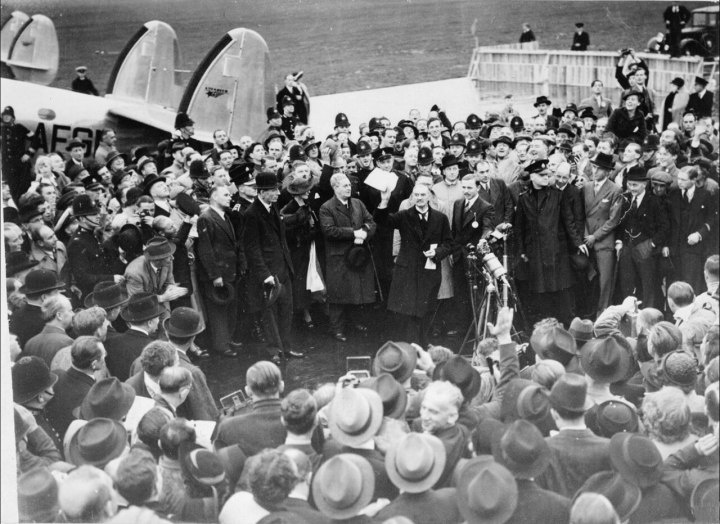
 

The infamous photograph of British PM Neville Chamberlain showing the Anglo-German Declaration from the Munich Agreement – public domain image used in Wikipedia “Peace for our time”


(3) APPEASEMENT – AXIS COLD WAR (1931-1941)


“Up to now, we’ve succeeded in leaving the enemy in the dark concerning Germany’s real goals…No, they let us through the danger zone. That’s exactly how it was in foreign policy too…They left us alone and let us slip through the risky zone and we were able to sail around all dangerous reefs. And when we were done, and better armed than they, then they started the war.”

That statement by Joseph Goebbels – transcribed by a participant in a secret briefing to selected German journalists and quoted in Paul Johnson’s A History of the Modern World – “is, on the whole, an accurate summary of what happened in the 1930s”.

My previous special mention entry for the Cold War within the Second World War (or vice versa) overlooks that there was, in effect, another cold war that was far more entangled with the Second World War – the three-sided cold war in which Nazi Germany and other fascist states, the western democracies, and the Soviet Union all maneuvered with or against each other.

Indeed, the conventional depiction of the Second World War from 1 September 1939 to 2 September 1945 overlooks that this was simply the ‘hot war’ as the culmination of the longer cold war before that, from 1933 to 1939 for Germany and from 1931 to 1941 for Japan.

And, as the statement by Goebbels indicates, it was a cold war that Germany largely won, outmaneuvering and wrong-footing Britain and France to a remarkable extent.

Yes, it’s arguable – as some historians have argued – that it was the Soviet Union that won it, with the subsequent outbreak of war fought on Stalin’s terms and to his intentions. While there’s some substance to this, I think it overlooks his catastrophic miscalculation that war between Germany and the western democracies would be more protracted and exhausting for the combatants to the advantage of the Soviet Union.

Back to Germany, it reflects my own belief that Germany has only succeeded in foreign policy or war when it has, knowingly or otherwise, followed Bismarckian strategy – with Germany’s diplomatic or political successes in the thirties essentially replicating Bismarck’s strategy unifying Germany under Prussia, down to Germany’s successes in annexing Austria and Czechoslovakia mirroring Bismarck’s victories in the Austrian-Prussian and Franco-Prussian Wars, except through diplomatic rather than military force.

Of course, Nazi Germany failed the fundamental part of Bismarck’s strategy – avoiding general war as opposed to a carefully limited one – which ultimately undid all their Bismarckian successes. Even then, Germany managed to succeed coasting on the fumes of Bismarckian strategy – friendly relations with Russia and limiting the scope of the war to successive individual campaigns that resembled Bismarck’s small wars – until 1941.

It has been observed that had Hitler concluded his ambitions with Munich, he might well have been hailed as one of Germany’s greatest statesmen. That certainly accords with my view that the occupation of Prague and what remained of Czechoslovakia was perhaps his fatal mistake, prompting as it did Britain’s guarantee to Poland and dashing any prospect of reclaiming Danzig and other German territory from Poland without war.

Of course, as it turned out, Hitler’s ambitions were not limited to reclaiming former German territory, and given the Germany he led resembled a Ponzi or pyramid scheme that relied on ongoing conquest, it is not at all clear to me whether he could have stopped even if he wanted to do so. I have read that Germany’s need for gold and foreign reserves, as well as the Czech armaments industry, drove Germany’s occupation of Czechoslovakia as much as Hitler’s sense of buyer’s remorse that – extraordinarily – Britain and France had cheated him of complete victory at Munich.

Azar Gat has also observed that conflict between the western democracies and the fascist nations was one of cold war. Indeed, he observes it to be part of the standard trajectory of liberal democracies facing hostile non-democratic states – “a pattern progressing on an upward scale from isolationism to appeasement, to containment and cold war, to limited war, and, only reluctantly, to fully fledged war”.

The diplomatic and political confrontation of Britain and France with Germany in the 1930s essentially corresponded to evolving from appeasement to containment and cold war within that standard trajectory, except that they didn’t pull the latter off as well as the Americans in the Cold War because they lacked a credible deterrent, particularly that of strategic airpower and the nuclear deterrent the Americans had.

Their deterrent was essentially that of the threat of war, ultimately enacted in the guarantee to Poland. In fairness to Britain and France, that should have been a credible deterrent, as they saw what Hitler did not, that war would ultimately be self-destructive for all of them, reinforcing their decline to the Soviet Union and the United States as the two superpowers.

That standard trajectory flows from the tendency of liberal democracies to eschew preventive war – something the Romans or other pre-modern states would happily do without qualms. “Historically, they have chosen not to initiate war even when they are under threat, hold the military advantage, and are in danger of losing it”.

In effect, the observation of Gat dovetails with the statement of Goebbels in that it is harder to imagine a more clear-cut example of this than against Germany in the 1930s. “The remarkable thing is that the western liberal democracies did not intervene by force during the 1930s to prevent Hitler’s Germany from rearming, even though this meant that the complete military superiority that they held over Germany would be lost, making it possible for Hitler to embark on his radical expansionist policy.”

It remains that Britain or at least certainly France and even Poland – both of which should have been strongly motivated to keep Germany from rearming to attack them – could easily have intervened against Germany without any serious repercussions from 1933 to 1935 when Germany broke the provisions of the Treaty of Versailles restricting its military forces, such as when it introduced conscription or its air force.

That window of opportunity for intervention without serious repercussions probably remained open to France (and Britain) until 1936, when it could – and should – have intervened against Germany remilitarizing the Rhineland, which would have decisively defeated Hitler’s regime and may well have seen its collapse. That’s even more striking given that France (and Belgium) had no issue intervening to occupy the Ruhr industrial area when a weakened Weimar Germany sought to resist reparations in 1923. The same action probably would have won the war without fighting in 1936.

Much the same observations might be made of the Soviet Union, particularly in its choice of the Nazi-Soviet Non-Aggression Pact without which Germany could not have started the war – as opposed to any other choice, such as collective security with Britain and France or even just neutrality, that would have deterred Germany from war.

Thereafter however, Britain and France faced the prospect of war when it came to opposing Germany, once Germany had rearmed and fortified its western borders sufficiently to move to the next phase of occupying its two neighbors, Austria and Czechoslovakia. The latter – with the Munich Agreement that accompanied it – has become synonymous with appeasement, particularly as a pejorative term. That seems somewhat unfair, particularly for Britain and Neville Chamberlain. It might well have been better for Britain and France to declare war on Germany over Czechoslovakia, but the competing arguments seem finely balanced to me and it is easy to imagine the potential outcome might have been even worse than what happened with Poland a year later.

It just illustrates the various ironies or paradoxes that can be argued with respect to appeasement. One is that Britain and France enforced the wrong provisions of the Treaty of Versailles (reparations as opposed to military restrictions), or appeased the wrong Germany (Nazi Germany as opposed to Weimar Germany). Another is that they practised appeasement from a position of military superiority or strength when it made no sense, only to abandon it from a position of weakness when they could not effectively deter Germany, let alone effectively defend Czechoslovakia or Poland, at least without Soviet participation.

Yet another irony or paradox is that they appeased the wrong nation, alienating Japan and Italy, allies against Germany in the first world war, to the extent that those nations allied with Germany against them instead.

The alienation of Japan as an ally commenced as early as the 1920s, with perhaps one of the worst foreign policy mistakes by Britain – failing to renew the Anglo-Japanese alliance. Japan is of course the reason this entry commences prior to the Nazi regime in 1933, with the Japanese invasion of Manchuria in 1931, and continues after the start of the European war in 1939, as the various nations opposed to Germany – increasingly and primarily the United States – also faced off Japan until 1941.

The response to Japanese expansionist policy deserves as much attention as that for Germany – and each could well be the subject of its own top ten list. The failure to respond effectively to the Japanese invasion of Manchuria in 1931 – which was at least possible by Britain and the United States in combination – was arguably as much a mistake as the failure to renew the Anglo-Japanese alliance and certainly compounded it.

Thereafter, a large part of Britain and France being out-maneuvered by Germany in Europe arose from their need to deal with Japan in Asia at the same time, particularly after Japan expanded its aggression to China in 1937. That continued to confront the allies with tough strategic choices after the commencement of war in Europe, obviously even more so once the allies also had to divide their resources between that war and the war with Japan. At very least, the war with Japan added a year to the war in Europe.

Britain and France repeated much the same errors with Italy in the 1930s, continuing to 1940 when Italy joined Germany to declare war on them allied – again to ultimate effect that the war with Italy or war in the Mediterranean arguably added a year or so to the war with Germany. Italy’s support also arguably made Germany’s war possible in the first place, by opening up Austria and Czechoslovakia to German occupation. Fortunately, that was offset to some degree by Italy’s weakness as strategic liability to Germany. Amusingly, the British War Cabinet considered whether they were better off with Italy as neutral or with Italy as actively allied to Germany, before concluding (probably correctly if only just) that it would be better if Italy remained neutral.

The errors alienating Italy to ally itself with Germany are even more striking as Mussolini’s Italy was strongly aligned towards the allies against Germany well into the thirties – and arguably remained so at the level of its populace and institutions, a large part of why its performance as German ally was so mediocre. Indeed, Italy was initially a stronger opponent to Germany’s expansionism than Britain or France, successfully blocking Germany from taking over Austria in 1934.

The turning point was the response of Britain and France to Italy’s conquest of Abyssinia, which saw them get the worst of both worlds – initially opposing Italy, antagonizing Italy without showing any real teeth (such as by the use of naval forces or use of sanctions on oil, to which Italy was particularly vulnerable), which they then compromised by the secret but abortive Hoare-Laval Pact to appease Italy by partitioning Abyssinia.

Thereafter, while Italy still aligned itself with Britain and France against the German remilitarization of the Rhineland in 1936, it increasingly and inevitably began to align itself with Germany.

And the rest, as they say, is history.


RATING: 5 STARS*****

S-TIER (GOD-TIER)


A map showing railroad traffic disruptions in the area of German Army Group Center in the Soviet Union, August 1943 – public domain image of the Historical Division, United States European Military Command (EUCOM), US Army Center of Military History


(4) UNDERGROUND WAR –

PARTISANS, RESISTANCE & GOVERNMENTS-IN-EXILE

(1931-1945)


Special mention has to go to what might be called the underground war – the war of partisans, resistance movements, and governments-in-exile against the Axis powers occupying their nations, primarily Germany but also Italy and Japan (as well as their lesser Axis partners).

Indeed, it is again Japan that is the reason this entry commences in 1931, with the first aggression by any Axis nation (prior to any of the pacts or treaties comprising the Axis from 1936 onwards) with Japan’s invasion and conquest of Manchuria. That saw numerous Chinese insurgents or resistance movements against Japan, as well as resistance movements within Japan itself – although one might identify dissent or resistance against the Japanese imperial government or military well before that in Japan and Korea.

Likewise, German anti-Nazi resistance movements started with the rise of the regime to power in 1933 (and again arguably before that), as did Italian anti-fascist dissent or resistance with the rise of Mussolini to power from 1922 onwards. Of course, the latter became much more substantial as partisans or armed resistance against the Germans (and the German puppet remnants of Mussolini’s government, including Mussolin himself), from 1943 after Italy surrendered to the Allies and the Germans occupied it.

However, the war of partisans, resistance movements, and governments-in-exile against the European Axis powers by the nations they occupied took definitive shape from the Italian conquest of Abyssinia or Ethiopia in 1935 onwards. The primary dichotomy of these combatants was between the communist-led ones, usually preferred by the Soviets, and the various nationalist ones – often resulting in civil war between them.

Most of the entries in my top ten have significant or substantial partisan warfare or armed resistance movements – most notably the Nazi-Soviet war with the partisans on the Soviet side, the partisans or resistance movements within Poland, and the Yugoslavian civil war and war of national liberation, particularly with Tito’s Partisans.

For the most part, partisans and resistance movements lacked significant or substantial military effect or impact, with the primary exceptions being those with the numbers or even more so the terrain for guerilla warfare – most notably in the Soviet Union and the Balkans, but also in Poland, Italy, and the Maquis in France.

That is not to say that partisans or resistance movements lacked any effect or impact where they did not have any such military effect or impact – one could well compile a top ten of forms of resistance, most notably contributions to Allied intelligence.

Even for those partisans or resistance movements that did have a significant or substantial military effect or impact, only those of two nations were able to liberate their nations largely with their own forces – Yugoslavia and Albania, albeit there were also uprisings and partial or temporary liberations achieved by partisans or resistance movements in Poland, France, Greece and Italy. Of course, Yugoslavia and Albania did have outside help, in the form of Soviet operations in the Balkans as well as Allied air support or supplies. They also had the benefit of a combination of terrain and the relative benevolence of Italian occupation, from which they also gained with the withdrawal or even desertion to them of Italian forces after the Italian surrender in 1943. Even with those advantages, they probably still could not have done so without Germany’s defeat by and need to commit forces elsewhere against the Soviets or western allies.

It is also impressive how many occupied nations maintained governments-in-exile, both in the war in Europe and the war against Japan, on both sides but predominantly on the Allied side and in exile in Britain or with British forces. Some of those, such as the governments-in-exile of Abyssinia and Czechoslovakia, predated the German invasion of Poland in 1939.

And it is also impressive just how many of the Allied governments-in-exile made significant or substantial contributions to the Allied war effort despite, you know, losing their nations to occupation.

The Polish government-in-exile, as we’ve seen, commanded Polish armed forces or underground armies that were the fourth largest Allied armed forces in Europe. While the Norwegian government-in-exile commanded more modest armed forces, the Allies gained the services of its merchant navy, the fourth largest in the world and of substantial importance for the Battle of the Atlantic. The Dutch government-in-exile brought with it the forces it had in the Dutch East Indies or Indonesia. The Belgian government-in-exile brought with it the Belgian Congo – and the uranium from there used for the first atomic bombs.


RATING: 5 STARS*****

S-TIER (GOD TIER)


Map of the Holocaust in Europe during World War II, 1939-1945. This map shows all German Nazi extermination camps (or death camps), most major concentration camps, labor camps, prison camps, ghettos, major deportation routes and major massacre sites – map by Dennis Nilsson for Wikpedia Äuschwitz concentration camp” licensed under https://creativecommons.org/licenses/by/3.0/deed.en


(5) HOLOCAUST (1933-1945)


Probably the best known and most disturbing “war” within the Second World War.

Of course, war might seem an entirely misplaced or sanitized term given how one-sided it was for Germany and her allies or collaborators – and how far it was removed from anything we normally accept as the field of battle, even including war crimes, hence the charge of crimes against humanity at the Nuremberg Trials.

It did, however, involve objectives, organization, personnel, logistics, and of course targets or intended casualties on the scale of a war – so much so that it might be argued to have cut across the war (or wars) Germany fought against actual enemy combatants, probably to the detriment of the latter, as cold-blooded or macabre as such historical analysis or study might seem.

The primary target was of course the Jewish population in Germany and the European countries controlled by or subordinate to it through its military victories – definitively so to the extent that the Holocaust is often defined in terms exclusive to that population, although that would be more accurate by its Hebrew name of Shoah.

However, it was much wider than that, including millions of non-Jewish Soviet civilians or prisoners of war (in addition to about 2 million Soviet Jews), close to 2 million non-Jewish Polish civilians (to add to about 3 million Polish Jews), and various other groups of people. Indeed, depending on how or whether you tally wider civilian casualties as part of the Holocaust, the Holocaust may extend upwards to the range of 11-17 million people, of which about half to a third were Jewish (in turn about one third of the world Jewish population or two thirds of the European Jewish population).

Nevertheless, Germany’s regime primarily identified it – and for that matter the world war itself – as, to borrow the title of the book by Lucy Dawidowicz, the war against the Jews. And as such, it was a war Germany largely won, given how one-sided it was.

It was, however, not entirely one-sided – there was some resistance, both passive and active, by some within the European Jewish population as well as by others coming to their aid. The primary passive resistance was of course hiding, fleeing or escaping from it – arguably the most effective form of any resistance in terms of numbers saved.

There was also active resistance by fighting against it, even with some uprisings in the camps themselves. The most famous revolt or uprising was the Warsaw Ghetto Uprising from 19 April to 16 May 1943, “the largest single revolt by Jews during World War II” and the closest it ever came to a war fought between two sides, however unevenly matched. The Uprising was fought desperately and tenaciously from block to block, even into the sewers, by people who knew “victory was impossible and survival unlikely”, fighting so as “not to allow the Germans alone to pick the time and place of our deaths”. I always remember reading somewhere that their resistance brought some grudging respect, if not mercy, in their opposing SS commanders that such “subhuman scum” could fight so well.

Sadly, such resistance when it occurred, passive or active, was tiny compared to the scale of forces and resources arrayed against it – and this war was largely fought through to its grim conclusion. That this grim conclusion left some surviving population is due in some small part to the resistance against it, overwhelmingly the passive resistance of hiding or flight from it, but more to Germany’s defeat in the wider war against enemy combatants – and also the extent to which it was at cross-purposes within itself or the wider war.

The largest cross-purpose perhaps reflected the extent to which the Holocaust cut across the wider war as an attempt to offset that extent – its use of industrial slave labor for war production. That also reflected the ambitions of Himmler to build the SS as effectively his own private empire within the German state and economy, something which was a strikingly recurring feature withing the inner circle of the regime – as indeed it was also for him and others raising what were effectively private armies within the Wehrmacht, of which SS combat units were one. As the tide of war turned against Germany, Himmler and others added a further cross-purpose to the use of industrial slave labor – the use of their prisoners as hostages for negotiations with or leniency from the Allies.

Some may query 1933 as the year of commencement but that reflects the history of its origins extending back at least to the rise of power of the Nazi regime in 1933, and arguably a prehistory well before that. Essentially, 1941 marks the commencement of it as a literal shooting war against Jewish and other civilian populations – with the invasion of the Soviet Union in Operation Barbarossa, albeit predominantly behind the lines, particularly as the Germans regarded communist and Jewish as synonymous. The Germans effectively had a policy of summary execution for both – in the colorful words of the War Nerd, they had a “pretty flexible definition” for either “and when in doubt, they killed”.

In the key event of that war, that remains surprisingly not well known, despite ultimately looming larger in casualties than any battle in the wider war – the Wannsee Conference of 20 January 1942, named for the Berlin suburb in which it was held – Germany extended that war throughout occupied Europe, literally under the official title of the Final Solution to the Jewish Question.

Of course, I say extended because it was a war that was not formally declared as such, indeed kept shrouded in euphemism or secret as much as possible, albeit that possibility was limited by Allied intelligence as well as its sheer scale and the number of people involved in it. Ultimately however it was to be the war that defined Nazi Germany the most.


RATING: 5 STARS*****

S-TIER (DEVIL-TIER)


Situation at the end of the Second World War – Japanese occupation (red) of eastern China and Communist bases (striped) in public domain map by US Army (West Point history department)


(6) CHINESE CIVIL WAR

(1911-1949)


Or how the Japanese won the Chinese Civil War for the communists.

The Second World War, or least the Second Sino-Japanese War part of it, cut right across the Chinese Civil War. The two largest warring parties in the civil war, the Communists and the Nationalists saw themselves as the true successors of the revolution led by Sun Yat-sen (or Sun Yuxian) and his Kuomintang or KMT party that overthrew the Qing dynasty as China’s last imperial dynasty in 1911-1912.

As was often the case with the collapse of central state authority in China, that revolution devolved into the usual competing warlords or warring states from 1916 to 1927.

The warlord period is generally considered to have transitioned to the first phase of the Chinese Civil War proper from 1927, as Chiang Kai-shek led two thirds of the KMT’s military forces under the mantle soon to be known as the Nationalists against Wang Jingwei’s socialist or communist third.

The Soviets assisted the main warring party, the Nationalists seeking to reunify China under their Republic, as the Soviets saw them as the necessary prelude to socialism.

Intriguingly, Sun Yat-sen had sent Chiang Kai-shek to train in Moscow – and Chiang then became head of the military academy training military leaders in China, with Soviet assistance in “teaching material, organization, and munitions”.

Even more intriguingly, the Germans also assisted the Nationalists – and more intriguingly, that assistance continued from the warlord period to the first genuine phase of the Chinese Civil War, by both the Weimar Republic and Nazi Germany. It is intriguing to ponder how world history might have turned out if Nazi Germany had continued to support Nationalist China, but they swapped to the foreign power that ominously loomed over China to exploit its weakness and ultimately was the one to intervene most decisively of all – Japan.

In the meantime, Wang Jingwei was eclipsed by the new Chinese communist leader who became virtually synonymous with the Chinese Civil War and for whom Chinese communist ideology was named – Mao.

However, the Chinese communists did not do too well in this first phase of the civil war, with effective control of less than a twentieth of the population (compared to the third controlled by Chiang’s Nationalists) and poised on the brink of complete extinction. “Their doom was, historians agree, imminent and inevitable” – until they were effectively saved by the Japanese in the Second Sino-Japanese War from 1937.

The Japanese had already indirectly given the Chinese communists some much needed reprieve with their invasion of Manchuria in 1931. In an episode which also showed that some of the warlord period chaos lived on in the Nationalists, the Xian Incident, two of Chiang’s generals kidnapped him to force him to form a united front with the communists against the Japanese.

Chiang subsequently reneged on the united front with renewed hostilities against the communists but the Sino-Japanese War from 1937 forced his hand again to put those hostilities on hold for a second united front against Japan, even if both he and the communists increasingly paid lip service to it. That lip service meant the Nationalists and Communists avoiding open battle with Japan as much as possible, looking for salvation from outside forces pending in the Pacific War while also looking ahead to renewed civil war with each other.

Despite the united front, Chiang’s Nationalists bore the brunt of Japan’s war in China, which arguably dealt them their mortal wound in China’s civil war.

Perhaps most of all in the one surprise Japan still had left for China, even while virtually collapsing in the Pacific War against the United States, and one that is almost entirely forgotten or overlooked in most Second World War histories – the Ichigo offensive in 1944. The largest Japanese army offensive of the whole war, it was also the most as well as last successful Japanese offensive – astonishingly so and on a scale unequalled for anything else by Japan or Germany at that late stage of the war.

It also severely weakened Chiang’s forces (as well as an economy increasingly ravaged by hyper-inflation), the last of a series of Japanese blows that ultimately proved fatal for the Chinese Nationalist government in the subsequent renewed civil war with the Communists – Japan arguably doing the most of anyone, including the Chinese Communists themselves, to win victory for the Communists in the civil war.

The civil war resumed soon enough – “as soon as it became apparent that Japanese defeat was imminent” (at the hands of the Americans) “with the communists gaining the upper hand in the second phase of the war from 1945 to 1949, generally referred to as the Chinese Communist Revolution”.

This again saw foreign intervention along predictable Cold War lines – the Soviets on the side of the Communists and the Americans on the side of the Nationalists, although each were cautious in their intervention, with that from the Americans notoriously resulting in accusations of “losing” China and communist infiltration of the American government.

However, the Soviets were equally cautious in their own intervention, perhaps from Stalin’s intuition that a united communist China would be their rival in the long term. Hence the Soviets consistently urged restraint on Mao to accept the north-south partition that was all the vogue in Cold War Asia – between a Communist north and a Nationalist south.

Mao ignored this and the Communists gained control of mainland China anyway, proclaiming the People’s Republic of China. However, the Communists ultimately had to accept a residual partition of a different kind with the Nationalists retreating to the island of Taiwan to proclaim their Republic of China there, as the Communists had no means to pursue them – particularly after the US gave their naval support to Taiwan. That partition of course continued even until today, remaining as a source of tension with no armistice or treaty signed between them.


RATING: 4 STARS****

A-TIER (TOP TIER)


Eritrea Campaign 1941 – map by Stephen Kirrage for Wikipedia “East Africa Campaign” under license https://creativecommons.org/licenses/by-sa/3.0/deed.en


(7) ITALO-ABYSSINIAN WAR / EAST AFRICAN CAMPAIGN

(1935 -1937 / 1940 – 1941)


Yes, everyone forgets (or overlooks) this war when it comes to the Second World War (or before it) – or indeed forgets or overlooks that any part of the Second World War was fought in Africa apart from North Africa.

Even if the Italo-Abyssinian War – or more precisely the Second Italo-Abyssinian War (or Second Italo-Ethiopian War to use its more modern but decidedly less glamorous nomenclature) – was fought on a scale to rival the Winter War, at least in numbers of troops, and for substantially longer.

Okay, the Italo-Abyssinian War received substantial attention at the time and since, as the second act of Axis aggression after Japan’s invasion of Manchuria and another stepping stone towards the breaking point of the postwar international order after the First World War – but not so much the details of the war itself.

Its sequel during the Second World War, the East African Campaign, is almost completely overlooked on the other hand, let alone in any detail, despite being “the first Allied strategic victory in the war” and not without its challenges.

I’m fond of quoting H.P. Willmott’s quip that, paradoxically, WW2 might be regarded as the last war of the 19th century and WW1 was the first war of the 20th century.

Whatever else you take that to mean, it seems most apt to describing the war in East Africa, as a throwback to the Scramble for Africa and contest between European colonial powers.

Indeed, the Second Italo-Abyssinian War was literally a throwback to the First Italo-Abyssinian War, that last gasp of the Scramble for Africa in which the only African polity to preserve its independence, Abyssinia, did so by soundly defeating Italy at the Battle of Adwa in 1896, one of the few African defeats of a European colonial power. (Yes, I’m aware of Liberia as the other “independent” state in Africa but it was effectively an American creation).

In the Second Italo-Abyssinian War, Mussolini’s Italy set out to use its massive superiority in weaponry to avenge – and reverse – its defeat in the First Italo-Abyssinian War, invading and occupying Abyssinia. The First Italo-Abyssinian War might have surprised the world (and inspired Africa) with an Abyssinian victory, the Second Italo-Abyssinian War did not with its Italian victory, albeit Abyssinian resistance and a government-in-exile under Emperor Haile Selassie persisted afterwards.

In the longer term, Italy’s choice to invade Abyssinia seems foolish, given how isolated and vulnerable even a victorious Italian occupation of Abyssinia would be to superior British and French naval power if war broke out. That perhaps should have been the case back in 1935 but certainly turned out to be the case with Britain’s East African campaign during the Second World War – which Britain won, against skilful and protracted Italian defense that is also often overlooked for a general and somewhat unfair caricature of Italian military competence during that war.


RATING: 4 STARS****

A-TIER (TOP TIER)


The how it started and how it’s going meme for the Spanish Civil War – with the areas controlled by the Nationalists (in pink) and Republicans (in blue) in September 1936 (left) and in February 1939 (right) as mapped by NordNordWest for Wikipedia “Spanish Civil War” under license https://creativecommons.org/licenses/by-sa/3.0/deed.en


(8) SPANISH CIVIL WAR

(1936 – 1939)


The war most seen as a precursor to the Second World War yet ironically not part of it, with the Nationalist victory in Spain on 1 April 1939 and Spain remaining neutral in the world war that erupted in Europe five months later. It was and is also seen as a Nazi-Soviet proxy war.

Also – George Orwell fought in it, reflecting that the Spanish Civil War “became notable for the passion and political division it inspired worldwide”, perhaps the most of any of the conflicts or events leading up to the war in Europe short of the outbreak of the latter war itself.

Ironically, its contemporary fame as political cause célèbre seems almost inversely proportional to its lack of actual impact in the Second World War, as Spain became something of a backwater to that war – no equivalent to the Peninsular War in the Napoleonic Wars to see here.

It always strikes me how much of an outlier the American Civil War is for civil wars in modern history, with its two neatly defined sides of the Union and the Confederates. The Spanish Civil War is more typical of most modern civil wars as a messy battle royale. Yes – again as in most civil wars, there were broadly two sides, but each side was chaotic or amorphous, to the point of at least one side almost as a civil war all on its own.

The war itself was also messy, although it was straightforward enough in broad outline. It originated from a military coup or revolt in July 1936 against the left-leaning Popular Front government of the Second Spanish Republic (which had been proclaimed in 1931). The coup failed as such but evolved into the Nationalists fighting to overthrow the Republic.

The Nationalists were a diverse alliance of groups “chiefly defined by their anti-communism” – and to a lesser extent, support for the Catholicism targeted by the Republic. Reflecting its origin in a military coup, the segments of the army and its officers opposed to the Republic predominated the Nationalists, among whom General Francisco Franco emerged as leader.

The Republicans were equally as diverse in their loyalty or allegiance to the Republic but reflecting the role of the Soviet Union as the primary source of support for the Republic, increasingly fell under the control of the more Stalinist elements, to the point of civil war within the civil war by them against anarchists and other factions on the Republican side.

From a combination of factors, the Republicans more consistently proved to be militarily ineffective, and the Nationalists ultimately won under Franco in 1939.

Of course, one of those factors – certainly the most famous and much of the reason for the war as cause célèbre – was the more effective foreign support for the Nationalists, above all from Italy and Germany in troops or advisors, munitions and armaments, and air support.

German air support – particularly in the form of the Condor Legion fighting in Spain – was arguably critical for the Nationalists by flying their troops that were otherwise stranded in Spanish Morocco to Spain in the early stages of the war. The Condor Legion also infamously bombed cities held by the Republicans, of which the bombing of Guernica led to international outcry against them (and a painting by Picasso that became iconic of the war itself).

International outcry perhaps but not too much support – with Britain and France declaring an official policy of non-intervention that was largely followed by the international community However, France and other nations covertly supported the Republicans, while tens of thousands of volunteers from non-interventionist countries fought in the war, mostly in the pro-Republican International Brigades.

“Only two countries openly and fully supported the Republic” – not surprisingly, the primary source of support was the Soviet Union, but I always find it surprising the second was Mexico. While Soviet support no doubt prolonged the resistance of the Republic, one might infer it was just not as effective as German or Italian support contributing to Nationalist victory.

And in some ways, it was a millstone around the Republic’s neck – as Soviet support brought with it Stalinist hardline organization or terror within the Republic and political commissars within its armed forces. Not to mention costing the Republic’s gold reserves in payment up front, diminishing Soviet interest in Republican victory when no longer expedient – as opposed to German or Italian interest in the Nationalists repaying their credit.

Franco ultimately led the Nationalists to victory in the civil war on 1 April 1939, although sporadic irregular or guerilla warfare persisted until 1965, and Franco’s government persisted for a decade after that until his death in 1975.

For all the furor during the civil war from 1936 to 1939, Franco’s Spain played little part in the world war that followed, remaining neutral if supportive to his Axis sponsors after they won his civil war for him – such as raising a volunteer division, the Blue Division, to fight as part of the German army against the Soviet Union.

However, despite the help Mussolini had given him in his civil war, Franco had more insight than Mussolini in recognizing that Spain would only achieve its self-destruction by anything more than token support in actively fighting on the German side or allowing German forces in Spain. Of course, a large part of that wisdom was born of necessity from Spain’s economic and military weakness recovering from its civil war.

However, Mussolini should have shared Franco’s insight as Italy was not much better than Spain in either economic strength or military readiness – which played a large part in its poor military performance and for which Italy’s own foreign adventures before the war, particularly including its support for Franco in the Spanish Civil War, contributed a large part.

As it was, Franco played the few cards he had extraordinarily well in dealing with a Germany and Italy that now expected a return on their investment in his civil war by Spanish participation on their side. He so frustrated Hitler at their meeting in Hendaye on 23 October 1940, with such extravagant preconditions for Spanish participation in the war as a German ally, that Germany essentially gave up on plans on using Spain to attack the British base in Gibraltar.

It is interesting to speculate that Germany might have been better off if the Republicans had won the civil war, since the communist Republicans would have come under pressure to aid Germany because of the Nazi-Soviet Pact at the time. However, I remain skeptical whether Soviet pressure would have extended to requiring Spain to effectively fight on Germany’s side when the Soviets themselves refrained from doing so – or whether a victorious Spanish Republican government would have been willing or able to comply with such pressure.

It might be said that Germany did not get a return on their investment in the Spanish Civil War when it counted in 1940, but that overlooks that Germany otherwise did very well for their investment of resources – notably in combat experience for their air force servicemen but also in securing its new alliance with Italy and destabilizing the European status quo for their diplomatic victories prior to 1939.

Not so much for Italy as we’ve seen – as they expended somewhat more resources than Germany, particularly in soldiers deployed to the Spanish Civil War, which with the resources spent in other foreign misadventures strained or exhausted Italy’s military readiness for wider war. In 1939, Mussolini advised Hitler that Italy was not ready for war before 1943 – interestingly the same advice down to the year that Hitler’s naval commanders gave him for their navy – and subsequent events showed that advice to be right (for both Italy and the German navy).


RATING: 4 STARS****

A-TIER (TOP TIER)

*

Map of Albania in WW2 by Nakko for Wikipedia “World War II in Albania” under license https://creativecommons.org/licenses/by-sa/3.0/deed.en


(9) ALBANIA – OCCUPATION & RESISTANCE

(1939 – 1944)


Everyone forgets about Albania in the Second World War – or that it was occupied by Italy in April 1939.

It’s easy to forget Italy’s occupation of Albania among the higher profile German occupations of Austria or Czechoslovakia, particularly the latter as Germany had effectively finished it off only the month before in March 1939, prompting Britain’s guarantee to Poland in April 1939.

It’s easy to forget even for Italy, overshadowed as it is by Italy’s invasion of Ethiopia or intervention in the Spanish Civil War.

That everyone forgets about Albania is striking because it had important knock-on effects for the course of the whole war as it provided the platform or springboard for Italy’s ill-considered and ill-fated invasion of Greece. Without Albania as a base right next to Greece, it is difficult to see that Italy would have had the motive, means or opportunity for its invasion of Greece.

However, apart from its role in the Italian invasion of Greece, Albania was a backwater of Italian occupation, effectively as its own separate corner of the war.

There was Albanian resistance to occupation, which everyone also forgets about because it essentially followed the same lines as Yugoslavia, just on a smaller scale. Again, that everyone forgets about Albania is striking because it is the only nation other than Yugoslavia that can claim to have liberated itself through its own resistance, except even more so than Yugoslavia. Also, the Albanian resistance achieved the rare feat of saving most of Albania’s Jews.

Like Yugoslavia, it had a royal government-in-exile but the communist partisans and their political leader Enver Hoxha emerged as predominant among the rival resistance movements. Also like Yugoslavia, the Albanian resistance got a boost from the Italian surrender and desertion to it of Italian soldiers, only more so due to Italy’s larger and exclusive occupation, as well as Germany’s more pressing priorities than maintaining the occupation of Albania after that. The Albanian resistance liberated Albania from German occupation by 29 November 1944.

After the war, Albania and its communist government went from being its own strange separate corner of the Second World War to being its own strange separate corner of the Cold War – firstly with a ‘split’ from Yugoslavia aligning itself with the Soviets, then splitting off from the Soviets to align itself with China, before the inevitable Sino-Albanian split and aligning itself with no one.


RATING: 4 STARS****

B-TIER (HIGH TIER)


Attack on Mers-El-Kebir harbor 3 July 1940 by Maxrossomachin for Wikipedia “Attack on Mers-el-Kebir” under license https://creativecommons.org/licenses/by-sa/3.0/


(10) ANGLO-FRENCH WAR

(1940 – 1942)


It’s another war that tends to be forgotten or overlooked when it comes to the Second World War, similarly to the Italo-Abyssinian War and East Africa Campaign – perhaps not coincidentally because it was the other war within the Second World War that involved fighting in sub-Saharan Africa.

It was also something of a historical throwback but even further back than to the nineteenth century and the Scramble for Africa. Instead, it was throwback to the Anglo-French wars fought from 1689 to 1815 – dubbed the Second Hundred Years War.

Of course, it was a pale shadow of the former Anglo-French rivalry for nothing less than global dominion – evoking the quip of Marx that history repeats itself, the first time as tragedy and the second time as farce. Yes, it was fought as part of a war effectively for global dominion – but not so much by Britain or France, and the fighting between them was at the fringes or periphery of the larger war.

Indeed, Britain only fought France to pre-empt Germany (or Japan) – and was mostly limited to fighting France or Italy at the fringes or periphery of its war with Germany because it lacked the ability or means to attack Germany directly. Or as historian H.P. Willmott observed – “In this initial period, Britain, expelled from the continental mainland and unable to carry the war to Germany, was obliged to fight where she could rather than where she would”.

The war was technically not Anglo-French war but Anglo-Vichy war, which effectively was also a civil war between the German puppet Vichy regime in France and the Free French government, contested not in France itself but in – and for control of – the French colonies. With the safety of distance and the lack of strategic importance, most of the French colonies aligned with the Free French – with the significant exceptions of French North Africa and Indochina.

It was also not continuous but sporadic, with fighting isolated to brief campaigns in dispersed locations.

The first of these campaigns was the British naval attack on French navy ships at Mers El Kebir in Algeria on 3 July 1940, “the main part of Operation Catapult, the British plan to neutralize or destroy French naval ships to prevent them falling into German hands” after France surrendered to Germany. That played a large part in Vichy hostility to Britain that saw Germany court the Vichy regime – and Spain – as active allies against Britain in 1940 but fortunately both Vichy France and Spain declined to abandon their neutrality for war against Britain.

On 23 September 1940, Britain and Free French forces under de Gaulle launched Operation Menace to take the Vichy port of Dakar in French West Africa, but withdrew on 25 September 1940 when they met fierce resistance from Vichy forces – the one British defeat in the Anglo-Vichy war.

Otherwise, French colonies in Africa aligned themselves with the Free French, although one colony – French Equatorial Africa or Gabon – had to be occupied by Free French forces with British support in a campaign from 27 October 1940 to 12 November 1940 before the Vichy colonial government surrendered.

From 8 June to 14 July 1941, British and Free French forces fought and won the Syria-Lebanon campaign to capture those Vichy territories, effectively to pre-empt Germany (and Italy) exploiting them against Britain in the Middle East, as with the coup Germany had sponsored in Iraq to install an anti-British regime – which Britain crushed in May 1941.

From 5 May to 6 November 1942, British forces fought the Battle of Madagascar to capture that Vichy territory for Free French control, effectively to pre-empt Japan using it as a base for naval forces to seal off the Indian Ocean – something of a missed opportunity by Japan.

The final campaign in the Anglo-French war – which also included a brief Franco-American war – was of course Operation Torch, the Anglo-American invasion of French North Africa. The Vichy regime in North Africa initially resisted before by good fortune the Vichy commander Admiral Darlan was captured and effectively defected to the Allies, nominating himself as the leader of French North Africa and West Africa with their forces now on the Allied side. Vichy France itself effectively ceased to exist as Germany now occupied all France, although Germany kept up some semblance of the puppet regime in occupied France and subsequently as government-in-exile in Germany.

The Anglo-French war prompts to mind the snide observations by historian Gerhard Weinberg which he posed as questions for World War Two historians – why Britain was so consistently defeated by German and Japanese forces until the Battle of El Alamein (such that its only consistent victories were against French and Italian forces), and why Vichy France strongly resisted Allied incursions but so readily gave up Germany or Japan without resistance.


RATING: 4 STARS****

B-TIER (HIGH TIER)


Map of Iraq during WWII by Kirrages for Wikipedia “Anglo-Iraqi War” under license https://creativecommons.org/licenses/by-sa/3.0/deed.en


(11) ANGLO-IRAQI WAR

(1941)


Everyone forgets about the Middle Eastern theater in the Second World War. Granted, it wasn’t much of a theater in terms of actual fighting, but that was because Britain moved quickly behind the scenes to secure the Middle East under its control – behind the scenes that is, of Britain’s defeats fighting Germany elsewhere in the Mediterranean at the same time.

One part of that was the British taking over Syria from the Vichy French government in the successful Syrian campaign in June-July 1941. However, before that was the Anglo-Iraqi war in May 1941 which was the central part or ground zero of the Middle Eastern theater – not least because it then enabled (and led to) both the Syrian campaign as well as my next special mention entry.

Britain had taken over Iraq from the former Ottoman Empire, ostensibly as a mandate under the League of Nations, but effectively in real terms as a colony or protectorate. Iraq nominally became independent in 1932 but the British had been careful to lock in a pro-British government with the Anglo-Iraqi Treaty of 1930.

Iraqi nationalists as well as the Axis nations of Germany and Italy saw the opportunity of the war for a coup to oust the pro-British government in April 1941. As usual, German political diplomacy and material support counted for little beyond the effective projection of its military power, although it (and Italy) did supply material and even aircraft through Vichy French Syria (hence the subsequent Syrian campaign).

If it’s one thing Britain could still do well, even at this late stage of empire, it was to crush colonial revolts – which it did by quickly mobilizing forces from the neighboring parts of its empire, notably including Indian troops, and stamping out the Iraqi coup in four weeks from 2 May 1941 to 31 May 1941.

Thereafter, Iraq served Britain as its base of operations within the Middle Eastern Theater.


RATING: 4 STARS****

B-TIER (HIGH TIER)


Map legend shows origins and direction of Russian and British attacks as the two nations invade Iran to protect oil fields from sabotage by German agents who they claim have infiltrated there – Iowa City Press Citizen Newspaper Archives August 26, 1941 Page 1 (public domain image)


(12) ANGLO-SOVIET INVASION OF IRAN & IRAN CRISIS

(1941-1946)


Another part of the Middle Eastern theater that everyone forgets about when it comes to the Second World War. Following on the heels of Britain’s successful campaigns in Iraq and Syria, as well as the new Anglo-Soviet alliance in the wake of Operation Barbarossa, Britain and the Soviet Union jointly invaded and occupied the neutral state of Iran in the six days from 25 August 1941 to 31 August 1941.

Britain invaded from Iraq to the west while the Soviet Union invaded from its border to the north. Hopelessly outmatched, Iran largely did not oppose the Anglo-Soviet invasion and surrendered on 31 August 1941.

Its primary purpose was to secure Allied supply lines to the Soviet Union – and indeed the so-called Persian Corridor turned out to be the most reliable route for Lend-Lease aid to the Soviets.

Other purposes included securing the Iranian oilfields – although the Middle East in general had a lot less prominence for oil during the war than it was to have later – as well as blocking German influence in Iran (understandably enough from the Iranian perspective of a history of being stood over by Britain and Russia) or pre-empting an Axis through Turkey (and later the Caucasus), albeit unlikely.

Not pictured among those purposes – concern for what was, after all, a neutral nation, or for the effects of the occupation on Iran, which manifested primarily in that recurring handmaiden of both British and Soviet empires, famine, with the disruption of food supplies and transport.

For their part, the Soviet Union and Britain signed a treaty with Iran ruling that Iran was not to be considered occupied by the Allies, but in alliance with them. They also declared that they would remain in Iran until six months after the end of the war. Once in the war, the Americans were also drawn into Iran, helping to man the Persian Corridor (and providing Lend-Lease to Iran itself) while effectively guaranteeing the Anglo-Soviet withdrawal from Iran after the war.

That led to the Iran Crisis in 1946 – the first crisis of the Cold War and one in which the Americans succeeded in forcing the Soviets to back down. While the British withdrew according to schedule after the war, the Soviets did not – refusing to relinquish their occupied territory, and worse, supporting pro-Soviet separatist states of the Azerbaijan’s People’s Government and the Kurdish Republic of Mahabad.

Those states actually fought against Iran, but ultimately intense pressure from the United States forced Soviet withdrawal and the dissolution of the Azerbaijani and Kurdish separatist states.


RATINGS: 4 STARS****

B-TIER (HIGH TIER)

*

US propaganda poster 1942-1943, Franklin D. Roosevelt Presidential Library and Museum / US National Archives & Records Administration – public domain image


(13) PHILIPPINES – WAR OF OCCUPATION & RESISTANCE

(1941-1945)


The fighting Filipinos!

The role of the Philippines in the Pacific War has always struck me as similar to that of Poland in Europe. While not playing the same role as casus belli – which is more properly assigned to Pearl Harbor – it was effectively the front line or ground zero for commencement of the war, and then a center of resistance behind the lines of occupation in that war.

Indeed, the parallel with Poland continues in that, similar to the Anglo-French planning that effectively foresaw writing off Poland to liberate it after German defeat, so too did American planning effectively to write off the Philippines.

As I understand it, particularly from my reading of Ronald Spector’s The Eagle Against the Sun, while War Plan Orange – the original American plan for war against Japan which was largely followed in the actual war – did not explicitly plan to abandon American and Filipino forces in the Philippines, its hope for those forces to hold out on their own until relieved by the American naval counter-offensive was unrealistic.

As it turned out, whatever hope there was of the forces in the Philippines holding out on their own, it was dashed first by the naval losses at Pearl Harbor and then, through bad luck and timing, the loss of US aircraft at Clark Field from Japanese attack in the Philippines itself. The loss of air cover forced the retreat of the American Asiatic Fleet from the Philippines, so that American forces were effectively left stranded without air or naval support except for the limited use of American submarines.

The doomed American campaign from 8 December 1941 to 8 May 1942 to defend the Philippines from the Japanese invasion, with its famous landmarks of Bataan (with the infamous Bataan Death March of American prisoners by Japan that followed) and Corregidor, may be the stuff of heroism but is more properly considered as part of the Pacific War.

Equally, the victorious American campaign from 20 October 1944 to 15 August 1945 to return to and liberate the Philippines is also more properly considered part of the Pacific War.

However, in the two and a half years between those two campaigns was the war of resistance in the Philippines. Indeed, the war of resistance in the Philippines overlapped with both. Significant parts of the resistance came from American or Filipino forces that escaped or did not surrender in the 1941-1942 campaign and instead led or fought as guerillas against Japanese occupation.

Among other American commanders, General MacArthur, who had been ordered to leave his command in the Philippines by submarine, maintained a keen interest in the maintaining or supplying the resistance there, consistent with his declaration that he would return – and indeed, the resistance would also play its part in preparing the ground by sabotage and other means for the 1944-1945 campaign.

The resistance in the Philippines was of no more small scale or effect. “Postwar studies estimate that around 260,000 people were organized under guerilla groups, and that members of anti-Japanese underground organizations were more numerous”. Also, such was their effectiveness that Japan only controlled the key or major islands in their occupation, with their control of the countryside or smaller towns often tenuous at best – “of the 48 provinces, only 12 were in firm control of the Japanese”.

Ironically, some Japanese soldiers took a leaf from the Filipino resistance, with the notorious Japanese holdouts on more remote islands throughout former occupied territory after the Japanese surrender. Many of them, as individuals or in groups, were in the Philippines. Only in Indonesia did one confirmed Japanese soldier endure longer – holding out to 1974! – but unconfirmed reports persisted after that in the Philippines, with  the last report taken seriously by Japanese officials in 2005.

As for the Philippines, while their resistance received mixed or belated recognition from the US government, it at least bore fruit with the US honoring its commitment from 1935 for the independence of the Philippines in 1946.


RATINGS: 4 STARS****

B-TIER (HIGH TIER)


Greek Civil War CIA Map – deployment of the communist “Democratic Army of Greece” in 1948. CIA Map Branch (Harry S.Truman Library, President’s Secretary’s File, Box 255 – public domain image)


(14) GREEK CIVIL WAR

(1941 / 1945-1949)

*

“In April 1941, the Axis powers conquered Greece and Yugoslavia and thereafter the real struggle for the control of those countries began”- only in the case of Greece, the struggle for control was where the Second World War became the Cold War.

Yes – I’m again quoting how H.P. Willmott summed it up in The Great Crusade, his history of the Second World War. When I quoted him for my top ten entry for Yugoslavia, I noted that Greece will earn a place in my special mentions. And here it is.

Indeed, you could argue that Greece and the civil war that originated from its rival resistance movements should outrank Yugoslavia because of the significance of the Greek Civil War not only for the Second World War but even more so for the Cold War.

The Greek resistance to Axis occupation followed similar lines to that in Yugoslavia and Albania. While the Greek resistance can’t quite claim the same as that in Yugoslavia and Albania to have liberated their nation on their own, it was able to control much of the countryside prior to the German withdrawal from mainland Greece in October 1944.

Of course, in large part the liberation of Greece was because of the German withdrawal from mainland Greece, although German garrisons remained in Greek islands and were among the German forces to hold out until the end of the war.

Like both Yugoslavia and Albania, Greece had a royal government-in-exile, with both military forces serving within British forces in the Mediterranean and resistance movements within Greece itself. However, as in Yugoslavia and Albania (as well as elsewhere), the communists emerged as predominant among the rival resistance movements.

The big difference with the communists coming out on top in Yugoslavia and Albania was that the British were having none of that in Greece – and what’s more, they were in a position to do something about it. Churchill had effectively secured Greece for Britain’s postwar sphere on influence in his “naughty document” or infamous “percentages agreement” with Stalin in October 1944 – an agreement that Stalin appears to have kept when it came to Greece. British forces landed in Greece in October 1944 on the heels of (or even in advance of) the withdrawing German forces, entering Athens on 13 October 1944 and aiding the returning Greek government in exile to suppress or disarm communist partisans. That saw British and Greek non-communist forces fighting against the Greek communist forces from December 1944, with the former very narrowly prevailing as the Fourth Indian Infantry Division were flown in as British reinforcements.

There followed a brief interlude in 1945 effectively by way of treaty between the Greek non-communist government and Greek communists, which broke down into the Greek Civil War proper from March 1946 onwards.

While the Yugoslavian and Albanian communist governments supported the Greek communists, Stalin’s Soviet Union remained ambivalent in a way often seen as sticking to its agreement with Churchill – and actively opposed to the Greek communists after the Soviet split with Yugoslavia.

Britain continued to support the non-communist Greek government re-equipping and training the Greek Army but by early 1947 had to appeal to the United States that it could no longer afford to do so. That saw the first instance of what became known as the Truman Doctrine and effectively the American role as combatant in the Cold War, with the United States taking over from Britain in supporting the non-communist Greek government.

The Western assistance to the non-communist Greek government, and isolation of the Greek communists from support elsewhere but particularly from the Soviet Union, ultimately saw the Greek communists demoralized and defeated in 1949 – something “Western anti-communist governments allied to Greece saw…as a victory in the Cold War”, indeed one of the first such victories and commitments of American aid to anti-communist regimes.


RATING: 4 STARS****

B-TIER (HIGH TIER)


UN General Assembly Resolution 181 – UN Special Committee on Palestine (3 September 1947) and UN Ad Hoc Committee (25 November 1947) partition plans. The UN Ad Hoc Committee proposal was voted on in the resolution and adopted 29 November 1947 (map – public domain image)


(15) PALESTINE – INSURGENCY, CIVIL WAR & ARAB-ISRAELI WAR

(1939 / 1944-1948)


And now we come to my wild-tier special mentions for conflicts or wars fought after the Second World War, but which took definitive shape during that war – above all in Asia.

Historian Ronald Spector, author of The Eagle Against the Sun, encapsulated this in the titles of his books, The Ruins of Empire and A Continent Erupts, reflecting their subject. In western Europe, the end of the war may have “marked the beginning of decades of unprecedented cooperation and prosperity…labelled the long peace”, but “east and southeast Asia quickly became the most turbulent regions of the globe”.

However, one region of western Asia soon vied as contender for the most turbulent region of the globe – the British mandate of Palestine or Mandatory Palestine, which Britain had administered since the end of the First World War as territory taken from the former Ottoman Empire.

The nascent conflict in Palestine, between Arabs and Jews, originated in the First World War – arguably in 1916-1917, with the Arab Revolt, Sykes-Picot Agreement, and Balfour Agreement in those years, although Palestine as the focus of Zionism or Jewish settlement and a Jewish “national home” originated earlier than that.

During the Mandate, there was further Jewish immigration and the rise of nationalist movements in both Jewish and Arab communities, culminating in the 1936-1939 Arab Revolt in Palestine. Britain ultimately suppressed the Arab Revolt, but in part by means of the 1939 White Paper, severely restricting Jewish immigration and land purchases – hence my choice of 1939 as starting date for this special mention.

The combination of Arab Revolt and White Paper led to the formation of Jewish underground militias, primarily the Haganah which was to become the core of the Israeli Defence Force – as well as increasing Jewish sentiment that they could not achieve their aims in cooperation with the British, particularly after the war. It also contributed to the idea of partition as solution, as it became clear that Arab and Jewish communities in Palestine could not be resolved.

The Second World War saw some suspension of this conflict, as Palestine even came under Axis air attack and within potential reach of Axis armed forces with Rommel’s victories in 1942. That saw British training of forces within the Haganah, as well as the subsequent creation of the Jewish Brigade within British armed forces.

However, the Second World War had not even ended when the Jewish insurgency in Mandatory Palestine began in 1944 and persisted through to 1948, albeit in fairness the tide of war had passed well away from Palestine when it began. The primary insurgents were the more radical Jewish militias or underground groups – Lehi (or the Stern Gang) and Irgun. Even the Haganah sought to suppress them in cooperation with Britain or at least avoiding direct confrontation with British armed forces, instead mainly supporting immigration spurred by Jewish refugees from or after the Second World War.

From there, the conflict spiralled out of British control or even its ability to do so, and like many or most of Britain’s commitments elsewhere, Britain could not (or did not want to) maintain it and instead handed it over to someone else – in this case, the newly founded United Nations, which formulated a partition plan.

The 1947 UN Partition Plan – proposing the division of Palestine between Arab and Jewish states – prompted the 1947-1948 civil war between Arabs and Jews in Palestine. In turn, the conflict escalated into the 1948 Arab-Israeli War as five Arab states – Egypt, Syria, Lebanon, Jordan, and Iraq – declared war (and lost) against the new state of Israel that Jewish leadership declared when Britain ended the Mandate and withdrew its forces.

Arab-Israeli wars, and even more so Palestinian-Israeli wars have defined the region ever since. While Jewish immigration to and settlement in Palestine predated the Second World War, it gained new impetus from the war – albeit more before and after the war than during the war itself – and it is difficult to see that the formation of the state of Israel would have had the same force or support without the events of the war, one event in particular above all, perhaps to the extent that it may not have been formed at all in Palestine.


RATING: 4 STARS****

X-TIER (WILD TIER)


Map of the partition of India in 1947 for Wikipedia “Partition of India” under license https://creativecommons.org/licenses/by-sa/4.0/deed.en


(16) INDIA & PAKISTAN – INPEPENDENCE & PARTITION

(1942-1947)

Moving closer to the focus of my wild-tier special mentions for conflicts or wars fought in Asia after the Second World War but which took definitive shape during that war – in this case, in south Asia or the Indian subcontinent.

India may have been fortunate in it did not have to fight a war of independence and Britain effectively ceded independence to it in 1947, but that independence was on the basis of partition into two independent states along religious lines – Hindu-majority India and Muslim-majority Pakistan (the latter as west and east Pakistan, with the latter subsequently seceding as Bangladesh).

Independence may have been relatively bloodless but partition brought with it displacement and violence on a large scale – with the former estimated as 12-20 million people displaced or as refugees, and the latter estimated as anywhere between 200,000 and two million people killed by sectarian violence, with the most common estimate as a million.

Both independence and the idea of Hindu-Muslim partition originated well before the Second World War. Indian independence movements arguably originated from resistance or revolts at the very outset of British imperialism in India by the British East India Company. However, the First World War “would prove to be the watershed of the imperial relationship between Britain and India” – as Indian independence movements hoped India’s contribution to that war would be repaid by British political concessions. Indian independence movements took even more definitive shape in the Second World War and India’s contribution to it – particularly with the Quit India Movement in 1942, hence my choice of 1942 as the starting date for this special mention.

My choice of 1947 as the end date for this special mention of course derives from the year of independence for the two new nations of India and Pakistan – with all the displacement and sectarian violence that this partition involved. The former persisted until at least 1951 and while the latter may have largely subsided by 1948, it laid the foundations for hostility and subsequent wars between Indian and Pakistan as well as the 1971 secession of the former east Pakistan as Bangladesh.

While the independence and partition of British India were probably inevitable, at least from the First World War onwards, it became inevitable on an almost immediate basis from the end of the Second World War due to Britain’s inability and unwillingness to maintain its former imperial or global commitments.


RATING: 4 STARS****

X-TIER (WILD TIER)

*

Map of the United States of Indonesia, December 1949 by Milenioscuro for Wikipedia “Indonesian National Revolution” under licence https://creativecommons.org/licenses/by/4.0/deed.en


(17) INDONESIAN WAR OF INDEPENDENCE

(1942 / 1945-1949)


And now we come to the focus of my wild-tier special mentions for conflicts or wars after the Second World War, but which took definitive shape during that war – the wars in east or south east Asia.

Of course, we’ve already seen one of the biggest such wars in my previous special mention for the Chinese Civil War, but it is also one that encapsulates many of the features of “the deadly confrontations that broke out–or merely continued–in Asia after peace was proclaimed at the end of World War II”.

“Under occupation by the victorious Allies, this part of the world was plunged into new power struggles or back into old feuds that in some ways were worse than the war itself”, compounded by the circumstance that “the U.S. and Soviet governments, as they secretly vied for influence in liberated lands, were soon at odds”.

“Within weeks of the famous surrender ceremony aboard the U.S.S. Missouri, civil war, communal clashes, and insurgency engulfed the continent, from Southeast Asia to the Soviet border. By early 1947, full-scale wars were raging in China, Indonesia, and Vietnam, with growing guerrilla conflicts in Korea and Malaya. Within a decade after the Japanese surrender, almost all of the countries of South, East, and Southeast Asia that had formerly been conquests of the Japanese or colonies of the European powers experienced wars and upheavals that resulted in the deaths of at least 2.5 million combatants and millions of civilians.”

Unlike British India, Indonesia had to fight a war of independence, also known as the Indonesian National Revolution, against the Netherlands that had ruled it as the Dutch East Indies – expanding from the original holdings of the Dutch East India Company in 1603 through to its full extent under the Dutch government until Japanese occupation in 1942.

There are some ironies here. That was the Dutch government in exile, as the Netherlands had been occupied by Germany in 1940, so the Dutch government found itself exiled twice over with the loss of the Dutch East Indies to Japan. Also, while Indonesia may not have had British India’s more “peaceful” cession of independence, it had fewer casualties from its war for independence than British India had from its partition into two states. Indeed, it was fortunate that its war for independence involved comparatively few casualties among the new or continuing wars that emerged in east or south-east Asia after the Second World War.

The Indonesian independence movement began well before the Second World War, but the occupation by Japan from 1942 to 1945 “was a critical factor in the subsequent revolution”. Firstly, Japan “spread and encouraged Indonesian nationalist sentiment”, even if more for their own advantage. Secondly, the Japanese occupation effectively “destroyed and replaced much of the Dutch-created economic, administrative, and political infrastructure”. Hence I’ve chosen 1942 as the starting date for this special mention.

And the Indonesian independence movement came out swinging straight from the end of the war, with their declaration of independence on 17 August 1945 – only two days after the announcement of Japan’s unconditional surrender (and prior to the formal ceremony of surrender on the U.S.S. Missouri).

The Dutch were able to regain some control of major towns or cities when they returned as a significant military force in early 1946. In the interim, other Allied forces occupied Indonesia or at least parts of it, primarily the British as it was assigned to Britain’s South East Asia Command.

Ironically, despite surrendering, the former Japanese occupying forces found themselves on both sides of the war. The overwhelming majority of them complied with the terms of surrender to assist the Allied forces to maintain order, albeit both Japanese and Allied forces often sought to avoid direct confrontation with Indonesian nationalists. However, some Japanese holdouts joined the Indonesian national revolutionaries – as did some defecting Indian soldiers from British forces.

Ultimately, Dutch forces were not able to extend or preserve the control they regained, partly because of the military situation facing “well-organized resistance with popular support”, but primarily because of international diplomatic and political opposition. That opposition came from neighboring Australia – where Australian maritime workers in their characteristic style boycotted loading or unloading Dutch ships – but also India, the Soviet Union, and most significantly, the United States. The opposition from the United States was the most significant because it threatened to cut off economic aid to the Netherlands under the Marshall Plan. The Dutch gave in, ceding sovereignty to Indonesia in 1949.


RATING: 4 STARS****

X-TIER (WILD TIER)

*

The Malayan Emergency 1948-1960 – Men of the Malay Police Field Force wade along a river during a jungle patrol in the Temenggor area of northern Malaya in 1953, photographed by a British official photographer, created and released by the Imperial War Museum (public domain image)


(18) MALAYA – MALAYAN EMERGENCY

(1942 / 1948-1960)


“Communist resistance forces in Malaya settled old scores and terrorized the indigenous population, while mujahideen holy warriors staged reprisals and terror killings against the Chinese–hundreds of innocent civilians were killed on both sides”

Malaya continues the focus of my wild-tier special mentions for conflicts or wars that broke out – or continued – in east or south-east Asia after the Second World War but originated in it. As opposed to Indonesia’s war of independence that commenced even before the formal ceremony of surrender by Japan on the U.S.S. Missouri, Malaya was a growing guerilla conflict that became full-blown war after Britain declared a state of emergency on 17 June 1948.

Hence the term Emergency – although it was also used by Britain to avoid referring to it as a war, apparently for insurance purposes, at least in part (as British insurers would not pay out claims in civil wars, presumably to rubber plantations or other British economic interests).

Like most of the postwar conflicts or wars in Asia, it had its origins and got its opportunity from the Second World War – in this case, the Japanese occupation of British Malaya and Singapore. The Malayan People’s Anti-Japanese Army or MPAJA “had been the largest anti-Japanese resistance group in Malaya” – a communist guerilla army “composed mainly of ethnic Chinese guerilla fighters” which had been “trained, armed and funded by the British to fight against Japan”. Its veterans then used that against the British themselves after the war, as the core of the communist Malayan National Liberation Army or MNLA which fought for Malaya’s independence from Britain and to establish a communist state.

The insurgency had its roots in Britain’s postwar restoration of its colonial rule, as well as the economic problems that came with it. Britain declared the state of emergency following attacks on plantations and the British victory in the Malayan Emergency that followed is often upheld as a model of counter-insurgency warfare, a counterpoint to the American defeat in Vietnam, although the better comparison may well be to the French defeat in Vietnam.

I’m not so sure whether the British strategy truly serves as either a model of counter-insurgency or as a counterpoint to French or American defeat in Vietnam. Britain had a number of advantages in the Malayan Emergency that were effectively unique to that conflict or at least were not readily adapted to the conflict in Vietnam, and its strategy was equally as much a sledgehammer as the latter rather than any surgical precision, even despite those advantages.

And in the end, Britain had to grant full independence to Malaya (as Malaysia) just as France did in the First Indochina War, while the communists remained able to renew their insurgency in what is known as the Second Malayan Emergency from 1968 to 1989.


RATING: 4 STARS****

X-TIER (WILD TIER)


Spot the difference! Map of the first month and last month of the Korean War taken in screenshots and placed together in collage by me from an animated series of maps through the war by Leomonaci98 for Wikipedia “Korean War” under licence https://creativecommons.org/licenses/by-sa/3.0/deed.en


(19) KOREAN WAR

(1945 / 1950-1953)


“Korea became a powder keg with the Russians and Americans entangled in its north and south.”

The Korean War may have been its own distinct war, but it directly arose from the circumstances of the Second World War before it, overlaid by the new Cold War of which it was part (and for which it was the first major conflict).

The primary circumstance which gave rise to the Korean War was the occupation of the northern and southern halves of Korea by the Soviet Union and the United States respectively – similarly to the eastern and western halves of Germany in Europe.

Ironically, Japan itself was fortunate to avoid the division of Germany into Europe, because of its sole occupation by the United States (and selected western allies), but its former imperial territory of Korea was not. Indeed, Korea was doubly unfortunate in that, unlike Germany, war was fought along the lines of that division.

Of course, the key distinction between Korea and Germany was that any war along the lines of division in Germany would have involved war directly between the United States and the Soviet Union – the very thing that they sought to avoid in the Cold War, with its potential escalation to nuclear war after 1949.

In Korea, however, the Soviet Union could wage war by proxy – firstly the North Korean communist regime that was already fighting low-level warfare across the border with its non-communist counterpart in South Korea from 1945 onwards, and secondly the new communist government in China on North Korea’s behalf.

The Korean War was also “largely fought by the same commanders and with the same doctrines, weapons, and equipment as the Second World War” – including strategic bombing on the same scale, dropping more bombs than in the whole Pacific War, ranking North Korea as one of the most heavily bombed countries in history.

Some of those weapons were developed from their versions introduced or tested in the last days of the Second World War. Notably, jet aircraft – while the Allies had eschewed replacing their propellor-driven prop counterparts in service at that late stage of the Second World War, they came into their own in the Korean War. Jet aircraft confronted each other in air-to air combat for the first time in history and it was the first war in which jets played the central role in air combat. Similarly, the Korean War also featured the first large-scale deployment of helicopters, which had been developed during the Second World War.

It was also the closest the United States came to using nuclear weapons against an adversary in war since the Second World War, actively contemplating or planning their use against China, or North Korean and Chinese forces.

The Korean War also featured General Macarthur’s daring amphibious invasion behind enemy lines for the Battle of Inchon as the closest comparison to Normandy since the Second World War. The Battle of Inchon has commonly been considered among historians and military scholars as a strategic masterpiece or one of the most decisive military operations in modern warfare, a particularly distinctive accolade for an amphibious operation – “a brilliant success, almost flawlessly executed,” which remained “the only unambiguously successful, large-scale US combat operation” for the next 40 years.

That said, but for its first year which did resemble the more mobile warfare of the Second World War, the Korean War mostly resembled the First World War and the conventional static stalemate of the Western Front, albeit crammed into the narrower space of the Korean peninsula.

Ironically enough, the war stabilized at or close to the original border between South and North Korea. That is where the fighting largely stayed for the next two years – and also where it ended at ceasefire.

In this the Korean War again more closely resembled the First World War than the Second, with their inconclusive armistices or ceasefires that are far more typical of modern war than the Second World War with its decisive victories. The Korean War is still very much with us – with the ceasefire division of the Korean peninsula into opposing North and South Korea, still technically at war with each other, in a frozen conflict like bugs preserved in some strange Cold War amber.


RATING: 4 STARS****

X-TIER (WILD TIER)


CIA map of “dissident activities” in French Indochina as at 3 November 1950, Page 8 of the Pentagon Papers – public domain image


(20) INDOCHINA WARS / VIETNAM WAR

(1940-1979)


“In Indochina, a nativist political movement rose up to oppose the resumption of French colonial rule; one of the factions that struggled for supremacy was the Communist Viet Minh led by Ho Chi Minh.”

You knew this one was coming – the iconic twentieth century war after 1945 and second only to the Second World War itself as visual image in popular culture or imagination, and as metaphor or archetype in history or politics.

Of course, it serves as the counterpoint to the Second World War in those things, particularly in moral terms, highlighted by the defeat of the United States and its allies in Vietnam, with the diminished number of its allies as further counterpoint to the Second World War.

It also serves as counterpoint in its nature, both as a limited war and as insurgency or guerilla warfare, contrasting with the Second World War as both unlimited and as more straightforward conventional warfare. Indeed, a common criticism of American military proficiency or strategy in the Vietnam War is that it essentially sought to fight an unconventional war by conventional means more suited to the Second World War and hence entirely misplaced in the Vietnam War, resulting or at least contributing to defeat.

Few things encapsulate the unconventional Vietnam War wrongly fought by conventional Second World War strategy in popular culture or imagination more than American bombing during the war, usually seen as futilely dropping bombs on jungle.

In popular culture or imagination, the Vietnam War is typically that involving the United States in varying levels of engagement from about 1954, with the height of its military engagement from about 1965 to 1972. However, that war was actually the Second Indochina War, which followed almost directly from the First Indochina War from 1945 to 1954 against the French colonial regime – and the First Indochina War commenced immediately as the last shots were fired in the Second World War.

The First Indochina War in turn took shape in the Second World War itself. The Vietnamese resistance to French colonial rule predated the Second World War but took its definitive shape in that war – as the Vichy French colonial administration effectively had to concede control to Japanese occupation from 1940 onwards until Japan “had extended its control over the whole of French Indochina”.

Interestingly, the Japanese occupation and control of French Indochina was the trigger point for the United States to embargo Japan, which in turn led to war with the Japanese attack on Pearl Harbor. Interestingly that is, because it illuminates Vietnam as another American trigger point for the Cold War in Asia.

During the Pacific War, however, the United States placed little weight on French Indochina – with President Roosevelt even offering it to Chiang Kai-Shek. In fairness, this may have reflected the predominant role of China for Vietnamese resistance – “most of the Vietnamese resistance to Japan, France, or both, including both communist and non-communist groups, remained based over the border, in China”.

One exception was Ho Chi Minh and the underground communist resistance he led within Vietnam from 1941 onwards – gaining mass support from the effects of the 1945 Vietnamese famine on the populace.

In March 1945, the Japanese effectively sought to salt the earth of the remnants of the French colonial administration – which the Japanese revoked, imprisoning French administrators and taking full control of Indochina, nominally under Vietnamese emperor Bao Dai who proclaimed the Empire of Vietnam.

As Japan lurched to its surrender, the communists or Viet Minh under Ho Chi Minh launched firstly their August Revolution from Hanoi and secondly declared Vietnamese independence. The latter had little real effect as the Allies had agreed to China occupying north Vietnam while the British occupied the south.

The Viet Minh remained largely intact under Chinese occupation of the north – such that they were even able to purge non-communist nationalist resistance – but British occupation of the south was another matter. I always recall reading how the British, having accepted the surrendering Japanese garrisons laying down their arms, then immediately rearmed them to keep order in Vietnam – which essentially translated to keeping order for the return of French colonial rule.

However, the Vietnamese communist resistance under Ho Chi Minh came out swinging against the restoration of French colonial rule from the outset and the First Indochina War took shape, along similar north-south lines as the postwar occupation and the subsequent Second Indochina War with the United States, with the Third Indochina War against China in 1979 echoing the postwar Chinese occupation of northern Vietnam.


RATING: 4 STARS*****

X-TIER (WILD TIER)


TL;DR TIER LIST RANKINGS


S-TIER (GOD TIER)


(1) WW1 – GREAT WAR 1914-1945

(2) COLD WAR – LONG WAR 1914-1991

(3) APPEASEMENT – AXIS COLD WAR 1931-1945

(4) PARTISANS & RESISTANCE – UNDERGROUND WAR 1931-1945

(5) HOLOCAUST 1933-1945


A-TIER (TOP TIER)


(6) CHINESE CIVIL WAR 1911-1949

(7) ITALO-ABYSSINIAN WAR / NE AFRICA CAMPAIGN 1935-1937 / 1940-1941

(8) SPANISH CIVIL WAR 1936-1939


B-TIER (HIGH TIER)


(9) ALBANIA – OCCUPATION & RESISTANCE 1939-1944

(10) ANGLO-FRENCH WAR 1940-1942

(11) GREEK CIVIL WAR 1941 / 1945-1949

(12) ANGLO-IRAQI WAR 1941

(13) ANGLO-SOVIET INVASION OF IRAN & IRAN CRISIS 1941-1946

(14) PHILIPPINES – OCCUPATION & RESISTANCE 1941-1945


X-TIER (WILD TIER)


(15) PALESTINE – INSURGENCY, CIVIL WAR & ARAB-ISRAELI WAR

1939 / 1944-1949

(16) INDIA & PAKISTAN – INDEPENDENCE & PARTITION 1942-1947

(17) INDONESIA – WAR OF INDEPENDENCE 1942 /1945-1949

(18) MALAYA – MALAYAN EMERGENCY 1942 / 1948-1960

(19) KOREA WAR 1945 / 1950-1953

(20) INDOCHINA WARS & VIETNAM WAR 1940 /1945-1979