Top Tens – Poetry & Literature: Top 10 Poetry (Special Mention) (7) Matthew Arnold

Hot damn, those are some fine muttonchops! Matthew Arnold by Elliott & Fry 1883, National Portrait Gallery, London


(7) MATTHEW ARNOLD (1822-1888)


“But now I only hear

Its melancholy, long, withdrawing roar,

Retreating to the breath

Of the night-wind, down the vast edges drear

And naked shingles of the world.”


A passage I’m fond of quoting from Arnold’s finest and best known poem, Dover Beach, for desperate last stands or holding one defensive line after another – I did it for the decline and fall of the Roman Empire because of course I did. All roads lead to Rome.

Anyway, Matthew Arnold “was an English poet, essayist, and critic from the Victorian era” – “considered one of the great Victorian poets…and one of the Victorian sages”, the latter for his essays on literary criticism and other topics.

Famously melancholic and pessimistic, particularly with respect to the decline of religious faith – that recurring source of angst and despair for Victorian poets or writers. Indeed, that melancholy, long, withdrawing roar retreating in Dover Beach is the tide going out for “the sea of faith” – that “was once, too, at the full and round earth’s shore”.

Arguably the most melancholic Victorian poet – although Alfred Lord Tennyson would give him a run for his money with Tennyson’s In Memoriam. Shortly after his death, Robert Louis Stevenson quipped about his bleak melancholy – “Poor Matt. He’s gone to heaven, no doubt – but he won’t like God”.


“Ah, love, let us be true

To one another! for the world, which seems

To lie before us like a land of dreams,

So various, so beautiful, so new,

Hath really neither joy, nor love, nor light,

Nor certitude, nor peace, nor help for pain;

And we are here as on a darkling plain

Swept with confused alarms of struggle and flight,

Where ignorant armies clash by night.”


RATING:

A-TIER (TOP TIER)

Stark Ravings – 8 D & D Schools of Magic for Bling & Booty: (3) Divination

“Lucky 8 Ball didn’t see that one coming!” – public domain image of Magic 8 Ball


(3) DIVINATION


And so we go from the flashy heights of conjuration to the subtle nuances of divination – this school of magic is essentially all about knowledge. As such, it rivals abjuration as one of the oldest schools of magic in actual history, as our ancestors sought magical means of knowing the unknown, from shamanic vision quests, through augurs and soothsayers, to hopelessly cryptic oracles. And like abjuration, it is the most substantial surviving into the present day, in the form of astrology, psychics and other frauds. (It’s my secret dream to walk in on a psychic, smack them in the head and say “Didn’t see that one coming!” – but I digress…)

There have been (and remains) an almost infinite variety of bewildering and surreal techniques of divination, including animal entrails, bird flights, tea leaves and basically any word ending in mancy – from dreamy oneiromancy (reading dreams or Freudian psychology) to the stuff of nightmares like arachnomancy (reading spiders – or dear God get that thing off me!).

Knowledge is power and divination is the ultimate source of magical knowledge – so much so that it is the one school of magic you can’t skip in Dungeons and Dragons, although you’d be better off blind than go without it anyway. (Indeed – there’s a long tradition of prophets and seers being blind or blindfolded for their ‘second sight’. And Odin, chief of the Nordic gods, plucked out one of his own eyes to drink from the fountain of wisdom, because the Nordic gods were hardcore – my money would be on them in an all-out smack-down brawl between pantheons).

Just knowing the past would be useful, knowing the present (particularly reading people’s minds) even more so and knowing the future would be approaching godlike power, as omniscience is next to omnipotence. A supreme diviner could walk through a pitched battle dodging everything without a scratch because he or she’s seen it all coming – or sit sipping cocktails served by demons in hell because he or she knows all their secret names and s€x tapes.


Clearly James Bond relies on divination for his uncanny luck in games of chance and villainous death traps

Clearly James Bond relies on divination for his uncanny luck in games of chance and villainous death traps (image of Daniel Craig as James Bond)


BLING & BOOTY POTENTIAL


Divination rivals conjuration as the jackpot of magic schools, unless your school of conjuration includes time travel. Again, even just knowing the past would be lucrative (not least in all the missing or lost secrets and treasures of the world), knowing the present even more so (not least as the ultimate insider trading) but knowing the future would be your licence to make money.

Even discounting such easy options as casinos, gambling and lotteries (which presumably would be abjured to the hilt in a fantasy world), there’d be the fabulous wealth to be made through markets and other business or political fields. Through divination, you would always be in the right place at the right time and cashing in your compound interest in the present. Basically, divination lets you steal from the future, not only having your cake and eating it but doing both before it’s even baked – like plucking Microsoft from the future mind of Bill Gates, just in time to sue him for copyright as the icing on the cake.

As for booty, apart from your fabulous wealth, you would also always be in the right place at the right time – with the perfect pickup line. Otherwise, you can always hang out with the freaky drugged and fantastically gymnastic oracle groupies from 300.

Top Tens – Poetry & Literature: Top 10 Poetry (Special Mention) (6) Lord Byron

Portrait of Lord Byron by English painter Thomas Phillips 1813 (public domain image)


(6) LORD BYRON (1788-1824)


Mad, bad and dangerous to know (according to Lady Caroline Lamb, who had an affair with him)

If Blake was a pioneer of the modern literary mythos, Byron was a pioneer of the modern literary hero or anti-hero – also the self-insert character, modelled on himself and thereafter named as the Byronic Hero, charismatic but deeply flawed.

“I awoke one morning and found myself famous”.

The original Byronic hero was the titular character of his epic poem Childe Harold’s Pilgrimage – the same epic poem that made that fame and paid for his vices. Although as his longer narrative poems go, I prefer his Don Juan, in which he recast the infamous womanizing Spanish folk legend of Don Juan as more a male ingenue tossed between impulse and circumstance.

Perhaps the best example of a poet who truly lived (and died) their art – the Romantic poet and revolutionary who died fighting for the Greeks in the Greek War of Independence. And by died fighting I mean sadly from the medicine of the day being bled to death from fever rather than, you know, in combat or the more dashing death he might have expected, albeit he still died young.

And yes – he was an actual Lord, “who gave two memorable speeches in the House of Lords”, one for Catholic emancipation.


“She walks in beauty like the night”.

While he made his fame from his longer poems, his short lyric poems appeal to me more to represent him here for this entry – and what else but She Walks in Beauty?


RATING:

A-TIER (TOP TIER)

Stark Ravings – 8 D & D Schools of Magic for Bling & Booty (2) Conjuration

The archetypal conjuration of the hat trick – Zan Zig performing with rabbits and roses, magician poster 1899, Wikipedia “Hat trick (magic trick)” under licence https://creativecommons.org/licenses/by/2.0/deed.en


(2) CONJURATION


Now we’re playing with power – conjuration is such a ridiculously overpowered school of magic in the game of Dungeons and Dragons that you’d be better off cutting off your own hands than skipping it (as you could always conjure new or better hands anyway). It’s not hard to see why – conjuration is like pulling a rabbit out of a hat for real (or putting it back for that matter), if by rabbit you mean potentially any material thing or any being to do your bidding, and if by hat you mean potentially anywhere in space and time. And in fantasy, space and time can mean any fantasy ‘plane’ of existence – all the heavens or hells, spirit worlds, classical elemental planes (earth, air, fire, water) and so on.

Conjuration is one of the archetypal schools of magic in literature. Faust conjured Mephistopheles from hell and Aladdin conjured the genie from the lamp – those beings in turn pretty much conjured up their masters’ every desire or wish. Conjuration would be ridiculously powerful enough even just in our own space and time – imagine wizards plucking dinosaurs out of the past and throwing them at each other (which actually sounds like another interesting premise for magic in fantasy). Throw in other fantasy planes of existence and the multiverse is your oyster – a supreme conjurer could simply conjure up all the demons of hell to serve him or her cocktails…

Of course, ultimately all magic is a form of conjuration, in that you’re pulling something out of your own, or the universe’s, ass.


BLING & BOOTY POTENTIAL


Not surprisingly, this school of magic is a licence to literally print money – in that you can actually conjure money, or something to get it for you. Take gold for example – you could conjure it up from the earth’s crust or anywhere in the universe, the vaults of heaven or hell, the elemental plane of earth or for those familiar with the actual periodic table of elements, the elemental plane of gold. Or you could conjure up beings – earth elementals for example – to find and mine it for you.

Naturally the rules of Dungeons and Dragons try to place limits on their school of conjuration to avoid these shenanigans so, you know, players actually have to go into the eponymous dungeons to loot the eponymous dragons for gold (you know, like burglars and robbers) instead of conjuring it themselves (or something to go into the dungeons for them – or just conjure water to flood the dungeons and then stroll through them at leisure).

However, this is magic after all and the only real limit is your imagination – that and the massive inflation that would result from everyone conjuring their own money. Probably the major problem is that conjuring is kind of a cosmic borrowing, so that when the demons or otherworldly beings come knocking at your door to collect the debt, they’ll make your average knee-capping loan-shark goon look like a birthday strippergram. (Note to self – organize strippergram for birthday).

As for your own Playboy Mansion, you could literally conjure up your own mansion (or something to build it for you) – and then conjure up whatever angels or heavenly nymphs, succubi or incubi and otherworldly babes and hunks your heart desired. Of course, after a certain point, you could just rely on whatever fabulous wealth you’ve already conjured, as actual money has a power of conjuration all of its own…

Top Tens – Poetry & Literature: Top 10 Poetry (Special Mention) (5) William Blake

The Great Red Dragon and The Woman Clothed in the Sun painting by Blake (and featured in Thomas Harris’ novel Red Dragon). And yes – the Great Red Dragon does squats and doesn’t skip leg day


(5) WILLIAM BLAKE (1757-1827)


“To see a world in a grain of sand

And a heaven in a wildflower

Hold infinity in the palm of your hand

And eternity in an hour”


Romantic mystic poet – “everything possible to be believ’d is an image of truth”.

Inspired The Doors through Aldous Huxley – “if the doors of perception were cleansed everything would appear to man as it is, infinite”.

Also one of the first comics or multimedia creators, since he was also a painter and printmaker who designed his visual art around his poetry and vice versa.

Poetry or mythology, that is, as Blake was one of the pioneers for creating his own literary mythos or Verse (heh) in the parlance of modern popular culture (and TV Tropes). The Blake Poetry & Visual Art Universe, as it were, in the style of the Marvel Cinematic Universe, only trippier – “I must create a system or be enslav’d by another man’s”.


“Tyger tyger, burning bright

In the forests of the night”


Blake excelled in poetic phrases and aphorisms but if I were to pick one of his whole poems for this entry it would be The Tyger, even if does have the same rhythm as Twinkle Twinkle Little Star. It was one of His Songs of Experience, in which each poem corresponded to one of his poems in his Songs of Innocence as a matched pair. The counterpart of The Tyger was The Lamb, but whereas latter invokes images of God knitting the lamb, the former is a fiery image of God literally forging the tiger.


RATING:

A-TIER (TOP TIER)

Stark Ravings – 8 D & D Schools of Magic for Bling & Booty (1) Abjuration

The temptation of St Anthony is a subject recurring surprisingly often in art and literature, with one of the most famous being this painting by Salvador Dali in 1946 – not only my favorite painting on the subject (and one of my favorite paintings on any subject) but still my favorite representation of abjuration, although I don’t know how well it’s working for St Anthony here against Dali’s forces of temptation


(1) ABJURATION


This school of magic seems pretty straightforward – it…ah, abjures? Essentially, it is protective magic, and as such perhaps one of the oldest schools of magical thinking in actual history, going by the fancy name of apotropaic magic with our ancestors looking to it to protect themselves from various dire threats – and the most substantial one surviving into the present day, in all our various charms or rituals for luck. (And remember religion is just organized magic – and prayer plea-bargaining with the universe to break the rules in your favor. Yeah, I went there.)

Firstly, it protects from mundane threats – protection spells against arrows, fire and so on. In the Boxer Rebellion of 1899-1901 in China, the Boxers (or the much cooler sounding Society of Righteous and Harmonious Fists) believed their magic or supernatural power would make them invulnerable to bullets. (Spoiler alert – it didn’t).

Secondly, and perhaps more importantly, it protects from magic threats – although our ancestors often didn’t distinguish between mundane and magical threats, seeing one originate in the other – such as the various anti-magic spells in the Dungeons & Dragons game. Although frankly I think the spells in the game don’t go far enough, as they really should make magical creatures such as dragons or giants collapse of their own biological impossibility – a true anti-sorcerer should roam a fantasy world sucking in all and sundry like a magical black hole.

Now in the rules of the game, you can of course skip this school in preference for others, but in a world of monsters and magic you’d be better off walking around naked. (Frankly, if I lived in such a world, I’d have abjuration spells tattooed into my skin – or even if they worked in this world). A supreme abjurer could stroll through a pitched battle without a scratch – or sit sipping cocktails in Hell while all the demons drooled uselessly around him or her.

Of course, in a sense all magic is abjuration – abjuring or suspending the laws of time and space, which actually sounds like an interesting premise for magic in a fantasy story, casting spells by picking which laws to suspend, like gravity or thermodynamics…


BLING & BOOTY POTENTIAL


As essential as it is, the school of abjuration is not so much fantasy Fortune 500 material (unless you’re very good or lucky) as it is more the solid high-earning fantasy professional option – the sort where fantasy parents want their children to grow up to be abjurers like we do doctors, lawyers and engineers (although there’d probably also be abundance of crappy cut-rate abjurers just getting by flogging bug-ridden or pirated lucky charms). The primary market would be as security or defence contractors (although throw in some divination and you could double up as a security and insurance provider). As for booty, you’ll just have to rely on the nice suits you wear and good money you’ll make as a professional abjurer. Personally, I’d take the easy anti-sorcerer option of roaming the fantasy world, ransoming dragons of their hoards by threatening them with their own biological impossibility. (The Hobbit would have been over much quicker – just strolling up to the Lonely Mountain and going all Scrooge McDuck swimming in Smaug’s vault).


Top Tens – Poetry & Literature: Top 10 Poetry (Special Mention) (4) Rubaiyat of Omar Khayyam

Yes – I couldn’t resist this pun from Rocky & Bulwinkle for the Ruby Yacht of Omar Khayyam. And yes – the metafictional canned audience groaned too


(4) RUBAIYAT OF OMAR KHAYYAM


Not bad for a Persian poet getting pissed – which is what the Rubaiyat is when you boil it down.

Of course, there’s more to it than that, given the religious prohibition on alcohol in Islam – which lends itself as the springboard for existential ennui or philosophical musings on religion and life itself.

The Rubaiyat is “the title that Edward FitzGerald gave to his 1859 translation from Persian to English of a selection of quatrains (rubaiyat) attributed to Omar Khayyam (1048–1131), dubbed the Astronomer-Poet of Persia”.

Translation that is in the very loosest sense – indeed, FitzGerald himself apparently referred to it as a ‘transmogrification’.

“Many of the verses are paraphrased, and some of them cannot be confidently traced to his source material at all…To a large extent, the Rubaiyat can be considered original poetry by FitzGerald loosely based on Omar’s quatrains rather than a translation in the narrow sense.”

For that matter, “the authenticity of the poetry attributed to Omar Khayyam is highly uncertain” – he was famed as an astronomer and mathematician, with the earliest references to his poetry being substantially after his death and “the extant manuscripts containing collections attributed to Omar are dated much too late to enable a reconstruction of a body of authentic verses”. There is an implausibly large number of quatrains attributed to him – varying from 1,200 to more than 2,000 – and “sceptical scholars point out that the entire tradition may be pseudigraphic”.

Fortunately, FitzGerald didn’t ‘translate’ or write that many quatrains. His original 1859 edition was a much more modest 75 quatrains, expanded in subsequent editions to the final edition of 101 quatrains – or a mere 404 lines.

Although “commercially unsuccessful at first”, the Rubaiyat subsequently became both highly popular and influential, albeit peaking in the 1880s – “the book was extremely popular throughout the English-speaking world, to the extent that numerous Omar Khayyam clubs were formed and there was a fin de siècle cult of the Rubaiyat”.

Of course, it helps that the quatrains are so eminently quotable.


RATING:

A-TIER (TOP TIER)

Stark Ravings – 8 D & D Schools of Magic for Bling & Booty (Introduction)

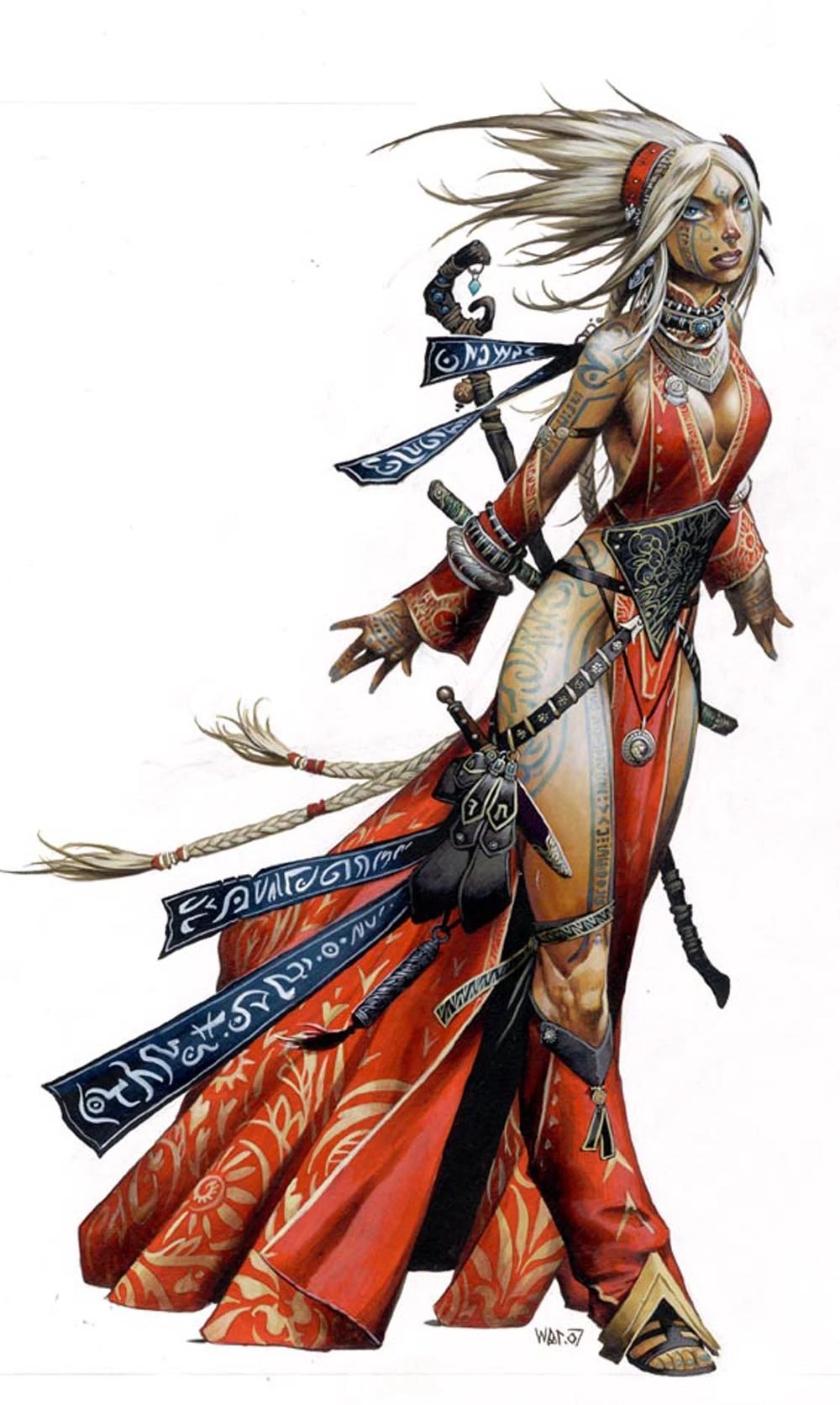
Sorcerer Seoni, one of the so-called iconics or iconic characters for Pathfinder, essentially the spinoff game from Dungeons & Dragons 3.5 edition, as she appears in her profile art from the Player’s Handbook – bringing the bling and booty to the schools of magic. I’m assuming she has to wear that for her magic to work.


8 D & D SCHOOLS OF MAGIC FOR BLING & BOOTY


No – we’re not talking about Hogwarts. We’re talking about the ‘schools’ of arcane power, classifying functional magic in fantasy by its type or effect. Now there’s probably as many such schools of magic as there are works of fantasy – black magic, blood magic, white magic, wild magic and so on – but perhaps the most comprehensive are the eight schools of magic in Dungeons & Dragons, at least in its peak 3.5 edition, which is not surprising for something that attempts to systematically codify the genre of fantasy for obsessive-compulsive rules-lawyering geeks to play as a game.


I mean, dear God, do the rules of chance need so many sides…or is that dimensions? And, dear God, what’s in the bag? WHAT”S IN THE BAG?! (Promotional image of GWHOLE brand D & D dice for sale on Amazon)


In the game, wizards can specialize in one of the schools of magic (at the expense of others), so it is a matter of some importance to pick the more powerful or versatile schools. However, this begs the most important question – for users of magic in the game or the genre of fantasy in general – which schools of magic are best for bling and booty (in every sense of the word)? After all, if you’re going to play with forces that put you at risk of some eldritch abomination sniffing out your scent, sucking out your soul with a straw and wearing your skin like a suit, then it better come with fabulous rewards – preferably the fantasy equivalent of the Fortune 500 and the Playboy Mansion. And just remember with the last, magic is equal opportunity – the sorceress Circe in Homer’s Odyssey essentially used her magic to have her own private island equivalent of the Playboy Mansion filled with her favorite, ah, manimals.

And so we take a stroll through the eight schools of magic, looking at which are the more powerful or versatile – including the extent to which they can effectively function as other schools of magic – and more importantly, which ones are the best for bling and booty…


Top Tens – Poetry & Literature: Top 10 Poetry (Special Mention) (3) Jim Morrison & Jimi Hendrix

Collage of Jim Morrison from one of his most iconic photographs (left) and Jimi Hendrix from an album cover for Electric Ladyland (right)


(3) JIM MORRISON & JIMI HENDRIX


Mr Mojo Risin’ and the Voodoo Child.

And here we are at the apex of mojo.

The Doors with their “dark, theatrical blues-influenced psychedelic rock”, led by the poetic lyrics, deep silky voice and charismatic persona of Jim Morrison “aka Mr. Mojo Risin’ aka The Lizard King”. And Jimi Hendrix – “one of the most celebrated musicians of the 20th century” and “arguably the greatest instrumentalist in the history of rock music”.

But hold on Stark After Dark, I hear you say – aren’t they your apex of mojo…in music?

Well, yes they are – which is why I’m giving them special mention here, similarly at god-tier ranking, for their lyrical content.

Of the two of them, Morrison leads for his lyrical content. Obviously I like Hendrix but his lyrical content – and for that matter his vocal performance – was eclipsed by his virtuosity of performance on electric guitar.

As the vocalist of The Doors, Morrison was all about lyrical content, vocal performance and onstage theater – the latter showcased by the sprawling trippy Oedipal epic performance of The End, not unlike the Greek drama that inspired it.

As for lyrical content, at the suggestion of Morrison their very name came from the title of Aldous Huxley’s The Doors of Perception, itself taken from William Blake – “When the doors of perception are cleansed, man will see things as they truly are, infinite” (from The Marriage of Heaven and Hell).

And I stand by L.A. Woman – both album and its titular single – as one of the great lyrical poems of the twentieth century. The title track song has so much mojo that it famously features the refrain of Mr. Mojo Risin’, an anagram of Jim Morrison no less, in the song’s break with its rising crescendo of unmistakably sexual rhythm (and a figure I’ve adopted into my own pagan mythology – I believe in L.A. Woman and Mr. Mojo Risin’).

Mr Mojo’ Risin’, Mr Mojo Risin! Whoa yeah!


RATING: 5 STARS*****

S-TIER (GOD TIER)

Top Tens – Top 10 Poetry & Literature: Top 10 Poetry (Special Mention) (2) Norton Anthology of Poetry

Norton Anthology of Poetry – 6th edition 2018 cover


(2) NORTON ANTHOLOGY OF POETRY


This may seem as a bit of a cheat, particularly ranked as my top special mention and in god tier to boot, given that it is an anthology – that is, a collection of poetry from different poets in contrast to the individual poets of my Top 10 Poetry (and most of the balance of special mentions).

Indeed, it is the most comprehensive collection of poetry, both in poems and in poets, from the very earliest poems in English to the present day, that I know – my favorite single volume anthology or collection of poetry.

And that essentially gives away the method to my madness behind it as my top special mention. In short, the Norton Anthology of Poetry is the means by which I encountered most of my favorite poems or poets, including those in my top ten or these special mentions.

It is one of a series of Norton Anthologies which tend to be favorite volumes for schools, colleges or universities. Two other Norton Anthologies come close to it in my education – the Norton Anthology of English Literature and the Norton Anthology of American Literature – and one other comes close to it in my personal reading – the Norton Anthology of Modern and Contemporary Poetry.

But no other anthology, Norton or otherwise, has ever matched the Norton Anthology of Poetry for my discovery and enjoyment of poems and poets – and I still discover or rediscover poems and poets within its pages to this day.


RATING: 5 STARS*****

S-TIER (GOD TIER)