Top Tens – Fantasy & SF: Top 10 SF Books (Special Mention) (5) L. Sprague de Camp – Lest Darkness Fall

The somewhat cheesy Mass Market paperback edition on Amazon (and also historically inaccurate since the book is set in Ostrogothic Italy) – all covers I’ve seen for editions of the book are cheesy (fair use)


(5) L. SPRAGUE DE CAMP –

LEST DARKNESS FALL (1939)


Sprague de Camp is sadly somewhat obscure these days, despite being a major figure – and prolific writer – of the so-called Golden Age of Science Fiction in the 1930’s and 1940’s, chumming around with better remembered writers such as Robert Heinlein and Isaac Asimov.

His novella Lest Darkness Fall has had more lasting influence, at least for my enduring love of alternate histories, particularly alternate histories created by time travelers from our own time. Written in 1939, it “is certainly one of the earliest and most influential” of the alternate history genre.

Visiting the Pantheon in Rome, protagonist Martin Padway finds himself transported by a mysterious storm to sixth century Rome – and sets out to singlehandedly stave off the impending Dark Ages. The western Roman Empire has fallen, but the Ostrogothic Kingdom that has replaced it in Italy is suitably stable for Padway’s purpose.

Fortunately, Padway is a capable individual for this tall task – I’d have been royally screwed. For one thing, he is a scholar of the period (hence his visit to Rome) and speaks Latin. He also knows double-entry bookkeeping – which, with his knowledge of Arabic numerals, he shares with a Roman moneylender to borrow money without the usual usurious Roman rates. He also knows how to distil brandy, which allows him to create his own profitable business. And so on, through using his money to create, by trial and error, the technologies of communication to prevent the Dark Ages, while becoming increasingly involved in politics and war to preserve the Ostrogothic kingdom from its opponents, particularly the encroaching eastern Roman Empire.

As I said, Lest Darkness Fall inspired my long-lasting love for alternate histories, particularly alternate histories through time travel, which become even more fun when you don’t just send individuals back in time, but whole groups or even towns – such as John Birmingham’s Axis of Time trilogy (in which a twenty-first century naval battle group is transported back to the Battle of Midway and find themselves fighting a very different Second World War) or Eric Flint’s 1632 series (in which the whole town of Grantsville in modern Virginia finds itself transported back to Germany in the Thirty Years War).

And as a side note, similarly to de Camp in Lest Darkness Fall, Asimov retold the history of the fall of the Roman Empire, but as future history rather than alternate history in his Foundation series – and his Galactic Empire would in turn seem to be an influence on the similar Empire in Star Wars).

Close runners-up are his light fantasy Harold Shea or Compleat Enchanter stories, written in collaboration with Fletcher Pratt. The premise of those stories is that the protagonist and companions use symbolic logic or the ‘mathematics of magic’ to travel to parallel worlds in which fantasy, myths and legends are real – Norse mythology, Edmund Spenser’s The Faerie Queene (where Shea meets his wife Belphebe), Samuel Taylor Coleridge’s Kublai Khan, Ludovico Ariosto’s Orlando Furioso, the Finnish Kavela and Irish mythology. These stories had a certain resonance for me as they seemed to symbolize the magic of reading fantasy itself.


RATING:

A-TIER (TOP TIER)

Top Tens – Fantasy & SF: Top 10 SF Books (Special Mention) (4) Warhammer 40k

Cover of the Warhammer Space Marine video game released in 2011 (fair use)


(4) WARHAMMER 40K (1987 – PRESENT)


Forget the power of technology and science, for so much has been forgotten, never to be re-learned.
Forget the promise of progress and understanding, for in the grim darkness of the far future there is only war.
There is no peace amongst the stars, only an eternity of carnage and slaughter, and the laughter of thirsting gods.

Warhammer 40,000 – usually known as Warhammer 40K – is the closest SF equivalent to Dungeons and Dragons, in terms of a game encapsulating its genre. It doesn’t have quite the same breadth of encyclopedic treatment of genre themes and tropes as Dungeons and Dragons, given that it is confined to its space opera setting. But what a setting!

“Warhammer 40,000 is your Standard Sci Fi Setting injected with a cocktail of every drug known to man and genuine lunar dust, stuck in a blender with Alien, Mechwarrior, Starship Troopers, Star Wars, and teeny, tiny sprinkles of Judge Dredd and 2000AD, embellished with spikes and prayer scrolls, bathed in blood and turned up to Eleventy Zillion (and then set on fire). Twice. With 8ft chainsaws.”

Although I’m surprised that quotation doesn’t reference Dune along with Star Wars – as well as Nemesis from 2000 AD, with that storyline’s Termight Empire led by the supremely xenophobic Torquemada. Not to mention the obvious influences of H.P. Lovecraft and J.R.R. Tolkien – but they’re obvious influences on almost everything in fantasy or SF. Also apparently Paradise Lost according to the game’s creator.

Warhammer 40K drew heavily on its publisher’s previous fantasy game Warhammer – hence the name – but has long since diverted from and totally eclipsed its fantasy predecessor. Whereas the fantasy game had a smattering of optional SF elements – primarily advanced technological weaponry as artefacts or relics left behind by a long-gone race of spacefarers – the SF game went further in the opposite direction, space opera fantasy in the style of Star Wars or SF with substantial fantasy elements.

“It adapts a number of tropes from fantasy fiction, such as magic, supernatural beings, daemonic possession, and fantasy races such as orcs and elves; ‘psykers’ fill the role of wizards in the setting”.

Its setting and plot is far too complex for a single entry – indeed, it could easily be its own top ten (or several top ten lists, given the volume of game material) – but stands out for the grim darkness of its tagline, which has evolved into a meme, as has much else in the game.

As its title indicates, it is about 40,000 years or so in the future. Humanity has a galactic empire (yay!) but that empire sucks (boo!), although the galaxy beyond that empire sucks even more – factions and forces against which the Imperium of Man is desperately trying to hold the line, against overwhelming odds in the long run.

That’s pretty much it. Oh sure – there’s the basic plot summary from Wikipedia:

“The setting of Warhammer 40,000 is violent and pessimistic. It depicts a future where human scientific and social progress have ceased, and human civilisation is in a state of total war with hostile alien races and occult forces. It is a setting where the supernatural exists, is powerful, and is usually untrustworthy if not outright malevolent. There are effectively no benevolent gods or spirits in the cosmos, only daemons and evil gods, and the cults dedicated to them are proliferating. In the long run, the Imperium of Man cannot hope to defeat its enemies, so the heroes of the Imperium are not fighting for a brighter future but raging against the dying of the light.”

Or the evocative summation from TV Tropes – “the most basic summation of the game’s plot is that our galaxy has been twisted into an unfathomable horror where an eternal, impossibly vast conflict occurs between several absurdly powerful genocidal, xenocidal, and (in at least one case) omnicidal factions, with every single weapon, ideology, and creative piece of nastiness imaginable cranked to an outlandish extreme… and even it has a Hell”

Perhaps the most interesting aspects of the game are its factions – foremost among the Imperium of Man as the default human protagonist faction. As previously mentioned, it sucks – an absurdly dysfunctional, paranoid, fascist theocratic state under the God-Emperor of Mankind, who now resembles some bizarre combination of mummified Egyptian pharaoh and Aztec god sustained by thousands of daily sacrifices.

The imperial cult holds sway throughout the empire – enforced by “a futuristic Inquisition” that ruthlessly hunts down anyone with even the slightest taint of the heretic, the mutant, or the alien, even going as far as destroying entire planets, just to be sure.

Science and technology have stagnated – “partly because they are treated with fear, ignorance and magical superstition” and partly because of “the Adeptus Mechanicus, the secretive, deranged machine cult that maintains the Imperium’s technological base. The latter have a point though, as technology is a portal for daemonic corruption – and The Warp, a corrupted parallel dimension connected to the material universe that provides the Imperium’s lifeblood as its only means of faster-than-light Travel, is incredibly dangerous.”

And then you have the forces of the Imperium holding the line – “the Space Marines (capricious, fanatical, genetically engineered Knight Templar Super Soldiers) and the Sisters of Battle (equally fanatical, pyromaniacal battle nuns) serve as the Imperium’s special forces, while the Imperial Guard, its at least trillions-strong regular army, takes disregard for human life to new and interesting extremes”.

For all its obvious dystopian dysfunction, the game publishers have to keep reminding fans that the Imperium’s “fascist totalitarianism is bad” – partly because they tend to be the point of view faction in game material, partly because they are indeed often awesome and cool in humanity’s last stand desperately holding the line, and partly because all other major factions are as bad, if not far worse.

You have the Aeldari or space elves, the Tyranids who consume everything else into themselves, the Necrons seeking to wipe out all organic life, the Orks modelled on fantasy orcs – and looming hungrily behind them all, the daemonic forces of Chaos.

Not bad for a game that primarily consists of miniatures or models, albeit with rulebooks – hence the special mention here.

Like many others, I don’t play the game – which seems to involve substantial expenditure of time and money in the ever-proliferating miniatures that are the basic components of gameplay – but enjoy the lore, of which there is an incredible volume beyond the game, not least in published tie-in books and comics.


RATING: 5 STARS*****
S-TIER (GOD-TIER – OR IS THAT GOD-EMPEROR TIER?)

Top Tens – Girls of History: Top 10

The scene from the 1989 film Bill & Ted’s Excellent Adventure, which I quote for the reference to historical babes


GIRLS OF HISTORY: TOP 10


“Bill: We gotta go, this is a history report, not a babe report!

Ted: But Bill, those are historical babes!”


That’s right – once again, I can find Fantasy Girls in anything.

Similarly to my Girls of Mythology, this is something of a personal novelty list, as my Girls of History don’t tend to have the same art or cosplay as my usual Fantasy Girls in popular culture – the holy trinity of comics, video games and anime of course, but also animation or fantasy and SF.

Although you may be surprised at the name recognition of the more distinctive girls of history and perhaps even more surprisingly, at the extent to which they do feature in popular culture, notably comics, film or television.

Also, comics artist Simon Bisley has done an awesome art collection of women from history, which features quite a few of my top ten entries. You can find it on his official website but I don’t feature any of it here, with one exception tightly cropped for fair use under copyright and because the full image is too racy, the same reasons that I don’t feature anything else from the collection.

While on the subject of art, there’s also a surprisingly prolific subculture of historical comics art on X or Twitter, usually featuring historical babes, by artists such as Gambargin, Centuriichan (a name shared with her signature female Roman legionary character), and Anonhistory (who likes to tease Centuriichan with a Pictish witch character, naked but for blue woad tattoos).


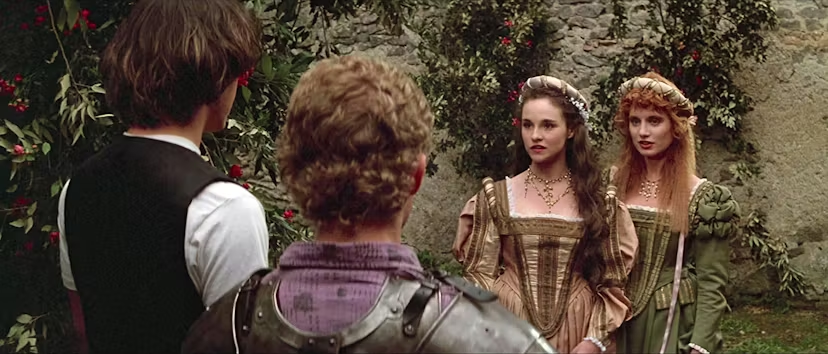
Ted: Oh, you beautiful babes from England, for whom we have traveled through time… will you go to the prom with us in San Dimas? We will have a most triumphant time! [princesses giggle]

Bill: Way to go, dude!


Sadly, Princesses Elizabeth and Joanna from Bill & Ted’s Excellent Adventure won’t be featuring in my Top 10 Girls of History – but here’s who does!


B-TIER (HIGH TIER)


Scene from the 2006 film Marie Antoinette, starring Kirsten Dunst as the titular French queen  (fair use)


(10) MARIE ANTOINETTE (1755-1793)


Let them eat cake?

And yes, I know that statement being attributed to Marie Antoinette as demonstrating her ignorance of the plight of her subjects – as her answer to their protest that they had no bread to eat – is apocryphal at best and fictional propaganda at worst.

History’s most famous aristocratic party girl, albeit that fame may owe more to how the party ended for her.

Born an Austrian princess – okay, archduchess but basically the same thing – she became Queen of France through her marriage to Louis XVI as well as the target of those opposed to the monarchy, culminating with her being beheaded by guillotine along with her husband as part of the Reign of Terror during the French Revolution.

“Long after her death, Marie Antoinette remains a major historical figure linked with conservatism, the Catholic Church, wealth and fashion. She has been the subject of many books, films, and other media. Politically engaged authors have deemed her the quintessential representative of class conflict, western aristocracy and absolutism. Some of her contemporaries, such as Jefferson, attributed to her as a cause of the French Revolution.”


RATING:

B-TIER (HIGH TIER)


Lucrezia Borgia as portrayed by Holliday Grainger in The Borgias TV series 2011-2013 from her profile in the fan wiki (fair use)


(9) LUCREZIA BORGIA (1480-1519)


Basically a Renaissance mafia princess.

I just have a soft spot for the ‘bad girls’ of history, albeit that adjective is a matter of historical perspective. You can make arguments for my preceding entry as a bad girl – or indeed pretty much all my entries as bad girls – but we’re much more in bad girl territory with Lucrezia Borgia, if only through her family.

After all, she was the illegitimate daughter of Rodrigo Borgia in his reign as Pope Alexander VI, and it doesn’t get much more bad than popes having kids – except perhaps her brother Cesare, the model for Machiavelli’s Prince, who was arguably even worse than their father. . .

Her family arranged several marriages for her among the Italian aristocracy that advanced their own political position, lending itself to “notorious tales about her family”  that “cast Lucrezia as a femme fatale, a controversial role in which she has been portrayed in many artworks, novels, and films”. That role extended to the role of black widow for one of her husbands (even if through her brother Cesare) and poisoning or murder in general, such as the rumor that she had a hollow ring that she used to poison drinks.

“Lucrezia was described as having heavy blonde hair that fell past her knees, a beautiful complexion, hazel eyes that changed colour, a full, high bosom, and a natural grace that made her appear to “walk on air”.


RATING:

B-TIER (HIGH TIER)


Tomoe Gozen as portrayed by Sayaka Akimoto in the Japanese 2022 TV drama The 13 Lords of the Shogun


(8) TOMOE GOZEN (1157-1247)


I had to get a ninja girl (or kunoichi) in there somewhere – even if the closest I could get was a female samurai (or onna-musha) and a possibly legendary one at that.

Tomoe Gozen is perhaps the best known female samurai by name, mentioned in The Tale of the Heike but not otherwise in any primary accounts of the Genpei War, a civil war between rival clans in Japan. She was famed as a swordswoman and archer, serving under the samurai lord Minamoto no Yoshinaka.


RATING:

B-TIER (HIGH TIER)


A-TIER (TOP TIER)


Promotional poster for the Zenobia: Queen of the East film in production (fair use)


(7) ZENOBIA (240-274)


The first of three rebels against Rome in my Top 10 Girls of History, Septimia Zenobia ruled what has become known to posterity as the Palmyrene Empire – Roman client state gone rogue and conquering most of the Roman East, culminating with the conquest of Egypt as the jewel in its crown and threat to Rome’s grain supply as the breadbasket of the Roman Empire.

First wife and then widow of Odaenathus, the king who had elevated the city of Palymra to its supreme power in the Roman East, she effectively became the de facto ruler as regent of her son. She “remained nominally subordinate to Rome” but Palmyrene predominance in the eastern part of the empire was too much of a threat for Rome to tolerate and so Emperor Aurelian led a campaign against her to restore her realm to the empire. That forced her reaction to declare her son emperor with herself as empress, as well as Palmyra’s independence from Rome. That did not turn out well for either Palmyra or her.

It is disappointing that she does not the same iconic status and mystique as Cleopatra, as Zenobia achieved what Cleopatra only dreamed – a genuine rival state to Roman power in the eastern empire with real prospects of success – and was at least as hot, by the account of Edward Gibbon  – at least by the account of Edward Gibbon, that she was considered “most lovely,” and “equalled in beauty her [claimed] ancestor Cleopatra”.

“Zenobia has inspired scholars, academics, musicians and actors; her fame has lingered in the West, and is supreme in the Middle East…a heroic queen with a tragic end…Harold Mattingly called Zenobia one of the most romantic figures in history.”


RATING:

A-TIER (TOP TIER)


Art by comics artist Simon Bisley from his Famous Women from History collection of Boadicea cropped to her face with frenzied battle expression for copyright fair use as well as the rest of the image being a litte too racy (although not as racy as it would be if she was fighting “sky clad” as is recorded of the Britons against the Romans)


(6) BOADICEA (? – 61)


You know her name, or maybe you don’t since it is one of many variants – Boudica or Boudicca in the Celtic language of Byrthonic connoting victory (so that she might also have been called Victory or Victoria) and Boadicea or Boudicea in Latin chronicles. There’s also a variant in Welsh as Buddug, which just sounds odd.

Anyway, she’s the second of my three rebels against Rome in my Top 10 Girls of History.

Queen of the ancient British Iceni tribe, essentially a client kingdom of Rome, “she led a failed uprising against the conquering forces of the Roman Empire in AD 60 or 61” and hence has become a British national heroine despite her defeat.

Her husband Prasutagus left his kingdom jointly to their two daughters and to the Roman emperor in his will, something which was always going to go badly as the Roman Empire in such dealings often resembled Darth Vader – “I have altered the deal. Pray that I don’t alter it further”.  In the case of the Iceni, Rome was particularly egregious – ignoring the will, annexing the kingdom, and according to Tacitus, flogging Boadicea and sxually abusing her daughters.

Boadicea led the Iceni and other British tribes in revolt, initially successful to the point that emperor Nero considered withdrawing from Britain, but ultimately defeated by the Roman legions under governor Paulinus in an admittedly impressive feat of arms despite being heavily outnumbered.

She evolved into a national icon from the English Renaissance to the Victorian period, not coincidentally with Britain’s female monarchs in those periods, Elizabeth and Victoria.


RATING:

A-TIER (TOP TIER)


Anne Bonney as depicted in starring role in the first issue of the Image Comics series A Man Among Ye by writer Stephanie Phillips and artist Craig Cermak released 17 June 2020. She was featured in some smoking art in that comics series – and in her depictions in comics in general (fair use)


(5) ANNE BONNY (? – 1733)


I mean, you knew I had to have a pirate girl in my top ten and Irish pirate girl Anne Bonny eclipses the other female pirates, including her fellow pirate Mary Read

Enter some sort of pun on crossbones here – actually now that I think of it, most pirate lingo seems to double up as entendres…

Although, she was only a pirate for 61 days. 61 days?! She basically just had a couple of months Caribbean cruise as a pirate!

She joined the crew of John Rackham, alongside fellow female pirate Mary Read, for her brief, piratical career before being captured. My respect for her increases as she had her execution stayed – as did Read – on the basis of claiming to be pregnant. That worked out better for Bonny – Read died in imprisonment but Bonny was likely let go at some point, as she died a dozen years later or so.

“Amongst the few recorded female pirates in the Golden Age of Piracy, she has become one of the most recognized pirates of the era, as well as the history of piracy in general…Despite a career of only 61 days, Anne Bonny is among the most famous pirates in recorded history, primarily due to her gender. Within a decade, Bonny-inspired characters were already appearing in contemporary culture…An 1888 cigarette card depicted Bonny as a redhead, a trait that continues to this day despite no evidence supporting it. Swashbuckling cinema often included a dashing redhaired woman or female pirate companion, occasionally directly naming Bonny…By the 21st century, Bonny has appeared in hundreds of books, movies, songs, stage shows, TV programs, and video games. Almost every female pirate character, is in some form, inspired by Anne Bonny.”


RATING:

A-TIER (TOP TIER)


Elizabeth Bathory as depicted in one of her appearance in comics – on the cover of a Dynamite series The Blood Queen Part 1: Reign in Blood released June 2014, art by Jay Anacleto and Ivan Nunes (fair use)


(4) ELIZABETH BATHORY (1560-1614)


And now we get to my biggest bad girl of history – I mean, you also knew I was going to get a vampire girl in there somewhere, even in my girls of history.

Of course, she wasn’t an actual vampire but essentially became one, literally bathing in blood as an icon of folklore, fantasy and horror – arguably second only to Dracula himself as iconic vampire, hence epithets as Countess Dracula or Blood Countess. Ironically, she was from Hungarian, neighbor to Dracula’s Transylvania and contesting that territory with Romania.

“Countess Elizabeth Báthory was a Hungarian noblewoman and alleged serial killer from the powerful House of Bathory, who owned land in the Kingdom of Hungary (now Slovakia). Báthory and four of her servants were accused of torturing and killing hundreds of girls and women from 1590 to 1610. Bathory and her cohorts were charged for 80 counts of murder and were convicted. Her servants were put on trial and executed, whereas Báthory was imprisoned…until she died in her sleep in 1614.”

My favorite folklore of her is that her spree started from her observation that her skin seemed fresher or younger from a servant’s girl blood after an accidental injury and she started bathing in the blood of virgins to retain her youth, hence her iconography as vampire or vampiric in nature (contrary to contemporary historical records and only evolving as a legend a century after her death).

I can’t feature Elizabeth Bathory without reference to my favorite fantasy art of her – the posthumous fantasy depiction by artist Olivier Ledroit in Requiem Vampire Knight by Pat Mills. (Posthumous that is, in that it is set in the afterlife – but not any afterlife you’d like to find yourself in, unless you were someone like Elizabeth Bathory).


RATING:

A-TIER (TOP TIER)


S-TIER (GODDESS TIER)


Photo of Marilyn Monroe while filming The Seven Year Itch on the streets of New York. She apparently stopped at some point during the shooting of the famous “skirt scene” and posed for the reporters and photographers who were covering the film shoot. Photograph taken by Sam Shaw and published by Corpus Christi Caller-Times-photo from Associated Press (public domain)


(3) MARILYN MONROE (1926-1962)


Few modern celebrities have transcended their celebrity to become as historically iconic and none quite like her. Her image and name are instantly recognizable, indeed enduring as a valuable advertising brand, licensed to hundreds of companies.

Born Norma Jeane Mortenson, she became the Hollywood blonde bombshell – as well as emblematic of Hollywood itself, Playboy (as the literal face of the first edition of the magazine on its cover and in its centerfold), and “the era’s sxual revolution”, perhaps also the American Dream (or at least the American dream girl).

“According to The Guide to United States Popular Culture, as an icon of American popular culture, Monroe’s few rivals in popularity include Elvis Presley and Mickey Mouse… no other star has ever inspired such a wide range of emotions—from lust to pity, from envy to remorse…Art historian Gail Levin stated that Monroe may have been “the most photographed person of the 20th century”.


RATING:

S-TIER (GODDESS TIER)


Joan of Arc depicted on the cover art of The Mission of Joan of Arc collected edition by Philip Kosloski, Alexandre Nascimento and Jesse Hansen published by Voyage Comics, a Catholic comics publishing company (fair use)


(2) JOAN OF ARC (1412-1431)


The Maid of Orleans – teenaged military leader and patron saint of France, surprisingly prolific in cultural depictions showcasing her enduring popularity.

“Joan of Arc…is a patron saint of France, honored as a defender of the French nation for her role in the siege of Orleans and her insistence on the coronation of Charles VII of France during the Hundred Year’s War. Stating that she acted under divine guidance, she became a military leader who gained recognition as a savior of France.”

Much of her religious originated from her claims of visions from angels or saints, but she walked the walk as much as she talked her talk, leading the French to victories “paving the way for their final triumph in the Hundred Years War several decades later’.

However, her divine fortune ran out with two unsuccessful sieges as well as being captured and handed over to her English opponents, Famously, they tried her for heresy and executed her by burning at the stake – which only served to increase her French religious mystique as martyr.

“After the French Revolution, she became a national symbol of France. In 1920, Joan of Arc was canonized by Pope Benedict XV and, two years later, was declared one of the patron saints of France. She is portrayed in numerous cultural works, including literature, music, paintings, sculptures, and theater…Joan is one of the most studied people of the Middle Ages, partly because her two trials provided a wealth of documents.Her image, changing over time, has included being the savior of France, an obedient member of the Catholic Church, an early feminist, and a symbol of freedom and independence.”

She’s also a magnet for alternative historical interpretations or revisionist theories – “theories she was an illegitimate royal child; that she was not burned at the stake; that most of her story is a fabrication; and that she escaped death at the stake”. My favorite of these was Margaret Murray conscripting Joan to Murray’s pagan witch cult thesis – in which Joan “was correctly identified as a witch”, but witchcraft was “a survival of the pagan old religion of pre-Christian Europe”.


RATING:

S-TIER (GODDESS TIER)


Cover of Cleopatra: The Last Great Queen of Egypt, history book for children by Samuel John published in 2025 (fair use)


(1) CLEOPATRA (70/69 BC – 30 BC)


Was there any doubt about the top spot? Although technically it’s Cleopatra VII – or Cleopatra VII Thea Philopator.

“Queen of the Ptolemaic Kingdom of Egypt from 51 to 30 BC, and the last active Hellenistic pharaoh. A member of the Ptolemaic dynasty, she was a descendant of its founder Ptolemy I Soter, a Macedonian Greek general and companion of Alexander the Great. Her first language was Koine Greek, and she is the only Ptolemaic ruler known to have learned the Egyptian language, among several others.After her death, Egypt became a province of the Roman Empire, marking the end of the Hellenistic period in the Mediterranean.”

Also famously the lover of Caesar, whom she aligned herself with to gain the upper hand in the civil war with her co-ruler and brother Ptolemy XIII. Even more famously, she was the lover of Caesar’s ally Mark Anthony in the Roman civil war with Caesar’s heir Octavian – to advance her Ptolemaic interests within Mark Anthony’s control of the eastern part of the empire as against Octavian’s control of the western half. Her alliance with Mark Anthony didn’t turn out well for either of them, with both taking their own lives in the face of their defeat by Octavian’s forces.

“Cleopatra’s legacy survives in ancient and modern works of art, Roman historiography and Latin poetry produced a generally critical view of the queen that pervaded later Medieval and Renaissance literature. In the visual arts, her ancient depictions include Roman busts, painting, sculptures, cameo carvings and glass, Ptolemaic and Roman coinage, and reliefs. In Renaissance and Barosque art, she was the subject of many works including operas, paintings, poetry, sculptures, and theatrical dramas. She has become a pop culture icon of Egyptomania since the Victorian era, and in modern times has appeared in the applied and fine arts, burlesque satire, Hollywood films, and brand images for commercial products.”

And yes – I know the historical Cleopatra wasn’t the bombshell as portrayed by Elizabeth Taylor in the 1963 film

Speaking of Elizabeth Taylor’s Cleopatra, I’ve always liked the cover of Asterix and Cleopatra, which was adapted from that film’s poster and joked about the epic cost of the film’s production – a cost which saw the film flop.

And speaking of Asterix and Cleopatra, Monica Belucci played Cleopatra in the 2002 live-action Asterix film, Mission Cleopatra.


RATING:

S-TIER (GODDESS TIER)


GIRLS OF HISTORY: TOP 10 (TIER LIST)


S-TIER (GODDESS TIER)


(1) CLEOPATRA

(2) JOAN OF ARC

(3) MARILYN MONROE


If Cleopatra and Joan of Arc are my Old Testament of girls of history, Marilyn Monroe is my New Testament.


A-TIER (TOP TIER)


(4) ELIZABETH BATHORY

(5) ANNE BONNY

(6) BOADICEA

(7) ZENOBIA


B-TIER (HIGH TIER)


(8) TOMOE GOZEN

(9) LUCREZIA BORGIA

(10) MARIE ANTOINETTE


Friday Night Funk – Top 10 Music (Mojo & Funk): Special Mention (Funk) (5) Devo – Whip It

Devo in their signature Red Energy Dome hats


(5) FUNK: DEVO – WHIP IT (1980)

B-Side: Beautiful World (1981)


“When a problem comes along

You must whip it!

Before the cream sits out too long

You must whip it!

When something’s going wrong

You must whip it!”


I say whip it!

Devo is an American new wave music band, best known for their red Energy Dome hats and this 1980 single from their album Freedom of Choice, their signature song and only mainstream hit. As such, they are labelled a one-hit wonder – for shame! – but their achievements and catalogue extend well beyond that, albeit more as cult following. For that matter, band front-man Mark Mothersbaugh has had a prolific career as a composer, notably in film – including the Academy Award-winning “Everything is Awesome” from The Lego Movie.

Devo wasn’t just a band – it was a philosophy! Devo stood for de-evolution – “the band’s part-satirical, part-serious take” on the world, with “their music and stage shows mingling kitsch science fiction themes, deadpan surrealist humor and mordantly satirical social commentary”.

But I said “Whip It” – and whip it good! The intention of the absurdist lyrics isn’t quite as kinky as they sound or listeners have assumed. Among other things, they are a play on “can-do” positive thinking self-help (notably Norman Vincent Peale’s The Power of Positive Thinking). Of course, that didn’t stop Devo playing up the song’s perceived kink in the accompanying (and pioneering) music video, with Mothersbaugh whipping the clothes off a woman on a dude ranch.

“If there was a Hall of Fame for early ’80s New Wave music, Devo’s ‘Whip It’ would be a shoo-in for induction. Undoubtedly the band’s most recognizable song, ‘Whip It’ elevated Devo from an underground art-rock outfit to a (briefly) mainstream pop act, albeit one that still retained its pointed and satirical view of society. And, of course, who can forget the song’s surrealist and now-iconic video that was a staple of MTV during the then-fledgling channel’s early years? The fact that The Simpsons even paid homage to both the song and the video in an episode demonstrates how much ‘Whip It’ has transcended pop culture.”

Whip it good!

As for my B-side, I have a soft spot for their 1981 single “Beautiful World”

And for those hardcore cult Devo fans, here’s some other Devo songs other than their signature hit – and the balance of this hardcore Devo fan’s Top 10 Devo songs:


(3) Freedom of Choice (1980) (from their album of the same name, also featuring Whip It and Girl U Want)

(4) Girl U Want (1980)

(5) Working in the Coal Mine (1981)

(6) Peek A Boo (1982)

(7) Big Mess (1982)

(8) Here to Go (1984)

(9) (I Can’t Get No) Satisfaction” (1977)

(10) Are You Experienced (1984)


Whip it good!


RATING: 4 STARS****

B-TIER (HIGH-TIER)

Top Tens – Film: Top 10 Films (Revamped) (7) Zulu


Scene from the Zulu film, with Michael Caine front and center – so much so that I tend to think of his historical character, Lieutenant Bromhead, simply as Michael Caine


(7) ZULU (1964)


The Battle of Rorke’s Drift.

That’s it – that’s the entry. Well that and the 1964 film Zulu which depicted it.

If you’re a fan of the Battle of Helm’s Deep in The Lord of The Rings film (The Two Towers), then you’re a fan of the Battle of Rorke’s Drift as depicted in this film, as the former was filmed in a manner deliberately reminiscent of the film Zulu according to Jackson.

If anything, Rorke’s Drift in Zulu was even more epic than Helm’s Deep – as a small company of less than 150 soldiers attached to the Royal Engineers (including a substantial number of sick and wounded) fought off a force of about 3-4,000 Zulus.

The battle was a small albeit highly celebrated part of the Anglo-Zulu War, with the British soldiers finding themselves in the path of a Zulu force in the aftermath of the opening Zulu victory at Isandlwana.

When it comes to Rorke’s Drift, I tend to default to its depiction in the film Zulu, as it is deeply embedded in my psyche. While generally accurate to the historical battle, it does of course have inaccuracies (with perhaps the most egregious involving the depiction of Private Hook, a model soldier, as a rogue redeemed in the battle). The film may also be seen as somewhat problematic in these times given its celebration of British imperial victory – I don’t care.

Indeed the film tends to glamorize both sides in the battle – with the Zulus depicted as a brave, intelligent, capable, resourceful and ultimately honorable adversary. And if anyone can resist the stirring orchestral theme by John Barry, I don’t know what to say.

The British soldiers were led by Lieutenant Chard, portrayed by Stanley Baker, and his second in command Lieutenant Bromhead, portrayed by a young Michael Caine in his breakthrough film role. Deciding that retreat isn’t an option as they will move too slowly with their sick or wounded and the Zulus will catch them out in the open, they have no option but to stand and fight behind improvised barricade defenses.

Throughout the day and night (into the following day) after the Zulu force surrounds them, wave after wave of Zulu attackers are narrowly repelled by the desperate British defenders. At one point, the Zulus succeed in setting fire to the field hospital, leading to tense scenes of the evacuation of patients under fierce attack by Zulu warriors – and British Surgeon-Major James Henry Reynolds calmly continues his surgery on a wounded soldier with fighting all around him. And yes – he got a Victoria Cross.

The British defenders retreat to the shortened lines of their inner barricades. One tactic you see through the film is the use of multiple ranks of soldiers to maintain a nearly continuous volley of fire with their bolt-action rifles. None more so than the climactic scene with three such ranks used (after falling back from desperate hand-to-hand combat at an outer barricade) to defend a massive assault by Zulu warriors. And as the camera pans back, you see the fallen Zulu warriors mere inches away from the front rank of breathless British soldiers – an impressive feat of holding the line.

That’s when you start to think from the preceding sense of overwhelming doom that hangs over the British soldiers – holy crap, they’re actually going to make it! And then – no, holy crap, they’re not…as the Zulu force masses on the hill overlooking Rorke’s Drift, seemingly barely diminished, while the British are exhausted and running low on ammunition. Lieutenant van den Burgh, their Afrikaaner advisor serving with the Natal Native Contingent, sinks to his knees and rebukes the British officers (and arguably their imperialism as well) – “Haven’t you had enough? We’re all dead!”

And then, holy crap again – as the Zulus chant, raising their spears. “They’re taunting us!” Michael Caine’s character exclaims. Van den Burgh laughs – “You couldn’t be more wrong – they’re saluting us as fellow braves!”. And then the Zulus slowly turn and walk away, still chanting, until a lone warrior is left, before he too turns and leaves.

Sadly, the historical battle ended in a more prosaic way, without the Zulus saluting the British but more withdrawing from strategic sense and an advancing British relief column. I prefer to think it ended the way it did in the film.

11 Victoria Crosses were awarded to the defenders of Rorke’s Drift, as the film itself narrates with a full roll call just before the end credits – including the surgeon as mentioned but also Hook and the two commanding lieutenants Chard and Bromhead.


FANTASY & COMEDY


I’ll deal with both at once, since the film has little fantasy or comedy as pure his


RATING:
A-TIER (TOP TIER)

Top Tens – Fantasy & SF: Top 10 SF Books (Special Mention) (3) Paranoia

Rulebook cover art


(3) PARANOIA (1984 – PRESENT)


Commie mutant traitor!

“The Computer is your friend. The Computer wants you to be happy. Happiness is mandatory. Failure to be happy is treason. Treason is punishable by summary execution. Are you happy, citizen? Have a nice daycycle”

Welcome to Alpha Complex in the SF role-playing game of Paranoia – “a world designed by Kafka, Stalin, Orwell, Huxley, Sartre, the Marx Brothers and that crazy old man at the airport bar at 2 am”. A dystopian fusion to the point where everything would be monstrously overwhelming but for its own dysfunctionality and the game’s absurdist dark humor.

It’s also a post-apocalyptic dystopia – although what apocalypse (if any?) forced the last survivors (or are they?) of humanity into the last underground or domed city (or is it?) run by the supercomputer known simply as the Computer or Friend Computer is now mysterious, as no one is sure what happened any more, if anyone ever did. Not even the Computer, when it tried to figure out what went wrong – “unfortunately, the Computer’s databases had been corrupted, and after finding some old Cold War propaganda, it concluded that the Communists did it”.

And now, the Computer is the equivalent of a barely functional paranoid schizophrenic – that probably would have wiped out Alpha Complex but for its inefficiency, its ability to simultaneously pursue wildly inconsistent goals at odds with each other, and its genuine but abstract benevolence towards Alpha Complex (or whatever remains of either that benevolence or Alpha Complex).

It may be teetering on complete breakdown (or outright psychosis) after decades of subversion or reprogramming by conflicting groups, but the Computer still rules Alpha Complex – “its dystopian society organized in a hierarchy of “security clearances based on the electromagnetic spectrum (specifically Isaac Newton’s version), from lowly Infrared worker drones, through Red grunts and Yellow managers, all the way up the rainbow to the Violet and Ultraviolet elite”, the High Programmers.

This society is supported by “swarms of robots” – which if anything, tend to be crazier and more dangerous to humans than the Computer – as well as “spies, omnipresent surveillance, and a bureaucracy so huge and convoluted no one’s quite sure who’s in charge of what any more”.

“Problems in Alpha Complex are solved by teams of Troubleshooters, whose job is to find trouble and shoot it”. (Stay alert. Trust nobody! Keep your laser handy!).

Those problems including traitors – where virtually everything is treason, and even the knowledge of what is or isn’t treason is usually above your security clearance – as well as Communists or other secret societies, and mutants. Or a combination of all of these – the trifecta of “commie mutant traitor”, which is what players yell as they shoot each other in the back. Indeed, I’m known to be fond of using that phrase in real life.

Of course, “thanks to years of clone breeding” (everyone is a clone in Alpha Complex), “overexposure to radiation, and other snafus”, everyone is a mutant. Everyone is also a member of one or more secret societies, mostly plotting to overthrow the order of Alpha Complex. Ironically, the secret societies were started by the Computer, as an outlet to the natural human impulse to conspire together, but as usual in Alpha Complex, got out of control.

(You seem a little too informed of matters above your security clearance, citizen – please report for termination! Have a nice daycycle!)

The players “are (usually) Red-level Troubleshooters working for Friend Computer, grudgingly assigned useless, backfiring equipment and weapons, and dispatched on (often impossible) Suicide Missions, all while navigating the endless deathtrap which is Alpha Complex, keeping their mutant powers a secret, advancing the cause of their secret society, and trying to earn promotion to higher color grades”. Not to mention in-fighting among players – if you’re not shooting each other in the back, it’s because you’re shooting each other in the face.

You’ll go through a few clones, if not all of them, by the end, if you make it to the end – which is the truly dangerous part, the mission de-briefing, when you accuse each of treason. If you’re lucky, your fabricated accusations of treason might just overlap with their genuine treason.


RATING: 5 STARS*****
S-TIER (GOD-TIER)

Top Tens – Film: Top 10 Films (Revamped) (9) The Raid


From the films’ theatrical release poster


(9) GARETH EVANS –

THE RAID (2011-2014)


100 minutes of awesomeness in a frenetic, claustrophobic martial arts action masterpiece – the martial arts being the Indonesian pencak silat that is showcased by the film’s fight choreography and the claustrophobic being the film’s premise.

That premise being an Indonesian police squad deployed to raid a drug lord’s apartment block in the sums of Jakarta – actually a fortress-like safe house for the city’s worst criminals – only to find themselves forced to fight their way through the complex to carry out their mission or just to survive long enough to escape.

“Good morning, everyone. You may have noticed we have some guests trawling the halls today. Now, I certainly did not invite them and they most certainly are not welcome. So, in the interests of public health, should you rid this building of its recent infestation, well, then, you can consider yourself a permanent resident of this building. Free of charge. You’ll find these f*cking cockroaches on the sixth floor. Now, go to work. And please, please enjoy yourself.”

And yes – it was the same premise that was (independently) used to similarly great effect in the 2012 Dredd film.

And ever since, I’ve enjoyed whenever The Raid pops up in one form or another – most obviously in its 2014 sequel, which maintained the frenetic action of the first. You know you’re in for glorious action when the climax of the film is preceded by a character telling its action hero that the only way to solve his problems is to kill all of the parties responsible. My personal highlight of the sequel was the assassin duo dubbed Hammer Girl and Baseball Bat Man.

I also get excited whenever I see what I call the Raid guys – primarily Iko Suwais and ‘Mad Dog’ Yahan Ruhian – in a film. Even when they were disappointingly wasted in The Force Awakens. Fortunately, John Wick Chapter 3 made up for that.

I’m also counting it as The Raid popping up for any film by the same director Gareth Evans.


FANTASY & SF

No, except to the extent that the intense fighting skill and survival of characters borders on supernatural.


COMEDY

Again, not really any comedic elements, except occasionally of the blacker kind


RATING: 4 STARS****

B-TIER (HIGH TIER)

Top Tens – Fantasy & SF: Top 10 SF Books (Special Mention) (2) Encyclopedia of SF

Cover of the 1993 print edition published by Palgrave Macmillan with the SFE logo in the circle – the edition I own (and yes – I own an elusive print edition)


(2) ENCYCLOPEDIA OF SCIENCE FICTION (1979 – PRESENT)


“That you could be reading it right now goes without saying, since in some alternate universe you surely are”.

Quite simply, my favorite reference work for the genre of science fiction in different media – books, comics, film & television, and so on (art and illustration, magazines, even music). The first print edition was edited by Peter Nicholls and John Clute in 1979 – with entries not only for works and creators, but also the greater (and lesser) themes and terminology of science fiction. Even better, it was published online in 2011 and is regularly updated since then (winning a Hugo Award in 2012), with editors expanded to include David Langford and Graham Sleight.

And like its companion Encyclopedia for Fantasy, its most engaging strength as a reference work is not so much its entries for individual authors or works, but its compilation of SF themes and terminology or tropes – although it doesn’t have the abundant classification of subgenres, nor quite the evocative phrases used as entry titles as the Encyclopedia of Fantasy. However, it does have a handy online index of themes, featuring such themes of interest as Dream Hacking or Medieval Futurism.

It even has an entry on itself. Kudos, SFE, kudos.


RATING: 5 STARS*****
S-TIER (GOD TIER)

Top Tens – Film: Top 10 Films (new entry) (10) Warfare

Film poster art


(10) WARFARE (2025)


Warfare is “a 2025 American action war drama thriller film” that earns my wildcard tenth place entry by my usual criteria as best film of the present or previous year. Also, it’s a nice bookend with my film in top spot – you’ll see why.

I like the films of Alex Garland, who wrote and directed the film with Ray Mendoza, based on Mendoza’s experiences during the Iraq War as a US Navy Seal. The backdrop is apparently the (Second) Battle of Ramadi or its aftermath in 2026. Mendoza’s platoon – shown with pseudonyms in the film – are on a surveillance mission, which involves them taking over a civilian house, much to the fear and distress of its occupants, and literally scoping out the local jihadi insurgents. Literally, that is, through their sniper sights.

And that’s where things go horribly wrong, as the insurgents scope them right back and get in first, just as American air support withdraws (except for a couple of shows of force that are indeed awesome). From there, it’s a tense story of survival, as the Americans focus purely on extraction – just getting the hell out of there, in one piece or as close as possible. Spoiler alert – it’s not possible, at least in one piece.

You, the viewer, are right there with them, immersed in a visceral experience of combat, and in real time to boot. Also the futility of it all, apart from the destruction of a random civilian house because it was in a good position for surveillance. As one of the female civilians repeatedly shouts after them – “Why?”. They don’t have a good answer for her.


RATING:

X-TIER (WILD TIER) – BEST OF 2025

Top Tens – Fantasy & SF: Top 10 SF Books (Special Mention) (1) Omni

One of Omni’s highlights was its top quality SF (and fantasy) art, showcased by this hardcover book collection of it published in 2014


(1) OMNI (1978-1998)


O Omni – the iconic magazine of science and science fiction!

Omni was founded by Kathy Keeton and her partner Bob Guccione, better known as the publisher of Penthouse magazine, in 1978. Unfortunately, it foundered with Keeton’s death in 1997 and wound up in 1998, having ceased print in 1995 but continued online for a short time.

I was introduced to Omni magazine when a spring-cleaning neighbor gave me their old collection of magazines, which also included an anthology Best of Omni Science Fiction. Omni was the gift that kept on giving, as it introduced me to a variety of SF writers, including many writers in my Top 10 SF list or special mentions.

In its halcyon days, it obviously paid writers well as it was a leading light of SF stories, including genre classics. Its impact wasn’t limited to stories – it also featured leading genre artists (including H.R. Giger) as well as feature articles on science and other recurring features. One of the latter was competitions for readers, with one such being for Partly Baked Ideas, the winning entry of which has lodged in my psyche ever since – the Partly Baked Idea for plant flight. Take certain plants that open and close their leaves with the alternation of day and night, combine them with gradually decreasing artificial light from the natural day cycle to strobe frequency, and you may just have plants that flap their leaves enough to fly…

Or not – they were Partly Baked Ideas after all!


RATING: 5 STARS*****
S-TIER (GOD TIER)