Top Tens – Poetry & Literature: Top 10 Poetry (Special Mention) (15) Charles Bukowski

Photograph of Bukowski on the cover of this 2018 anthology of his poetry published by Canondale PBS


(15) CHARLES BUKOWSKI (1920-1994)


Also known as Chuck Buk – a quip about his name that I read somewhere and have used ever since.


Charles Bukowski can be summed up by that meme of one of Bender’s best lines from Futurama (from the second episode at that) – I’ll write my own damn poetry, with blackjack and hookers!

Except as the line goes later in the episode – forget about the blackjack. And some might say the poetry.

Charles Bukowski shot poetry (and prose) straight from the hip, as well as the flophouse and the gutter – raw and wriggling to quote another meme (Gollum from The Lord of the Rings film trilogy).

And yet that rawness has a striking sharpness at times – with an undeniable knack for titles of anthologies too.

As for which Bukowski poem to pick for this entry, I’d go with the pack – about the dogs of hell that pursue the poet.


RATING:

B-TIER (HIGH TIER)

Top Tens – Poetry & Literature: Top 10 Poetry (Special Mention) (14) A.D. Hope

Bust of A. D. Hope in “Poet’s Corner”, Garema Place, Canberra (one of a group of three, with two other poets) photographed by Doug Butler, Wikipedia “A.D. Hope” – licensed https://creativecommons.org/licenses/by-sa/4.0/deed.en


(14) A.D. HOPE (1907-2000)


“Floods her monotonous tribes from Cairns to Perth.
In them at last the ultimate men arrive
Whose boast is not: “we live” but “we survive”,
A type who will inhabit the dying earth.”


If you were to ask the average Australian to name one poem about Australia, I suspect you’d mostly get the answer “My Country” – as in “I love a sunburnt country” – by Dorothea Mackellar.

Well, that is, if you got any answer at all, or one that wasn’t “Waltzing Matilda”, the country’s unofficial national anthem (aptly enough about a criminal swagman who prefers death to arrest and whose ghost haunts a billabong thereafter) by Banjo Paterson – the latter also probably the answer you’d get if you asked the average Australian to name one Australian poet and not without reason as Australia’s bush balladeer bard and poet laureate.

Or perhaps the official national anthem, “Advance Australian Fair”, for which everyone forgets there’s more than one verse – and only remembers the first because of its use of the word girt, because who puts girt in a national anthem?

And then there’s that other unofficial Australian anthem and greatest lyrical genius of Australia or by any Australian ever – “Aussie Aussie Aussie! Oi oi oi!”. There’s actually more lines of this but you get the point.

If I were to name one poem about Australia, however, I’d name the poem I quoted at the outset, aptly and simply titled “Australia”, by Alec Derwent Hope- who would also be the one Australian poet I would name.

Also aptly enough for a poem about Australia by an Australian, it’s taking the p!ss out of patriotic poetic platitudes, presenting Australia as a nation clinging timidly to its coasts while draining its desert continent like a “vast parasite robber-state”.

Mind you, it’s not that much more complimentary to the European civilization of which Australia is a second-hand offshoot – “the learned doubt, the chatter of cultured apes which is called civilization over there”.

That pretty much sums up the “savagely satirical” style of A.D. Hope. I was delighted to learn that his highly er0tic verse and “frequent allusions to s€xuality” caused him to be dubbed “Phallic Alec” (in a letter to Norman Lindsay, an Australian also known for his er0ticism).

His style also harked back to eighteenth century poetry, leading an American journal to quip about him as “the greatest eighteenth century poet in the twentieth century”.

“When once asked what poets could do for Australia, Hope replied “oh not much, merely justify its existence”.


RATING:

B-TIER (HIGH TIER)

Top Tens – Poetry & Literature: Top 10 Poetry (Special Mention) (13) W.H. Auden

Auden in 1939 photographed by Carl Van Vechten – Wikipedia “W.H. Auden” (public domain)


(13) W.H. AUDEN (1907-1973)


“A poem is never finished; it is only abandoned”

An adage that I have used ever since at work to illustrate that there comes a cut-off point – or where you have to get to the point – for attention to detail, although it was actually Auden paraphrasing the French poet Valery.

Like T.S. Eliot, a poet claimed by both Britain and the United States except in reverse – where T.S. Eliot was an American-British poet who moved from the United States to Britain, Wystan Hugh Auden was a British-American poet who moved from Britain to the United States. Although to be honest, I tend to think of both as British.

Also one of the holy trinity of modern poets along with Eliot and Yeats – although he ranges from being seen as a lesser figure (as I suppose I do since I rank the other two in my top ten and Auden in these special mentions) to ranking him above them. I would agree that Auden was the most consummate poetic stylist of the three – Auden could pretty much compose a poem to any style or technical form on tap.

“Auden’s poetry is noted for its stylistic and technical achievement, its engagement with politics, morals, love, and religion, and its variety in tone, form, and content.”


“Iron-hearted man-slaying Achilles

Who would not live long.”


As for which Auden poem to choose for this special mention, there are so many from which to choose but I’ll go with the forlorn title poem of his collection of poetry, The Shield of Achilles.


“The mass and majesty of this world, all

That carries weight and always weighs the same

Lay in the hands of others; they were small

And could not hope for help and no help came”


RATING:

A-TIER (TOP TIER)

Top Tens – Poetry & Literature: Top 10 Poetry (Special Mention) (12) D.H. Lawrence

Passport photograph of D. H. Lawrence on 22 February 2029, enclosed in a letter to Bernard Falk, Wikipedia “D.H. Lawrence” (public domain)


(12) D. H. LAWRENCE (1885-1930)


Memorably described by popular historian Paul Johnson as a “strange and intuitive Englishman”, D.H. Lawrence is perhaps best remembered for novels that were the subject of censorship trials – although he should be remembered for his best novel based on title alone, Kangaroo, because what else are you to call a novel set in Australia?

However, he was also a poet – and I prefer his poetry to his novels.

“His best-known poems are probably those dealing with nature such as those in the collection Birds, Beasts and Flowers, including the Tortoise poems, and “Snake”, one of his most frequently anthologised, displays some of his most frequent concerns: those of man’s modern distance from nature and subtle hints at religious themes.”

I was tempted to nominate his poem “The English are so Nice” – a poem that among quite a few others of his were “often wry attacks on the moral climate of England” – for this special mention entry, if for no other reason than my English ex-wife who embodied it.


“The English are so nice

So awfully nice

They are the nicest people in the world

And what’s more, they’re very nice about being nice

About your being nice as well!

If you’re not nice, they soon make you feel it”


However, I chose one of his posthumously published poems, aptly enough about death and one of his most famous – The Ship of Death.


“Have you built your ship of death, O have you?

O build your ship of death, for you will need it.”


RATING:

A-TIER (TOP TIER)

Heart of Starkness – Eightfold Path 1: I live in a mythic world (underworld)

Artist’s impression of Utopia, painting by Efthymios Warlamis, Wikipedia subject category “Utopia” – licensed https://creativecommons.org/licenses/by-sa/3.0/


I live in a mythic world –

underworld and paradise

Babylon and Jerusalem

Olympus and Avalon

L’america and electric ladyland

*

I live in a mythic world (pagan)

*

*

I live in a mythic world (shaman)

*

*

I live in a mythic world (zen)

*

*

Top Tens – Poetry & Literature: Top 10 Poetry (Special Mention) (11) Gerard Manley Hopkins

Gerard Manley Hopkins as photographed – public domain image


(11) GERARD MANLEY HOPKINS (1884-1889)


“The achieve of, the mastery of the thing!”

Hopkins would earn special mention for “the sonnets of desolation” alone – a title I think would make a good name for a music band, perhaps as Gerard Manley Hopkins and the Sonnets of Desolation.

You don’t really expect poetry, let alone sonnets of desolation, from a man who was primarily a Jesuit priest – and an English one at that – but there you have it. Mind you, he published very little of his poetry during his life – it was only through a posthumous volume of his poems published in 1918 by his friend and fellow poet Robert Bridges that he “became recognised as one of the leading Victorian poets”.


“That night, that year

Of now done darkness I wretch lay wrestling with (my God!) my God.”


Not surprisingly for a priest, a focus of his poetry is his celebration of the natural world through the lens of his religious belief –  “his praise of God through vivid use of imagery and nature”.

Not so much however his sonnets of desolation, which evoke religious doubt or as he described them to Bridges, “the thin gleanings of a long weary while” – hence why I prefer them (as I do the poems of T.S. Eliot that reflect his early doubt rather than his later faith).

According to John Bayley – “All his life Hopkins was haunted by the sense of personal bankruptcy and impotence, the straining of ‘time’s eunuch’ with no more to ‘spend’ …”

We’ve all been there.

As for which sonnet of desolation I’d choose over the others for this special mention, I’d nominate “Carrion Comfort” – the source of my quote of wrestling with (my God!) my God.


RATING:

A-TIER (TOP TIER)

Heart of Starkness – Eightfold Path

Dharmachakra – the eight spoke Dharma Wheel symbolizing the Eightfold Path, Jokhang Temple in Lhasa, Tibet, photograph by Chris Falter in Wikipedia “Noble Eightfold Path”, licensed under https://creativecommons.org/licenses/by-sa/3.0/deed.en


EIGHTFOLD PATH


My personal mythology – pagan and playful, for I’m joking and I’m serious – is encapsulated in my eightfold path, a play on the Buddhist Eightfold Path in the form of my myths to live by.


1 – I live in a mythic world (the dreaming)


2 – I don’t have a religion, I have a mythology (apocalypse)


3 – I believe in all the gods, especially the goddesses (pagan catholicism)


4 – She is the goddess and this is her body (l-a woman)


5 – I am the serpent of my eden and the beast of my apocalypse (mr mojo risin’)


6 – I am a shaman in the tribe of catholicism (shaman catholicism)


7 – I believe in the god of doubt (zen catholicism)


8 – life is the laughter of the gods (cult of the dog)

Stark Ravings – 8 D & D Schools of Magic for Bling & Booty (Complete)


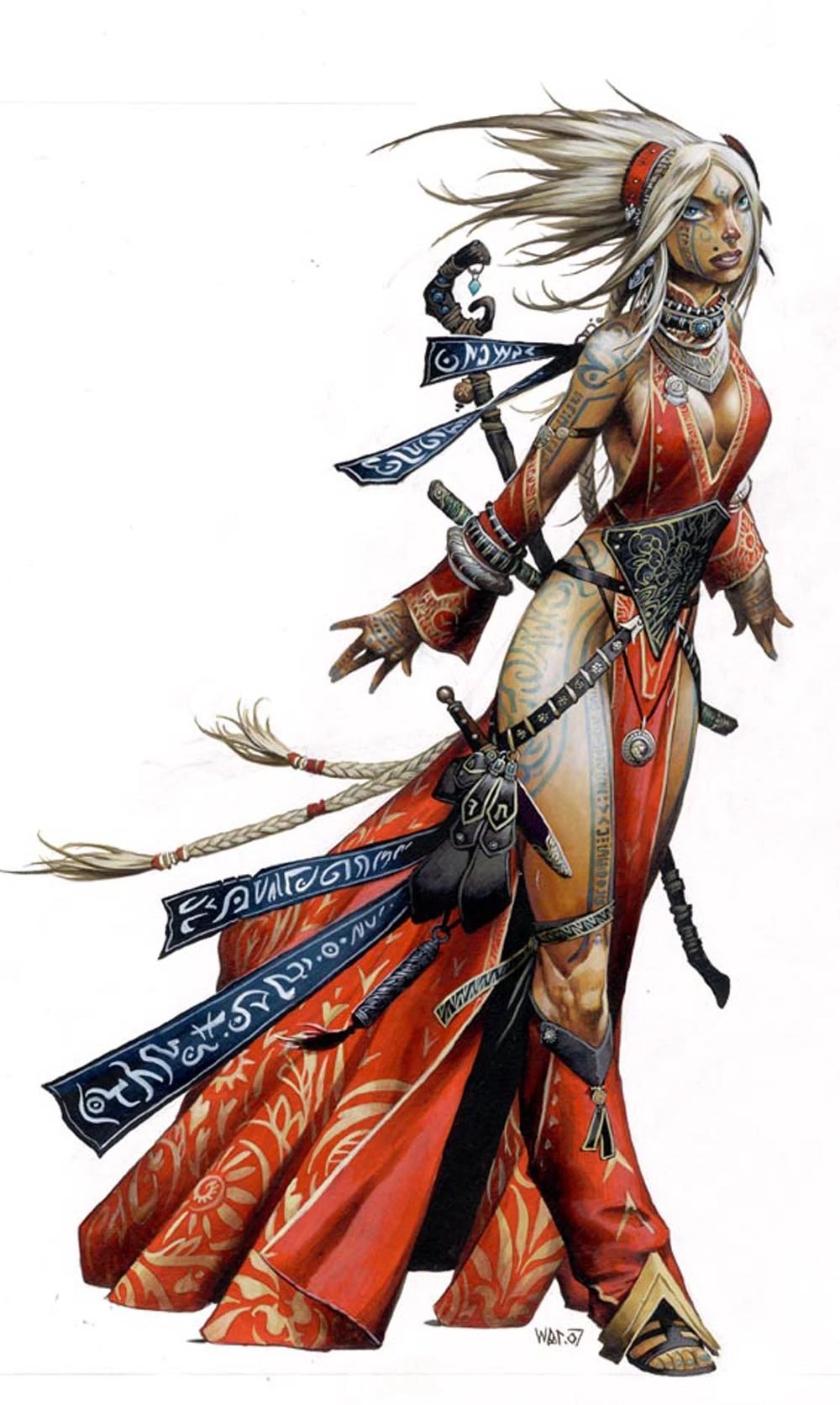
Sorcerer Seoni, one of the so-called iconics or iconic characters for Pathfinder, essentially the spinoff game from Dungeons & Dragons 3.5 edition, as she appears in her profile art from the Player’s Handbook – bringing the bling and booty to the schools of magic. I’m assuming she has to wear that for her magic to work.


8 D & D SCHOOLS OF MAGIC FOR BLING & BOOTY


No – we’re not talking about Hogwarts. We’re talking about the ‘schools’ of arcane power, classifying functional magic in fantasy by its type or effect. Now there’s probably as many such schools of magic as there are works of fantasy – black magic, blood magic, white magic, wild magic and so on – but perhaps the most comprehensive are the eight schools of magic in Dungeons & Dragons, at least in its peak 3.5 edition, which is not surprising for something that attempts to systematically codify the genre of fantasy for obsessive-compulsive rules-lawyering geeks to play as a game.


I mean, dear God, do the rules of chance need so many sides…or is that dimensions? And, dear God, what’s in the bag? WHAT”S IN THE BAG?! (Promotional image of GWHOLE brand D & D dice for sale on Amazon)


In the game, wizards can specialize in one of the schools of magic (at the expense of others), so it is a matter of some importance to pick the more powerful or versatile schools. However, this begs the most important question – for users of magic in the game or the genre of fantasy in general – which schools of magic are best for bling and booty (in every sense of the word)? After all, if you’re going to play with forces that put you at risk of some eldritch abomination sniffing out your scent, sucking out your soul with a straw and wearing your skin like a suit, then it better come with fabulous rewards – preferably the fantasy equivalent of the Fortune 500 and the Playboy Mansion. And just remember with the last, magic is equal opportunity – the sorceress Circe in Homer’s Odyssey essentially used her magic to have her own private island equivalent of the Playboy Mansion filled with her favorite, ah, manimals.

And so we take a stroll through the eight schools of magic, looking at which are the more powerful or versatile – including the extent to which they can effectively function as other schools of magic – and more importantly, which ones are the best for bling and booty…


The temptation of St Anthony is a subject recurring surprisingly often in art and literature, with one of the most famous being this painting by Salvador Dali in 1946 – not only my favorite painting on the subject (and one of my favorite paintings on any subject) but still my favorite representation of abjuration, although I don’t know how well it’s working for St Anthony here against Dali’s forces of temptation


(1) ABJURATION


This school of magic seems pretty straightforward – it…ah, abjures? Essentially, it is protective magic, and as such perhaps one of the oldest schools of magical thinking in actual history, going by the fancy name of apotropaic magic with our ancestors looking to it to protect themselves from various dire threats – and the most substantial one surviving into the present day, in all our various charms or rituals for luck. (And remember religion is just organized magic – and prayer plea-bargaining with the universe to break the rules in your favor. Yeah, I went there.)

Firstly, it protects from mundane threats – protection spells against arrows, fire and so on. In the Boxer Rebellion of 1899-1901 in China, the Boxers (or the much cooler sounding Society of Righteous and Harmonious Fists) believed their magic or supernatural power would make them invulnerable to bullets. (Spoiler alert – it didn’t).

Secondly, and perhaps more importantly, it protects from magic threats – although our ancestors often didn’t distinguish between mundane and magical threats, seeing one originate in the other – such as the various anti-magic spells in the Dungeons & Dragons game. Although frankly I think the spells in the game don’t go far enough, as they really should make magical creatures such as dragons or giants collapse of their own biological impossibility – a true anti-sorcerer should roam a fantasy world sucking in all and sundry like a magical black hole.

Now in the rules of the game, you can of course skip this school in preference for others, but in a world of monsters and magic you’d be better off walking around naked. (Frankly, if I lived in such a world, I’d have abjuration spells tattooed into my skin – or even if they worked in this world). A supreme abjurer could stroll through a pitched battle without a scratch – or sit sipping cocktails in Hell while all the demons drooled uselessly around him or her.

Of course, in a sense all magic is abjuration – abjuring or suspending the laws of time and space, which actually sounds like an interesting premise for magic in a fantasy story, casting spells by picking which laws to suspend, like gravity or thermodynamics…


BLING & BOOTY POTENTIAL


As essential as it is, the school of abjuration is not so much fantasy Fortune 500 material (unless you’re very good or lucky) as it is more the solid high-earning fantasy professional option – the sort where fantasy parents want their children to grow up to be abjurers like we do doctors, lawyers and engineers (although there’d probably also be abundance of crappy cut-rate abjurers just getting by flogging bug-ridden or pirated lucky charms). The primary market would be as security or defence contractors (although throw in some divination and you could double up as a security and insurance provider). As for booty, you’ll just have to rely on the nice suits you wear and good money you’ll make as a professional abjurer. Personally, I’d take the easy anti-sorcerer option of roaming the fantasy world, ransoming dragons of their hoards by threatening them with their own biological impossibility. (The Hobbit would have been over much quicker – just strolling up to the Lonely Mountain and going all Scrooge McDuck swimming in Smaug’s vault).


The archetypal conjuration of the hat trick – Zan Zig performing with rabbits and roses, magician poster 1899, Wikipedia “Hat trick (magic trick)” under licence https://creativecommons.org/licenses/by/2.0/deed.en


(2) CONJURATION


Now we’re playing with power – conjuration is such a ridiculously overpowered school of magic in the game of Dungeons and Dragons that you’d be better off cutting off your own hands than skipping it (as you could always conjure new or better hands anyway). It’s not hard to see why – conjuration is like pulling a rabbit out of a hat for real (or putting it back for that matter), if by rabbit you mean potentially any material thing or any being to do your bidding, and if by hat you mean potentially anywhere in space and time. And in fantasy, space and time can mean any fantasy ‘plane’ of existence – all the heavens or hells, spirit worlds, classical elemental planes (earth, air, fire, water) and so on.

Conjuration is one of the archetypal schools of magic in literature. Faust conjured Mephistopheles from hell and Aladdin conjured the genie from the lamp – those beings in turn pretty much conjured up their masters’ every desire or wish. Conjuration would be ridiculously powerful enough even just in our own space and time – imagine wizards plucking dinosaurs out of the past and throwing them at each other (which actually sounds like another interesting premise for magic in fantasy). Throw in other fantasy planes of existence and the multiverse is your oyster – a supreme conjurer could simply conjure up all the demons of hell to serve him or her cocktails…

Of course, ultimately all magic is a form of conjuration, in that you’re pulling something out of your own, or the universe’s, ass.


BLING & BOOTY POTENTIAL


Not surprisingly, this school of magic is a licence to literally print money – in that you can actually conjure money, or something to get it for you. Take gold for example – you could conjure it up from the earth’s crust or anywhere in the universe, the vaults of heaven or hell, the elemental plane of earth or for those familiar with the actual periodic table of elements, the elemental plane of gold. Or you could conjure up beings – earth elementals for example – to find and mine it for you.

Naturally the rules of Dungeons and Dragons try to place limits on their school of conjuration to avoid these shenanigans so, you know, players actually have to go into the eponymous dungeons to loot the eponymous dragons for gold (you know, like burglars and robbers) instead of conjuring it themselves (or something to go into the dungeons for them – or just conjure water to flood the dungeons and then stroll through them at leisure).

However, this is magic after all and the only real limit is your imagination – that and the massive inflation that would result from everyone conjuring their own money. Probably the major problem is that conjuring is kind of a cosmic borrowing, so that when the demons or otherworldly beings come knocking at your door to collect the debt, they’ll make your average knee-capping loan-shark goon look like a birthday strippergram. (Note to self – organize strippergram for birthday).

As for your own Playboy Mansion, you could literally conjure up your own mansion (or something to build it for you) – and then conjure up whatever angels or heavenly nymphs, succubi or incubi and otherworldly babes and hunks your heart desired. Of course, after a certain point, you could just rely on whatever fabulous wealth you’ve already conjured, as actual money has a power of conjuration all of its own…


“Lucky 8 Ball didn’t see that one coming!” – public domain image of Magic 8 Ball


(3) DIVINATION


And so we go from the flashy heights of conjuration to the subtle nuances of divination – this school of magic is essentially all about knowledge. As such, it rivals abjuration as one of the oldest schools of magic in actual history, as our ancestors sought magical means of knowing the unknown, from shamanic vision quests, through augurs and soothsayers, to hopelessly cryptic oracles. And like abjuration, it is the most substantial surviving into the present day, in the form of astrology, psychics and other frauds. (It’s my secret dream to walk in on a psychic, smack them in the head and say “Didn’t see that one coming!” – but I digress…)

There have been (and remains) an almost infinite variety of bewildering and surreal techniques of divination, including animal entrails, bird flights, tea leaves and basically any word ending in mancy – from dreamy oneiromancy (reading dreams or Freudian psychology) to the stuff of nightmares like arachnomancy (reading spiders – or dear God get that thing off me!).

Knowledge is power and divination is the ultimate source of magical knowledge – so much so that it is the one school of magic you can’t skip in Dungeons and Dragons, although you’d be better off blind than go without it anyway. (Indeed – there’s a long tradition of prophets and seers being blind or blindfolded for their ‘second sight’. And Odin, chief of the Nordic gods, plucked out one of his own eyes to drink from the fountain of wisdom, because the Nordic gods were hardcore – my money would be on them in an all-out smack-down brawl between pantheons).

Just knowing the past would be useful, knowing the present (particularly reading people’s minds) even more so and knowing the future would be approaching godlike power, as omniscience is next to omnipotence. A supreme diviner could walk through a pitched battle dodging everything without a scratch because he or she’s seen it all coming – or sit sipping cocktails served by demons in hell because he or she knows all their secret names and s€x tapes.


Clearly James Bond relies on divination for his uncanny luck in games of chance and villainous death traps

Clearly James Bond relies on divination for his uncanny luck in games of chance and villainous death traps (image of Daniel Craig as James Bond)


BLING & BOOTY POTENTIAL


Divination rivals conjuration as the jackpot of magic schools, unless your school of conjuration includes time travel. Again, even just knowing the past would be lucrative (not least in all the missing or lost secrets and treasures of the world), knowing the present even more so (not least as the ultimate insider trading) but knowing the future would be your licence to make money.

Even discounting such easy options as casinos, gambling and lotteries (which presumably would be abjured to the hilt in a fantasy world), there’d be the fabulous wealth to be made through markets and other business or political fields. Through divination, you would always be in the right place at the right time and cashing in your compound interest in the present. Basically, divination lets you steal from the future, not only having your cake and eating it but doing both before it’s even baked – like plucking Microsoft from the future mind of Bill Gates, just in time to sue him for copyright as the icing on the cake.

As for booty, apart from your fabulous wealth, you would also always be in the right place at the right time – with the perfect pickup line. Otherwise, you can always hang out with the freaky drugged and fantastically gymnastic oracle groupies from 300.


Preview images of two of the hypnotizers on the Hypnotizer app by SergioGF sold on Amazon – and fortuitously depicting two frequent images for hypnotism in popular culture (with the one on the left particularly being used for hypnotic or hypnotized eyes)


(4) ENCHANTMENT


There’s no nice way of saying this – enchantment is the school of magic for mindscrewing. It ranges from more benign charms for friendship or infatuation, through various forms of mind control or domination, to metaphorically riding your subjects like rodeo bulls or attaching the fuzzy dice of their testicles (or ovaries) to the rear view mirror of your mind…


Like so – in this photograph of fuzzy dice doing just that in a 1958 Ambassador photographed by CZmarlin – Wikipedia “Fuzzy Dice” under licence https://creativecommons.org/licenses/by-sa/4.0/deed.en


If your school of enchantment extends to memory, then you can up the ante from brainwashing to complete mindwiping, as you replace the previous inconvenient persona or psyche of your subject wholesale with one entirely of your own choosing – family, friend or lover who’ll do anything for you. In theory, this makes enchantment potentially the most powerful school of magic of all, as you could tell the very gods they should let you run the show.  A supreme enchanter could sit sipping cocktails in Hell served up by all the brainwashed demons.

In practice, apart from all the protective abjurations against it (screw you, mind blank!), there is the narrative need for enchantment to be severely nerfed for the sake of game or story, otherwise you’d simply mindscrew your way from one end of fantasy to the other or pilot your dragon like a drone through any dungeon. So this tends to be one of the weaker schools of magic you can skip in Dungeons and Dragons or any other fantasy, because anything powerful enough to be game or story breaking is immune or resistant to it. Otherwise, Gandalf would have just told Sauron to go jump like Gollum.

In a sense, the only real ‘magic’ is enchantment, as humanity finds a bewildering number of ways to enchant itself through religion, politics, money, fame, celebrity, love, sex…just take any cult.


BLING & BOOTY POTENTIAL


Obviously, if enchantment is opened up to its full potential in fantasy – or let loose in our world with no resistance against it – then this would be the ultimate jackpot. Even if others conjured more money and divined more profit or power, you’d simply enchant them into giving it to you – just like you’d simply enchant Bill Gates, Warren Buffet and Elon Musk into doing the same in this world. H. L. Mencken quipped that no one went broke or lost an election by underestimating the taste or intelligence of the average person – with enchantment, you’d just go that step further of making their taste and intelligence for them.

As for your own Playboy Mansion, you could let your enchanted fame and fortune work their own powers of enchantment, as indeed they did to fill the actual Playboy Mansion. With enchantment, however, you don’t have to wait. You could equally be able to just enchant it full of the subjects of your choice. Of course, while you’re doing all this, you may want to enchant away your own conscience as you enchant away other people’s minds.


One of the most famous D & D gaming memes and the motto of the evocation school – Glasstaff I Cast Fireball D & D sticker promotional profile image for sale on Amazon


(5) EVOCATION


And so we come to the Michael Bay school of magic – all explosive action, but lacking in depth or versatility. Evocation is the conjuration of energy – fireballs, lightning bolts, cold blasts and various other manifestations of energy or force – so something like the misnamed enchanter Tim firing off random blasts from his staff in Monty Python’s Holy Grail.

While it would be tempting in a fantasy world of hostile monsters and magic to be able to blast fireballs from your fingertips like six-shooters, evocation is actually one of the weaker schools of magic and the first one to skip in the game of Dungeons and Dragons. Even at its full strength, it obviously lacks versatility for anything else that doesn’t involve blasting or blowing things up (although in fairness that would seem to solve most plot problems in The Lord of the Rings) – and in the game of Dungeons and Dragons, it’s severely nerfed by all types of magic resistance so that your hardcore spells fizzle into a tickle or at most a moderate spanking. In theory, however, a supreme evoker should be a walking weapon of mass destruction and could sit sipping cocktails in Hell served up by spell-shocked demons after nuking or freezing it.

Of course, evocation is just the poor man’s conjuration anyway – it’s just conjuration of energy, people! Ignoring that matter is energy (E = mc2? I conjure thee from the elemental plane of uranium…), is there any real distinction between evoking fire for example and conjuring lava or molten metal or plasma or hellfire or elemental fire or so on from the myriad planes of fantasy? The only real distinction is that the game of Dungeons and Dragons split off the conjuration of energy as evocation so that the school of conjuration didn’t become even more ridiculously overpowered…


BLING & BOOTY POTENTIAL


Like abjuration (and unlike conjuration, divination or enchantment), you can’t simply evoke money and are sadly reduced to working with your magic, which kind of defeats the point of magic as wishful thinking or getting something from nothing. Fortunately, again like abjuration, evocation is the solid high-earning fantasy professional option, like the fantasy equivalent of engineers. Although that may be because I only have the vaguest idea of what engineers actually do…


Um, they do science to stuff? Public domain engineering logo


Actually, evokers are even better placed than abjurers to strike it rich as the entrepreneurs of energy in the fantasy world, particularly if they can replicate their magic in mass produced devices or items – it would be evokers who kick-start the fantasy equivalent of the Industrial Revolution, like magitek or dungeon punk. You know, like mass producing rings of power in The Lord of the Rings (“Precious?! Get over it, Gollum – they’re $39.99 a set at the Shire 7-11…”), instead of the elves hoarding all the magic.


One ring to rule the mall!

One ring to rule the mall! (Image of the One Ring in The Lord


Don’t get me started on the elves – they showed Sauron how to make the ring in the first place, then spend their time prancing about in forests or p!ssing off ‘west’ leaving men to clean up the mess. “I have no faith in men.” Shut up, Elrond – who’s manning your frontline for you, you smug elven pr!ck?.  But I digress.

As for booty, you will just have to rely on your skyrockets in flight for your afternoon delights…


Fraser spiral illusion (public domain image in Wikipedia article of that name)


(6) ILLUSION


Use your illusion – the school of magic for special effects or fantasy generated imagery. Quite simply, illusion is all about the magical control or manipulation of perception or sensation, so as to hopelessly blur the line between image and reality. And that’s just for starters – with illusion, you can effectively trap your subjects in their own head, like a drug trip or the Matrix or scientists juicing up rats through the pleasure centers of their brains.

In other words, illusion can be virtually as effective for mind control as enchantment, given the fine line between our perceptions or sensations and our emotions, thoughts or memories. You can use it to assume the appearance of a close friend, family member or lover. The supreme illusionist could sit sipping cocktails in Hell, served up by deluded demons thinking they’re serving their infernal master – or just look like they’re doing it.

Sadly, this is why illusion tends to be nerfed like enchantment in fantasy games or stories, although it is somewhat less game or story-breaking and has more potential for plot devices (as well as clichéd it-was-all-a-dream sequences). So once again, there is an abundance of protective abjuration against it (screw you, true seeing!) and anything powerful tends to be immune or resistant to it. And given that illusion is all style over substance, you’re more screwed than the Wizard of Oz if they start looking behind the curtain.

Of course, all magic in our world is ultimately only illusion – sleight of hand or smoke and mirrors. Or if we’re going to get philosophical, all our perception of reality is illusion, as in the Hindu concept of maya. (Sometimes I think my whole life has been an illusion but then I’m pretty sure my life is real because no one would make an illusion this pointless and boring.) On the other hand, the fantasy school of illusion is really just enchantment – or vice versa. Is there any real distinction between controlling perceptions or sensations and controlling emotions or thoughts, given how they each influence the other? For example, is there any real difference between turning invisible by illusion – or enchanting people that they don’t see you?


BLING & BOOTY POTENTIAL


If illusion is opened up to its full potential or let loose in our world with nothing to resist it, then you could effectively use it to enchant your way to fame and fortune – especially in a world where life is essentially a beauty contest anyway. At very least, you could have a wild ride as a con artist – using ticket stubs or toilet paper as money or winning lottery tickets. Alternatively, you could use your illusion as a solid high-earning fantasy profession or business, particularly if you could mass-produce it – the fantasy equivalent of advertising (“Your ad on every dragon’s ass”), cosmetics and cosmetic surgery, entertainment or anything involving appearance or imagery. Personally, I’d use my illusion for the fantasy equivalent of internet p0rn. (“She was an innocent young paladin, pursuing her quest in the Hot Tub of Doom…”). As for your Playboy Mansion, you are the ultimate photoshopper, so you can give yourself or your housemates any appearance you or they choose…


A lich – arguably the peak of necromancy – as represented in the profile image for lich from the D&D Beyond online resource


(7) NECROMANCY


Come to the dark side of the Force or the Slytherin school of magic. Technically, necromancy is divination by talking to the dead or their spirits (hence the name). However, necromancy has accrued wider meanings of dealing with the dead or death – typically animating the dead and creating or controlling undead. Funnily enough, in the game of Dungeons & Dragons, it is generally observed that because of the mechanics of play, clerics or priests make better necromancers than wizards, which would certainly make for far more interesting church services.

Necromancy also tends to involve magic to do with souls or spirits (as in taking or trapping them) and ‘negative’ energy – blight, curse, fear, hex, paralysis, poison and just outright draining life energy like siphoning gas. So it may not be particularly versatile but it does tend to be powerful, and of course, evil – as in EEEVIL (although arguably it could be neutral, like death itself, or even a weird form of good – but where’s the fun in that?). Sauron wasn’t just the Necromancer in The Hobbit for kicks.

A supreme necromancer is a walking ground zero of zombie apocalypse or god of death – and could sit sipping cocktails in hell because the demons think he or she is cool. And old necromancers don’t retire, they become undead themselves – vampires are the popular choice, although the true necromancy geek goes lich.


BLING & BOOTY POTENTIAL


Let’s face it – if you go with necromancy, you’re looking at a career in fantasy supervillainy or at least doctorate of fantasy evil, and chances are you’re in it for love of evil lulz rather than money. So while there may be other more imaginative ways of making money from necromancy, the most easy or obvious is as the fantasy equivalent of Blofeld in SPECTRE (bonus points if that involves actual spectres), stroking your mummified cat. And again, there may be more subtle nuances of necromantic villainy, you just can’t beat the fantasy classic of threatening to unleash your zombie apocalypse unless the kingdom pays you one million gold pieces – or you know, actually unleashing your zombie apocalypse as you carve out your unholy roaming empire.

Sadly however, necromancy is not the school for building your own Playboy Mansion, with the exception of the s€xier ghosts or vampires – although at least your undead minions will always be, ah, thin?


King Harold in his classic transformation scene back into a frog in the Shrek 2 film – itself obviously an adaptation of the classic (cursed) fairy tale transmutation of The Frog Prince. Now that I think of it, I never realized how much the plot of both films revolved around transmutation


(8) TRANSMUTATION


Finally, there is transmutation – a ridiculously overpowered school of magic to rival or even exceed conjuration. Instead of conjuring material things or beings (potentially including yourself) through space, time or fantasy planes, this school of magic transforms (or transmogrifies – whoa!) material things or beings (potentially including yourself) into other material things and beings of your choice.

Like conjuration, it is one of the archetypal schools of magic in literature. Zeus showcased it by turning himself into animals to pick up chicks. It totally worked too, although you have to admit it would be pretty impressive if you could pull it off. Zeus’ one night stands read like a menagerie of seduction (as well as the entire genealogy of Greece) – bull, eagle, goat, snake, swan and on one particularly kinky occasion a shower of gold.

Speaking of which, transmutation has had a long-standing reputation in actual human history, as the humanity saw the best minds of many generations destroyed by the madness of alchemy, or trying to transmute lead into gold.


Because Leadfinger just doesn't have the same ring

Because Leadfinger just doesn’t have the same ring to it (iconic scene of Jill Masterson killed by gold paint in the 1964 James Bond film Goldfinger)


So transmutation is almost limitlessly powerful and versatile – a supreme transmuter could sit sipping cocktails in Hell, because otherwise he or she will transform all the demons into frogs or little lambs or Playboy bunnies (or himself or herself into the biggest, baddest demon of all). Or just sit around anywhere – turning everyone else into demon cocktail waiters and waitresses.


BLING & BOOTY POTENTIAL


By now, it should be obvious that transmutation is as much a fantasy jackpot as conjuration – or more so, as it’s without the cosmic borrowing (or loan-sharking). Like King Midas, you can turn whatever you touch (or look at) into gold – or whatever you choose. Or for that matter, it knocks illusion out of the ballpark, because you can change things in reality not just appearance. What more do I need to say? Again, naturally the rules of Dungeons and Dragons try to place limits on their school of transmutation for the sake of the game, but it is magic after all.

As for your own Playboy Mansion, you could literally just transform any slum into your mansion – and anyone or anything into your Playmates. Your Playboy bunnies could have been actual bunnies just a moment ago. Indeed, people would probably line up to pay you for it and you could make your fortune from cosmetic transformation alone…


Top Tens – Poetry & Literature: Top 10 Poetry (Special Mention) (10) Robert Frost

There are photographs of Frost when younger but they just seem right – Robert Frost in 1949, photograph by Walter Albertin, World Telegram staff photographer, Library of Congress, New York World – Telegram & Sun Collection (public domain image)


(10) ROBERT FROST (1874-1963)


“Two roads diverged in a wood, and I,

I took the one less traveled by,

And that has made all the difference.”


When I wrote of Walt Whitman, Robert Frost was that one possible exception I proposed for Whitman as the American poet – the Great American Poet, or at least the Great New England poet in Frost’s case.

Robert Frost “was one of the most iconic and influential American poets of the 20th century. He is best known for “The Road Not Taken” and “Stopping by Woods on a Snowy Evening”, both of which are commonly taught to US students beginning in elementary school.”

There were two Robert Frosts – the folksy Frost that most people think of from school, “the genial homespun New England rustic”, and the folk horror Frost, who pops up from his poetry like a jump scare, “depicting with chilling starkness the loneliness of an individual in an indifferent universe” (or outright hostile one).

The latter is the dark Frost, the apocalyptic Frost of fire and ice.


The Frost of the poem House Fear from the short series of poems collated as The Hill Wife.

“Always—I tell you this they learned—

Always at night when they returned

To the lonely house from far away

To lamps unlighted and fire gone gray,

They learned to rattle the lock and key

To give whatever might chance to be

Warning and time to be off in flight”


Or the Frost of the poem Bereft:

“Where had I heard this wind before

Change like this to a deeper roar?…

Leaves got up in a coil and hissed,

Blindly struck at my knee and missed.

Something sinister in the tone

Told me my secret must be known:

Word I was in the house alone

Somehow must have gotten abroad,

Word I was in my life alone,

Word I had no one left but God.”


Folk horror Frost may be my tongue in cheek description of the dark(er) Frost – but not by much. I always remember being taught that the central metaphor for Frost was the title of his final collection of poem, In the Clearing – in which “Frost portrays human security as a rather tiny and quite vulnerable opening in a thickly grown forest, a pinpoint of light against which the encroaching trees cast their very real threat of darkness”.

I also always remember being taught that the central characteristic of Frost – the same characteristic that underlays (and arguably resolves) the apparent duality of the folksy Frost and the folk horror Frost – is his ambiguity which undercuts what otherwise appears to be country proverbs with profound doubt.

As for example, my opening quote from his most famous poem where the road less traveled “has made all the difference”…which may be no difference at all.

Or my quote from Bereft. To the devout Puritans who settled his beloved New England, being all alone but for God would be a source of strength or the ultimate reassurance – the God who carries you like in that Christian “Footsteps” poem. But to someone in the twentieth century filled with doubt, being alone but for God may be very alone indeed.

As for which Frost poem I would choose for this special mention, there are so many from which to choose but I’d just have to come back to his Hill Wife poems, particularly the forlorn Impulse with its rural marriage falling apart:


“Sudden and swift and light as that

The ties gave,

And he learned of finalities

Besides the grave.”


RATING:

A-TIER (TOP TIER)

Top Tens – Nymphomancy (Mythology): Top 10 (Special Mention)

She looks flexible – 12th century sandstone statue of apsara – essentially equivalent to a nymph in Hindu mythology – from Madhya Pradesh, India, collected in the Metropolitan Museum of Art, New York (public domain image)


The gods must be horny – again!

Yes – I’ve compiled my top ten nymphomancy list for the subject of mythology, but mythology is such a rich source of actual or potential adult content that there’s enough for my usual twenty special mentions I like to have for my top tens.

You know the drill – my nymphomancy lists being like the kinky or kinkier entry I throw in my top ten list special mentions, but for every entry or the entire list, across the board of subject categories as my top ten lists in general. They measure the, shall we say, adult content of cultural or literary subjects, either actual or potential. That is, the extent to which they contain or could be adapted to the content of adult films. You know the ones – the ones with at least one X in the rating and usually two or three.

And you the know rankings – l rank entries by their richness as sources for actual or potential adult content in three tiers – from lowest to highest as X-tier or risqué tier, XX-tier or softcore tier, and XXX-tier or hardcore tier.

Essentially, all my XXX-tier or hardcore tier entries were in my top ten, so these special mentions will be in one of the next two tiers.

The middle nymphomancy tier – XX-tier or softcore tier, equivalent to A-tier or top tier – is for those sources not quite as rich as the highest tier. The adult content itself may be as hardcore as the highest tier – there’s just less of it, although you might still get enough scenes for a film or two.

The lowest nymphomancy tier – X-tier or risque tier, equivalent to B-tier or high tier – is for those sources that extend to or suggest enough adult content for a scene or two but not much more without stretching it.


XX-TIER (SOFTCORE TIER)


Zatanna #3 with cover art by J. Scott Campbell published in May 2025 – cropped for fair use (with the full exclusive art available for sale at his online store) to showcase Zatanna embodying the nymphomancy of magic or at least the archetypal stage magician’s assistant costume, down to the fishnets and attention to detail of those standard tropes of stage magic such as pulling a rabbit out of a hat and card tricks


(1) MAGIC


Abracadabra bow chicka wow wow!

You should have seen this coming (heh) – there’s a whole category of magic known as s€x magic (sometimes styled as s€x magick), with its own Wikipedia entry.

Beyond that to magic in general, this is essentially the trope of power perversion potential in TV Tropes – where supernatural or superhuman powers “gets used for something s€xual”, applied to the near infinite permutations or varieties of magic. .

Think Hogwarts but what would actually happen if adolescents were let loose with magic – which by the way is one of my perceived plotholes of the Harry Potter franchise, not that I’d want to see that particular hole filled. Hey – phrasing!

Speaking of schools of magic, that prompts me to the eight schools of magic popularized by Dungeons and Dragons – abjuration, conjuration, divination, enchantment, evocation, illusion, necromancy and transmutation. All of which have their power perversion potential for bling and booty, or the magical equivalent to the Playboy Mansion suiting your preferences or tastes.

“Mind control, psychic powers (synchronization in particular), invisibility, intangibility, sprouting tentacles, X-ray vision, and the ability to stop (or otherwise manipulate) time are especially vulnerable to this…a few core spells can be dirverted from their normal usage to become the nudifier”.

For that matter, even stage magic – with that magician’s assistance costume modelled by Zatanna in my feature image, down to those fishnet stockings. Pulling a rabbit out of a hat never sounded more like double entrendre. Nothing up my sleeve – hey, presto!


RATING:

XX-TIER (SOFTCORE TIER)


Think hot fairy thoughts? Tinker Bell strutting her stuff – her already hot Disney design made even hotter here in cropped art from J. Scott Campbell for his Fairytale Fantasies calendar. So hot they made a statue out of it!


(2) FAIRIES


It’s uncanny how much fairy folklore seems to focus on how horny fairies are for humans.

It’s like the trope Mars Needs Women in TV Tropes, named for the 1967 B-movie of that title – except of course in this case Fairyland needs women, or just humans in general. Fairyland seems strangely dependent on constant infusions of human blood or other bodily fluids, abducting or luring humans to be their playthings, most famously swapping human children for changelings.

Fairies even tend to appear or be depicted as inhumanly beautiful, particularly inhumanly beautiful woman to lure men to their fate, albeit often with some hidden flaw that gives away their fairy nature.

Even diminutive modern fairies tend to be depicted as attractive, although obviously some sort of magical shapeshifting in size would be required for nymphomancy. Think Tinker Bell as influenced by the Disney depiction – essentially a blond centerfold as a pixie.

There’s also the figure of the Fairy Queen.

I’m including the Wild Hunt in this one – its very name lends itself to the obvious pun for adult film titles but also its theme of roaming at night, orgiastically snatching up anyone in its path to join it.


RATING:

XX-TIER (SOFTCORE TIER)


Those hot Transylvanian nights – the Brides of Dracula from the 2004 Van Helsing film


(3) VAMPIRES


Few supernatural beings embody nymphomancy as much as vampires – so much so that there’s a trope for it in TV Tropes, Vampires are Sex Gods.

Although vampires themselves being s€xy seems more a trope for adaptations of vampires in popular culture than of folklore or mythology in which vampires were a dark inversion of s€x rather than s€xy.

Vampires representing s€xual themes goes back a long way but more in the sense of vampirism representing s€xuality or s€xual predation (or disease) rather than vampires being s€xy as such, particularly given that vampires are essentially reanimated corpses, which begs a number of questions about having s€x with them, not least how they can even replicate the biology of s€x. Of course, that last may be magical or telepathic in nature.

Ironically, the s€xy side of vampire folklore and mythology can be argued to have been more that of the other side, that is the side of vampire hunters or slayers, given how often virgin girls seem to pop up. It’s like that scene with the naked virgin girl on horseback in the Nosferatu film by Robert Eggers – played by Czech model Katerina Bila and credited simply as virgin on horseback – prompting me to stand up and shout at the screen to see more of her in the film or even a spinoff about her as naked virgin vampire hunter. And after they bounced me out of the cinema, I still stand by that.

Even Bram Stoker’s Dracula – the original novel – featured its titular count more as s€x than s€xy, although his Brides certainly lived up to the latter, including Lucy Westenra and Mina Harker as de facto Brides. Or, ah, undeaded up to the latter? Anyway, it was Dracula’s cinematic adaptations that saw him s€xed up as the suave count of popular culture – with all the vampire love gods that followed in his wake.


RATING:

XX-TIER (SOFTCORE TIER)


Disney’s Little Mermaid Ariel in her iconic scene – I never realized how much it looked like, well, something out of nymphomancy until I saw this shot


(4) LEGENDARY CREATURES


Yeah, we’re talking demi-humans or sufficiently humanoid legendary creatures here, except if there’s some sort of humanoid shapeshifting, magical mind s€x or something similar involved.

Even so, there’s a surprising range of such creatures, particularly if you’re (magically) inventive enough – so much so that there’s enough to rank legendary creatures in my softcore nymphomancy tier.

Indeed, they might well have ranked in my hardcore nymphomancy tier but for effectively being included in other entries. Biblical mythology has its angels and demons horny for humans – arguably the origin of the nephilim most famously mentioned in Genesis. Classical mythology has its satyrs and sirens, equally horny for humans (or in the case of satyrs, everything but especially nymphs) – at least from the waist up. Satyrs of course lending themselves to the term satyriasis as the male equivalent of nymphomania – and inspiration to Bill Hicks’ Goat Boy.

Mermaids (and mermen) are famously s€xed up in legend or folklore, although again that’s from the waist up (and are often merged with sirens in any event) or the still more humanoid versions.

Think Jim Balent’s Tarot Witch of the Black Rose, in which every legendary creature or supernatural being is a busty centerfold, albeit sometimes more jarring than alluring. Or dare I say it, think the Xanth fantasy series by Piers Anthony, who manages to put his characteristically kinky spin on virtually every female legendary creature.

By way of potential nymphomancy roll call…

The aforementioned angels and demons, including my favorite – devil girls and succubi. Anything sufficiently anthropomorphic – heck, Fritz Leiber wrote a story with a hot female anthropomorphic personification…of the number seven. Elves and fairies. Gargoyles and golems? Genies. Gorgeous gorgons. Horned or winged humanoids. The aforementioned mermaids – and sirens. Nymphs – and satyrs, at least from the waist up. Vampires. And quite a few more if you push their characteristics or depictions enough in the direction of nymphomancy.


RATING:

XX-TIER (SOFTCORE TIER)


Well they may have but I haven’t! One of my favorite gags from The Simpsons, featuring two of my favorite gag characters – Kodos and Kang, the recurring aliens of the Treehouse of Horror Halloween specials. I voted for Kodos!


(5) UFOS & UFOLOGY


The Mars Needs Women trope played straight – as I said for fairies in fairy folklore, it’s uncanny how much aliens in UFO folklore are horny for humans, what with all the probing.

As I’m fond of quipping, it’s hard to imagine that aliens are so advanced as to cross light years of space or different dimensions just to give some hick an enema. I mean, I would, but I’m not particularly advanced and that’s just my sense of humor.

Indeed, UFO or alien folklore is essentially fairy folklore with the fairies swapped out for aliens and magic for technology. “In both cases, you have creatures who are ineffable and don’t understand humanity, who randomly abduct humans, play with them, and return them with time loss and occasionally strange powers / afflictions”. Although on the whole aliens seem hornier for humans than fairies, what with the aforementioned probing.

Funnily enough, horny aliens have been routinely adapted to science fiction – hence the Mars Needs Women trope and titular film – except also with s€xy aliens, not least the green-skinned alien space babes so popular in SF. I’m still haunted by James Tiptree Jr’s short story featuring aliens so inhumanly beautiful or alluring to humans that it turned those humans who observed them into obsessive deranged space groupies.


RATING:

XX-TIER (SOFTCORE TIER)


X-TIER (RISQUE TIER)


Advertised image for female shaman figure (of Mesoamerican appearance) by First Legion, a company that produces historical figurines and models


(6) SHAMANISM


“But then the awesome mysterious world will open its mouth for you, as it will open for every one of us, and then you will realise that your sure ways were not sure at all”.

Well, if you put it like that, I can think of some adult content suggested by the world opening its mouth for you, even if I know that quotation is meant to convey something entirely different. It’s just how my mind works.

And so too with shamanism in general, although it lacks the same depth of nymphomancy as paganism. Just think shamans – or rather shamanesses – in the style of jungle girls and cavewomen from comics. Or Racquel Welsh in her iconic fur bikini from the film 1 Million Years BC.

Or prehistoric cave art for that matter – of which there’s an awful lot where human figures, obviously male, let it all hang out or stick out. The so-called Sorcerer at the Cave of the Trois-Frères is a famous example of the former.


RATING:

X-TIER (RISQUE TIER)

*

I like how one of them has installed a swing – why not a pole while they’re at it? Mara’s Daughters Tempt the Bodhisatta as depicted in Wat Olek Madu, Kedah and photographed by Photo Dharma from Sadao, Thailand – Wikimedia Commons under licence https://creativecommons.org/licenses/by/2.0/deed.en.


(7) ZEN


Wait – what? You’re saying zen has adult content?!


Well, yes – just what did you think was the sound of one hand clapping? Or why my horns won’t fit through the door? In part, that’s again just how my mind works, reworking zen koans into dirty jokes. Also in part it’s because I consider zen not just in terms of Zen Buddhism but also Taoism and similar East Asian traditions of mysticism – hence adapting their visual elements or symbolism to adult content.


And if nothing else, there’s the Buddha’s original temptation under the Bo tree, which included the dance of desire personified by the daughter or daughters of Mara.


RATING:

X-TIER (RISQUE TIER)


(8) AZTEC & VOODOO


Yes – the nymphomancy of Aztec mythology and voodoo is essentially a matter of adult content with their visual trappings.


To be honest, as distorted an adaptation of the visual trappings of Aztec mythology as it is, I just can’t get past Salma Hayek as Santanico Pandemonium in From Dusk Till Dawn – or perhaps Chel in The Road to El Dorado. And yes I know – it’s the most superficial visual trappings of what TV Tropes dubs Mayintec, an amorphous conflation of the three best known pre-Columbian American civilizations. Santanico’s club goes from “Mayincatec-inspired nightclub to vampire den to a full-blown Mayincatec sacrificial pyramid almost buried in the Mexican desert”.


Similarly for voodoo, it’s Live and Let Die, although that might have more to do with Jane Seymour as Solitaire.


RATING:

X-TIER (RISQUE TIER)


(9) DRAGONS & GIANTS


Wait, what? There’s nymphomancy for dragons and giants?

Well, yes. I mean, dragons always seem to be associated with maidens in myth or legend. Of course, obviously magic has to be involved for any dragon-human interaction of a kinky manner, at least without things getting…scaly. (And we don’t want things getting scaly).

So we’re talking shape changing, telepathic mind s€x or something similar. And while we’re getting kinky with dragons, I can’t resist playing with the variety of dragons and their breath weapons in Dungeons & Dragons – it’s in the name of the game after all. The staple of dragons is that they breathe fire – to which D & D adds dragons that breathe lightning, acid, gas, poison, ice and so on. So why dragons that breathe…aphrodisiac? Or pheromones? Where anyone who catches a whiff of it has uncontrollable urges to get in on with anyone else in the vicinity, doubly so if that anyone else also caught a whiff of it. You know, unless they make their saving throw.

And giants? Again magic obviously has to be involved, albeit where the shape changing is more size changing. Well, unless your kink is to be used as a literal s€x toy. It does invoke vague memories I have of a gag film scene where a man imagines himself as part of a team scaling a giant version of the woman of his dreams (or fantasy). You know, mountaineering her breasts. Or spelunking her…well, we’ll just leave it there.


RATING:

X-TIER (RISQUE TIER)


Okay, she can haunt me. Jim Balent’s ghostly Crypt Chick in a scene from his Tarot Witch of the Black Rose comics series, published by his independent Broadsword label


(10) GHOSTS


Putting the 0rgasm into ectoplasm!

Again, nymphomancy for ghosts would seem to be as implausible as that for dragons and giants, except perhaps even more so given the incorporeal nature of ghosts. I mean, having a physical body would seem a prerequisite for nymphomancy

But no! There’s even a term for it – spectrophilia, although apparently that term is also used for arousal by images in mirrors as well as an attraction to ghosts. Setting aside the same kind of magical or telepathic link we’ve seen in other entries, it necessarily would involve ghosts that despite their incorporeal nature can interact physically with objects in reality, the objects in this case being people. Think poltergeists – or dare I say it, p0rnogeists.

Surprisingly, Wikipedia not only has an article for spectrophilia but one that has a surprising amount of content – “accounts of paranormal encounters with ghosts and spirits frequently include sexual encounters”. The article references succubi and their male counterparts incubi – yes, they tend to be depicted as demonic beings but they are somewhat ghostly in their nocturnal encounters. Interestingly, the article traces ghostly s€xual encounters to sleep paralysis.

I have to throw in white ladies or women in white – those recurring female ghosts in folklore.


RATING:

X-TIER (RISQUE TIER)


(11) LYCANTHROPY


Yeah, no furries here – the nymphomancy of lycanthropy involves the shape changing aspect of it and only one way at that. We’re talking the Sybil Danning parts of The Howling II, not the wolf parts. To be honest, all I recall of that film is Sybil Danning taking her top off. Apparently, she stipulated that the film only had one scene where she takes her top off, so the film just kept repeating that same scene (apparently seventeen times).

I’ll throw kitsune and selkies in here as well.


RATING:

X-TIER (RISQUE TIER)


If there’s any visual element people recognize from the 1999 Stanley Kubrick film Eyes Wide Shut, it’s the people (and its protagonists) in masks at parties


(12) CONSPIRACY THEORIES


When do we get to the wild s€x party part of the conspiracy theory?

That’s essentially it for the nymphomancy of conspiracy theories. Think Eyes Wide Shut or Bohemian Grove.

On the other hand, my pet conspiracy theory is that if you dig deep enough into any conspiracy theory, you’ll eventually hit the bedrock of wild s€x parties.

Illuminati? Wild s€x parties.

JFK? Wild s€x parties with Marilyn Monroe. Or the Kennedy s€x tunnels referenced by pop culture such as Rick and Morty.

You get the idea.

Whatever the conspiracy theory, no matter how long it takes, no matter how far, I will find the wild s€x party part of it.


X-TIER (RISQUE TIER)


(13) URBAN LEGENDS


When do we get to the wild s€x party part of the urban legend?

Yes, the nymphomancy of urban legends is essentially the same as that for conspiracy theories.

Except, no – I can’t quite back that up. Urban legends don’t quite have the same ubiquitous wild s€x party bedrock as conspiracy theories – but it is interesting just how many urban legends do have or even revolve around some risqué component.


X-TIER (RISQUE TIER)


(14) TANTRA


Well, obviously.

It’s s€x magic, after all.

So why doesn’t it rank more than risqué-tier? Isn’t s€x magic the literal definition of nymphomancy?

Well, yes, but it isn’t much more than the s€x magic. That is, it lacks that defining characteristic for my nymphomancy rankings – the extent to which the subject contains or could be adapted to the content of adult films, which in turn generally depends on its visual story elements.


X-TIER (RISQUE TIER)


(15) BARBARA WALKER –

WOMEN’S ENCYCLOPEDIA OF MYTHS & SECRETS / WOMEN’S DICTIONARY OF SYMBOLS & SACRED OBJECTS


She is the goddess and this is her body.

Yes – it’s more nymphomancy of paganism, given that these books are encyclopedia or dictionary references to mythology and religion through the lens, or rather the dance, of pagan goddesses or the neopagan Goddess.

And there are prolific references to s€x or s€xuality.

When it comes to the Goddess, you’re baptised between her breasts or crucified between her thighs – o yes!


RATING:

X-TIER (RISQUE TIER)


O yes – he’ll be showing her his savage sword! Classic Conan pose (or leg cling) in The Savage Sword of Conan cover art by Earl Norem for “The Treasure of Tranicos”, issue 47, 1 December 1979, Marvel Comics (fair use)


(16) JOSEPH CAMPBELL –

THE HERO WITH A THOUSAND FACES


You: Looking for the archetypal Hero’s Journey in Star Wars and popular culture.

Me: Looking for the archetypal Hero’s Journey in adult films

We are not the same.


I’m joking and I’m serious.

Firstly, if one identifies the archetypal hero’s journey in most or even all narratives, then it stands to reason that one can identify it in the narratives of adult films, as condensed as those narratives are. Let’s just say they make short work of the call to adventure – like not having enough change for the pizza delivery. (“The story is ludicrous…you can imagine where it goes from here” “He fixes her cable?”)

Secondly, it doesn’t take too much nymphomancy to do a s€xual version of the Hero’s Journey. I mean, some steps write themselves as nymphomancy to begin with – such as the Meeting with the Goddess or Woman as the Temptress.

Thirdly, Campbell and those who follow him tend to overlook how many of heroic exploits in mythology are, well, s€xual exploits.


RATING:

X-TIER (RISQUE TIER)


(17) SIR JAMES GEORGE FRAZER – THE GOLDEN BOUGH


Who are these coming to the, ahem, sacrificial orgy?

Yes – it’s the nymphomancy of sacred kings.

Camille Paglia spoke of her mythology as a fusion of Frazer and Freud – and so is mine, or at least my nymphomancy of sacred kings.

Although really the nymphomancy of sacred kings was woven in from the outset.

Who else but a fool would be king for a day? Well you might if you could spend your brief reign in an orgiastic satiation of your desires – or hieros gamos with the Goddess (or goddesses). Women would throw themselves at you or fight each other to conceive the child of a divine king. It’s essentially the plot of Philip Jose Farmer’s Flesh. It also pops up in The Wicker Man – and it remains my profound disappointment to this day that Edward Woodward’s Sergeant Neil Howie didn’t enjoy the night with Brett Ekland’s Willow, gyrating and pounding away on the wall of the room next to him in invitation, before his day of sacrifice.

There’s also the identification of the health of the sacred king, particularly his virility with maidens, with health of the land he reigned, particularly its fertility for agriculture. Of course, the flip side of this was that once you couldn’t get it up then you were going down – ritually sacrificed and replaced by the new sacred king…


RATING:

X-TIER (RISQUE TIER)


(18) ROBERT GRAVES – THE WHITE GODDESS


And…we’re back to the nymphomancy of paganism or at least Grave’s idiosyncratic version of it – getting your wild ride in with the White Goddess before your weird comes for you.

Or essentially the nymphomancy of sacred kings from Frazer’s Golden Bough, but where Graves saw Frazer’s sacred king and raised it with the queen of his White Goddess – with jokers wild in the form of your weird, that is your rival for the love of the Goddess.


RATING:

X-TIER (RISQUE TIER)


(19) BACCHAE & GOLDEN ASS


I mean, the title alone of The Golden Ass writes its own nymphomancy.

As does the climax (heh) of The Bacchae – where the women of Thebes are driven by Dionysus to orgiastic frenzy.


RATING:

X-TIER (RISQUE TIER)


Bow chicka wow wow! Scene from the 2007 Beowulf film used as promotional image or poster art. I always love how Grendel’s shapechanging mother gave herself heels! (Fair use)


(20) BEOWULF


The nymphomancy of Beowulf has basically been done by the 2007 Beowulf film, in which Beowulf gets it on with Grendel’s hot mother


RATING:

X-TIER (RISQUE TIER)