Top Tens – Tropes & Other: Top 10 Geological Time Periods (Special Mention)

Geological time scale, proportionally represented as a log-spiral with some major events in Earth’s history by Jarred C Lloyd for Wikipedia “Geologic Time Scale” licensed under https://creativecommons.org/licenses/by/4.0/deed.en


TOP 10 GEOLOGICAL TIME PERIODS (SPECIAL MENTION)


But wait – there’s more!

I’ve counted out my Top 10 Geological Time Period but there’s clearly more than enough for special mentions with 22 periods formally defined as such, not to mention the longer 4 eons and 10 eras as well as shorter 37 epochs and 96 ages.

Not that I’m going to go through each eon, era, period, epoch or age of geological time. Indeed, my first two special mentions aren’t even geological time periods as such but are intimately caught up with them.

Speaking of which…


(1) EXTINCTION EVENTS


Yes, extinction events aren’t geological time periods as such but are intimately caught up with them and are indeed named for them.

There’s the so-called “Big Five”, of which the most famous (but not the deadliest) is the extinction of the dinosaurs in the Cretaceous-Paleogene (or K-Pg) extinction event – and to which is proposed a sixth big extinction event for our own Holocene Epoch…by us. All the corresponding periods for the “Big Five” extinction events feature as entries in my top ten.

However, there are more theorized extinction events – “estimates of the number of major mass extinctions in the last 540 million years range from as few as five to more than twenty” – so more than enough for their own top ten.


(2) CONTINENTAL DRIFT – SUPER-CONTINENTS


Again, continental drift and super-continents are clearly not geological time periods as such but are intimately connected to them and indeed take geological time periods to manifest, given that continental drift averages to something similar to the growth of human hair or nails (1.5-10 cms or 0.6-4 inches per year).

The most well known is Pangaea. While there are only four supercontinents by strict definition of most or all continents as one landmass, by broader definitions there’s enough supercontinents for their own top ten.


(3) PRE-CAMBRIAN (4.567 BILLION – 538.8 MILLION YEARS AGO)


Informally, the time before the Cambrian Period is known as the Pre-Cambrian (Supereon).

I for one endorse this informal usage because let’s face it, there’s nothing much of interest before the Cambrian.


(4) EON – HADEAN (4.567 – 4.031 BILLION YEARS AGO)


Eons are the longest period of geological time, ranging from 536.3 million years (the Hadean Eon) to 1.9612 billion years (the Protozeroic Eon).

The Hadean Eon is the shortest eon of geological time – and the oldest, commencing with the planet’s formation.

Not to mention hellish, consistent with its name. Essentially, the planet had to cool for the conditions for life to emerge. There was also the little matter of the interplanetary impact (with an object theorized as the size of Mars) that produced the Moon and resulted in a magma ocean. Magma ocean!

The average atmospheric temperature was 230 degrees Celsius or 446 degrees temperature – “thanks to asteroids bombarding the planet, a thick atmosphere trapping the heat, volcanic eruptions, constant radiation, and lava as a floor”. Also no oxygen in atmosphere – and atmospheric pressure was 27 atmospheres.

On the bright side, at that atmospheric pressure, water remains liquid even at that temperature, such that it is theorized that eventually a superocean was formed, covering nearly all the planet and turning Earth into an ocean planet.

It is theorized that primitive life emerged from the middle to the end of the Hadean Eon, although If if did, it copped constant extinction events from the bombardment of asteroids every thousand to million years in the Late Heavy Bombardment – with some of them theorized to be bigger than the one that killed the dinosaurs


(5) EON – PHANEROZOIC (538.8 MILLION YEARS – PRESENT)


The second shortest eon and our present one, starting with the Cambrian Period – so essentially the converse of the informal Precambrian. Let’s face it – life on Earth only really gets interesting from the Cambrian Period onwards. That’s reflected in the name of the eon itself – Phanerozoic from the Greek for abundant life.

And yes, I’ve skipped the two intervening eons between the Hadean and the Phanerozoic – the Archean and Proterozoic, even if they are just under 3.5 billion years between them, because they’re mostly boring.


(6) ERA – CENOZOIC (66 MILLION YEARS AGO – PRESENT)


Eras are the second longest geological time period. There’s ten of them – three in the Phanerozoic Eon, three in the Proterozoic Eon, and four in the Archean Eon (none in the Hadean Eon because what’s the point?) – so there’s enough for their own top ten, but only a few are distinctive enough to score special mention, foremost among them our own present era (and the shortest at 66 million years ago to the present), the Cenozoic Era.

The Age of Mammals, yeah! The era of rapid evolution and diversification of mammals and birds after the extinction of the dinosaurs.

This era includes our present Holocene Epoch and the preceding Pleistocene Epoch, as well as quite a few others, from most to least recent – Pliocene (more about that later), Miocene, Oligocene, Eocene, and Paleocene. While there are obviously distinctions between them – most notably the continents drifting towards their modern positions – it’s mammals all the way down, once that asteroid got rid of those pesky dinosaurs.


(7) ERA – MESOZOIC & PALEOZOIC


Eras are the second longest geological time period. There’s ten of them – three in the Phanerozoic Eon, three in the Proterozoic Eon, and four in the Archean Eon (none in the Hadean Eon because what’s the point?) – so there’s enough for their own top ten, but only our present era (and the shortest at 66 million years ago to the present), the Cenozoic Era, and two preceding eras, score special mention.

Otherwise, the Mesozoic Era earns special mention as effectively the era of dinosaurs (251.9 million to 66 million years ago) and the Paleozoic Era as everything before that from the Cambrian onwards (538.8 million to 251.9 million years ago). All the other eras – I mean, who cares, really?


(8) SIDERIAN PERIOD (2.5 BILLION – 2.3 BILLION YEARS AGO)


So now we come to the units of geologic time that are most interesting – the periods formally defined as such. There’s no periods for the Hadean and Archean Eons because who cares, really? They only commence from the Protorezoic Eon onwards.

And they commence with the Siderian Period, the first period in the geologic time scale and of the Proterzoic Period. I mean, still not too interesting but for the Great Oxygenation Event, which saw the irreversible rise of oxygen in the atmosphere, usually inferred to be caused by microbial photosynthesis.


(9) RHYACIAN & OROSIRIAN PERIODS (2.3 – 2.05 & 2.05-1.8 BILLION YEARS AGO)


The second and third periods after the Siderian as part of the Proterozoic Eon.

More of the same from the Siderian Period, really – although the Rhyacian Period may have seen the first macroscopic life while the Orosirian Period saw two of the largest asteroid impacts in Earth’s history.


(10) BORING BILLION (1.8 BILLION – 720 MILLION YEARS AGO)


Yes, the “Boring Billion” (or Earth’s Middle Ages) is a nickname for the Mid-Proterozoic – the Stratherian Period (1.8 – 1.6 billion years ago), the Calymmian Period (1.6 – 1.4 billion years ago), the Ectasian Period (1.4 – 1.2 billion years ago), the Stenian Period (1.2 billion – 1 billion years ago), and the Tonian Period (1 billion – 720 billion years ago).

I’ll give a pass for the Ectasian Period, because the name is reminiscent of ecstasy and prompts images of microbial rave parties. I’ll also give a pass to the Stenian Period for the first fossilized evidence of sexual reproduction.

The Boring Billion is “known for geological and biological stability, characterized by low oxygen, slow evolution (mostly microbes), and calm climate, contrasting sharply with the dynamic events before (Great Oxidation Event) and after (Snowball Earth, Cambrian Explosion).”

However, “recent research challenges this “boring” label, suggesting dynamic tectonic shifts, like supercontinent breakup, actually created crucial conditions for complex life, making it a pivotal time for evolutionary pathways, not a stagnant era.”


(11) CRYOGENIAN PERIOD (720 – 635 MILLION YEARS AGO)


Snowball Earth!

No, seriously – this period is identified as having two glaciations, that may well have extended to the entire planet, although a compromise Slushball Earth (with a band of open sea at the equator) is proposed.


(12) EDIACARAN PERIOD (635 – 541 MILLION YEARS AGO)


Named for the Ediacara Hills in South Australia, where significant fossils were found – of Ediacaran Biota, the first large complex soft-bodied multicellular organisms like jellyfish or segmented sea worms, representing “a crucial transition from simple microbial life to the emergence of animal life (metazoans)”.

The period of life bouncing back from the Cryogenian (huddled around geothermic vents) but before the Cambrian Explosion.


(13) CARBONIFEROUS PERIOD (359 – 299 MILLION YEARS AGO)


The Age of Coal!

Well, not quite – more the age of forests that became coal, hence the name for the period. It’s the intervening period between the Devonian and Permian Periods.

It wasn’t just forests, however – “The Carboniferous is the period during which both terrestrial animal and land plant life was well established. The period is sometimes called the Age of Amphibians”. It also saw the appearance of amniotes – the forerunners of reptiles, birds and mammals. Insects, particularly flying insects, “also underwent a major evolutionary radiation”.

Oh – and everyone’s favorite supercontinent, Pangaea, formed.


(14) PALEOGENE PERIOD (66 – 23 MILLION YEARS AGO)


The period on the other side of the Cretaceous-Paleogene extinction event that killed the dinosaurs and hence characterized by the rise of mammals to top evolutionary spot. Informally known by its former title of the Tertiary Period (which also included my next special mention entry), hence the former abbreviation of K-T extinction event (K for Cretaceous and T for Tertiary), as opposed to the current usage of K-Pg.


(15) NEOGENE PERIOD (23 – 2.6 MILLION YEARS AGO)


As its name indicates, the period after the Paleogene (and before our own period) and pretty much more of the same – “During this period, mammals and birds continued to evolve into modern forms, while other groups of life remained relatively unchanged. The first humans (Homo habilis) appeared in Africa near the end of the period”.


(16) QUARTERNARY PERIOD (2.6 MILLION YEARS AGO – PRESENT)


Our present period of geological time, as well as the shortest, consisting only of the Pleistocene Epoch and our present Holocene Epoch – those two epochs effectively took the place of this period in my top ten (in the two top spots). It largely coincides with the Paleolithic period of prehistory, although the latter is somewhat longer.


(17) EPOCH – PLIOCENE (5.33 – 2.38 MILLION YEARS AGO)


Epochs are sub-divisions of geologic periods from the Cambrian Period onwards, because why bother before then? Apart from our present Holocene Epoch of only 11,700 years, they range from 2.5683 million years (the Pleistocene) to 42.6 million years (the Lower Cretaceous).

As I said in the introduction to my Top 10 Geological Periods of Time, epochs also tend not to be particularly distinctive – with the recurring convention of being the “upper”, “middle” and “lower” parts of their period, for example the Upper Jurassic, Middle Jurassic, and Lower Jurassic.

The distinctive epochs are those of our present Cenezoic Era – indeed, I gave the two top spots of my top ten to our present epoch, the Holocene Epoch, and the preceding Pleistocene Epoch or Ice Age.

However, the Cenezoic Era includes quite a few others prior to the Pleistocene, all distinctive for mammalian evolution, from most to least recent – Pliocene, Miocene, Oligocene, Eocene, and Paleocene.

So why does the Pliocene score special mention above these others?

Firstly, for human evolution – “The Pliocene is bookended by two significant events in the evolution of human ancestors. The first is the appearance of the hominin Australophithecus anamensis in the early Pliocene, around 4.2 million years ago. The second is the appearance of Homo, the genus that includes modern humans and their closest extinct relatives, near the end of the Pliocene at 2.6 million years ago. Key traits that evolved among hominins during the Pliocene include terrestrial bipedality and, by the end of the Pliocene…brains with a large neocortex relative to body mass and stone tool manufacture.”

Secondly, for the setting of the Pliocene Exile Saga SF book series by Julian May – it might not have the fame of Jurassic Park but I like it


(18) AGE – MEGHALAYAN (4,200 YEARS AGO – PRESENT)


Yes – there are ages as units of geological time. They are the shortest units of geological time, of which there are 96 formal ages, ranging from thousands of years to millions of years. Like the epochs of which they are sub-divisions, they are only used from the Cambrian Period onwards

But who cares, really? No one seems to refer to them, other than specialists.

However, because they are a unit of geological time, I have to give them special mention, represented here by our own present age.


(19) ANTHROPOCENE EPOCH


An informal term for our present epoch, whether coinciding with the Holocene Epoch or succeeding it at some point – usually that of the Industrial Revolution or 1780 onwards – to represent the period of time in which humanity has become a planetary force of change.

It’s been rejected as a formal unit of the Geologic Time Scale but has seen wide popular usage – and even when rejecting it as a formal unit, the International Union of Geological Sciences stated that “it will remain an invaluable descriptor of human impact on the Earth system”.


(20) EVOLUTION OF S€XUAL REPRODUCTION


Wait – what? That’s not a geological time period!

I like to reserve my twentieth special mention for a kinky (or kinkier) entry, where the subject permits, so I took that personally – as a challenge where the subject was geological time units.


After all, I had special mentions for the Anthropocene and Boring Billion, but also extinction events and continental drift or super-continents as caught up with geological time periods.


Which led to me to…the evolution of s€xual reproduction, which indeed took place over geological time periods, as far back in the fossil record as 2 billion years ago in the Proterozoic Eon, although the later date of 1.2 billion years ago has also been presented as its origin.


Don’t get too excited though – I think it was algae or something? Phwoah!


What amuses me is the thought of people looking for fossilized sexual reproduction (and what exactly would be fossilized sexual reproduction), which strikes me as being of the same nature as looking through the dictionary for dirty words.


Top Tens – Fantasy & SF: Top 10 Children’s Fantasy Books (Special Mention) (4) Encyclopedia of Fantasy

St Martin’s Press, hardcover 1997 edition – the edition I own


(4) JOHN CLUTE & JOHN GRANT –
THE ENCYCLOPEDIA OF FANTASY (1997)


As children’s fantasy is such a substantial part of fantasy (and a substantial part of literature for children), it’s not surprising that my special mention for the Encyclopedia of Fantasy carries over from fantasy in general to children’s fantasy as well.

Indeed, its entry “Children’s Fantasy” alone pays the price of admission to special mention here – from the origins and establishment of children’s fantasy as a distinctive sub-genre of fantasy to the predominant modes of children’s fantasy as worlds in miniature, secret gardens, time fantasies, otherworlds, wish fulfilment, and animal stories.

Of course, it also has entries for individual creators and works of children’s fantasy, although sadly not updated from its online publication.


RATING: 5 STARS*****
S-TIER (GOD TIER)

Top Tens – Heroes & Villains: Top 10 Villains of Mythology (Special Mention) (10) Tiamat

Chaos Monster and Sun God – a drawing of a Mesopotamian bas-relief, often associated with the battle of Marduk and Tiamat (but variously interpreted) – ‘Monuments of Nineveh, Second Series’ plate 5, London, J. Murray, 1853, ditor Austen Henry Layard , drawing by L. Gruner


(10) TIAMAT


Like my special mention for Orcus and Demogorgon, Tiamat is a mythological villain raised in profile by her adaptation in Dungeons and Dragons.

In fairness, Tiamat started with a higher – and more defined – profile in mythology than Orcus or Demogorgon. She was the primordial sea in Mesopotamian mythology – essentially that recurring mythic archetype of chaos monster.

And yes, I said she – Tiamat was very much a female figure, indeed a maternal one, as mother of monsters as well as the first deities and creation itself, albeit that last was not by giving birth but by her bodily dismemberment by the god Marduk.

“It was once thought that the myth of Tiamat was one of the earliest recorded versions of a Chaoskampf, a mythological motif that generally involves the battle between a culture hero and a chthonic or aquatic monster, serpent, or dragon.”

Tiamat was reborn as an arch-villain of Dungeons and Dragons – distinctively as a multi-headed dragon.


RATING:

A-TIER (TOP TIER)

Top Tens – Fantasy & SF: Top 10 Children’s Fantasy Books (Special Mention) (3) Dungeons & Dragons


Yes – it’s the ur-text of (Advanced) Dungeons and Dragons, the iconic cover of the Player’s Handbook for the first edition of the game, featuring its classic art stealing the stones from the eyes of a demonic idol (by artist D.A. Trampier), as featured in the book profile in the Forgotten Realms Wiki


(3) DUNGEONS & DRAGONS (1974 – PRESENT)


Although I do have a special mention entry for an actual Encyclopedia of Fantasy, Dungeons & Dragons remains the best de facto encyclopedic treatment of fantasy themes and tropes- which is not surprising for something that strives to systematically codify the genre of fantasy for obsessive-compulsive rules-lawyering geeks to play as a game.

Hence it was the third special mention entry for my Top 10 Fantasy Books, but what people may forget is its popularity as a game among children or teenagers – something of which the TV Series Stranger Things reminded us. Accordingly, it earns the third special mention entry here.


RATING: 5 STARS*****
(S-TIER: GOD TIER)

Top Tens – Fantasy & SF: Top 10 Children’s Fantasy Books (Special Mention) (2) C.S. Lewis – Narnia Chronicles


Prince Caspian movie poster art


(2) C.S. LEWIS –
NARNIA CHRONICLES (1950-1956)


It’s a rare child in Anglophone culture that doesn’t know about Narnia, and the Narnia Chronicles are arguably more definitive as children’s fantasy than Tolkien, particularly when it comes to children’s fantasy involving secondary worlds. Hence the Narnia Chronicles are not only second top spot after Tolkien in my Top 10 Fantasy Books, but also second place special mention after Tolkien here.

It also features child protagonists, who find themselves drawn from our world (specifically England) to Narnia through magic portals – hence the description of the Narnia Chronicles in Wikipedia as portal fantasy.

However, if one character both embodies Narnia and rises above the others, albeit not so much as protagonist but as the moving force behind the world – from singing it into being in the beginning to literally closing the door on it in the end – it’s Aslan.

And Aslan embodies the spirit of Lewis’ Narnia Chronicles, those seven fantasy books that continue to inspire readers and remain among the most popular fantasy books or series, strikingly so for children’s fantasy books and explicitly Christian ones at that, although many readers remain unaware of the Christian themes.

Narnia might lack the same grandeur as Middle-Earth but for me it will always have a charm and place close to my heart, with these books as something of a recurring source of familiar comfort even as an adult. And so enchanting that after reading its Chronicles, what young reader doesn’t search wardrobes for other worlds? (Or hot White Witches with Turkish delight? Except I’ll pass on the Turkish delight). I know I still do…


RATING: 5 STARS****
S-TIER (GOD TIER)

Top Tens – Heroes & Villains: Top 10 Heroes of Mythology (Special Mention) (10) Robin Hood

Statue of Robin Hood in Sherwood Forest, photographed by Richard Croft and published as image in Wikipedia “Robin Hood” licensed for use under https://creativecommons.org/licenses/by-sa/2.0/deed.en


(10) ROBIN HOOD


“The legendary outlaw archer Robin Hood is an incredibly famous character of medieval folklore, so much so that he has been adapted into countless different media” – and so incredibly famous that for English historical legend he is perhaps exceeded by only one other figure, King Arthur.

“Robin Hood is a legendary heroic outlaw from England. The character was first alluded to in William Langland’s poem Piers Plowman written in the year 1377, although the reference in this poem indicates Robin Hood existed much earlier than that in oral tradition.”

I’d say he needs little introduction, except elements of his legend originally varied from his subsequent adaptations. He is traditionally associated with Sherwood Forest in Nottinghamshire – hence the Sheriff of Nottingham as his antagonist – but an early ballad places him in Yorkshire, while later ones place him even further away in Scotland and London. “He is identified as a yeoman — a non-noble, free, small landholder — in his original incarnations. The Elizabethans would attribute a title of nobility to Robin as Earl of Huntingdon; several modern incarnations make him a knight (or at least a soldier) and treat The Crusades as some sort of medieval Vietnam.”

More religious elements, such as his devotion to the Virgin Mary, have been replaced by his iconic charity to the poor.

He is the archetypal archer hero – an archetype that has proved surprisingly enduring in the modern age of firearms or squires – combined with “association with nature” and “rebellious personality”.

“The possible inspirations for the myth are equally varied and unclear. While there is limited evidence that he may have been a historical figure, or at least named after one, the modern consensus is that he is a distillation of multiple figures — historical and mythical — from the early 2nd millennium.”

Although there are also theories identifying him as a “a remnant of pre-Christian pagan belief in some form of nature spirit” such as “Robin Wood”, the “Spirit of the Forest”. I’ve read one such version which also conflated him with the folklore figure Robin Goodfellow.

Robin Hood is accompanied by a cast of other characters in legend, perhaps most famously Maid Marian, and his Merry Men – including Little John, Will Scarlett, and Friar Tuck.


RATING:

A-TIER (TOP TIER)

Top Tens – Fantasy & SF: Top 10 Children’s Fantasy Books (Special Mention) (1) J.R.R. Tolkien – The Hobbit

Tolkien’s own art used on the cover of various editions, including the one I own


(1) J.R.R. TOLKIEN –

THE HOBBIT (1937)


While the top entry in my Top 10 Fantasy Books, Tolkien’s The Lord of the Rings, was written for adult readers, it is also regularly read by children – as indeed it was by me, first reading and being enchanted by it as a child.

However, the book to which it was a sequel, The Hobbit, was very much a children’s fantasy book, evident from its opening line onwards. Hence, it has to be Tolkien’s entry among my special mentions for children’s fantasy books – and it has to be my first special mention, reflecting Tolkien’s top spot for fantasy books in general.

“The Hobbit is set in Middle-earth and follows home-loving Bilbo Baggins, the titular hobbit who joins the wizard Gandalf and the thirteen dwarves of Thorin’s Company on a quest to reclaim the dwarves’ home and treasure from the dragon Smaug…The story is told in the form of a picaresque or episodic quest, several chapters introduce a new type of monster or threat as Bilbo progresses through the landscape.”

It might be more accurate to describe The Lord of the Rings as successor to The Hobbit rather than sequel – “the story began as a sequel to Tolkien’s 1937 children’s book The Hobbit but eventually developed into a much larger work.” However, there’s still parts of The Lord of the Rings that evoke the sense of children’s fantasy, or at least the childlike sense of wonder, from The Hobbit – particularly in the opening birthday party for Bilbo through to Tom Bombadil, the latter very much a character of children’s fantasy whimsy who wandered into the main plot.


RATING: 5 STARS*****

S-TIER (TOP TIER)

Top Tens – Fantasy & SF: Top 10 Children’s Fantasy Books

The Fairy Tale, painting by James Saint in 1845


TOP 10 CHILDREN’S FANTASY BOOKS


“The baby has known the dragon intimately ever since he had an imagination. What the fairy tale provides for him is a St. George to kill the dragon.”


I’ve ranked my Top 10 Fantasy Books as well as special and honorable mentions, but fantasy is perhaps unparalleled among genres for the prevalence and significance of its sub-genre written for or read by children or young people – children’s fantasy in other words. It’s perhaps even more prevalent and significant when considered in the converse direction – that is, not what proportion of fantasy is books or stories for children, but what proportion of books or stories for children is fantasy. Indeed, I’d be prepared to bet that fantasy is predominant among stories for children – and not just in books but across all media. That probably says something about childhood and human nature in general, perhaps a predisposition to fantasy or magic in imagination.

Anyway, here are my Top 10 Children’s Fantasy Books – or Top 10 Children’s Fantasy Literature. Note that two entries – my top two entries – are duplicates of special mentions for my Top 10 Fantasy Books, reflecting their god-tier or top-tier significance not only for childrens’ fantasy but for fantasy in general. Otherwise, the top ten is predominated by the iconic classics of children’s fantasy, particularly that cluster of classics from Victorian and Edwardian literature through to the 1920s.


S-TIER (GOD TIER)


Little Red Riding Hood and the Wolf in the Forest – painting by Carl Larsson in 1881, profile image of Wikipedia “Fairy Tale” (public domain image)


(1) FAIRY TALES


“Fairy tales do not give the child the idea of the evil or the ugly; that is in the child already because it is in the world already…What fairy tales give the child is his first clear idea of the possible defeat of (evil). The baby has known the dragon intimately ever since he had an imagination. What the fairy tale provides for him is a St George to kill the dragon” – G.K. Chesterton

Unfortunately, the term fairy tale tends to be used dismissively for stories only for children – although the best children’s literature arguably speaks to all ages – or even pejoratively for obvious fanciful falsehoods or “happily ever after” wishful thinking.

To that, one could argue that such preconceptions don’t even apply to those stories commonly called fairy tales, except in their modern incarnations, particularly their modern cinematic and television adaptations. Perhaps such preconceptions might be avoided by one of their alternative names – of which my favorites are wonder tales or the German term marchen – but the term fairy tale is too deeply ingrained in popular consciousness or imagination.

Whatever the name, a fairy tale is a “short story that belongs to the folklore genre” or a “specific type” of fantastic folktale. Ironically, not many fairy tales actually feature fairies – the fairy in the name of fairy tale refers more to fairy as a place or setting, the fairy lands or otherworlds of folklore and mythology but taking on a more generic meaning as a place of magic. Such stories do indeed typically feature magic and enchantments as well as “mythical or fanciful beings”, fairies or otherwise, although some stories such as Bluebeard don’t have any explicit magic or supernatural elements.

“Fairy tales were originally intended for all ages, but for a long period of time, they were only written or presented as children’s stories”, particularly in their cinematic adaptations by Disney. Many fairy tales were extraordinarily dark in their original form – some to the point of verging on horror – and some remain so in their modern versions, even if only by way of lingering hints or subtext. Ironically again, there is a countervailing trend within popular culture to revert fairy tales to their darker and edgier roots – or to subvert them as more adult deconstructions (or reconstructions), as well as parodies or satires (or the trope of “fractured fairy tales”).

The demarcation between fairy tales and legends or fables can be fuzzy. Fairy tales tend to be distinguished from legends by some degree of belief in historicity or veracity for their events, location or people. By contrast, fairy tales tend to be more timeless – “once upon a time” – and set in their own space distinct from our own world. Fables tend to focus more on the moral of a story as their definitive element.

“Fairy tales are found in cultures all over the world” and with “widespread variants”, but “only a tiny handful of them are widely known in modern culture”. They have a span to match their geographic scale – “many of today’s fairy tales have evolved from centuries-old stories that have appeared with variations, in multiple cultures around the world”. Fairy tales in literary form are relatively modern, mostly evolving from their predecessors in oral form or tradition. This makes “the history of the fairy tale…particularly difficult to trace because often only the literary forms survive”, but even so some fairy tales may date back thousands of years to the Bronze Age or the beginnings of civilization and writing itself.

“What fairy tales do share is a distinct and consistent set of narrative conventions. They usually take place “once upon a time”, in a setting that’s familiar but usually broadly generic, with few (if any) references to real people, places or events…typically told in an extremely spare and laconic style, using archetypical characters and locations”. That style was cited by Italo Calvino as a prime example of “quickness” in literature.

JRR Tolkien famously used the term for literary fantasy, including his own, in his essay “On Fairy-Stories” – an essay well worth reading for its philosophy of literary fantasy and Tolkien’s own writing. Like others who have pointed out that even traditional fairy tales tended not to involve fairies as such, Tolkien defined fairy tales as “stories about the adventures of men in Faerie, the land of fairies, fairytale princes and princesses, dwarves, elves, and not only magical species but many other marvels”. However, by either definition of fairy tale, it is worth remembering that Tolkien’s definitive literary fantasy, “The Lord of the Rings” (and even more so “The Hobbit”), would qualify as (extended) fairy tales – with elves, dwarves, goblins and trolls that have all been regarded as types of fairies.


RATING: 5 STARS*****

S-TIER (GOD TIER – OR IS THAT ONCE UPON A TIER?)


A-TIER (TOP TIER)


Cover of The Annotated Alice, combining both books, Penguin 2001 (the edition I own)


(2) LEWIS CARROLL –

ALICE’S ADVENTURES IN WONDERLAND / THROUGH THE LOOKING GLASS (1865-1871)


“Curiouser and curiouser”…

Few fantasies are as iconic as Lewis Carroll’s classic Alice’s Adventures in Wonderland and its sequel Through the Looking Glass (although the two books are often merged in popular culture) – which for simplicity I’ll conflate with their protagonist, Alice.

Through the vivid imagery or encounters of her adventures, as well as their potential symbolic allusions, Alice has lent herself readily to adaptation and popular imagination.

Allusions to Alice have earned their own trope on TV Tropes, which notes that the original novels can be associated with surreal or psychedelic fantasy, drug imagery (as in Jefferson Airplane’s White Rabbit), gothic horror and other aspects of Victorian England, such as steampunk.

As TV Tropes notes, “the name ‘Alice’, when used in a reference to Alice in Wonderland, therefore tends to be used for fantastical, ethereal characters or concepts, and that goes double if her last name is a variation on Carroll” (or Liddell – but more about that later). Other frequent references include white rabbits or going down the rabbit hole (as in The Matrix) – into a world of the hero’s journey that doesn’t conform to real world logic (and in which our heroine has to use intuition, a good heart, and an ability to acquire allies).

Not to mention white rabbits, cats and tea parties – or Mad Hatters. While we’re here, I should also note cards and chess as the premise for each of the settings in Wonderland and beyond the looking-glass respectively.

As for Alice herself, Lewis Carroll described her (when writing on her personality in “Alice on the Stage”) as “wildly curious, and with the eager enjoyment of Life that comes only in the happy hours of childhood, when all is new and fair, and when Sin and Sorrow are but names — empty words signifying nothing!”. I can’t think of a better – or more endearing – description than that.

For Carroll, there was, at least to some extent, a real Alice – Alice Pleasance Liddell, who inspired Alice’s Adventures in Wonderland, when she asked Carroll to tell her a story on a boating trip in Oxford. The extent to which his character can be identified with Alice Liddell is not clear (and the brunette Liddell certainly did not resemble the blonde illustrations in the original book by cartoonist Sir John Tenniel). However, there are direct links to Liddell in the books – they are set on her birthday and her half birthday six months later (with the corresponding age), they are dedicated to her and the letters of her name are featured in an acrostic poem in the sequel.

As Catherine Robson wrote in Men in Wonderland – “In all her different and associated forms—underground and through the looking glass, textual and visual, drawn and photographed, as Carroll’s brunette or Tenniel’s blonde or Disney’s prim miss…in novel, poem, satire, play, film, cartoon, newspaper, magazine, album cover or song—Alice is the ultimate cultural icon, available for any and every form of manipulation, and as ubiquitous today as in the era of her first appearance.”


RATING:

A-TIER (TOP TIER)


Cover art hardcover annotated centenniel edition W.W. Norton & Co 2010 (the edition I own)


(3) L. FRANK BAUM –

THE WONDERFUL WIZARD OF OZ (1900)


“I’ve got a feeling we’re not in Kansas anymore”

Better known these days from the 1939 cinematic adaptation – shortened to The Wizard of Oz – than from the original novel The Wonderful Wizard of Oz by L. Frank Baum, the story and its female protagonist Dorothy Gale remain iconic in modern fantasy.

Through Dorothy’s adventures with their vivid imagery and characters, not least the central trio of her companions in the original novel and cinematic adaptation – the Scarecrow, the Tinman, and the Cowardly Lion – the book and its protagonist Dorothy have remained rich sources of adaptations and allusions throughout popular culture.

Dorothy is fundamentally (mid-western) American, befitting the protagonist of what was intended as a modern American fairy tale. She’s a Kansas farm girl, although she subsequently becomes a princess of Oz and lives there, in the numerous sequels which lack the iconic status of the first book. She’s an orphan raised by her Aunt Em and Uncle Henry, with her equally iconic dog Toto. Famously, she and Toto are swept up in a tornado to the Land of Oz.

However, Dorothy is more iconic in popular culture through the 1939 cinematic adaptation (portrayed by Judy Garland) than her original novels. Her appearance was never set out in the books, so that her cinematic appearance has become iconic – although it did retain the literary description of her clothing as her trademark blue and white gingham dress. Otherwise, the film condensed the novel – but most significantly altered the ending, that it was all just a dream – unlike the original novel, where it was all definitely real.


RATING:

A-TIER (TOP TIER)


Cover annotated centennial edition published by W.W. Norton & Company in 2014 (the edition I own)


(4) J.M. BARRIE –

PETER PAN (1904-1911)


Peter Pan, the fictional character created by Scottish novelist and playwright J.M. Barrie, needs little introduction but I’ll quote one anyway.

“A free-spirited and mischievous young boy who can fly and never grows up, he spends his never-ending childhood having adventures on the mythical island of Neverland as the leader of the Lost Boys, interacting with fairies, pirates, mermaids, Native Americans, and occasionally ordinary children from the world outside Neverland…Peter Pan has become a cultural icon symbolising youthful innocence and escapism”.

On the topic of fairies, I can’t mention Peter Pan without his fairy companion Tinkerbell.

However, there are some things I might be able to introduce about him.

The first major appearance of Peter Pan was in a play rather than the novel he is better remembered by – the 1904 stage play by Barrie, Peter Pan: or The Boy Who Wouldn’t Grow Up (although that was preceded by his appearance in another of Barrie’s works, The Little White Bird in 1902), before the play was expanded into the 1911 novel, Peter and Wendy.

“The original play is fairy Child-Friendly: Captain Hook is a blustering comic villain, the violence is usually a pratfall or similar form of slapstick, and death is treated more like a time-out. In contrast, the book version (Peter and Wendy) later written by Barrie is a sly deconstruction of the Victorian notion of the sacred innocence of children, full of parental bonus dark humor and subtle gallows humor; Barrie was a master satirist for his time, though few of his satires are remembered today.”

However, Peter Pan is an archetypal magical trickster hero – “a playful demigod, with aspects of Puck and Pan” (the latter even in his name) and “a cultural symbol of youthful exuberance and innocence”. And I just can’t resist the revival of Pan, that most pagan of classical pagan gods – indeed one that came to embody classical paganism – as a trickster hero of children’s fantasy. Not to mention giving him a thoroughly Dionysian character and – particularly for the proverbial boy who never grew up – a veritable harem of fairies, mermaids and Wendy Darling.

And of course there’s his love of adventure among the Lost Boys fighting pirates, including the ‘adventure’ of his own mortality

“The story of Peter Pan has been a popular one for adaptation into other media” – film, both live-action and animated, stage plays or musicals, television, comics and so on, with perhaps the best known as the 1953 Disney animated film.


RATING:

A-TIER (TOP TIER)


Covers Winnie-the-Pooh and The House at Pooh Corner with the original illustrations by Ernest H. Shepard


(5) A.A. MILNE –

WINNIE THE POOH / THE HOUSE AT POOH CORNER (1926-1928)


Everyone’s favorite beast fable!

I mean, it is essentially a beast fable, isn’t it? And yes – I know the “beasts” are the stuffed toy animals of the author’s son Christopher Robin Milne, although Winnie himself was also inspired by an actual zoo bear of that name. I think the Pooh part came from comically grandiose titles like Grand Poobah, itself originating from a character Pooh-bah in a Gilbert and Sullivan play.

“Winnie-the-Pooh is a British children’s book written in 1926 by author A.A. Milne. The original book of stories was, famously, inspired by Milne’s son Christopher Robin Milne and Christopher’s assortment of stuffed animals, including a teddy bear that became Winnie-the-Pooh, a tiger that became Tigger, and a donkey that became Eeyore. Pooh and his friends live in a Forest inspired by Ashdown Forest in Sussex, where Milne had a cottage.”

It was followed by the 1928 sequel House at Pooh Corner, although there are also some references to the characters in Milne’s collections of poetry.

And that pretty much sums up what has become a media franchise.

Except perhaps that the Disney media franchise is such that “Disney estimates that merchandise based on the Pooh characters brings in as much revenue as merchandise featuring the characters Mickey Mouse, Minnie Mouse, Donald Duck, Goofy, and Pluto combined”.

It’s not hard to see why – the Pooh characters are just so darn endearing, while also representative of human personality types or emotional aspects that readily lend themselves to all sorts of allegorical interpretations.

Of those, my favorite would be The Tao of Pooh (and its sequel the Te of Piglet), in which Pooh represents the ideal balance of Taoism or at least a happy mean between the melancholy of Eeyore and the over-enthusiasm of Tigger, the latter being my favorite character.

In looking up this entry’s articles on Wikipedia and TV Tropes, I was delighted to learn that Christopher Robin’s original stuffed animals have been preserved and are on public display, except poor Roo “who was lost in an apple orchard around 1930” (itself something that sounds so…Milnesian). On that note, I had a stuffed Tigger as my favorite toy as a young child, which might have something to do with him enduring as my favorite character.


RATING:

A-TIER (TOP TIER)


B-TIER (HIGH TIER)


Cover of hardcover Aesop’s Fables Classic Edition illustrated by Charles Santore (New York Times bestselling illustrator) published by Applesauce Press in 2018. Aesop’s most famous fable character, the tortoise (from The Tortoise and the Hare) is front and center winning the race!


(6) AESOP’S FABLES


The most famous anthology of fables – notably beast fables – in European culture, attributed to Aesop, a Greek slave and later freedman, “living somewhere in Asia Minor in the sixth century BC”, if indeed he existed at all. There was a tendency for subsequent European fables to be attributed to him as well – or at least added to collections of his fables.

And the most famous of Aesop’s fables would have to be The Tortoise and the Hare – slow and steady wins the race, illustrating the moral of the story as characteristic of fables, usually but not always explicitly pointed out at the end. Indeed, TV Tropes has dubbed the use of the moral of the story an “aesop”.

Of course, there’s a lot more fables by (or attributed to) Aesop – more than enough for a top ten Aesop’s fables many times over.


RATING:

B-TIER (HIGH TIER)


Cover leatherbound Arabian Nights edition published in 2011 by Canterbury Classics


(7) ARABIAN NIGHTS


Also known as One Thousand and One Nights, the Arabian Nights are essentially Middle Eastern fairy tales or folk tales compiled from Arabic. The Arabian part of Arabian Nights is a bit of a misnomer – as the stories originate from the Middle East, central Asia, South Asia, and North Africa (as well as some with origins back to Persian or even Mesopotamian stories). Heck – Aladdin is even ostensibly set in China!

And there’s another heck right there. The three most well known tales of the Arabian Nights – Aladdin, Ali Baba, and Sinbad – were not part of the original Arabian Nights but were added to it by European translators and I understand Sinbad even traces its influences back to Homer’s Odyssey.

What is part of all variations of the Arabian Nights is the framing device of Scheherazade, one of the most tongue-twisting names (and most mind-boggling to spell), at least for those from Anglophone nations, which is why I prefer the Persian variant of Shahrazad. You may know her as simply the most famous and significant female character of the Arabian Nights, indeed without whom they wouldn’t exist according to their own narrative – the plucky heroine and narrator in the frame story, who told all one thousand tales in the titular one thousand and one nights.

As the story goes, the monarch Shahryar discovered his first wife was unfaithful to him and resolved upon the monstrously misogynistic plan to marry a new virgin every day and behead her the following day to avoid betrayal or dishonour. Betrayal or dishonour by her to him, that is – I’m not too sure that executing your wife the next day is quite in the spirit of marriage and certainly had the bride gagging in her wedding vows for death to do them part.

Anyway, the vizier ran out of virgins of noble blood and so Shahrazad, the vizier’s own daughter, volunteered to be the next bride, against her father’s wishes. Fortunately, Shahrazad had a plan – which was to tell the monarch a story on that first night, but leaving it on a cliffhanger at dawn, so the monarch postponed her execution until the next day for her to finish that story – which she did the next night, but started an even more exciting story, leaving that one too on a cliffhanger. And so on for a thousand nights or about three years, until she finally ran out of stories but the monarch had genuinely fallen in love with her, decreeing her to be his wife for life rather than execution the next day – although it might be noted that she had borne him three sons as well in this time. And so they lived happily ever after.

Or not, because I have difficulty imagining that Shahrazad did not have post-traumatic stress disorder after that – or why the monarch Shahryar deserved to live happily ever after executing so many innocent women. Indeed, one woman each day for three years, or approximately 1,100 women – at least according to British adventurer Sir Richard Burton in his translation, which makes Shahrazad’s heroism a little less impressive, given she sat on her plan for that time. Also the similarity of her name with that of the monarch suggests it was an honorific, either named as such after she was married to him – or named for him by her father, the monarch’s vizier.

But I prefer to overlook these things, as what’s not to love about her? Beautiful, intelligent, heroic and she tells a good story – indeed, a thousand of them.


RATING:

B-TIER (HIGH TIER)


Promotional art used for The Jungle Book film on the Disney channel (fair use)


(8) RUDYARD KIPLING –

JUNGLE BOOKS & JUST SO STORIES (1894-1895 & 1902)


Kipling was incredibly prolific, such that he won the 1907 Nobel Prize for Literature and was considered for British Poet Laureate – and yet he is best known for his children’s fantasy in The Jungle Book and its sequel, The Second Jungle Book.

In part that may be because they are less tainted by the political controversy that attaches to his works these days, given that Kipling was the quintessential poet of the British Empire, the Victorian Virgil as it were.

However, mostly I think it comes from the sheer mythic resonance of the Jungle Books that has endured for children and adults since their publication, reflecting Kipling’s undoubted literary skill as well as “a versatile and luminous narrative gift”.

It helps that it pre-empted Tarzan as jungle hero, except with its protagonist Mowgli as a feral child raised by wolves rather than apes – invoking mythic characters who were similarly raised by wolves, most notably the founders of Rome, Romulus and Remus.

It also helps that it was adapted by Disney in both animated and live action versions, although it is disappointing that the latter didn’t take the opportunity to restore the python Kaa as heroic savior of Mowgli rather than villainous antagonist. Still, I can perhaps forgive the live-action version as it had Kaa voiced by Scarlet Johansson. I’d be hypnotized by her too – she could slither her coils around me anytime.

But for the iconic popularity of The Jungle Book, I’d be almost tempted to substitute his anthology Just So Stories, akin to myths with the flavor of fairy tales or beast fables explaining such things as how the elephant got its trunk (usually the cover art of the collection) or how the kangaroo got its legs.


RATING:

B-TIER (HIGH TIER)


Cover art of the 1989 paperback edition (featuring the original artwork by Ernest Shephard, best known for his illustrations in this book and the Winnie the Pooh books)


(9) KENNETH GRAHAME –

THE WIND IN THE WILLOWS (1908)


“Beloved 1908 children’s novel by British author Kenneth Grahame, set in an idealized England of the late Victorian to early Edwardian Era. It details the adventures and misadventures of four variably anthropomorphic animals living around the banks of The River.”

‘Nuff said, except to note that those four animals are Mole, Ratty, Mr. Toad, and Mr. Badger.

And that it is based on bedtime stories by Grahame for his son, as well as that “has been adapted numerous times for both stage and screen”.

The highlight for me is of course the glorious paganism of the god Pan in the chapter “The Piper at the Gates of Dawn”. Such is Pan’s power that he has no connection to the main plot yet muscles himself into a chapter that is effectively a side-quest – hence is often left out of adaptations. Blasphemy! Io Pan! Io Pan Pan!


RATING:

B-TIER (HIGH TIER)


Cover 2012 Harper Collins (media tie-in) edition


(10) E.B. WHITE – CHARLOTTE’S WEB (1952)


“Some pig”.

I mean, what else do you need to know than that message written in a spider’s web, which effectively states the premise of this classic children’s fantasy that has been heartwarming American audiences since publication.

I suppose I can expand on that a little more – it tells the story of a farm livestock pig Wilbur and his friendship with a barn spider Charlotte, who saves him from the usual fate of farm livestock pigs by writing messages about him in her web.

Ah, Charlotte – the only spider this arachnophobe may ever like or even love (but not in the sense of the twisted parody that the animated series Drawn Together did of it, now sadly forever etched in my mind).

This is of course a book that could never have been written in Australia.

Also, I’m sorry, Wilbur, but you’d just be too delicious as bacon.


RATING:

B-TIER (HIGH TIER)

Top Tens – Fantasy & SF: Top 10 Fantasy Books (Honorable Mention: Cult & Pulp)

Cover – Conan the Barbarian #1 comic (October 1970), by Barry Smith and John Verpoorten, also used as the cover of the original comics omnibus Volume 1 published by Titan Books in February 2025 (fair use). Note once again the classic Conan pose


TOP 10 FANTASY BOOKS (HONORABLE MENTION: CULT & PULP)


I’ve ranked my Top 10 Fantasy Books but fantasy is too prolific – and phantasmagorical – a genre to be confined to a mere top ten books or even my usual list of twenty special mentions.

Indeed, I also have two lists of honorable mentions for fantasy books – one classic and the other cult and pulp.

This is obviously the latter – for those fantasy books or works that don’t quite that iconic status or recognition within the genre ion of my classic honorable mentions but I like them anyway!

That or they’re an enduring influence on me despite (or perhaps because of) their “cult & pulp” status.

Unlike my top ten or twenty special mentions, I have no numerical limit or rankings on entries for honorable mention and list them in chronological order by date of publication, so I’ll include an index of entries at the outset.


(1977 – PRESENT) PIERS ANTHONY – XANTH & TAROT

(1983-1987 & 1993-1994) ALAN DEAN FOSTER – SPELLSINGER

(1987-1995) DAVID GEMMELL – JON SHANNOW

(1988-2024) TAD WILLIAMS – MEMORY, SORROW, THORN (OSTEN ARD)

(1991-1993) NICK BANTOCK – GRIFFIN & SABINE

(2008 – 2020) STUART SLADE – SALVATION WAR


Collage of cover by legendary GOAT fantasy cover artist Michael Whelan (depicting a scene from the book) for the first edition of the first Xanth book, A Spell for Chamelon (also used in subsequent editions) on left and for the compilation edition of the Tarot series (the edition I own) on right


(1977 – PRESENT) PIERS ANTHONY – XANTH & TAROT


Piers Anthony is something of a guilty pleasure for me, writing as he does in an adolescent style – a very horny adolescent, with a distinctively male gaze, but also contemplative and prone to wild ideas or flights of fancy. It is fortunate that I mostly read him as an adolescent, indeed an adolescent that might be described similarly.

TV Tropes aptly describes him as a writer “with pattern of starting a new series with a fresh innovative idea, and then never stopping it unless the publisher begs him to” – which is perhaps a little unfair, as he also tends to write with some striking images to go with those ideas. I wouldn’t quite go so far as Joe Lansdale’s description of Philip Jose Farmer as the man with the electric brain for Anthony but he comes close – and has more than a few points of comparison with Farmer.

And hot damn – most of those images and ideas still resonate with me now, cemented deep in my psyche, even with all the years with all the other fantasy or SF books I have read since, such that I remember them vividly.

He has several distinctive series, each with its own innovative idea or ideas for its premise. His most extensive and best known series is his Xanth series – set in the titular fantasy land of Xanth, a peninsula that resembles Anthony’s home state of Florida but can magically overlap with ones in our own world at different times and places, such as Italy when invaded by Carthaginians or Korea invaded by Mongols. Magic effectively becomes a force infusing everyone and everything in Xanth, with the key premise that every human born there has a unique magical ‘talent’, which vary in power and versatility. I’d suggest the consensus seems to be that anywhere from the first book to first three books are the best – after that, your mileage very much varies as where you draw the line reading further into the series if at all, particularly as the puns that started off as the occasional sly references begin to choke out the books as reflected by their titles.

The other series I would nominate – nominally SF but with a distinct fantasy feel to it – is his Tarot series, a prequel to his SF Cluster series (but also overlapping with it), but one that just resonated more with me. Partly that’s because the chapters follow the sequence of Tarot cards, albeit a greatly expanded Tarot, but mostly it’s the premise of a planet in which religious visions seem to take concrete – and dangerous – form and which the protagonist investigates on a quest to find the true religion.


Cover of the mass market paperback edition of the first book


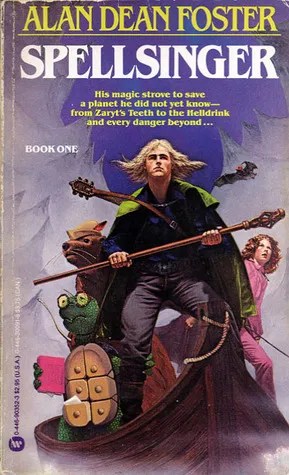
(1983-1987 & 1993-1994) ALAN DEAN FOSTER – SPELLSINGER


Alan Dean Foster’s Spellsinger series is in a similar vein of pulp fantasy to the works of Piers Anthony (and the latter’s Xanth series in particular), or perhaps C. S. Lewis in a much more lighthearted vein. Again, the premise involves a magical world separate from our own, but with various magical links between them. That world is a world in which humans are only a small minority with other animals, mammalian or avian (larger than their equivalents on our world) that otherwise have the abilities or attributes of humans – walking upright, manual dexterity to make or use clothing and tools, sapience and speech. (They don’t eat each other – that niche would appear to be occupied by non-sapient reptiles, resembling the world of smaller dinosaurs).

Their antagonists are the giant intelligent insects or Plated Folk – the protagonist is mistakenly summoned from our world by a tortoise sorcerer to counteract his insect counterpart’s summoning of some mysterious source of power from our own world to aid their conquest of the other animals once and for all. Although the protagonist does not prove to be the ‘engineer’ sought by the wizard, he does prove to have a mysterious magical ability that may just be their salvation after all – a ‘spellsinger’ with the ability to conjure magic through music. The premise is best sustained in the first two books (essentially two halves of the one duology), but falters somewhat after that.


Covers of the mass market paperback edition of the Jon Shannow Trilogy


(1987-1995) DAVID GEMMELL – JON SHANNOW


Pure pulp fun.

David Gemmell was a prolific writer of heroic fantasy – “Gemmell’s works display violence, yet also explore themes of honour, loyalty and redemption. There is always a strong heroic theme but nearly always the heroes are flawed in some way.”

My favorite will always remain his Jon Shannow books, featuring the titular protagonist – the Jerusalem Man (also the title under which the first book was published in the US), named for his quest to find the fabled city of Jerusalem and hence God in a post-apocalyptic weird West future.

That’s not quite as weird as it sounds – the apocalypse three hundred years before the events of the first book remains mysterious and was so, well, apocalyptic, that people in the post-apocalyptic world believe not only that it was the Biblical apocalypse but recently after the events in the New Testament itself.

The Bible thoroughly imbues the book, reflecting Gemmell’s own Christian beliefs. The antagonist styles himself as Abaddon, leading the Hellborn. Shannow himself is a follower of the Book – prompting Abaddon to sneer whether Shannow is a Christian and will love Abaddon to death, to which the reply is that Shannow follows the old God, the God of vengeance in the Old Testament.

The world is weird, as the apocalypse seems to have flipped the poles and swapped the oceans with continents, if the wreck of the Titanic now on a mountain inland is anything to go by. There’s also magic, powered by the mysterious Sipstrassi Stones – which recur through Gemmell’s fantasy books.

The first book was originally intended as a standalone novel, as is clear from its epilogue in which Jon Shannow “finds” Jerusalem (with a twist) but was expanded into a trilogy – the three books were compiled into an omnibus volume in 1995.


1st edition covers of the Memory, Sorrow, Thorn trilogy – the edition I own


(1988-2024) TAD WILLIAMS – MEMORY, SORROW, THORN (OSTEN ARD)


The Osten Ard high fantasy books by Tad Williams, named for its setting, was originally the trilogy known as the Memory, Sorrow, and Thorn trilogy, to which other books in the series have been added, notably the Last King of Osten Ard series

It’s essentially high fantasy in the vein of The Lord of the Rings, except that the Dark Lord – the Storm King – has more justice to his claims, as one of the elven Sithi that humanity has almost wiped out from Osten Ard.


Cover of first edition of the first book of the trilogy


(1991-1993) NICK BANTOCK – GRIFFIN & SABINE


A trilogy of epistolary novels – or more precisely epistolary visual novels, showcasing the author’s art as the narrative unfolds in the form of letters and postcards between the titular two characters. Narrative in the form of mystery, that is, as it unfolds that one or both of the postcard-crossed lovers may be more fantastic than they seem.


This but we’re doing it to both of them – indeed, there’s even the pun that the Sun of Man rose up in Heaven when we nuke it. The Son casts the Rebels out of Heaven – 1885 illustration by Gustave Dore for Milton’s Paradise Lost (public domain image)


(2008 – 2020) STUART SLADE – SALVATION WAR


Yes – it’s cheesy and never evolved past its raw first draft as a playful tongue-in-cheek thread on an online forum (hence the wild-tier special mention) but I still have a soft spot for it. After all, what’s not to love about humanity taking on both sides of the apocalypse, heaven and hell? And winning!

Sadly, it remains unedited and unpublished as an actual book as it should have been – and also unresolved, as only the first two parts of a trilogy (although the war on heaven at least reached its conclusion), as the author firstly faced issues with its publication and then passed away as he was working on the third part. That author, Stuart Slade, did publish another series The Big One as self-published books – the title referring to its opening premise of the United States nuking the crap out of Nazi Germany in 1947 after Britain made peace in 1940).

The premise of The Salvation War is simple. What is humanity to do when God abandons Earth in the apocalypse, declaring it and everyone on it forfeit to the forces of Hell? Well, what else but declare war on both Heaven and Hell – and to kick ass doing it!

Top Tens – Fantasy & SF: Top 10 Fantasy Books (Honorable Mention: Classic)

Classic Conan pose (or leg cling) in The Savage Sword of Conan cover art by Earl Norem for “The Treasure of Tranicos”, issue 47, 1 December 1979, Marvel Comics (fair use)


TOP 10 FANTASY BOOKS (HONORABLE MENTION: CLASSIC)


I’ve ranked my Top 10 Fantasy Books but fantasy is too prolific – and phantasmagorical – a genre to be confined to a mere top ten books or even my usual list of twenty special mentions.

Indeed, I also have two lists of honorable mentions for fantasy books – one classic and the other cult and pulp.

This is obviously the former – for those classic fantasy books or works that have iconic status or recognition within popular culture or imagination.

Unlike my top ten or twenty special mentions, I have no numerical limit or rankings on entries for honorable mention and list them in chronological order by date of publication, so I’ll include an index of entries at the outset.


(1912 – PRESENT) EDGAR RICE BURROUGHS – TARZAN

(1919) JAMES BRANCH CABELL – JURGEN

(1950 – 1984) JACK VANCE – DYING EARTH

(1961 – 2023) MICHAEL MOORCOCK – ELRIC OF MELNIBONE

(1964 – 1977) THOMAS BURNETT SWANN – DAY OF THE MINOTAUR

(1968 – 1970) JAMES BLISH – BLACK EASTER / THE DAY AFTER JUDGEMENT

(1972) RICHARD ADAMS – WATERSHIP DOWN

(1977 – 2013) STEPHEN DONALDSON – THE CHRONICLES OF THOMAS COVENANT

(1980 – 1987) GENE WOLFE – THE BOOK OF THE NEW SUN

(1996 – 2001) NEVERWHERE & AMERICAN GODS

(1996-?) GEORGE R.R. MARTIN – A SONG OF ICE & FIRE / GAME OF THRONES


Cover art of Tarzan Alive by Philip Jose Farmer published in 2006 by Bison


(1912 – PRESENT) EDGAR RICE BURROUGHS – TARZAN


Tarzan is the most iconic hero of fantasy and science fiction – the archetypal jungle hero (or perhaps modern barbarian hero), in a series of books by Edgar Rice Burroughs. The start of the series is easy to date to “Tarzan of the Apes” in 1912. The end of the series less so – Burroughs died in 1950 but “Tarzan and the Valley of Gold” in 1966 was authorized as the 25th official Tarzan novel by the Burroughs estate. However, I’m prepared to continue this entry through to the present to reflect the enduring popularity of the character – or at least to include Philip Jose Farmer’s books featuring Tarzan or versions of him.

Born John Clayton and heir to English aristocracy as Lord Greystoke (or more precisely Viscount Greystoke), Tarzan was marooned with his aristocrat parents and ‘adopted’ after their deaths by a maternal female ape within a ‘tribe’ of great apes – indeed, Tarzan is his name in the ape language.

Philip Jose Farmer condensed Tarzan’s fictional ‘biography’ from the series by Edgar Rice Burroughs into his book Tarzan Alive, which is essentially my central reference to Tarzan (and exclusively so after the first two books). Farmer was an enduring fan of the character and wrote of Tarzan (or his world) in a number of books – most infamously in A Feast Unknown, featuring a thinly veiled pastiche of Tarzan and Doc Savage, or most famously, in his so-called Wold Newton Universe, where he linked together a number of fictional superheroes to the effect of a meteorite.

And I say superheroes as Tarzan has virtually superhuman abilities. After all, we’re talking someone who has wrestled virtually every animal, including full grown bull apes and gorillas. In short, he easily out-Batmans Batman and is the Superman of the jungle.

He is also of superhuman intelligence – a feature not readily discerned from the unfortunate monosyllabic and broken English of his screen adaptations. In the books – indeed, the first book – he could read English before he could speak it, having taught himself to read from the children’s picture books left in his parents’ log cabin and deducing the symbols as a language, in complete isolation from humans. He also spoke French before he spoke English, learning it from the first European he encountered. He readily learns to speak English – as well as thirty or so languages after that. So much for “Me Tarzan, you Jane”.

Despite a certain lack of plausibility, he remains an enduring hero – a “daydream figure” who obviously appeals to our continuing fascination for an animal or nature hero (and perhaps less fortunately to a ‘white god’ figure).


Cover of Dover 1977 paperback edition – the edition I own


(1919) JAMES BRANCH CABELL – JURGEN


Sadly obscure these days, even for this as his best known book and subject of an obscenity trial – a golden advertisement if ever I saw one.

“The eponymous hero, who considers himself a monstrous clever fellow, embarks on a journey through ever more fantastic realms, even to hell and heaven. Everywhere he goes, he winds up seducing the local women, even the Devil’s wife.”

Makes a lot of use of double entendre for everyone admiring his sword. I like the nod to the need for every hero to descend into the underworld. Also that hell is a democracy, just having suspended elections for its government while in war against heaven, an authoritarian monarchy.


Cover of Fantasy Masterworks edition – the edition I own


(1950 – 1984) JACK VANCE – DYING EARTH


Undeniably classic work of fantasy – and one that has had a huge influence on fantasy, not least in the adaptation of “Vancian” magic or ‘fire-and-forget’ spells as the game mechanic for magic in Dungeons and Dragons.

Otherwise, a fantasy setting in the far future of the titular dying earth with Vance’s tongue very much in his cheek – so far in the future that the world has gone all the way back from science to magic in its senility, albeit magic that actually works. Oh – and the sun is about to going out, something the characters frequently invoke with a superstitious glance at it every now and then, hoping that this isn’t the moment it does.

Four Dying Earth books were written by Vance – the first an anthology of short stories, the second and third picaresque adventures revolving around the confidence trickster Cugel the Clever, and the fourth reverts to something of an anthology centered around a conclave of magicians including the titular Rhialto the Marvelous.

Vance’s prose is a delight to read – a particularly memorable passage is the increasing degrees of lucidity you get from an oracle the higher the payment.


Cover of Fantasy Masterworks edition – the edition I own


(1961 – 2023) MICHAEL MOORCOCK – ELRIC OF MELNIBONE


Undeniably classic work of fantasy – and one that has had almost as huge influence on fantasy as Vance’s Dying Earth, again not least in Dungeons and Dragons with the Law-Chaos axis of character alignment. Also the multiverse and the Eternal Champion, the latter often accompanied by the Eternal Sidekick and “has a (typically doomed) love interest, the Eternal Consort” as well as an Eternal Enemy.

Moorcock has been a prolific writer of fantasy and SF, virtually all of which he has shoehorned into his Eternal Champion mythos in one way or another, but most people know him for the Elric Saga, itself a prolific collection of stories and novels as well as multimedia franchise from 1961 through to the present.

At least one fantasy & SF critic, John Clute, considers Elric a deliberate parody of Conan and it’s not hard to see why – a sickly sorcerer as heir to a decadent empire and owing his power or prowess to his soul-sucking sword Stormbringer. (Clute also proposes that Moorcock’s character Jerry Cornelius is a parody of Elric).


Cover of 2012 Wildside Press paperback editiom – the edition I own


(1964 – 1977) THOMAS BURNETT SWANN – DAY OF THE MINOTAUR


I’m dubbing this Arcadian fantasy – Thomas Burnett Swann’s Day of the Minotaur, published in 1966 but previously serialized in 1964-1965, was Cretan in setting but Arcadian in theme, a recurring one for the author.

And by Arcadian, I mean in the sense of paradise lost – not Biblical Eden but classical Arcadia, a literally “mythological, idyllic, pastoral paradise of natural harmony and simplicity”, populated by the demi-humans of classical mythology as fabulous Beasts and presided over by the benevolent Great Mother.

In Day of the Minotaur, we see the vestiges of Arcadia clinging to the forests of Crete, in full retreat from humanity. Relations are strained even with the Minoan civilization with which it has relatively close affinity, but both are under attack from the invading Achaeans.  Both survive what seems a last stand, but both know they are ultimately doomed. Like the elves in The Lord of the Rings, the Beasts sail west to return to their mystical homeland, the Isles of the Blessed.

As I said, this theme of Arcadian retreat was a recurring one for the author – “The bulk of Swann’s fantasy fits into a rough chronology that begins in ancient Egypt around 2500 BC and chronicles the steady decline of magic and mythological races…The coming of more “advanced” civilisations constantly threatens to destroy their pre-industrial world, and they must continually seek refuge wherever they can. They see the advent of Christianity as a major tragedy; the Christians regard magic and mythological beings as evil and seek to destroy the surviving creatures, although some manage to survive and preserve some of their old ways through medieval times down to the late 19th century and perhaps even the 20th.”

*


Promotional art for the Amazon Kindle edition


(1968 – 1970) JAMES BLISH – BLACK EASTER / THE DAY AFTER JUDGEMENT


Black Easter essentially reads like a joke – an arms dealer, a black magician and a priest walk into a bar…

Well, not quite a bar but the arms dealer does a deal with the black magician to release all the demons from Hell on Earth for a single night. The reason – partly for the lulz but mostly to drum up business for arms. The priest comes in due to a pact between white magicians (from the Vatican!) and black magicians to monitor each other – incredibly, the priest does not attempt to interfere with the deal but is simply there to ensure the black magician sticks to the rules of the pact.

It’s a slow burn – dare I say it, something of a shaggy dog joke, or is that shaggy God joke? – a short story premise expanded to novel or novella and mostly focused on the details of the black magic involved, but like any good joke it’s all set up for the punchline.

And that punchline is (spoiler alert) that they have unleashed the apocalypse on the world, except that God is dead and there is no power to return the demons to Hell. (One wonders why the demons didn’t break out on their own before if that was the case.)

The sequel novel doesn’t quite have the same wham effect for its punchline. The characters from the first novel as well as everyone else in general deal with hell let loose on Earth in – where else? – California and Las Vegas.

The punchline arises from the apparent premise that God may not be so dead after all as something seems to be restraining the force of Hell. The punchline, delivered with Miltonian effect by the Devil himself, is that something turns out to be Satan, who now has to assume the role of God – something he now realizes he never really wanted and so is undone by his own Pyrrhic victory.

It might seem a fantasy duology based on one or two theological punchlines (depending on whether you like the second as much as the first) but it has continued to endure as an influence on my imagination and psyche.


Poster art for the 1978 animated film adaptation, perhaps best known for the number 1 hit from its soundtrack “Bright Eyes” – also used as a cover for the book, including the edition I owned


(1972) RICHARD ADAMS – WATERSHIP DOWN


“All the world will be your enemy, Prince with a Thousand Enemies, and whenever they catch you, they will kill you. But first, they must catch you, digger, listener, runner, prince with the swift warning. Be cunning and full of tricks and your people shall never be destroyed.”

The classic animal fantasy – Lord of the Rings with rabbits instead of hobbits and if the plot was that the hobbits had to find a new Shire.

On the one hand, “these are not humans in rabbit form” – “They live and think like fragile prey animals. Caution is a way of life because death is a moment-to-moment possibility”.

On the other hand, the rabbits have “their own culture, language, proverbs, poetry, and mythology”. Not surprisingly, the last is my favorite, focusing on their trickster folk hero, the first rabbit – El-ahrairah, the Prince With a Thousand Enemies.

Although I also have a soft spot for “going tharn” – when a rabbit becomes “frozen in a state of instinctive terror”.


*

Cover art of the First Chronicles of Thomas Covenant – I think from the 1996 Harper Voyager paperback editions but certainly the editions I own


(1977 – 2013) STEPHEN DONALDSON – THE CHRONICLES OF THOMAS COVENANT


The Chronicles of Thomas Covenant might seem a lot like The Lord of the Rings and indeed it is to a point. It has a similar fantasy secondary world – the Land instead of Middle Earth – menaced by a similar Dark Lord, Lord Foul the Despiser, who if anything is even darker than Sauron, as his name indicates. It even has a Ringbearer in its titular protagonist, albeit that ring is a mundane object in our own world – Covenant’s white gold wedding ring – but the ultimate ring of power in the Land.

At a certain point, however, the reader becomes aware that the Chronicles of Thomas Covenant is a profound deconstruction of The Lord of the Rings. Typically, that point is a plot point soon into the first book of the first trilogy, Lord Foul’s Bane, where Covenant is overwhelmed by the sensory overload of the Land and commits a crime that has consequences through the first trilogy. If not that point, it is typically a point in the second book of that first trilogy, The Illearth War, where the leader of the military forces against Lord Foul fails despite his best efforts and must resort to a self-sacrificial Pyrrhic victory.

Or that point may be the overarching nature of its titular protagonist – where The Lord of the Rings had three Christ-like heroic figures (Frodo, Gandalf, and Aragon), Thomas Covenant is the Land’s literal leper-messiah. Worse, because of his leprosy in our world, he has spent a lifetime of managing the disease to the effect of rigorous mental discipline that he cannot believe in the false hope of any magical cure or else he will succumb to the disease – his survival depends on such things as his habitual VSE or visual surveillance of extremities. Hence, when he finds himself transported to a world in which there is a magical cure, it goes against a lifetime of literally life-saving mental discipline and so he cannot believe in that world, becoming Thomas Covenant the Unbeliever.

And yet after the deconstruction comes reconstruction, as the series ultimately returns to something like The Lord of the Rings after all – with the heroic resistance of the Land against Lord Foul and Covenant finding some balance between unbelief and doing the right thing, even in a dream, because as he himself says, Lord Foul laughs at lepers.

And between the deconstruction and the reconstruction falls the resonance – a resonance of phrase and fable that lodges in the psyche long after reading it and refuses to go away. Phrases such as Thomas Covenant the Unbeliever, Lord Foul the Despiser, and my personal favorite – the Ritual of Desecration, the original sin that almost destroyed the Land in the distant past.


Cover of Fantasy Masterworks edition (Volume 1: Shadow and Claw) – the edition I own


(1980 – 1987) GENE WOLFE – THE BOOK OF THE NEW SUN


“He’s not an easy read” – or alternatively, what the hell is going on?!

The former was Sterling Archer on Bartleby the Scrivener – “Anyone? Not a big Melville crowd here, huh?” – but it applies also as much if not more so to Gene Wolfe’s Book of the New Sun, probably with the latter being a common exclamation on reading it.

Sure, I “got” a lot of it, but I’m also sure that I missed a lot more in the mind screw narrative of its unreliable narrator protagonist set in a feudal dying Earth in the far future, about a million years or so (such that a picture of the first moon landing is an incredibly ancient artifact in the book’s signature scene).

It doesn’t help that there are characters apparently jumping back and forth through time that I still haven’t worked out, although I like the “green man” – a time traveler who has been genetically engineered to extract energy from photosynthesis and is held captive in a carnival sideshow “predicting” the future.

There’s also bizarre aliens or alien animals loose on Earth – such as the unforgettable alzabo, an alien predator that absorbs the memories of its victims and then can speak with their voice to lure in further prey. The alzabo gland that allows it to do this is an important plot point.

As you can tell, the parts you get tend to be unforgettable by how bizarre or striking they are.


Excerpt clip from the American Gods TV series adaptation


(1996 – 2001) NEVERWHERE & AMERICAN GODS


“So do you have mighty bacchanals in her honour? Do you drink blood wine under the full moon while scarlet candles burn in silver candle holders? Do you step naked into the sea foam chanting ecstatically to your nameless goddess while the waves lick at your legs like the tongues of a thousand leopards?”


I had quite the quandary with this entry, which I ultimately resolved by separating the art from the artist by effectively featuring the works anonymously, without reference to their author, as I can’t deny the enduring influence of these two works on me. Also, as I understand it, the author seems to have retired from writing, possibly due to the same reasons for which I separate the art and the artist. And in a sense, these two works exist independently of their author in other media. Indeed, a little like Hitchhiker’s Guide to the Galaxy, Neverwhere began as a BBC TV series, albeit also written by the author. Apart from the novelization of it, it has also been adapted to nine issue comics series (written by Mike Carey) as well as a radio play, although I anticipate it’s unlikely to see further adaptations. American Gods has seen an adaptation as a TV series – I liked the first season, although it went in some very different directions from the book. The second season apparently fizzled with the departure of the showrunners for the first season, although it may have bounced back in its third and final season. The book has also had a sequel novel (or more precisely a novel set in the same world with the same premise) and two sequel short stories (that are indeed sequels to the book), as well as an adaptation as a series of comics.

Of the two, my favorite is American Gods and its premise is also more straightforward to explain. Essentially its premise is that all myths are true, to the extent that people believe in them. However, that is not as good as it might sound for the myths in question. Yes, all the old gods of all the people that came to America still continue to exist but eke out that existence on the dregs of whatever belief in them that remains, even if half (or completely) forgotten and even if only as symbol or metaphor. And if that wasn’t bad enough, they’re squaring off against the new gods, such as the god of Media, who are very much coked up to the eyeballs on belief in them. It also has one of my favorite protagonists of fantasy, Shadow Moon – who wants nothing more than to return to his wife and a job with his best friend after release from prison, but the gods have other plans for him. Literally.

Neverwhere has a similar premise, not quite all myths are true but that there is a magic – not unlike megapolisomancy in Fritz Leiber’s literal urban fantasy novel Our Lady of Darkness – formed from large cities and that takes shape in their magical underground equivalents, such as London Below. I particularly like how each city has its mystical Beast at its heart.


Collage of the covers of the five books of the series (to date) as bookset feature image from the fan wiki (and for the editions I own)


(1996-?) GEORGE R.R. MARTIN – A SONG OF ICE & FIRE / GAME OF THRONES


A Song of Ice and Fire needs little introduction, due to its own popularity and even more so that of its TV adaptation in A Game of Thrones.

Due to that popularity, its high fantasy setting – the two continents of Westeros and Essos – are one of the most well known fantasy settings in popular culture and imagination. Of the two continents, Westeros has the more focus – Essos mostly seems to be there to throw in something bizarre or weird, usually imported into Westeros. As for Westeros, it’s essentially the War of the Roses as Battle Royale, with Starks substituting for York and Lannister for Lancaster, crossed with Hadrian’s Wall – except the latter is to keep out an icy apocalypse of death as well as the Picts. That apocalypse is part of a general trend of old magic that people had thought long gone coming back.

What also needs little introduction is how A Song of Ice and Fire stalled without conclusion – and worse, how Game of Thrones had a conclusion but one so bad that it undermined the iconic status and popularity of the entire series. Both are offset somewhat by prequel series – obviously there can’t be any sequel series as one didn’t end and one ended so badly.