

Cover – Conan the Barbarian #1 comic (October 1970), by Barry Smith and John Verpoorten, also used as the cover of the original comics omnibus Volume 1 published by Titan Books in February 2025 (fair use). Note once again the classic Conan pose
TOP 10 FANTASY BOOKS (HONORABLE MENTION: CULT & PULP)
I’ve ranked my Top 10 Fantasy Books but fantasy is too prolific – and phantasmagorical – a genre to be confined to a mere top ten books or even my usual list of twenty special mentions.
Indeed, I also have two lists of honorable mentions for fantasy books – one classic and the other cult and pulp.
This is obviously the latter – for those fantasy books or works that don’t quite that iconic status or recognition within the genre ion of my classic honorable mentions but I like them anyway!
That or they’re an enduring influence on me despite (or perhaps because of) their “cult & pulp” status.
Unlike my top ten or twenty special mentions, I have no numerical limit or rankings on entries for honorable mention and list them in chronological order by date of publication, so I’ll include an index of entries at the outset.
(1977 – PRESENT) PIERS ANTHONY – XANTH & TAROT
(1983-1987 & 1993-1994) ALAN DEAN FOSTER – SPELLSINGER
(1987-1995) DAVID GEMMELL – JON SHANNOW
(1988-2024) TAD WILLIAMS – MEMORY, SORROW, THORN (OSTEN ARD)
(1991-1993) NICK BANTOCK – GRIFFIN & SABINE
(2008 – 2020) STUART SLADE – SALVATION WAR

Collage of cover by legendary GOAT fantasy cover artist Michael Whelan (depicting a scene from the book) for the first edition of the first Xanth book, A Spell for Chamelon (also used in subsequent editions) on left and for the compilation edition of the Tarot series (the edition I own) on right
(1977 – PRESENT) PIERS ANTHONY – XANTH & TAROT
Piers Anthony is something of a guilty pleasure for me, writing as he does in an adolescent style – a very horny adolescent, with a distinctively male gaze, but also contemplative and prone to wild ideas or flights of fancy. It is fortunate that I mostly read him as an adolescent, indeed an adolescent that might be described similarly.
TV Tropes aptly describes him as a writer “with pattern of starting a new series with a fresh innovative idea, and then never stopping it unless the publisher begs him to” – which is perhaps a little unfair, as he also tends to write with some striking images to go with those ideas. I wouldn’t quite go so far as Joe Lansdale’s description of Philip Jose Farmer as the man with the electric brain for Anthony but he comes close – and has more than a few points of comparison with Farmer.
And hot damn – most of those images and ideas still resonate with me now, cemented deep in my psyche, even with all the years with all the other fantasy or SF books I have read since, such that I remember them vividly.
He has several distinctive series, each with its own innovative idea or ideas for its premise. His most extensive and best known series is his Xanth series – set in the titular fantasy land of Xanth, a peninsula that resembles Anthony’s home state of Florida but can magically overlap with ones in our own world at different times and places, such as Italy when invaded by Carthaginians or Korea invaded by Mongols. Magic effectively becomes a force infusing everyone and everything in Xanth, with the key premise that every human born there has a unique magical ‘talent’, which vary in power and versatility. I’d suggest the consensus seems to be that anywhere from the first book to first three books are the best – after that, your mileage very much varies as where you draw the line reading further into the series if at all, particularly as the puns that started off as the occasional sly references begin to choke out the books as reflected by their titles.
The other series I would nominate – nominally SF but with a distinct fantasy feel to it – is his Tarot series, a prequel to his SF Cluster series (but also overlapping with it), but one that just resonated more with me. Partly that’s because the chapters follow the sequence of Tarot cards, albeit a greatly expanded Tarot, but mostly it’s the premise of a planet in which religious visions seem to take concrete – and dangerous – form and which the protagonist investigates on a quest to find the true religion.
Cover of the mass market paperback edition of the first book
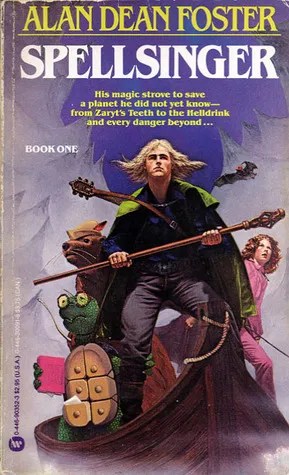
(1983-1987 & 1993-1994) ALAN DEAN FOSTER – SPELLSINGER
Alan Dean Foster’s Spellsinger series is in a similar vein of pulp fantasy to the works of Piers Anthony (and the latter’s Xanth series in particular), or perhaps C. S. Lewis in a much more lighthearted vein. Again, the premise involves a magical world separate from our own, but with various magical links between them. That world is a world in which humans are only a small minority with other animals, mammalian or avian (larger than their equivalents on our world) that otherwise have the abilities or attributes of humans – walking upright, manual dexterity to make or use clothing and tools, sapience and speech. (They don’t eat each other – that niche would appear to be occupied by non-sapient reptiles, resembling the world of smaller dinosaurs).
Their antagonists are the giant intelligent insects or Plated Folk – the protagonist is mistakenly summoned from our world by a tortoise sorcerer to counteract his insect counterpart’s summoning of some mysterious source of power from our own world to aid their conquest of the other animals once and for all. Although the protagonist does not prove to be the ‘engineer’ sought by the wizard, he does prove to have a mysterious magical ability that may just be their salvation after all – a ‘spellsinger’ with the ability to conjure magic through music. The premise is best sustained in the first two books (essentially two halves of the one duology), but falters somewhat after that.

Covers of the mass market paperback edition of the Jon Shannow Trilogy
(1987-1995) DAVID GEMMELL – JON SHANNOW
Pure pulp fun.
David Gemmell was a prolific writer of heroic fantasy – “Gemmell’s works display violence, yet also explore themes of honour, loyalty and redemption. There is always a strong heroic theme but nearly always the heroes are flawed in some way.”
My favorite will always remain his Jon Shannow books, featuring the titular protagonist – the Jerusalem Man (also the title under which the first book was published in the US), named for his quest to find the fabled city of Jerusalem and hence God in a post-apocalyptic weird West future.
That’s not quite as weird as it sounds – the apocalypse three hundred years before the events of the first book remains mysterious and was so, well, apocalyptic, that people in the post-apocalyptic world believe not only that it was the Biblical apocalypse but recently after the events in the New Testament itself.
The Bible thoroughly imbues the book, reflecting Gemmell’s own Christian beliefs. The antagonist styles himself as Abaddon, leading the Hellborn. Shannow himself is a follower of the Book – prompting Abaddon to sneer whether Shannow is a Christian and will love Abaddon to death, to which the reply is that Shannow follows the old God, the God of vengeance in the Old Testament.
The world is weird, as the apocalypse seems to have flipped the poles and swapped the oceans with continents, if the wreck of the Titanic now on a mountain inland is anything to go by. There’s also magic, powered by the mysterious Sipstrassi Stones – which recur through Gemmell’s fantasy books.
The first book was originally intended as a standalone novel, as is clear from its epilogue in which Jon Shannow “finds” Jerusalem (with a twist) but was expanded into a trilogy – the three books were compiled into an omnibus volume in 1995.

1st edition covers of the Memory, Sorrow, Thorn trilogy – the edition I own
(1988-2024) TAD WILLIAMS – MEMORY, SORROW, THORN (OSTEN ARD)
The Osten Ard high fantasy books by Tad Williams, named for its setting, was originally the trilogy known as the Memory, Sorrow, and Thorn trilogy, to which other books in the series have been added, notably the Last King of Osten Ard series
It’s essentially high fantasy in the vein of The Lord of the Rings, except that the Dark Lord – the Storm King – has more justice to his claims, as one of the elven Sithi that humanity has almost wiped out from Osten Ard.

Cover of first edition of the first book of the trilogy
(1991-1993) NICK BANTOCK – GRIFFIN & SABINE
A trilogy of epistolary novels – or more precisely epistolary visual novels, showcasing the author’s art as the narrative unfolds in the form of letters and postcards between the titular two characters. Narrative in the form of mystery, that is, as it unfolds that one or both of the postcard-crossed lovers may be more fantastic than they seem.

This but we’re doing it to both of them – indeed, there’s even the pun that the Sun of Man rose up in Heaven when we nuke it. The Son casts the Rebels out of Heaven – 1885 illustration by Gustave Dore for Milton’s Paradise Lost (public domain image)
(2008 – 2020) STUART SLADE – SALVATION WAR
Yes – it’s cheesy and never evolved past its raw first draft as a playful tongue-in-cheek thread on an online forum (hence the wild-tier special mention) but I still have a soft spot for it. After all, what’s not to love about humanity taking on both sides of the apocalypse, heaven and hell? And winning!
Sadly, it remains unedited and unpublished as an actual book as it should have been – and also unresolved, as only the first two parts of a trilogy (although the war on heaven at least reached its conclusion), as the author firstly faced issues with its publication and then passed away as he was working on the third part. That author, Stuart Slade, did publish another series The Big One as self-published books – the title referring to its opening premise of the United States nuking the crap out of Nazi Germany in 1947 after Britain made peace in 1940).
The premise of The Salvation War is simple. What is humanity to do when God abandons Earth in the apocalypse, declaring it and everyone on it forfeit to the forces of Hell? Well, what else but declare war on both Heaven and Hell – and to kick ass doing it!