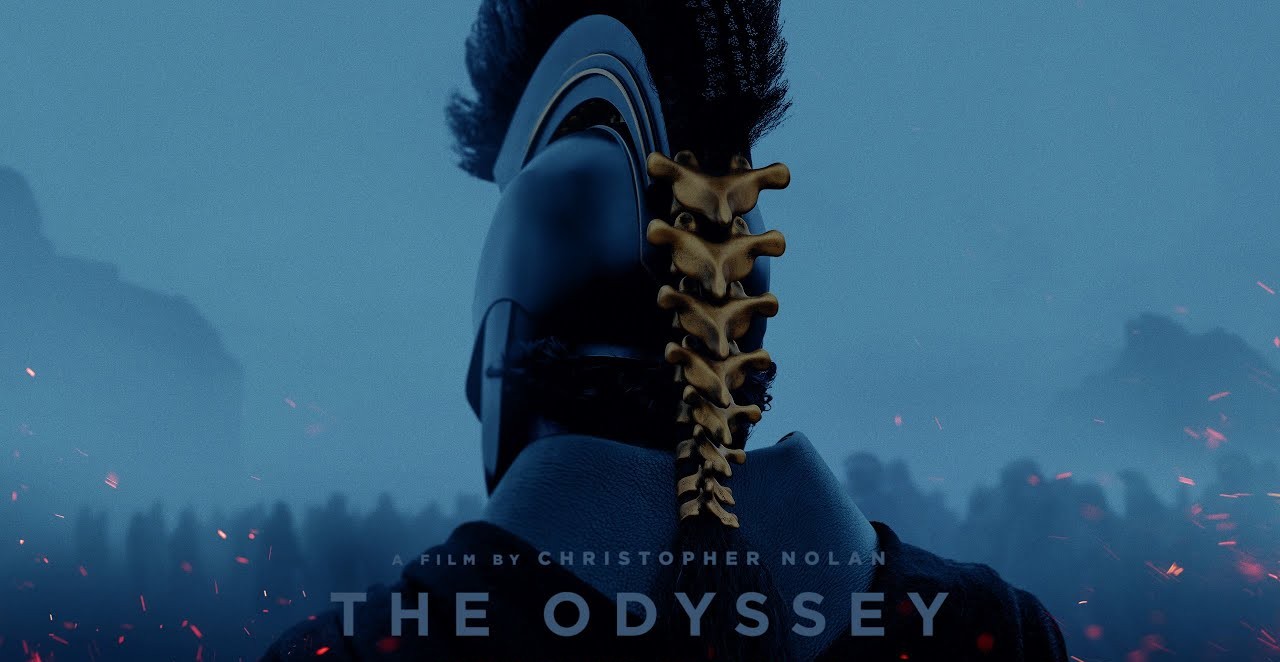
The Odyssey as told in two images from the Nolan film trailer -he’s a good boy (fair use)
TOP 10 BOOKS OF THE ODYSSEY
Sing, Muse, of my Top 10 Books of the Odyssey.
After all, there are twenty-four of them, essentially the equivalent of modern chapters, hence more than enough for a top ten.
It gets more straightforward than that as the top four books are obvious. They’re the odyssey part of the Odyssey, often more formally titled the Wanderings of Odysseus. The otherworldly Odyssey. The mythic fantasy adventure Odyssey. What we think of when we think of the Odyssey.
In other words, the part for which most people come to or keep coming back to the Odyssey, or at least remember most about it, in the style of the trope Just Here For Godzilla in TV Tropes.
Except in the case of the Odyssey, Godzilla is the Cyclops, or the Sirens, or any or all of the mythic fantasy elements in Books 9-12, which recount the wanderings of Odysseus from Troy to Helios’ cattle. Interestingly, the contents of these books are the story within the story, told by Odysseus himself to the Phaeacians – which begs the question of how true it is, given Odysseus’s defining traits of deception and disguise.
But what books of the Odyssey do I rank in my top ten after Books 9-12? How do I rank Books 9-12 in my top four? And above all, which of Books 9-12 do I rank in top spot?
Well…
(1) BOOK 11 – KATABASIS (DESCENT TO THE UNDERWORLD)
All true heroes and poets go down into the underworld…
Yes, Book 11 is the single best book of the Odyssey, arguably its narrative and thematic crossroads that tie it all together. It is also the definitive core mythic heart of the Odyssey (within its most mythic part for the wanderings of Odysseus).
Yes, it may not be as action-packed as the other books for the wanderings of Odysseus, or lack the titillation of Circe and the Sirens. I mean, it’s essentially Odysseus just talking to dead people, but he went down to the underworld to do it. Have you gone down to the underworld – and more importantly, come back to tell the tale? I didn’t think so.
There’s a word for Book 11 – katabasis. A katabasis is a journey into the underworld, harrowing Hades as it were – “its original sense is usually associated with Greek mythology and classical mythology more broadly, where the protagonist visits the Greek underworld, also known as Hades”.
And yes, okay, Odysseus barely went into the underworld, a liminal katabasis as it were, certainly when compared with those of some other Greek heroes who went to the very heart of the underworld. I understand there is even some dispute whether he went to the highest part of the underworld, or simply “the lowest edge of the living world” bordering it.
And yes, yes, okay, there’s two words for Book 11 – katabasis and nekyia, the latter being necromancy and tending to involve a vision of the underworld rather than a visit to it. Although it’s not so much that the dead in general have any particular gift of prophecy in the Odyssey, but rather the shade of Tiresias which retains the gift of prophecy he had when he was alive. He just happens to be, you know, dead, so doesn’t do prophecy house calls any more.
However, it remains the first literary katabasis of classical mythology, inspiring in turn the katabasis of the Aeneid, which in turn inspired that of Dante’s Inferno (with the Aeneid’s author Virgil as guide to Dante).
Of course, everyone goes down into the underworld at some point – the trick is to come back.
(2) BOOK 12 – BETWEEN SCYLLA & CHARYBDIS (OR SIRENS & CATTLE)
Book 12 is where it all goes down – literally.
Book 12 is how and why he ends up alone with Calypso on her island or telling his wanderings to the Phaeacians, as literal flotsam and jetsam, sans his remaining ship and men.
Book 12 is the climax of his mythic wanderings – and the climactic destruction of his ship and men, because of their sacrilegious theft of the best cattle from the herds of Helios while Odysseus slept
Although forewarned about the dire consequence of their theft, they were starved for food from being marooned for a month on the island by bad weather – which is to say, by the gods. Odysseus himself was spared as he apparently did not eat the stolen cattle, despite his crew eating them for six days.
That’s not the only supernatural obstacle Odysseus faces in this book – just the final, fatal one for his crew. The book might be summarised as sailing between Scylla and Charybdis, both literally for those two monsters, and figuratively between opposing supernatural forces that threaten to pluck off some of his crew (like the Sirens) or to suck them down to total destruction with their ship (like the cattle of Helios). Although I suppose the Sirens might have well threatened the latter if Odysseus had not been forewarned about their song.
Interestingly, people seem to forget or omit that Odysseus faced Scylla and Charybdis twice – the first famously with his ship and crew, the second drifting on his own after the destruction of his ship and crew when the winds send him back through the two. Odysseus survives his makeshift raft being sucked down by Charybdis only by leaping to grab a tree on her rock and clinging to it until she spat the water with his raft back up again. From there, he drifted for nine days until he ended up on the Ogygia, the island of Calypso.
(3) BOOK 10 – THE WINDS, THE GIANTS AND THE WITCH
Everyone loves Circe.
Yes, she’s the witch part of this book. Sadly there’s no lion or wardrobe.
But seriously, she has been the subject of enduring fascination ever since her depiction in the Odyssey. In terms of Dungeons and Dragons schools of magic, she specialized in transmutation, hence her island of manimals and the pigs she makes from Odysseus’ crew, the former arguably a precursor to the Island of Doctor Moreau. Famously, she did a heel face turn from bad girl antagonist to Odysseus to good girl love interest. The Nolan film omitted the love interest part and the year spent on her island. The book ends with Circe directing Odysseus to the underworld (for his katabasis in Book 11).
The winds are of course a reference to the demi-god Aeolus, ruler of the winds. One of the most heartbreaking parts of the Odyssey is that Odysseus almost makes it home right at the start, courtesy of the divine (or semi-divine) help of Aeolus – until, as usual, his crew screw up. Aeolus literally bagged up all the winds other than the west wind to blow Odysseus home. Odysseus and his crew are literally within sight of home when Odysseus succumbs to sleep and his crew open up the bag of winds, thinking it to be gold. The winds take them all the way back to Aeolus – and Aeolus doesn’t give Odysseus a second chance, perceiving (correctly) that Odysseus is the subject of divinely ordained misfortune. The Nolan film omitted Aeolus.
The giants are the Laestrygonians – a tribe of man-eating giants that destroy all but Odysseus’ ship, or eleven out of twelve of his fleet, along with their crews. Only Odysseus ship survives, with all of his crew, because of his prudence in mooring it in a cove away from the island’s harbor. While the Nolan film retained them as giants, it clearly did so on the basis that the cyclops Polyphemus was man-eating giant enough and instead substituted them as armored figures, almost as emblematic of the encroaching Iron Age.
(4) BOOK 9 – CICONES, LOTUS-EATERS AND CYCLOPS
Yes – it’s the one with the Cyclops.
I might have ranked this book higher, perhaps even highest, reflecting that Odysseus’ encounter with the cyclops Polyphemus and his ruse of naming himself Nobody or Noman is probably the most famous episode from the Odyssey.
The fact that I ultimately preferred the underworld, Sirens, Scylla and Charybdis, Helios’ cattle, Circe, Aeolus, and even those other cannibal giants, the Laestrygonians, just goes to show how epic the wanderings of Odysseus were.
Still, Polyphemus plays a fundamental part as the cause for the wanderings of Odysseus, in the curse upon Odysseus that he calls from his father Poseidon and essentially occurs – that Odysseus should not return home but if he did, that he should return alone having lost his men, in the ship of another, and to find his house full of woe.
Despite Odysseus’s hubris in taunting the cyclops with his true identity after escaping, the curse Polyphemus called down upon Odysseus seems inherently unfair – given Polyphemus own violation of sacred hospitality and the small matter of, you know, eating people. Sadly, the Nolan film does not adapt Odysseus’ ruse, or the subsequent taunt of his true identity.
However, Book 9 isn’t all about the cyclops. Prior to Polyphemus, Odysseus encounters the Cicones and the Lotus Eaters.
The Cicones are relatively mundane – Trojan allies that Odysseus and his men sack after leaving Troy, only to succumb to a counterattack while drunk at the plunder party and lose six men from each of his twelve ships. They’re not directly adapted in the Nolan film but are perhaps hinted at in the people being sacked by Odysseus and his men at the outset.
The Lotus Easters are more interesting, at least to me because of their adaptation into a poem by Tennyson that is something of a counterpoint to his poem Ulysses – and because they have lent themselves to a metaphor for “people who spend their time indulging in pleasure and luxury rather than dealing with practical concerns” ever since.
You wouldn’t think that people doped up to their eyeballs with lotus would pose such a threat but they do – albeit by assimilation into their state of narcotic intoxication and amnesia.
The Nolan film conflates the lotus-eaters with Odysseus himself on Calypso’s island – although I’m pretty sure she’s getting stuck into it too.
(5) BOOK 21 – CONTEST OF THE BOW (RETURN OF THE KING)
So what next after Books 9-12 of Odysseus’ mythic wanderings?
What else but Book 21 with the contest of the bow?
I mean, I don’t even have to say anything else as it has the most famous and iconic scene of the Odyssey outside of Odysseus’ wanderings – indeed, probably ranking up there with his wanderings or at least some of them.
It’s the penultimate scene of his triumphant homecoming – the ultimate scene is, of course, in my next entry.
You know the scene just from that description of it as the contest of the bow. Inspired by Athena, Penelope proposes that she will marry whichever suitor can string Odysseus’s bow and shoot an arrow through a line of twelve axe-heads. The suitors all fail. Odysseus, still disguised as a beggar, asks his turn and of course he does it.
And the book ends on a literally thunderous cliffhanger as Odysseus, no longer disguised as a beggar, faces off against the suitors with Telemachus by his side.
(6) BOOK 22 – FATE OF THE SUITORS (WRATH OF ODYSSEUS)
Yes king, slay!
Sometimes described as the slaying of the suitors, although personally I stand by that people missed the chance to mirror the wrath of Achilles from the first line of the Iliad and call it the wrath of Achilles.
While the Wanderings of Odysseus is the adventurous soul of the Odyssey – “I am become a name for always roaming with a hungry heart” – his Homecoming is its emotional core. Home is where the heart is – certainly Ithaca is where the heart of Odysseus is, as well as that of the Odyssey.
The Wanderings of Odysseus are his adventure; the Homecoming of Odysseus is his quest – the restoration of law or order over chaos, arguably of more thematic importance than even the adventurous odyssey.
And it is this book that is the ultimate scene of his triumphant homecoming, that ties it all together – after his revelation as Odysseus comes the revenge against the suitors.
It’s pretty epic as well – Odysseus against over a hundred suitors. Yes, Telemachus and two loyal servants join the fight (in the book as opposed to the Nolan film) but let’s face it – Odysseus does the heavy lifting, although Athena also appears in the battle (in her human disguise as Mentor) to give him a pep talk (and deflect spears thrown by the suitors).
However, one part of this book sits uneasily with modern readers – and modern viewers, hence its omission from modern adaptations such as the Nolan film – and that is Odysseus ordering his royal household maids to be slain for disloyalty. Telemachus comes off even worse than Odysseus, as at least Odysseus ordered a “clean death” by sword while Telemachus has them hanged instead.
(7) BOOK 5 – CALYPSO
After the opening build-up of the Telemachy in Books 1-4 – where’s Odysseus? – we finally see Odysseus and where he’s been for the last seven years, chilling as a beach bum and sleeping with hot sea nymph Calypso at nights on her island of Ogygia. Oh the humanity! I wish I was held “captive” by a sea nymph – who, by the way, offers him immortality if he stays with her.
In fairness, he does cry about it a lot, pining for his wife and home. Although it is funny that Odysseus spent eight of ten years “odysseying” shacked up with one nymph (Calypso) or another (Circe).
But no more! Athena finally does something to help Odysseus, interceding with Zeus to send Hermes to order Calypso to let Odysseus go. Unfortunately, Athena omitted to run his divine hall pass past Poseidon, who promptly sinks Odysseus’ raft. Odysseus is then saved by the sea goddess Ino and he safely reaches Phaeacia, albeit naked because that’s how true heroes roll.
Yes, it’s what I’d call the lesser wanderings of Odysseus – after the greater wanderings of Odysseus in Books 9-12 – but it’s still the wanderings of Odysseus. Also – nymphs!
(8) BOOK 6 – NAUSICAA
I have a soft spot for Nausicaa, princess of Phaeacia who comes to the aid of the thrice-shipwrecked Odysseus in this book, albeit with some divine guidance from Athena coming to her in a dream.
As I’ve observed elsewhere, at least in my Top 10 Girls of the Odyssey, it’s intriguing how much Odysseus depends on the kindness of women, divine or otherwise – Nausicaa and Athena here of course, but also Circe (albeit after a heel-face turn from antagonist), Calypso and Ino. Not to mention the enduring faithfulness and loyalty of Penelope.
Sadly, this book is skipped by Nolan’s film, which has Odysseus end up directly in Ithaca from Calypso’s island.
(9) BOOK 17 – ARGOS (WHO’S A GOOD BOY?)
Look, I’m not made of stone. I teared up when I saw the puppy in the Nolan film because I knew this scene was coming – Argos, the legendary best of good boys, who waited twenty years for his master Odysseus to come back home one last time before passing away.
It’s like the meme of Death taking away the dog:
“It is time to go”
“Was I a good boy?”
“No…I’m told you were the best”
Oh – and a bunch of other stuff happens, including both Telemachus and Odysseus returning to the palace, the latter disguised among the suitors as a beggar as his homecoming after twenty years.
But this entry is for Argos.
(10) BOOK 23 – ODYSSEUS & PENELOPE
As I said, I’m not made of stone. Yes, Odysseus has triumphed in the trials and tribulations of his homecoming, the contest of the bow and the battle with the suitors – but he faces one last test – Penelope herself.
Penelope hasn’t held the line for twenty years of his absence because she’s an idiot – on the contrary, she’s as wary and wily as Odysseus himself, so she gives him one last test to prove himself to her, invoking the secret knowledge of their marital bed known only to the two of them. Odysseus of course knows the secret and so at last they are reunited.
This might seem odd to those who have only seen the Nolan film as Penelope was present for the contest of the bow and the battle with the suitors – and, well, I prefer that climactic and emotive revelation. That turn of her head as Odysseus strings the bow – chef’s kiss. However, her final test to him makes sense in the original literary version as she was not present for those, having been whisked off to her chamber (and put to sleep by Athena) to keep her safe in the impending violence with the suitors.