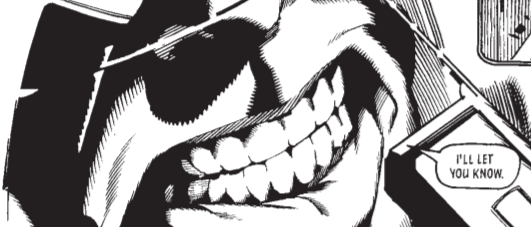
Mega-City Law: Top 10 Judge Dredd Epics & Episodes: Episodes


Counting down my Top 10 Judge Dredd epics and episodes – essentially as a running list updated as I finish each volume of the collected Judge Dredd Complete Case Files in my ongoing Mega-City Law reviews (presently up to Case Files 16).

I distinguish between epics and episodes – with epics as longer storylines over a five or more episodes. However, that still leaves a distinction for me with respect to episodes – episodes that encapsulate their storylines within the single episode (probably most of the comic) as opposed to those that have a longer story arc over 2-4 episodes (with four episodes being perhaps the most common standard for such mini-epics).

There is a real art in encapsulating a story within a single episode – and a mere six pages or so at that – akin to writing a short story, typically with a twist in the tale, as opposed to a novel. Some of the stories in the Judge Dredd comic which had the most impact on me or which defined the comic for me are stories of a single episode. These are my top ten episodes of Judge Dredd, standing on their own as single episodes.


(10) A, B OR C WARRIOR
(CASE FILES 18: prog 824)


“Well, citizen Colon. Can you guess what happens now? Is it a) we let you go? b) you get off with a five cred fine? or c) we lock you in the psycho cubes and throw away the key?”

A, B, C Warrior is easily my favorite single episode in Case Files 18 – involving yet another citizen gone mad in Mega-City One, or ‘futsie’ as Mega-City slang goes for people suffering from ‘future shock’, who have snapped from the pressure of just living in “a society where every single thing has become monstrously overwhelming” (as per Chris Sims).

In this episode, the futsie is a citizen with an unfortunate surname, Mori Colon – and the even more unfortunate madness from losing his job as a pollster. Although given the nearly universal automation of jobs in Mega-City One, I’m not sure how he ever had it in the first place since it would seem a job where a robot would be first in line.

Anyway, he’s adapted his former occupation as pollster to his new preoccupation as serial killer. As one Judge observes – “It’s incredible, Dredd. He’s killed over fifty people – all so he can ask them these insane questions!”.

That is of course after Colon is apprehended by Dredd. We’re introduced to him at the opening of the episode “polling” a resident of Frank Hovis block, as usual named for a character in a British television comedy series contemporary to the date of publication rather than someone you’d expect it to be named for in a twenty-second century American megalopolis. And by “polling”, I mean asking some of those inane questions – as multiple choice between options a, b, and c, hence the title – before shooting his victim. As in what will the victim do when Colon brandishes a gun – a) try to jump me b) beg for mercy or c) run for it. (The answer in this case was b).

The sound of gunfire is reported by neighbors – which is how Dredd is called to the scene. Unfortunately, he doesn’t have much to go on for clues at the scene, particularly given the insane polling that is Colon’s modus operandi, but fortunately Colon decides further “research” is needed at a local club (where Colon laments that he should have thought of “polling” a crowd further). Research such as whether on learning of their impending deaths they will a) pray to Grud…b) pray to Satan…c) start to cry. (In fairness, Colon is researching whether religious belief is declining in Mega-City One because of the reactions of previous victims).

So as nearest Judge, Dredd is called to the club when Colon’s latest disturbance is reported and catches Colon in mid-massacre. Colon even polls Dredd which ammunition he will use. (Dredd choses an option that wasn’t on the poll, shooting through a table – and Colon’s arm – with an armor-piercing round). Although I do have to give Colon mad props for his justification to Dredd – “but I’m conducting an opinion poll!”

And that leads to us to the line I quote at the outset Dredd’s deadpan snark with his facetious “poll” to Colon after he recovers from med-bay treatment. And like the readers, Colon easily guesses the answer – “at a wild guess…c?”. Which if you recall was throwing him in the psycho-cube without a key – “You got it. Take him away.”


RATING: 4 STARS****
X-TIER (WILD TIER)


(9) FIRST OF THE MANY
(CASE FILES 16: prog 775)

An episode which revisits Dredd’s very first arrest or more precisely, in which it revisits him – “I’m Bert Dubinksi. I’m the first guy you ever arrested.”

This episode is worth revisiting in some detail, flashing back as it does to such a monumental moment in Dredd’s history – his first arrest, as a rookie under Judge Morphy – but also featuring the art of one of my favorite Dredd artists, Cliff Robinson (as did my other favorite episode from Case Files 16, Watch Dogs).

You have to love that introduction as Dredd signs off after having “been on the streets a hundred hours straight” – bonus points for the Rowdy Yates Block sign in the background, Dredd’s destination as his rostered block of ‘residence’ as block Judge (and as I’ve noted, a sly reference to his source of influence in Dirty Harry as the name of Clint Eastwood’s character in the TV Western series Rawhide).

Just as Dredd pulls up in what appears to be the parking bay for his Lawmaster (and is awaiting the security door as it opens), that’s when Dubinski approaches him with that declaration. Dubinski seems friendly enough but it bodes trouble that he just happens to be there when Dredd is coming off shift and in that suspiciously long coat as well.

The episode flashes back to the arrest, with Dredd as a hotshot rookie in his first street assessment by Judge Morphy. Father figure and mentor to Dredd. Oh – and it’s good to see you again, Morph, in your prime to boot (those tight boots – yes, it’s a plot point in Judge Dredd). He was killed in the line of duty in the countdown to Necropolis just a couple of Case File volumes back – an important factor in Dredd’s breakdown and decision to take the Long Walk. (Dredd got better…and came back).

Anyway, here he is with Rookie Dredd at the dawn of Dredd as the Judge we know and love. Prompted by the same gunman approaching him thirty-five years later, Dredd recalls his very first arrest, as a rookie Judge eighteen years of age. Which would of course make Dredd fifty-three years of age – as at the time of this episode in 1992 (or 2114 for Dredd in Mega-City One). Since each year passes at the same rate in the comic as in the real life – that would make him eighty-four years of age in 2023 (or 2145 for Dredd in Mega-City One). Lucky he has those rejuvenation treatments mandated by Justice Department.

Rookie Dredd coolly assesses the situation of a gunman having killed two people in a shop – “Don’t want to start a firefight in a crowded street if we can help it. I’ll try and take him quietly”.

And that’s exactly what he does. Of course, it helps that the gunman appears to be a ball of nerves, backing away from the scene of his offences, so all Dredd has to do is quietly come up behind him and hold a Lawgiver to his head. “Pays to look where you’re going, meathead! Drop it!”

And Dredd does the same thing here as Dubinski tries to gun him down, having foolishly turned away from Dredd before doing so – “Getting’ a sense of déjà vu, Dubinski?”

Dredd is quite the deadpan snarker arresting the first person he ever arrested…again.

In hindsight, perhaps they should have sentenced Dubinski to a psych cube thirty-five years ago – his motive in his original offence appears to be the two people in the shop weren’t “friendly” and that appears to be a motive here, as he becomes enraged at Dredd before pulling out the gun from his coat.

This time, however, Dubinski is not prepared to surrender quietly – not surprisingly as he doesn’t want another stretch in the cubes and he opts for suicide by cop. So Dredd calls in a meat-wagon for Dubinski, much to the bemusement of Control – “Wilco. Uh…would that be Dubinksi who was released from Iso-Block 10 this morning? One of your old perps?”

And Dredd has his own moment of hindsight, with his characteristic deadpan snark – “Yeah. Might have been better if I put a bullet in him first time round. Would have saved us both a lot of trouble.”

RATING: 4 STARS****
B-TIER (HIGH TIER)


(8) WATCHDOGS
(CASE FILES 16: prog 739)

“Attaboy Dreddy! Give ‘im the old judicial excess!”

The Citizens Watchdog Committee may regard Dredd’s use of force as shocking, disgusting, and disgraceful – but their audience loves it.

The Committee and their audience are watching Dredd as he performs his duties – we are introduced to them as Dredd apprehends muggers. And so is Dredd, asking Justice Department Control whether they have spy in the sky surveillance on him – “Somebody has. I count at least two of them. Check into it”.

No rest for the wicked – or those who judge them, as Control directs Dredd to the next incident, a brawl at the Dire Straits bar. Meanwhile, we see more of the Committee – three people watching Dredd on screen while sitting behind a desk with the banner Citizens Watchdog Committee, with another man sanctimoniously narrating Dredd’s use of force, all four of them in terms of utmost opprobium.

The narrator is heckled by the Committee’s wider audience of citizens, who are wildly enthusiatic for Dredd’s onscreen actions in a manner consistent with a crowd at a gladiatorial arena. Are they not entertained? Yes. Yes, they very much are – and loving it. The Citizens Watchdog Committee only have themselves to blame – we see the two large signs outside their venue, emblazoned in the style of a boxing match or wrestling show:

No wonder they got fans of “judicial excess”, cheering on Dredd’s every bone-crunching tooth-breaking act by their affectionate nickname for him – “Nice one, Dreddy!”. Although I’m not sure I’d want to be too casual with calling him that in person, albeit Dredd seems to brush it off in this episode.

Control did “check into it”, tracing the serial numbers from the spy in the sky camera drones – using their own counter spy in the sky – to the Citizens Watchdog Committee, who are conveniently just across the road from the Dire Straits bar where Dredd is mopping up the brawlers.

So of course Dredd attends the Committee in person, asking them “You jokers got a licence to operate this vid show?”

Meanwhile, the audience loves it – “Go get ’em, Dreddy!”, “Break some face!” and “You shoulda heard the things they were sayin’ about you!”

The Committee spokeperson – the one narrating the drone camera footage with such outrage and indignation – protests that they don’t need a licence as they’re “exercising our right to scrutinise the actions of our Judges”. Dredd smoothly counters – “But you do if you’re using the image of a Judge for the purposes of entertainment”. All the spokesperson can do is stammer “But it’s not entertainment!”

And the audience goes wild – “Oh-yes-it-is!”

Case closed – and Dredd arrests all four of the Committee. As he does, one of the audience asks “Hey Dreddy, any chance of you getting’ a regular slot prime time?”

If only, Mega-City One citzen, if only. Where’s the Judge Dredd TV show, Hollywood?

For that matter, where’s the sequel to the 2012 film?!

That wraps up the Watchdogs episode – and the Citizens Watchdog Committee. Iso-cubes all round, I bet.

Although if we were to think about it, perhaps we should identify with the Citizens Watchdog Committee rather than their audience or even Dredd himself. After all, they do have a point with that whole judicial excess thing. Indeed, it goes to the heart of the comic itself, although as we’ve seen, the authoritarian violence of the Judges in general and Dredd in particular is a lot more nuanced than that. Arguably, that nuance defines the comic, which essentially walks the line as to whether that authoritarian violence may be a necessary evil amidst the dystopian satire of it.

Aptly enough, it walks a similar line to that of the character that inspired Dredd, Clint Eastwood’s Dirty Harry – that as much we might admire the character’s personal code of honour in service of the law akin to an instinct for justice, perhaps we might not want our police (or judges) to actually be like Dirty Harry, let alone like the over the top authoritarian violence of Dredd and the Justice Department he serves.

RATING: 4 STARS****
B-TIER (HIGH TIER)


(7) THE LURKER
(CASE FILES 9: prog 440)


Another of my favorite single Judge Dredd episodes, with a blackly comic twist to the tale worthy of Roald Dahl.


The episode involves the titular lurker, essentially a nocturnal criminal scavenger equivalent to one of those bottom-feeding fish but in Mega-City One’s underworld, picking up the scraps left behind by more powerful predators such as muggers.


Tonight, however, is his big score – or so he thinks, as he picks over a mugging victim after the muggers made off with a briefcase and the victim manages to blurt out “my case…tell Judges – ten million”. Naturally, the lurker thinks the case contained ten million creds, the currency of Mega-City One. So the lurker follows after the muggers, hanging back as they attempt to open the case – and gets his break when they flee Judge Dredd, leaving the case behind. Equipped with a las-knife, he makes more progress on the case, which is too heavy for him to move.


Meanwhile, Dredd apprehends the muggers (well, one of them as he shoots the other) as an alert comes through from control – the victim was courier for Nukco and the case contains radioactive isotopes giving out, you guessed it, ten million rads. Just as the lurker pries open the case – and is instantly snap-fried by the radiation with a flash that even Dredd sees at his distance.


RATING: 4 STARS****

B-TIER (HIGH TIER)


(6) THE SQUADRON THAT TIME FORGOT
(CASE FILES 9: prog 446)

World War Two comes to Mega-City One!

Literally – in the form of an actual German air squadron displaced in time from Stalingrad.

Having introduced time travel in City of the Damned in Volume 8, the Judge Dredd comic continued it with enthusiasm. Of course, in City of the Damned, that was Justice Department’s own prototype time travel technology, but they continue to advance it for further use in subsequent episodes. In this storyline, the time travel is more of a natural displacement or rift in spacetime, in so far as such things are natural although of course I am referring to it not occurring through any human agency. The German air squadron just happened to be in the wrong place at the wrong time to find themselves mysteriously in the wrong place at the wrong time – Mega-City One in the twenty-second century as opposed to Stalingrad in 1942.

So naturally I’m a huge fan of this episode, ranking it in my Top 10 Judge Dredd episodes – at least for the first decade of Dredd. For one thing, I’m a fan of Second World War history, and for another, I’m a fan of time displacement or travel stories involving the Second World War, so this one’s a double delight. Although most time displacement or travel stories with which I’m familiar involve time travel in the opposite direction – from the present day to the Second World War, such as the 1980 film The Final Countdown, or John Birmingham’s Axis of Time trilogy

RATING: 4 STARS****
B-TIER (HIGH TIER)


(5) THE POWER OF THE GODS
(CASE FILES 12: prog 600)

Judge Dredd does Bruce Almighty (or more precisely has it done to him), but with small gods instead of God – or Grud, as they say in Mega-City One, presumably to avoid restrictions in British comics publishing at the time.

One of my favorite episodes from it and the Judge Dredd comic as a whole – and an example of the tongue-in-cheek absurdist or black comedy that tends to predominate in my favorite episodes. Of course, it’s a little silly and starts to fall apart when you take its premise – actual gods of Mega-City One – too seriously, so of course we’ll have a bit of fun doing that too. We’re talking actual magic here – a similar premise to that we saw in The Genie. But it is one of the most hilarious humorous episodes – and features some of the best art of Judge Dredd, when he is forced by the titular power of the gods, to be…nice. You can just feel his pain.

As for the gods themselves, they are introduced at the start of the episode – Comus, god of consumer spending and credit cards, and his sister, Venus Muncia, goddess of unemployment. Cosmus does not have a high opinion of Mega-City One’s citizens. Well – he’s got that right. They’re lovable idiots. Cosmus is complaining about their idiocy, while Venus Muncia argues for their lovable nature. And so they have a bet – Cosmus bets that if he bestows his power on an ordinary citizen for an hour, that citizen will have screwed things up within the hour.

Judge Dredd crosses paths with the divinely empowered citizen, who wishes the Judges would all be nice.

That does it – Dredd is transformed into being…nice (and apparently kinda…gay?)

There are the nice touches in transformation to his uniform as well – with his name badge replaced with a smiley face and the fierce eagle on his shoulder pad transmogrified into, well I’m not sure it’s an eagle but some sort of happy bird, with a flower in its beak. And then the citizen goes about wishing Mega-City One into paradise.

Of course that won’t do. It’s the Law vs the power of the gods. Dredd manages to outwit the citizen (not a high bar), firstly to wish Dredd back to normal and then to do the same to Mega-City One itself.

As for the gods, Judge Dredd is the Law, even to the very gods themselves – “Meddle in the affairs of this city again and you’ll answer to me!”

That would explain why we have never seen them since. Well that and we’re not meant to take the concept seriously – it’s one of those blackly comic one-off episodes that recur in Judge Dredd, with Judge Dredd facing off against characters from other fiction (or analogues of them), and even as here from outright fantasy or involving magic, typically with Dredd arresting or warning them off. As the punchline went when Dredd arrested a literal genie with magic wishes – “magic is no defence from the law”.

It’s usually best not to take them seriously, or at least regard them as non-canonical in terms of narrative continuity – because if you did, their implications tend to break the narrative world of Judge Dredd right open. (Usually I suspect it’s just the writers having fun playing around with fantasy fights for Dredd).

But I think we can still make this work even if we do take it seriously – well, part seriously and part joking, for fun. These gods – Cosmus, the god of consumer spending and credit cards, and Venus Muncia, the goddess of unemployment – seem more like Terry Pratchett’s small gods. They’re certainly not big gods in the sense of God – or Grud as he is called in Mega-City One, and indeed Dredd references as such in this very episode (“my Grud!”)

So like Pratchett’s small gods, they are coalesced from belief – or rather the omnipresent force of the phenomena they represent. In other words, they came into being from the omnipresent consumerism and unemployment in the minds of Mega-City One citizens.

And on that basis, when he’s not ambushed by their divine power, Judge Dredd can go toe to toe with them as the literal embodiment of justice in the minds of Mega-City One’s citizens – as the one figure or even name citizens identify above all others as representing the Judges, Justice Department and the Law.

So quite literally, Judge Dredd is legend – for the Law.

RATING: 4 STARS****
A-TIER (TOP TIER)


(4) THE SAGE
(CASE FILES 12: prog 577)

Judge Dredd does Lao Tzu, with the latter not faring so well for it.

One of my favorite episodes from Case Files 12 and the Judge Dredd comic as a whole – as an example of the tongue-in-cheek absurdist or black comedy that tends to predominate in my favorite episodes.

The Sage picks up right where the legend of Lao Tzu left off, riding a magical water buffalo into the sunset – give or take almost three millennia and another continent or so. The titular sage is not quite presented as Lao Tzu himself, but the resemblance is uncanny, down to riding a buffalo from the Cursed Earth in search of perfect enlightenment and the name of Yu Tzu. He also apparently has a disciple narrating his story to followers in an unknown location (but seemingly not Mega-City One itself), which is the framing device for the episode. How and why he ended up at the gates of Mega-City One is not clear – his disciple narrates that he had “seen the greatest cities of the world – yea, even the fabled summer city of psi-lords of Ji” – and even less clear is why he thought that Mega-City One, of all places, had anything to teach him about enlightenment. Judge Dredd – of all people, as luck would have it, doing duty on the city walls – tells the sage as much: “Enlightenment, huh? You’ve come to the wrong place, pal! Beat it!”

Mega-City One tends not to be hospitable or receptive, particularly to visitors from the Cursed Earth. And things continue to get worse for the sage, which belies his wisdom in seeking enlightenment in Mega-City One, as Mega-City One and Judge Dredd dish out to indignities to sages seeking enlightenment within their walls.

Firstly, Dredd requisitions the buffalo for meat – and showing more wisdom than the sage, it magically makes its exit. As for the sage himself, he is decontaminated, interrogated, shaved (a particular indignity as he’d vowed not to do so as a symbol of his quest) and interrogated again, this time with electrical torture. Dredd finally accepts the sage’s account of himself as true – but then ejects him from the city anyway. This is the final straw for the sage – “And finally I have learned that even a wise man – a man whose whole life has been dedicated to understanding and non-violence – has a limit to his tolerance, and I, my friend, have reached that limit!”

As the zen koan goes, if you meet the Buddha on the road, kill him – and if you meet Judge Dredd in Mega-City One, punch him.

He punches Dredd – and in that moment achieved enlightenment. “For as you know, enlightenment is the gift from heaven. And for Yu-Tsu, the moment when his fist struck face was that time. Buffalo – city – judge – self…all merged into no-thing. Yu-Tsu was finally enlightened. And he laughed long and hard at the cosmic joke. It is only unfortunate that he had to spend the next ten years in a Mega-City kook cube!”

RATING: 4 STARS****
A-TIER (TOP TIER)


(3) A CHILD’S TALE
(CASE FILES 13: prog 631)

One of the most genuinely heartbreaking episodes in the Judge Dredd comic – an individual tragedy born from the casual brutality of Mega-City One, recorded by Justice Department as the accidental death of a citizen.

“Sweet Grud! Didn’t you hear me? What’s the matter? Are you…”

She was deaf, Dredd.

Judge Dredd hits – and kills – a female bystander with his Lawmaster motorcyle while in pursuit of perps and despite his shouted warning to clear the way. He stops to try to assist – an event that is drawn by the child himself, who records Dredd’s exclamation before turning his head and simply stating “Oh” as he sees the Deaf Club from which she and her son had just left.

And the effect on her son is devastating – as she was all he had in the world…

We see the heartbreaking effect on the orphaned son of his mother’s accidental death caused by Judge Dredd, in the poignant form of the child’s own words and drawings (which Dredd reads).

The boy writes “It was an accident. It couldn’t be helped. They put my mom in a meat-wagon. And it couldn’t be helped. Now I’m upset all the time. Sometimes I feel mad. Sometimes I feel like being very bad. But mostly I feel sad…I just want my mom back”.

It’s even more poignant as you can see its effect on Dredd himself. He’s been regularly visiting the welfare unit treating the boy for three months since the incident and offers to try to talk to the boy, but that’s rejected by the treating medical practitioner as too destructive for the boy’s psyche. There’s really nothing Dredd can do to make it right. Dredd may seem unshakeable in his demeanour as Judge, but you do see the effects such as these – even more poignantly as they originate from his own actions, unintended or unavoidable as they might be – and they accumulate as cracks in his demeanour or faith in the Law. And soon, those cracks start to fall apart.

RATING: 5 STARS*****
S-TIER (GOD TIER)


(2) THE THIRTEENTH ASSESSMENT
(CASE FILES 8: prog 421)

And now we come to one of my favorite single episode storylines in the Judge Dredd comic – and one that I intend to make into a Mother’s Day card.

It involves the titular assessment of a Judge Cadet at the Academy of Law, consisting of an on-street investigation – essentially through a drone or “spy in the sky” camera – in which the cadet directs the actions of a street Judge. In this case, the cadet is Brisco and the street judge is of course Judge Dredd.

Brisco directs Dredd through an investigation into three juve gang slayings, which as luck would have it, ultimately leads to Brisco’s own mother, as part of an eldster gang trying to spark off a juve gang war. That’s life in Mega-City One for you – almost everyone’s in some gang or other.

“Do you wish to discontinue the assessment?” Dredd asks Brisco. Brisco declines “No sir, I’ll carry on” – to which Dredd replies approvingly “Good”.

Dredd then arrests Brisco’s mother for conspiracy to commit murder. When she (falsely) protests her innocence, it is cadet Brisco himself who admonishes her through the drone. She pleads with him – “You don’t understand, Harald! You don’t live on the streets. You don’t know what it’s like having to walk in fear all the time! Those wicked juve gangs, always beating us and mugging us – and the older we are, the harder they hit us!”

Cadet Brisco remains stern with her – “There’s never a time to break the law, mother. I want you to give Judge Dredd the names and addresses of all those involved”. She is shocked at the idea of informing on her co-conspirators and refuses. Cadet Brisco reprimands her – “It hurts me to do this, mother, but I must be strict with you. Withholding evidence is a crime. So I’m going to start counting! Every number I count is another year added to your sentence.” He counts to three before she stops pleading with him as his mother and cracks, confessing the name of twelve other residents. Dredd asks Brisco’s direction for sentencing – for which Brisco directs Dredd fifteen years for each of them, except for his mother who receives eighteen years.

With that the assessment is over, Dredd advising Brisco through the drone “you’ll be informed of your grading in due course”. The Judge Tutors ask Dredd his grade, but is there any doubt about Dredd’s assessment? “Pass. With distinction” of course – “any cadet that can put his mother away for eighteen years has got the makings of a damn fine Judge!”

There’s my Mother’s Day card right there!

RATING: 5 STARS*****
S-TIER (GOD TIER)


(1) LAWMASTER ON THE LOOSE
(CASE FILES 4: prog 202)

My favorite single episode, perhaps because it encapsulates so much of the character of Judge Dredd and the dystopian satire of Mega-City One in its few pages. As the title suggests, it deals with a rogue Lawmaster. It’s always been an amusing part of Judge Dredd’s dystopian satire that Mega-City One Judges ride the streets on their Lawmaster motorcycles armed with their Lawgiver guns. Both are as over the top as the Judges’ uniforms.

As one comics commentator (Chris Sims of Comics Alliance) marvelled at Dredd’s uniform and motorcycle:

“The one thing you can get just by looking at that dude? He has a lot going on. The costume is blindingly ornate, almost overwhelming in just how much there is to it — you can’t really take it in all at once, and when you throw in the fact that he’s riding on a motorcycle with five headlights, four exhaust pipes, two machine guns and a Crash Bomber stuck to it, it’s ridiculous. There’s just too much. Which is, at a single glance, the perfect representation of Dredd and his world”.

So of course when a Lawmaster goes rogue (from damage to its computer), it is deliciously over the top. We get to see one of the finest uses of Dredd’s catchphrase (“I am the Law!”) and some black humor at the collateral damage the Judges do in keeping Mega-City One ‘safe’ (from their own equipment).

The Lawmaster is introduced with a spiel that with its “Synitron GK13 Audio Computer, Notron 4000CC engine and Cyclops Phylon TX laser cannon”, it is one of the most deadly fighting bikes ever devised. Although there’s not exactly a large pool of candidates for that title, as a motorcycle lacks that primary advantage of other vehicles, fighting or otherwise, for its operator – cover.

As the episode opens, we see a Judge Gorman shot and injured by munce raiders – munce being the main synthetic meat product of Mega-City One, although I wouldn’t have thought there was enough of a black market in it for raiders. Worse, his Lawmaster’s computer is damaged – by a lucky hit as Gorman calls it, or an unlucky one for everyone involved, as it first goes out of control mowing down the perps and then turns on Gorman:

“Bleeding on the public highway is an offence against the Litter Act! The sentence is six months!”

Of course, by six months, it means gunning Gorman down, or rather, dead. After all, its law enforcement options are limited to its bike cannons. It’s as limited in its design as the ED-209 law enforcement droid in Robocop, which doesn’t have any options other than the two cannons for ‘arms’. Or for that matter, the Jedi with their lightsabers in Star Wars – whose minimum response is limited to lopping off a limb or two.

Dredd responds to the alert call – he has to as we’re told that a rogue Lawmaster is automatic priority one rating and all judges in the area must respond. And no wonder given the sheer danger a rogue Lawmaster is to Mega-City One citizenry: “Loitering with possible intent! Sentence – three months probation!”

Of course, it makes no difference what sentence the Lawmaster pronounces – it’s all the same sentence as it guns everyone down.

The responding Judges attempt to bring it down, but that’s not easy. “Lawmasters bear extensive 12mm armor plating. Firelock all-weather tyres are bullet-proof. Only an accurate shot – or a lucky one – can damage them”. (So there you have it – every Judge is the equivalent of Batman with the Batmobile).

“Conspiracy to damage Justice Department property! 2 years penal servitude!”

The Lawmaster continues to evade the efforts of the responding Judges (although Dredd remains in pursuit) – all the while continuing with its garbled pronouncements of crimes (with sentence of death by gunfire, regardless of what it says):

“Lawbreakers in force! Taking avoiding action! I’m letting you off with a warning this time, citizens!

“Walking on a public walkover! Remanded for psychiatric reports!”

Dredd tries to intercept it, but not before it gets on a monorail and pronounces sentence on the passengers with virtual glee:

“What have we here? More lawbreakers by the look of you!…All must be punished!”

Dredd successfully boards the monorail, but unfortunately not before the Lawmaster’s shooting spree of the passengers. The two of them face off in a futuristic gunfight. The Lawmaster pronounces “Interfering with a Lawmaster in the execution of its duty is a serious offence. Sentence – 20 years”

And perhaps the primary reason why this is my favorite one-off episode of Judge Dredd – the classic example of his catchphrase, in reply to the rogue Lawmaster:

“I AM THE LAW!”

And of course there’s the conclusion to the episode. As the episode pointedly repeats, “only an accurate shot – or a lucky one – can disable a Lawmaster”. Dredd’s shot is accurate – piercing the fuel tank with a high explosive round, which takes out what little was left of the monorail train. Although the lone survivor does thank him, with a nice touch of black humor.

RATING: 5 STARS*****
S-TIER (GOD TIER)


MEGA-CITY LAW – TOP 10 JUDGE DREDD EPICS & EPISODES:

EPISODES (TIER LIST)


This is my running tier list of Top 10 Judge Dredd Episodes up to and including Complete Case Files Volume 18 – classifying episodes as those consisting of a single episode rather than a longer story arc over multiple episodes


S-TIER (GOD TIER)

(1) LAW MASTER ON THE LOOSE

(2) THE THIRTEENTH ASSESSMENT

(3) A CHILD’S TALE


A-TIER (TOP TIER)

(4) THE SAGE

(5) THE POWER OF THE GODS


B-TIER (HIGH TIER)

(6) THE SQUADRON THAT TIME FORGOT

(7) THE LURKER

(8) WATCHDOGS

(9) FIRST OF THE MANY


X-TIER (WILD TIER)

(10) A, B OR C WARRIOR

Top Tens – Film: Top 10 Films (4) Clint Eastwood – The Man with No Name & Dirty Harry

Perhaps the most iconic image of Clint Eastwood as Dirty Harry


(4) CLINT EASTWOOD –

THE MAN WITH NO NAME & DIRTY HARRY


Ask yourself a question: “do I feel lucky?” Well, do you, punk?

You had me at Clint Eastwood.

No, seriously – I could just stop there, with one of the foremost icons of screen masculinity.

As per TV Tropes in rating him the trope Rated M for Manly – “The 6’4, gravel-voiced, ultra-macho action star Clint Eastwood is one of the most enduring cultural icons of masculinity in the history of American cinema and beyond.”

Although my quip for his vocal delivery is one of whispered menace. The above description also omits his signature steely gaze or glare – the latter lending itself to TV Tropes coining the trope Clint squint. Not to mention a certain wiry quality to him, even grizzled, if not both.

However, it doesn’t stop there. There are his two most iconic characters, who also happen to be two of the most iconic characters in cinema – the Man with No Name from the so-called Dollars Trilogy or even The Man with No Name Trilogy, most famously the third film of the trilogy, and Dirty Harry.

Again as per TV Tropes, Eastwood is “most famous for portraying tough-as-nails gunslingers who speak very little, and make each word (and bullet) count. The two most famous roles of this kind are Dirty Harry, and the Man With No Name in Sergio Leone’s Dollar’s Trilogy.”

The Man with No Name came first – in the cinematic trilogy of Westerns directed by Sergio Leone, labelled as the subgenre of Spaghetti Westerns because they were produced by Italian film studios and Italian directors in the case of Leone. The trilogy itself consists of A Fistful of Dollars, For a Few Dollars More, and the best (as well as most famous) of them, The Good, the Bad and the Ugly.

Of course, the Man with No Name has a name in each film – Joe, Manco, and Blondie respectively – but they are nicknames given him by other characters. There is only a loose continuity, if any, between each film, such that it’s not clear that he’s even the same character. I prefer to think of each film as more within a mythology than a continuity – and the Man with No Name a different incarnation of a mythic character in each film.

And that mythic character – the lone gunman, with “his aloof nature, questionable motives, and his mysterious past”, not to mention his laconic persona.

“There are two kinds of people in this world – those with loaded guns and those who dig. You dig”.

Personally, I’d say that Eastwood played the type in almost all his Western roles – he was the Man with No Name even when his character was named, from Pale Rider through to Unforgiven. And I am here for each and every one of them.

But I am here for his Dirty Harry over and above his Man with No Name. In part, that is due to the eclipse of the Western as a film genre, although I would argue that most films are essentially Westerns in all but setting, as reflected by the Dirty Harry films themselves with its anti-hero gunslinger protagonist transferred from the Wild West to the urban landscape (which, being San Francisco is still in the geographic American West).

Or as TV Tropes labels the character type, the Cowboy Cop – “a blunt, cynical, “the buck stops here” kind of law enforcer who’s constantly at odds with his indifferent, incompetent, strictly-by-the-book superiors”.

And, I would argue, an instinct for justice as an essential character type – and one that is often at odds with (and usually played as superior to) the letter of the law.

Not to mention his most iconic character trait – well, apart from his Smith & Wesson Model 29 .44 magnum revolver (“We’re not just going to let you walk out of here.” “Who’s we, sucker?” “Smith, Wesson and me”) – his one-liners, “(like the Pre Ass Kicking One-Liner, Pre-Mortem One-Liner, or just the generic “I’m so badass”-One-Liner).” They’re so good I’m fond of adapting them to my work.

Hence TV Tropes attributes to Eastwood that “his Influence on the movie industry was such that without him (or his Dirty Harry library, to be more specific) the ‘80s would have seen about a mere fourth of the action movies it actually did see.”

Some of you may also recognize the “thematically similar'” influence of Eastwood in general and Dirty Harry in particular on someone who just happens to be my favorite comics character and protagonist of my favorite comic – Judge Dredd. Judge Dredd is essentially a futuristic Dirty Harry in a dystopian SF satire. The character was also directly modelled on Eastwood – something to which we see paid tribute in the name of Judge Dredd’s block from Eastwood’s character in the Western TV series, Rawhide – Rowdy Yates.

Which makes Dredd one of two characters from the 2000AD anthology comic modelled on Eastwood and his two iconic characters – with Strontium Dog’s Johnny Alpha as the Man with No Name to Dredd’s Dirty Harry.

So yes – if I had to choose, I would pick Dirty Harry over The Man with No Name. And if I had to choose which Dirty Harry, well the first one with that title obviously – not just for the title but also for the most compelling presentation of Dirty Harry having to break the rules to apprehend the antagonist serial killer Scorpio.


FANTASY & SF

Yeah – The Man with No Name and Dirty Harry are pretty solidly grounded outside fantasy or SF, although some of his Western incarnations of the type border on fantasy, particularly Pale Rider with its revenant protagonist.


COMEDY

Well there’s those one-liners, although I wouldn’t really describe them or the films as comedic, even if they have their dry and wry moments of black humor.


RATING: 4 STARS****

A-TIER (TOP TIER)

Mega-City Law – Top 10 Judge Dredd Epics & Episodes: Arcs


Counting down my Top 10 Judge Dredd epics and episodes – essentially as a running list updated as I finish each volume of the collected Judge Dredd Complete Case Files in my ongoing Mega-City Law reviews (presently up to Case Files 18).

I distinguish between epics and episodes – with epics as longer storylines over a five or more episodes. However, that still leaves a distinction for me with respect to episodes – episodes that encapsulate their storylines within the single episode as opposed to those that have a longer story arc over 2-4 episodes (with four episodes being perhaps the most common standard for such arcs).

That is because there seems to be a distinction between the art of telling a story within a few episodes and telling it in only one – a mere six pages or so at that! I tend to admire the art involved in the latter more – but some of the stories in the Judge Dredd comic I have enjoyed the most or which had the most impact on me are those stories of potentially epic proportions yet encapsulated in only a few episodes. In short – literally (heh) – behold the arcs of Judge Dredd! These are my top ten arcs  or storylines of 2-4 episodes.


(10) INNOCENTS ABROAD

(CASE FILES 18: progs 804-807 – 4 episodes))


“Go to Mega-City One…bring back them O’Dilligan brother hallions”


That pretty much sums up the post-heist shenanigans of Innocents Abroad. That and “a couple of Emerald Isle scumbags are on the run in the Big Meg”.


Essentially the reverse of the Emerald Isle arc, except now Judge Dredd escorting Irish Judge Joyce around Mega-City One to retrieve two Irish perps – the Sons of Erin they ain’t.


It’s a good romp – a bit of a Lock, Stock & Two Smoking Barrels vibe to it before that film’s time – essentially involving three Emerald Isle elements on collision course.


The first of those elements is Judge Joyce, assigned the mission because of his previous involvement with Dredd back in the Emerald Isle arc in Case Files 15. Sadly, Joyce is not having the luck of the Irish – the running gag of this arc with Joyce as butt of the joke, and after all that work writer Garth Ennis put into boosting up Joyce, his own creation hailing from his homeland, into something more than a joke character in Judgement Day…only to return to Joyce as the butt of the gag here.


The second of the elements is Mickah O’Dilligan, Emerald Isle boyo made good in the Big Meg. If by good you mean running an Irish club as cover for his “shady little racket” – and looking down the barrel of McSod’s Syndrome, one to add to the list of diseases you do NOT want to get in MC-1. The good news – it can be completely cured. The bad news – that cure is literally gold.


Enter the luck of the Irish with the third element – his prodigal brothers Paddy and Francie O’Dilligan on the lam from the Emerald Isle who just happened to rob a bank of the gold their brother Mickah needs right now, if only they can avoid the heat to retrieve it from its hiding place…


RATING: 4 STARS****

X-TIER (WILD-TIER)


(9) BILL BAILEY, WON’T YOU PLEASE COME HOME

(CASE FILES 15: progs 723-726 – 4 episodes)


It’s a pity these guys didn’t pop up during Necropolis when they could have been genuine heroes.

One of my favorite storylines over four episodes – I guess I just have a soft spot for lost legions. In this case the lost legion is a Citi-Def unit that literally went underground during the Apocalypse War when their block, Bill Bailey presumably named for the British comedian, was destroyed – and comes out swinging against the Sovs nine years later or so. Except of course there are no Sovs, as Mega-City One won the Apocalypse War, so they’re just committing random acts of terrorism against their own city.

As I said, it’s a pity these guys didn’t pop up just a little earlier during Necropolis – when they could have been genuine resistance against the Dark Judges. They may have initially thought they were fighting the Sovs and their puppet Mega-City One Judges, but the latter was not too different from the Judges as puppets of the Dark Judges – and they would have soon adapted after realizing the situation, albeit they may have assumed the Dark Judges have simply taken over after the Sov victory.

Sadly, these guys are just too unlucky for that and the storyline does resemble a comedy of errors, with one bad luck pile-up after another to stop them realizing that Mega-City One is not Sov-occupied, or at least to avoid their last stand shootout with Mega-City One Judges, even with Judge Dredd doing his best to, well, bring Bill Bailey back home.

So a comedy of errors but also tragedy of errors, as the storyline has some surprisingly effective pathos. I dare anyone to remain unmoved as the unit defiantly sings their block anthem before going over the top – both in First World War parlance and the slang of extreme reaction – one last time to their doom.


RATING: 4 STARS****

B-TIER (HIGH TIER)


(8) BOB & CAROL & TED & RINGO

(CASE FILES 7: progs 346-349 – 4 episodes)


Judge Dredd does Jurassic Park: The Lost World!

Like that film, this time the dinosaurs are coming (from Sauron Valley in the Cursed Earth) to Mega-City One. They’re essentially part of a Jurassic Park-style circus, but of course the titular four carnivores escape (with the help of a strangely empathic caretaker robot) to wreak havoc in the city. And that’s the plot of this four episode mini-epic in a nutshell.

And we get it right from the opening panel, narrated as the Parade of the Century – “the day Irrawaddy Skinner led his monsters in from Sauron Valley”. Oh – how the Cursed Earth has fallen from the days of the Cursed Earth epic, where it was virtual suicide to cross it by land, let alone all the way to Sauron Valley and back again. Or to travel around it in some sort of dinosaur circus, as this episode implies Skinner does – and riding the tyrannosaur Bob, no less. Of course, that would make me feel safer, from everything else but the tyrannosaur itself. His control over it is explained by reference to a Skinner box, itself a play on controversial American psychologist B.F. Skinner and his conditioning chamber or Skinner Box. In this case, it’s some sort of electrical shock collar – which begs the question of how Skinner installed it on his dinosaurs and trained them using it. One suspects he must have got the dinosaurs as eggs or hatchlings.

The storyline then uses the plot device of Mega-City One wildlife expert, David Baloney – a play on British nature documentary television presenter David Bellamy – to explain the origin of the dinosaurs. And it’s essentially Jurassic Park (pre-dating it – where’s the check, Jurassic Park), except the dinosaur theme parks (plural!) were on the American mainland and the dinosaurs were set loose by the Atomic Wars. (One would have thought the Atomic Wars would rival the asteroid as an extinction event for them but now you know better).

The dinosaur exhibition is basically a big dinosaur zoo, with cages to match, and we’re introduced to our titular carnivorous dinosaurs through the labels on the cages – Bob the tyrannosaurus rex, Carol the tyrannosaurus rex, Ted the allosaurus and Ringo as the runt deinonychus of the litter.

Unfortunately, while the herbivorous dinosaurs are docile in captivity, the carnivorous dinosaurs just aren’t adapting themselves to captivity (which just raises even more questions about that Skinner box) and slowly killing themselves resisting it (injuring themselves against the bars and so on). Caretaker robot Granville takes pity on them for their plight, but his protests to Skinner falls on deaf ears – as Skinner callously tells Granville there’s more where they came from. Although the carnivores have adapted enough at least to sense that Granville is their friend when he tends to their self-inflicted wounds (it probably helps that he’s not made of tasty flesh), Anyway, it’s too much for Granville, who decides to help them to, well, run away FROM the circus…

Needless to say, it all goes horribly wrong.


RATING: 4 STARS****

B-TIER (HIGH TIER)


(7) PIRATES OF THE BLACK ATLANTIC

(CASE FILES 4: progs 198-201 – 4 episodes)


Judge Dredd does Pirates of the Caribbean! Literally, as in mutant submarine pirates (or are they?) operating out of an underwater sea fortress in the Caribbean. There’s even a version of the Kraken. Where’s the check, Disney?

Anyway, even as another ‘mini-epic’ entry, Pirates of the Black Atlantic had a significance extending beyond its four episode story arc and its mutant pirates to foreshadowing the escalation of conflict with Mega-City One’s most persistent adversaries, the Sov-Judges of East Mega-City One…


RATING: 4 STARS****

B-TIER (HIGH TIER)


(6) BLOOD OF SATANUS
(CASE FILES 3: progs 152-154 – 3 episodes)

These episodes feature a little spot of horror, a genre that recurs surprisingly often in Judge Dredd.

Satanus is back!

Well, not quite – just his blood. Remember Satanus, the tyrannosaur from the Cursed Earth when Judge Dredd did Jurassic Park? Quick recap – the Judge Dredd storyline did genetically recreated dinosaurs before Jurassic Park and they still roam the Cursed Earth. The biggest and baddest of them all was Satanus, the black tyrannosaur – who survived his encounter with Judge Dredd (after Judge Dredd survived his encounter with Satanus).

Satanus himself doesn’t return – he went on to haunt humanity’s galactic empire in the far future through time travel and alien warlocks in Nemesis – but his blood returns to haunt Judge Dredd in Mega-City One. Of course, his blood doesn’t have a mind of its own or cross the Cursed Earth to Mega-City One – a genetic research laboratory in Mega-City One has some of the original “plasma based secretion” taken from Satanus when he was still in Dinosaur National Park, from which potentially “a new tyrannosaur can be grown”. Fortunately, “the Judges have banned such experiments as being too dangerous”. Unfortunately, disgruntled laboratory assistant Cyril Ratfinkle sees the potential for his own dangerous experiment, posing the question what would happen if someone drank the tyrannosaur blood?

If you think probably nothing (other than perhaps some food poisoning or similar reaction), then clearly you are not familiar with science in comics. Of course, Satanus’ blood has mutagenic properties, capable of transforming people into tyrannosaur-like creatures, because Satanus just oozes evil tyrannosaur-ness. It’s the tyrannosaur version of the elixir in Dr. Jekyll and Mr. Hyde.

And so Ratfinkle does David in Prometheus before Prometheus, stealing the plasma so he can slip it into someone’s drink like David did with the black goo. He drills a hole in his floor to the apartment below him, which fortuitously lines up perfectly with the exact position and opportunity to drip plasma into the wine glass behind the back of his unfortunate neighbor Rex. (Get it – tyrannosaurus…Rex?)

The next day, Rex expresses his concern to his wife Lynsey about the new black scales on his stomach. Unfortunately, “some days later”, Rex also expresses his concern about his worsening rash when he bumps into Ratfinkle, who exploits the opportunity to lie that his laboratory is working on a cure for this new virus and offers Rex free medicine. No prizes for guessing what that medicine is…

Yes – it’s more of the blood. After several doses of the “medicine”, Rex is thickly scaled and develops a taste for raw meat, “red and dripping”, much to the alarm of his wife – and much to the delight of Ratfinkle observing through the spyhole above, that “on day twelve of the experiment…the metamorphosis of man into tyrannosaur is imminent”. Enough of his humanity remains for Rex to exhort Lynsey to leave the apartment – “Get out before it’s too late!” – when she discovers him building a nest of their furniture and chowing down on another neighbor’s pet.

Lynsey contacts Judge Dredd but unfortunately he’s busy dealing with a “crazy punk”. However, Dredd remains troubled by Lynsey’s message, but unfortunately she did not leave any address. Even more unfortunately, she has returned to her address, where the tyrannosaur-thing that was her husband waits hungrily – and strangely, still wearing shorts, like the Hulk, with the same artistic concern for modesty.

And so Rex spontaneously divorces Lynsey by devouring her, due to their irreconcilable differences that he is now homo tyrannosaurus – as Ratfinkle gloats through his spyhole at the success of his experiment, although he soon receives his poetic justice as just dessert for Rex as the latter sniffs him out.

Well, it wasn’t a total loss as Ratfinkle left the “tapes” of his experimental notes behind – allowing Dredd to identify that Mega-City One has a man-beast on the loose. Meanwhile, Rex has reverted to his human state, but Dredd apprehends him just as his attempted suicide causes him to transform into the tyrannosaur again – because the beast within won’t let him kill himself. The tyrannosaurus Rex (heh) attacks Dredd and things look grim as the beast is poised to devour Dredd (while choking him with its strangely prehensile tail). Fortunately of course, Dredd has been in a similar spot with the original Satanus, so escaping this beast’s grasp is easy in comparison. (He cuts the tail with his trusty boot knife). Dredd pursues the beast into the slum area of ‘Old New York’, where it reverts to Rex again – but Dredd lures out the beast once more by the scent of his own blood (by cutting his hand) and shoots it. As it dies, the beast reverts into Rex once more, thanking Dredd for restoring his humanity – “You may have taken my life – but you have saved my soul!”

And Dredd’s dry reply – “Just routine, citizen”.

RATING: 4 STARS****
B-TIER (HIGH TIER)


(5) NOSFERATU
(CASE FILES 9: progs 430-433 – 4 episodes)

The Judge Dredd comic introduced vampires into its world in the City of the Damned Epic in Volume 8, but that might readily have seen them become a one-off feature. After all, the vampires in that epic were the Judges from the future 2120 timeline transformed into vampires by the uniquely powerful psi ability of the mutated Owen Krysler or Judge Child.

However, Volume 9 reintroduced vampires as a recurring and surprisingly regular feature in the mini-epic Nosferatu – continuing the vein of the nominally post-apocalyptic or dystopian SF Judge Dredd as a regular fantasy kitchen sink, where any genre trope from SF, fantasy or horror was up for grabs. Of course, the title was a dead giveaway, a word popularized by Bram Stoker purportedly as a Romanian name for vampire, but in fairness the vampire here had an SF rather than supernatural twist – an alien spider-vampire, albeit a shape-changing one.

RATING: 4 STARS****
A-TIER (TOP TIER)


(4) SHANTY TOWN
(CASE FILES 6: progs 300-303 – 4 episodes)

Ah – Shanty Town! Or Judge Dredd does Helm’s Deep (or the film Zulu)

Shanty Town looms large for me among Judge Dredd episodes. For one thing, it’s a storyline very much told in the shadow of the Apocalypse War, as the titular Shanty Town is some weird refugee residue from that war just beyond the outskirts of Mega-City One (although it’s a little unclear how it came into being and persisted outside the attention of Mega-City One’s Judges).

For another – and more fundamentally – it has always been a classic Judge Dredd story for me. Judge Dredd – and the Mega-City One Judges (including Hershey) who accompany him to enforce the Law in Shanty Town – are at their most classic characterization. Damn they make those Mega-City One Judges tough.

It is also a classic Judge Dredd action plot – in this case similar to those heavily outnumbered heroic last stands we see in war films, although of course here Dredd and his fellow Judges (although not all of them) prevail by force of sheer guts and toughness as well as their superior firepower, experience and training.

Shanty Town is introduced in the first few pages as a lawless – indeed literally beyond the Law – makeshift but vast “conglomeration containing the flotsam and jetsam of the Apocalypse War”. Well, not literally flotsam or jetsam, since that refers to debris in water, and Shanty Town is very much on land beyond the west wall of Mega-City One, but you get the idea. It also consists of more than a million refugees – presumably originating from the millions we saw flee the city during the Apocalypse War – lorded over by crime gangs. How exactly the refugees subsist is not clear – since most shanty towns eke out their economic survival from the cities of which they are part or attached – but it is clear how the crime gangs subsist, off the backs of the refugees. Literally in some cases, as they harvest them for organ smuggling, to which has recently been added smuggling live merchandise or babies. Which is how Shanty Town provokes the attention of Judge Dredd, as he comes across a baby being smuggled into Mega-City One.

And so Dredd gets authority from Chief Judge McGruder to “clean up Shanty Town” – to which end she orders him “choose a squad and take whatever action you deem necessary”. Finally, the Law comes to Shanty Town – as Dredd and his squad (on Lawmaster bikes) ride into it and nail their notices up:

“Justice Department be warned. This habitation now comes under the jurisdiction of the law of Mega-City One. All lawbreakers will be punished accordingly. By order – Dredd”

Of course, Shanty Town has its own way of biting back hard – hence the epic battle that is the climax of the storyline.

RATING: 4 STARS****
A-TIER (TOP TIER)


(3) THE BLACK PLAGUE

(CASE FILES 3: progs 140-143 – 4 episodes)


Judge Dredd gets spider-iffic in The Black Plague – and there’s a spider invasion of Mega-City One!


Actually, Dredd gets spider-iffic surprisingly often, although usually not on this scale – typically in the form of some sort of mutant or mutants, courtesy of the Cursed Earth, that endless source of mutant weirdness. In this case, it’s a mega-swarm of billions of Cursed Earth spiders – which would be bad enough in itself, but you know if anything comes from the Cursed Earth, it’s usually highly toxic as well, and these spiders are no exception.


This storyline of four episodes also sees one of my favorite minor characters (although unfortunately we never see him again after it) – the carnivorous talking mutant horse jokingly named Henry Ford. Carnivorous, intelligent (with quite the wise-cracking personality) and the ability to talk – that’s one hell of a mutation, but who cares? He’s just too much damn fun.


RATING: 4 STARS****

A-TIER (TOP TIER)


(2) FATHER EARTH

(CASE FILES 3: progs 122-125 – 4 episodes)


The Father Earth storyline was the first of the recurring incursions into Mega-City One from the Cursed Earth, that post-apocalyptic mutated wasteland that was the United States.

Setting aside a previous minor incursion in the nature of a raid by the mutant Brotherhood of Darkness, this is the first incursion on a major scale – particularly as earlier mutant raiders preceded the city wall built by Chief Judge Cal.

This particular incursion is led by the messianic mutant Father Earth, apocalyptic eco-terrorist and walking embodiment of flower power (as plants literally bloom from him). Father Earth is accompanied by his groupies, who seem surprisingly attractive for inhabitants of the Cursed Earth (much like Immortan Joe’s supermodel “wives” in Mad Max: Fury Road).

More ominously, he has his mutant army 10,000 strong or so, with his revolutionary vanguard of the Doomsday Dogs – and doomsday is what Father Earth preaches for Mega-City One. Father Earth has a dream – and that dream is the total destruction of Mega-City One, returning it to nature (such as it is in the Cursed Earth).


RATING: 4 STARS****

A-TIER (TOP TIER)


(1) MONKEY BUSINESS AT THE CHARLES DARWIN BLOCK

(CASE FILES 4: progs 184-185 – 2 episodes)


This two-episode story features one of my classic Dredd favorites, in which Dredd arrests the origin of the species. Literally.

Set in one of the most aptly and conveniently named blocks in Mega-City One history – “Mega-City One had seen some strange disasters, but none so bizarre as the day evolution ran wild – and a whole city block became…the naked jungle”.

Well not so much evolution but devolution. It starts with Professor E. Northcote Fribb, who has just “isolated an enzyme which can reverse the process of evolution” – because, uh, science! However, for someone who is intelligent enough to succeed in such an unprecedented discovery, he is remarkably stupid in taking no basic precautions – or indeed, outright sniffing his test tube (which smells rather like spaghetti sauce). The scent immediately starts to devolve him. Worse, he drops the enzyme on the floor and ventilation spreads it throughout the block, devolving the rest of its population into hominids or ape-like primates, even Judges sent in without respirators.

Dredd of course figures out it’s an airborne contaminant and heads into the block to root out the source of contamination – quickly identified to be the block’s notoriously mad professor on the 66th floor. Dredd slowly makes his way through the apes of wrath to the 66th floor, impeded somewhat as the apes set fire to the building in an inversion of that black monolith from 2001: A Space Odyssey. As he nears that floor, the devolution has, ah, regressed further from ape-like primates to “lower animal stages”, from recognizably mammalian to unrecognizably reptilian on the 66th floor itself…

Behold the origin of the species – as in the professor’s unit 66C itself, the professor has kept devolving right back past any vertebrate ancestry to its starting point. As Dredd exclaims (after the usual “Drokk!” of course), it’s “some kind of giant amoeba”.

Eww! And why does it still have eyes?! Kill it with fire! Not the amoeba, but the de-evolutionary enzyme – as Dredd instructs the fire-fighting crews to eliminate any trace of it. As for the now protoplasmic perpetrator, Dredd arrests him or it of course, presumably to do a few billion years in an iso-cube to evolve back to humanity.


RATING: 5 STARS*****

S-TIER (GOD TIER – OR IS THAT DARWIN-TIER?)


MEGA-CITY LAW:

TOP 10 JUDGE DREDD EPICS & EPISODES – ARCS (TIER LIST)


S-TIER (GOD TIER)

(1) MONKEY BUSINESS AT CHARLES DARWIN BLOCK


A-TIER (TOP TIER)

(2) FATHER EARTH

(3) THE BLACK PLAGUE

(4) SHANTY TOWN

(5) NOSFERATU


B-TIER (HIGH TIER)

(6) THE BLOOD OF SATANUS

(7) PIRATES OF THE BLACK ATLANTIC

(8) BOB & CAROL & TED & RINGO

(9) BILL BAILEY, WON’T YOU PLEASE COME HOME?


X-TIER (WILD TIER)

(10) MUZAK KILLER

Top Tens – Film: Top 10 Films (5) Bruce Lee – Enter the Dragon

Bruce Lee in his iconic pose from Enter the Dragon


(5) BRUCE LEE –

ENTER THE DRAGON (1973)


“Don’t think. Feel.”

The iconic martial arts action film by the iconic martial arts action film star.

And yes – the film may be somewhat cheesy at points, albeit not more so than other films in the 70s and which may also owe something to how much this film has blurred together with its superb parody A Fistful of Yen in the 1977 comedy sketch film Kentucky Fried Movie deep within my psyche. (The other thing deeply embedded in my psyche from that film is the sketch Catholic High School Girls in Trouble – “never has the beauty of the sexual act been so crassly exploited”).

But it is glorious, showcasing Bruce Lee – “the quintessential martial arts film star, particularly for action films set in contemporary times, a breakthrough star for Asian actors in Hollywood and widely considered one of the most influential martial artists of the 20th century”.

So deeply has it embedded itself in my psyche that it has fostered a love of martial arts action films ever since – which I then consciously or subconsciously compare to Enter the Dragon. And for that matter a love of martial arts film stars ever since, particularly east Asian martial arts film stars. Indeed, this entry is intended to be representative of martial arts action films (and film stars) in general.

As per TV Tropes, it is the martial arts action trope codifier – “since this movie, almost every other work of martial arts tournament fiction has borrowed from Enter The Dragon, particularly its usage of the main hero seeking revenge against the Big Bad in a fighting tournament in a faraway exotic location full of colorful villains and other supporting heroes with their own personal motives for entering”.

Of course, the whole concept of the martial arts tournament doesn’t hold up too well as a vanity project by a criminal organization – given the potential for exposing and jeopardizing the organization, at least to the very infiltration that is the plot of the film.

Nor for that matter does a criminal organization relying on training masses of minions in martial arts – another visually iconic element of martial arts films, moving and shouting in unison – instead of, you know, guns.

Finally, I have to give a chef’s kiss to yet another iconic element of martial arts films codified – the climactic showdown between protagonist and antagonist, strikingly displayed here in a mirrored maze.


FANTASY & SF

Not really here, but there’s always been a fine line between martial arts action films and fantasy in the mystical skill (or visions) of combatants – something which things like wuxia films and animated or anime series cross over. Not to mention the space Shaolin monks of Star Wars…


COMEDY

It has its comedic elements, albeit not as prominent as other martial arts action films – notably those of Jackie Chan (who had a minor role in Enter the Dragon). It certainly has its comedic elements after you’ve seen A Fistful of Yen – such that you’ll never watch it in quite the same straight-faced fashion again – and it has been repeatedly parodied elsewhere.


RATING: 4 STARS****

A-TIER (TOP TIER)

Mega-City Law – Top 10 Judge Dredd Epics & Episodes: Epics


Counting down my Top 10 Judge Dredd epics, arcs and episodes – essentially as a running lists updated as I finish each volume of the collected Judge Dredd Complete Case Files in my ongoing Mega-City Law reviews (presently up to Case Files 18).

Note that I distinguish between epics, arcs and episodes – at present, I classify epics as storylines of five or more episodes (as opposed to arcs of 2-4 episodes and episodes being single-episode storylines). As such, this includes what I would normally regard as ‘mini-epics’ or just longer story-arcs, with the ‘true’ epics usually 20 episodes or more but those are obviously special events within the Judge Dredd comic. As of Case Files 18, there’s only been 7 ‘true’ epics of 20 episodes or more – the first two such epics in Case Files 2, the third in Case Files 4, the fourth in Case Files 5, the fifth in Case Files 11, the sixth in Case File 14, and the seventh in Case Files 17, all but one of which (Oz in Case Files 11) are in my Top 10 Epics.


(10) JUDGEMENT DAY
(JUDGE DREDD CASE FILES 17: prog 788-799 / Megazine 2.04-2.08 – 20 episodes)


Judge Dredd does a zombie apocalypse! Or should that be Judge Dredd does The Walking Dead? Heh – The Walking Dredd

I have mixed feelings towards this epic from what I dub the Dark Age of Dredd, but it is the most recent epic in my Mega-City Law ongoing review of the Judge Dredd Case Files so it qualifies for my wildcard tenth place entry in my Top 10 Epics.

Firstly, the good:

  • It’s Judge Dredd doing a zombie apocalypse!
  • It hits quite a few narrative or action beats, including some of the finest “oh crap!” moments in Judge Dredd epic history – one in particular comes to mind – and above all in the dramatic tension and stakes of Mega-City One’s very survival itself
  • As in The Apocalypse War, you get the very real sense that the Meg may go under, barely holding on right down to the wire, as it fights for its very survival against the reanimated corpse of every dead person within range. And it’s not just the Meg barely holding on, but their former Apocalypse War adversary, the Sovs – and every other mega-city in a global zombie apocalypse
  • Indeed, Judgement Day has the highest stakes of any Judge Dredd epic. Other epics have had the survival of Mega-City One itself on the line – in Judgement Day  the existential threat is global in a way no other epic has been before or since, except perhaps for the recent End of Days storyline. In Judgement Day, every city on the planet is on the line at the same time. And the existential threat is even bigger than that – the zombie apocalypse is not just global but galactic, and not just in the present but the future as well. You see, if Earth is turned into a planet full of zombies, it will be ground zero – or more precisely planet zero – for the zombie apocalypse IN SPACE! And IN THE FUTURE!

So next, the bad. Ooo boy:

  • There’s the entire premise of the zombie apocalypse – it’s magic. And worse – it’s the magic of one man or at least what used to be a man since he’s now more of a lich. Oh sure – the epic tries to combine necromancy with some waffley weird geomancy, with the villain using Earth’s mystical energy explained in similar terms to ley lines, but that doesn’t really help. That’s right – a wizard did it. It’s actually worse than that – it’s a time-travelling wizard from the future (64 years into the future to be precise, time-jumping from 2178 back to Dredd’s 2114), who calls himself Sabbat. He’s essentially a necromancer Terminator – or perhaps more precisely necromancer Skynet. Or time-travelling Sauron. Except not as awesome as that sounds
  • Sabbat is such an annoyingly characterized villain – writer Garth Ennis himself lamented his “feeble villain” with “incredibly repetitive zombies”. Above all, he’s annoyingly over the top – melodramatically both hammy and cheesy! And the over top antics of Sabbat mostly don’t work – sometimes they do but mostly not. I mean, for Grud’s sake, there’s a zombie musical scene and at the climax too. Even Dredd literally groans for Grud’s sake at that one.
  • It’s gets worse. Sabbat as time-travelling villain from 64 years in the future is the mechanism for a crossover with 2000 AD’s Strontium Dog and its protagonist Johnny Alpha . Now, don’t get me wrong – I like Strontium Dog and Johnny Alpha, just not as a crossover with Judge Dredd as here. This isn’t DC or Marvel. I just don’t a crossover works between the two series in general or for the plot here in particular. If the stakes are so high, not only for Judge Dredd’s timeline but for that of Strontium Dog, since Sabbat’s actions in the former will erase the latter entirely, then why are they only sending Alpha?! Why are they not sending – to quote that memorable line from Gary Oldman’s Norman Stans in Leon the Professional – EVERYONE!!!? Or at least send someone else back with him – Durham Red would have been nice
  • Finally, RIP Judge Perrier. Also RIP Dekker. What was the point of taking them off the shelf if you were just going to fridge them in this epic?!

But there’s one thing that bugs me most of all in this epic – which brings me to the ugly:

Yes – it’s that part of the plot where “Judge Dredd nukes five cities and two billion people”. Ennis was obviously aiming at the dramatic and emotional impact of that iconic scene in The Apocalypse War, where Dredd literally pushed the button to nuke East Meg One and its half a billion citizens. Wouldn’t it be bigger and better if Dredd nuked five mega-cities and their two billion citizens? Wouldn’t that have even more dramatic and emotional impact?

In short, no – it wasn’t bigger or better, and it absolutely fell flat of the same dramatic or emotional impact. As Ennis himself characteristically observed later – “As for the scenes where the cities get nuked, who cares? The sheer drama of Part 23 of The Apocalypse War makes the sequence look like a series of damp farts.”

Which brings me to the sleight of hand involved here about those “two billion people”. Those cities had been overwhelmed by zombies and the two billion “people” in them were already dead – and worse, now zombies themselves. Well, the overwhelming majority of them – as is protested to Dredd, there probably were survivors still fighting or in hiding, although the epic itself tells us satellites detect no signs of like. Probably even in the millions – although also probably nowhere near the 500 million in East Meg One, hence why I said this was neither bigger nor better.

Also…aren’t they jumping the gun – or the nukes – on this one?! Here the epic forgets something it repeatedly emphasized elsewhere – that they’re on the clock, with literally only hours to go. Now I don’t care how many zombies there are in Mega-City Two, there’s no way they’re getting to Texas City, let alone Mega-City One in that time. And the same goes for the other nuked cities being within twenty-four hour zombie range of any neighboring cities.


RATING: 4 STARS****
X-TIER (WILD TIER)


(9) NECROPOLIS
(JUDGE DREDD CASE FILES 14: progs 662-699 – 38 episodes, including the various prelude or countdown episodes)


When the Dark Judges reigned supreme over Mega-City One as the titular Necropolis according to their mantra – “The crime is life. The sentence is death!”

And they racked up perhaps the second highest body count of any Mega-City One crisis after the Apocalypse War or Day of Chaos – with estimates of over 60 million (out of a population of 400 million). Yes – Judgement Day had a higher body count (2 billion!!), but that was more global (to other mega-cities) rather than Mega-City One itself. Of course, the Dark Judges might have racked up a higher body count if they didn’t insist on dispensing their “justice” personally (and usually literally) by hand like chumps, as opposed to using weapons of mass destruction like the Sovs – but then, it’s a labor of love for them and they have all the time in their world or any other for it.

Of course, Necropolis is effectively part of the ongoing Dark Judges storyline, but I prefer to consider the Necropolis epic separately (at least for now).

Necropolis falls into one of the two essential Judge Dredd epic plotlines established by the first two Judge Dredd epics, The Cursed Earth, and The Day the Law Died (as well as arguably their precursors Luna, and the Robot Wars) – Dredd confronting some threat, usually existential, to Mega-City One, and Dredd venturing to some other, usually exotic, location, (or a combination of the two, Dredd venturing to some other, usually exotic, location TO confront some threat, usually existential, to Mega-City One).

Necropolis falls into the category of Dredd confronting an existential threat of Mega-City One (although he does start the epic in the Cursed Earth) – and it doesn’t get more of an existential threat than the omnicidal Dark Judges.

It also continues that element introduced back in The Day the Law Died and demonstrated par excellence in The Apocalypse War, that Dredd becomes the focus of resistance to the existential threat to Mega-City One, leading a small ragtag underground force to defeat it. In this case, as in The Day the Law Died, literally underground – in the Undercity. It still works effectively here, although it was to become something of a recurring cliché in future epic storylines.

Like The Apocalypse War, you feel genuine and very real tension for the continued existence or survival of Mega-City One. It has a similar prelude with the countdown to Necropolis that the Apocalypse War had with Block Mania – a slow burn or creeping doom, starting small but building to a force overwhelming Mega-City One. And like The Apocalypse War, Necropolis starts as that force overwhelming the city – and from there it is a taut and tensely told story of grim, gritty desperation of the mega-city on a knife’s edge from extinction, fighting for its very survival against the overwhelming odds of a relentless invader, in this case the extra-dimensional invasion of the Dark Judges and Sisters of Death as opposed to the Soviets. Arguably there is even more tension in Necropolis – at least the Soviets wanted to preserve the population of Mega-City One for conquest, while the Dark Judges have no such concern, indeed quite the opposite.

To that Necropolis adds some genuine elements of horror – always in the background with the Dark Judges, although it is often swamped out with their black comedy or high camp. Certainly, they and the Sisters of Death are also campy in Necropolis, but there is their horror as well – as with Judge Mortis pursuing the Judge cadets through the Undercity, clamoring to them as “children”.

So why does it fall short of the Apocalypse War?

Well, firstly there is the element of personal preference or nostalgia – the Apocalypse War was my introduction to Judge Dredd (through the reprint comics lent to me by a friend) and remains the classic Judge Dredd epic for me, my once and future king epic of all time. However, my second and third reasons are more objective.

Secondly, there is the simplicity of the Block Mania and Apocalypse War epic – in that I believe a first-time reader of Judge Dredd could pick it up, read it and enjoy it without too much difficulty. Block Mania is a reasonable introduction to the character of Judge Dredd and the claustrophobic dystopian nature of Mega-City One, “a society where every single thing has become monstrously overwhelming”. And the Apocalypse War is straightforward enough from history or even contemporary geopolitics – Americans vs the Soviets or Russians. There is little in the way of necessary backstory

That is not the case in Necropolis. It is arguably one of its strengths – tying together a number of longstanding themes or threads – but that will also leave new readers at a loss for those themes or threads. Probably the most important is the background of Judge Kraken, a clone of Judge Dredd by the renegade Judda, in the Oz epic – but there’s also the Democracy storyline and the Dark Judges themselves.

This is compounded by the true prelude to the epic, The Dead Man, running as a separate story from the regular Judge Dredd comic altogether (albeit partly not to spoil its central twist). The countdown to Necropolis does do a reasonable job of recapping it, but might still leave a new reader at a loss that Dredd has been disfigured or scarred from acid burns as a result of psychic attacks from the Sisters of Death – and that their attacks are themselves a sign of the doom that has already fallen on Mega-City One.

Thirdly, on the subject of the Sisters of Death, they are my third reason for ranking Necropolis below The Apocalypse War as their powers seem both ridiculously overpowered and vaguely defined for plot contrivance, the latter leaving some substantial holes. They are the means by which the Dark Judges take over the city – through their mind control of the Mega-City One Judges, although it is unclear how two entities control thousands of Judges across the city and which begs the question of why the Dark Judges didn’t use them earlier. It also begs the question of what exactly is stopping the Sisters of Death from similar psychic infiltration of the city afterwards.


RATING: 4 STARS****
A-TIER (TOP TIER)


(8) P.J. MAYBE
CASE FILES 11: prog 534 “Bug”
CASE FILES 12: progs 592-594 “PJ Maybe, Age 13”
CASE FILES 12: prog 599 “The Further Misadventures of PJ Maybe”
CASE FILES 13: progs 632-634 “The Confeshuns of PJ Maybe”
CASE FILES 14: progs 707-709 “Wot I Did During Necropolis”
(11 episodes)


One of my favorite recurring characters and storylines – the ongoing misadventures of juvenile genius and psychopathic serial killer P.J. Maybe. With his complete amorality and high intelligence, albeit combined to comic effect with an apparent exception when it comes to written English (where he continues to write like a juvenile), P. J. Maybe is a recurring antagonist to Judge Dredd and one of the few perps wily enough to consistently escape detection or custody.

Of course, as the comic universe time passes at about the same rate as in real life, at least year for year, P.J. Maybe doesn’t stay a juvenile. We’re introduced to him in “Bug” at 12 years of age – in 1987 in our world and 2109 in Mega-City One – but we continue to follow him at regular intervals as he grows into adulthood, ultimately rising under an assumed identity to Mayor of Mega-City One, ironically one of its best as he successfully compartmentalized his public office from his private life (until slipping up). And of course, Judge Dredd is his ultimate as well as ongoing nemesis, although almost thirty years after he was introduced, in 2138 at 41 years of age. Arguably, he was at his best – or at least his “cutest” – as a juvenile.

Of course, most of his story was ahead of his first teaser episode, even his background as the only child of the Maybe family, relatives through his mother of the wealthy Yess clothing manufacturers, specifically of trousers (with a lucrative contract for Justice Department uniforms), or that his initials stand for Philip Janet (with his middle name as a result of his parents wanting a girl. His parents – decent law-abiding citizens completely oblivious, as most people were, of their juvenile son’s extra-curricular activities of murder – end up inheriting the Yess fortune. Not that his background really comes into play, particularly after the Judges catch up with him, as his parents die (by suicide during Necropolis) and he routinely changes identity – face-changing machines being one of his favorite tools of choice, along with his skill in robotics and chemistry, particularly the mind-altering drugs SLD-88 and SLD-89.


RATING: 4 STARS****
A-TIER (TOP TIER)


(7) CITY OF THE DAMNED
(CASE FILES 8: progs 393-406 – 14 episodes)

Vampire Hershey – and zombie Dredd! What more could you want? (Well, other than the writers not to have tired of it and finished it less abruptly)

Of course, it leans heavily on the preceding epic in The Judge Child Quest (collected back in Case Files 4). Indeed, it goes back to the very origin of that Quest – the deathbed precognitive vision of Psi Judge Feyy that Mega-City One would be overwhelmed and destroyed by some mysterious disaster in 2120:

“I saw a war more ghastly than any we have known. I saw our city destroyed – and from the destruction, foul creatures rose to prey on the survivors”.

Unless of course the Judges found the Judge-Child also seen by Judge Feyy as prophesied savior – “he is fated to rule Mega-City One in its gravest hour” – but as we know, that didn’t turn out well in The Judge Child Quest. Judge Dredd found him alright, but then simply abandoned him to his fate because the Judge Child – Owen Krysler – was evil. Ultimately the Judge Child’s fate was death, killed by the Mega-City One equivalent of an interstellar drone strike when he sought revenge on Dredd for abandoning him.

And of course, at the same time, Dredd abandoned Mega-City One to its prophesied fate, essentially shrugging it off that they’ll have to face whatever comes on their own.

However, Mega-City One and the Judges are not quite done with the Judge Child Quest or the Judge Child, particularly given that Judge Feyy’s precognitive visions were 88.8% accurate (a figure only slightly less than Mega-City One’s unemployment rate). And the Judge Child Quest was back in 2102 – now it is 2107, with 2120 only thirteen years in the future.

Of course, it’s still in the future and hence unknown – until now, with the introduction of time travel to the Judge Dredd comic, indeed in the very introduction of this comic with the first successful time machine prototype, Proteus. By the way, that seems have been a popular name for time machines at that time (heh), since I’ve also read the SF novel The Proteus Operation with its titular time travel.

Anyway, the Judge Dredd comic had already introduced dimensional travel between alternate dimensions with the Dark Judges, albeit by those antagonists rather than Justice Department – but now both dimensional and time travel will be a recurring feature in the comic, albeit still somewhat rare. In its introduction, the prototype time travel still seems somewhat risky despite short-range tests – but the importance of its destination, the prophesied disaster of 2120, overrides any risk. So Chief Judge McGruder sends the duo of Judge Dredd and Psi-Judge Anderson on a time travel mission to 2120.

As I’ve said before, there are two essential Judge Dredd epic plotlines which were set up by The Day the Law Died and The Cursed Earth respectively – Dredd confronting some threat, often existential, to Mega-City One and Dredd venturing to some other exotic location. The two tend to be combined in the latter, with Dredd venturing to some other exotic location TO confront some existential threat to Mega-City One itself – as here in City of the Damned, albeit where that exotic location is Mega-City One in the future.

And 2120 turns out to be grim indeed – also introducing vampires among the “foul creatures” preying upon the survivors. Those vampires turn out to be shockingly familiar to Dredd, as is the overwhelming psychic force that destroyed Mega-City One and the Judges. The epic also involved some drastic and enduring developments for Dredd himself.

Sadly, the epic itself did not endure for its anticipated length of at least twenty episodes, as is characteristic of Judge Dredd epics, but instead ended after only fourteen episodes – apparently because writers John Wagner and Alan Grant got bored of it (as they did not like time travel stories). However, it did include some of the late great Steve Dillon’s finest Dredd epic art.

RATING: 4 STARS****
A-TIER (TOP TIER)


(6) THE JUDGE CHILD QUEST
(CASE FILES 4: progs 156-181 – 26 episodes)

As I’ve said before, there are two essential Judge Dredd epic plotlines which were set up by The Day the Law Died and The Cursed Earth respectively – Dredd confronting some threat, usually existential, to Mega-City One and Dredd venturing to some other exotic location. The two tend to be combined in the latter, with Dredd venturing to some other exotic location TO confront some existential threat to Mega-City One itself (which is why I tend to classify the former as Dredd confronting the threat to Mega-City One within the city itself, with the city typically embattled against some invading force). The Cursed Earth was an example – except that the existential threat was not to Mega-City One but its West Coast counterpart of Mega-City Two – and The Judge Child Quest is in the same vein, only even more so.

For one thing, it doesn’t get more exotic or downright weird than the Cursed Earth, except for alien space – so The Judge Child Quest ups the ante by starting in the Cursed Earth and then going into alien space (via our first distinctively different mega-city setting, Texas City). For another, this time the existential threat is to Mega-City One itself. This is one of the important elements introduced in this epic, that would loom large and cast a long shadow in Dredd’s world – the deathbed prediction of Psi Division’s foremost pre-cog, Judge Feyy, with his track record of 88.8% accuracy in predicting the future, that Mega-City One would be destroyed in 2120 (so 18 years in the future in the comic’s timeline of 2102) by a “ghastly war” from which “foul creatures” would rise up to prey on the survivors UNLESS Judge Dredd could find the Judge Child, Feyy’s fated savior of the city.

And so the epic introduced another important element that would persist along with Feyy’s prophecy, the Judge Child himself, Owen Krysler, the boy “born of this city” and bearing the Mark of the Beast – I mean Eagle of Justice on his forehead – which makes for a convenient identifying feature in order to find him (as well as his appearance like that of a Buddhist monk in training).

Unfortunately, the stage is set as Owen Krysler was taken by his parents to a Cursed Earth settlement four years previously and from there abducted by mutant slavers. And of course, since finding him in the Cursed Earth would be too easy, he is abducted twice more, with the second taking him into alien space. So Dredd has to go into space on an episodic adventure rivalling that of The Cursed Earth epic, where he encounters weirdness beyond that even of the Cursed Earth – aliens of course, but also living planets, necromancers, Oracle Spice, robot kingdoms and my personal favorite, Jigsaw Disease.

Enter two more important recurring elements of Dredd’s world that would persist long after the Quest itself. The first is the villainous and notoriously violent Angel Gang, particularly fan favorite cyborg and quintessential weird Judge Dredd villain, Mean Machine Angel. As a boy, he was good-natured and showed none of the family’s violent tendencies. Obviously, the Angel Gang patriarch, Pa Angel, decided that this would simply not do, and arranged radical…surgery to transform him into a murderous cyborg, with four ‘settings’ of rage literally dialled into his head – with his basic default setting merely as the lowest level of anger. (“I’m going up to 4 on you, Dredd!”)

The second is Judge Hershey, a female character to rival Psi-Judge Anderson – whose telepathic abilities would have come in very useful to locate the Judge Child, except that she was presently in a boing bubble containing another apocalypse within her – and one who would subsequently rise high among the ranks of Judges to the ultimate position of Chief Judge.

Sadly, both those elements were mashed into the 1995 Judge Dredd film in its usual mangled manner – nothing was too sacred in Judge Dredd’s lore for that film not to desecrate in the pursuit of fan favorites. And so, we saw a version of Mean Machine Angel in the Cursed Earth, as well as Judge Hershey – played well enough by Diane Lane, but as Dredd’s love interest?! Whom he kisses, after having taken off his helmet for most of the movie. Oh the humanity!


RATING: 4 STARS****
A-TIER (TOP TIER)


(5) THE DAY THE LAW DIED
(CASE FILES 2: progs 86-108 – 23 episodes, including the 3 episode prelude where Dredd is framed)

The Day The Law Died will always rank highly among Judge Dredd epics. It was the second true Judge Dredd epic, running straight on back-to-back from the first epic The Cursed Earth, when Judge Dredd returned to Mega-City One from Mega-City Two. More fundamentally, the duo of The Cursed Earth and The Day the Law Died saw the Judge Dredd comic come of age. This duo is the origin of the classic Dredd I know, although Mega-City One wouldn’t quite find its shape until just afterwards – not least in population, jumping from 100 million as referenced in The Day The Law Died to 800 million. Each of the epics (and their precursors in Luna and the Robot Wars) respectively set up the quintessential Judge Dredd epic plotlines – Dredd venturing to some other, usually exotic location, or confronting some threat, usually existential, to Mega-City One.

We saw the former in the Cursed Earth, now we see the latter in The Day The Law Died. In this case, the existential threat to Mega-City One came from the Justice Department itself, in the form of the insane Judge Cal’s rise to the position of Chief Judge, essentially by way of coup. As such, The Day The Law Died effectively introduced a recurring theme in Judge Dredd – the dangers of corruption, and especially the corruption of power, within the Justice Department, albeit rarely at the level of existential threat to the city as it is in this epic. Ironically, the source of that corruption in this epic is Judge Cal’s position as head of the SJS or Special Judicial Squad, the Justice Department’s equivalent of Internal Affairs or the body of Judges who judge other Judges. Nominally, the Special Judicial Squad is meant to guard against corruption within the Justice Department, but in practice in this and subsequent storylines they tend to have a somewhat antagonistic role to the rest of the Department (and Dredd in particular) at best and be a source of power unto themselves at worst – the House Slytherin in Justice Department.

In fairness to Judge Cal, most of the existential threats posed to Mega-City One come from Judges, just not usually Judges of Mega-City One. The extra-dimensional Dark Judges, led by Judge Death, are perhaps the most recurring danger to the city and became an existential threat to it in the Necropolis epic, with their warped philosophy that all crime is committed by the living so the elimination of crime involves the elimination of all life – “The crime is life. The sentence is death!” However, when it comes to the most effective existential threat to Mega-City One, the Dark Judges are amateurs compared to the Soviet or Sov Judges, mainly because the Dark Judges typically insist on meting out their dark justice by hand, whereas the Sov Judges typically employed weapons of mass destruction – in the Apocalypse War and subsequently in the Day of Chaos.

As for the storyline, like The Cursed Earth, it is simple and straightforward – all the better to let the SF future satire and absurdist black comedy play out. Indeed, just as The Cursed Earth essentially just, ahem, borrowed its storyline wholesale from Roger Zelazny’s Damnation Alley, The Day The Law Died also borrowed its storyline, but from a more classical source – the ill-fated reign of Roman Emperor Caligula, straight from the pages of Suetonius’ The Twelve Caesars, or more so as it was closer in time to this epic, the BBC TV adaptation of Robert Graves’ I Claudius. Indeed, Judge Cal was named for Caligula (with his appearance modelled on John Hurt’s portrayal in the BBC TV series), and he is even named AS Judge Caligula when the series was introduced (and subsequently collected under that title). Of course, if that was his actual name, it would seem to have been begging for trouble. I mean, what next? Judge Hitler?

Anyway, his insanity mirrors that of Caligula, albeit (somewhat disappointingly) without the depravity – not surprisingly in the more ascetic Justice Department of Mega-City One, or even more so, in the publishing restrictions for 2000 AD. And so, just as Caligula appointed his horse as a senator of Rome, Judge Cal appoints a goldfish as Deputy Chief Judge Fish, ironically remembered fondly by the Mega-City One citizenry for a death that saved the city. Speaking of which, the insanity of Judge Cal was such that he sentenced the entire city to death – twice. Which again evokes the historical Caligula, who according to Suetonius, wished that all the city of Rome had but one neck.

However, Judge Cal is made more dangerous in his insanity – and hence earns his place among the top tier of Judge Dredd’s villains – in that, unlike his historical predecessor, he at least has the cunning and presence of mind for a technique of mind control to ensure the loyalty of his equivalent of the imperial Praetorian Guard. And as a failsafe, when Mega-City Judges proved too unreliable, to import a new Praetorian Guard – in the form of alien Klegg mercenaries. The Kleggs and their Klegg Empire – aliens resembling giant bipedal crocodiles with appetites to match – would prove to be an occasionally recurring element in Judge Dredd (and Dredd’s recurring hatred), although the reach of their Empire is obviously limited by their temperament and lack of intelligence.

The Day The Law Died also introduced an element that would prove to be something of a recurring cliché in subsequent Dredd epics (until it was dramatically subverted in the Day of Chaos storyline) – that Judge Dredd becomes the focus of resistance to the existential threat to Mega-City One, leading a small ragtag underground force to defeat it. In this case, literally underground – in the Undercity, which became more fleshed out in this epic from its previous introduction, and contributed a critical ally to Dredd’s resistance, in the form of the dim-witted but hulking brute Fergee. Of course, Dredd didn’t have much choice in this, as he was an important target of Cal’s plans to assume the position of Chief Justice and control of Mega-City One – and he had not been subject to Cal’s mind control technique due to his absence from the city on his mission in the Cursed Earth. Cal’s initial plan is to frame Dredd – and when that fails, to assassinate him along with the incumbent Chief Judge. Sadly, these elements have something of a bad aftertaste as they were adapted into the abominable Stallone Judge Dredd film – including where the character of Fergee was transformed beyond recognition in all but name to comic relief played by Rob Schneider. Sigh.


RATING: 4 STARS****
A-TIER (TOP TIER)


(4) THE CURSED EARTH
(CASE FILES 2: progs 61-85 – 25 episodes)


And here we are in Judge Dredd’s first true epic The Cursed Earth – for which some of my favorite images come not from the original episodes in 2000 AD, but the Eagle Comics reprints with their cover art by Brian Bolland.

The location of the Cursed Earth featured all the way back in progs 3-4, although it had yet to be christened the Cursed Earth and was simply described as the “wilderness from the Atomic Wars” – if by wilderness, of course, you mean most of the former United States (outside the mega-cities on East and West Coasts and in Texas), now dangerous and mutated badlands (with a running theme of dark, mutated versions of the United States). The Cursed Earth is downright drokking dangerous – mutants, aliens, ratnadoes, the last President of the United States, Las Vegas, war droids…and freaking dinosaurs!

The Cursed Earth combines the essential Judge Dredd epic plotlines – Dredd confronting some threat, usually existential, to Mega-City One, and Dredd venturing to some other, usally exotic, location, or a combination of the two, Dredd venturing to some other, usually exotic, location TO confront some threat, usually existential, to Mega-City One. The Cursed Earth epic is just that – except the existential threat is not to Mega-City One, but its West Coast counterpart of Mega-City Two. In this case, it is a deadly virus that turns people into murderous, cannibalistic psychopaths (not unlike Rage virus in the 28 Days Later film(s).

And it doesn’t get more exotic, or downright weird, than the Cursed Earth – except perhaps for alien space.

As for the storyline, it is simple and straightforward, much like that in Mad Max Fury Road (which come to think of it, would make for an excellent Cursed Earth storyline – Judge Dredd and Mad Max are even owned by the same studios, hint hint) – all the better to let the SF future satire and absurdist black comedy play it out. Dredd must drive through the Cursed Earth to take a vaccine to Mega-City Two. Of course they, ahem, borrowed the storyline from Roger Zelazny’s Damnation Alley. I know it, you know it and the writers know it. Who cares? It was an SF classic – a former Hell’s Angel must drive a vaccine from the West Coast to the East Coast in a post-apocalyptic United States after a nuclear war. Judge Dredd just goes in the opposite direction. He even takes his own former Hell’s Angel-style biker with him (by the name of Spikes Rotten). In Damnation Alley, flight was simply not possible due to the freakish atmospheric conditions because of the nuclear war. In the world of Dredd, with its regular aircraft (and space flights!), this excuse doesn’t really seem to wash, although there is a passing reference to the Death Belt of floating (and radioactive) atmospheric debris – which doesn’t seem to recur much after this epic. Hell – Mega-City One supersurfer Chopper later crosses the Cursed Earth on a hoverboard! The Cursed Earth storyline offers the flimsy excuse that the plague infectees have taken over the Mega-City Two airport(s?). Surely Mega-City One aircraft could simply land as near the city as possible? Or Mega-City One could use drones or similar craft to land anywhere else within the city other than the airports? But again, who cares? Who wants to see Judge Dredd fly over the Cursed Earth? Of course, we want to see Dredd ride across it (in his special Killdozer vehicle) and fight dinosaurs. So strap yourself in for the ride.


RATING: 4 STARS****
A-TIER (TOP TIER)


(3) THE GRAVEYARD SHIFT
(CASE FILES 7: progs 335-341 – 7 episodes)


Here we have it – the miniature but boutique epic of seven episodes, The Graveyard Shift, that remains for me the single best ‘snapshot’ introduction to Judge Dredd and Mega-City One as a futuristic Dirty Harry in an absurdist dystopian post-apocalyptic SF satire.

Its strength is its premise – unlike the longer epics that usually involve some awareness of backstory or mythos, this shorter storyline is just another normal night of Judge Dredd and his fellow Judges policing Mega-City One, the titular graveyard shift from 9 pm to 5 am.

Well, normal night might be an understatement, as the events of this storyline do seem to exceed the usual nocturnal criminal activity of Mega-City One, even if only by a question of degree or level of intensity. I mean – it seems to involve all the usual things we see on a night in Mega-City One, just somewhat worse for some of them. And let’s face it, the criminal activity of Mega-City One is insanely intense or deliciously over the top to start with – it’s why they have the Judges in the first place.

The Graveyard Shift has it all. All the usual crimes and features of Mega-City One life – suicide ‘leapers’, Judges killed on duty, gang violence, mutant incursions from the Cursed Earth as illegal immigrants, illegal underground sporting competitions (in this case bite fighting matches) and the random searches of citizens’ apartments known as crime blitzes or crime swoops.

There’s also a block war – block wars are of course also a regular feature of Mega-City One, but this one’s a doozy, even by Mega-City One standards short of the city-wide Block Mania. Serial killers are also a recurring feature of Mega-City One, albeit perhaps not on a nightly basis – but the one we see here is out to break a record. Literally.

And we get random flashes of events unusual even by Mega-City One graveyard shift standards, including one of my favorite images for the storyline – an escaped alien devouring citizens. The story concedes that “even by graveyard shift standards, it is a busy night” – particularly at the business end of it all, the city’s body recycling plant or resyk, where a dozen Justice Department autopsy units are set up to keep those recycling conveyor belts moving.

We also get to see the more heroic self-sacrificial side to Judge Dredd along with his usual straight-shooting wisecracking police officer in the style of Dirty Harry – as he risks his life to save an infant trapped in a collapsing building. As he admonishes his fellow Judge who declare him too valuable to risk – “When a Judge gets too valuable to risk, he’s no longer a Judge!”

And Judges Hershey and Psi-Judge Anderson make appearances as well.

And of course there’s the classic scene in my feature image – classic Dredd in the style Dirty Harry. “What’s the body count, Dredd?” – “I’ll let you know.”


RATING: 5 STARS*****
S-TIER (GOD TIER)


(2) THE DARK JUDGES
CASE FILES 3: progs 149-151 “Judge Death”
CASE FILES 5: progs 224-228 “Judge Death Lives”
(8 episodes)


Judge Death. The Dark Judges.

Need I say more?

Well, yes. The first Judge Death story arc, while not epic in length, proved epic in enduring impact – introducing not just one but two of Judge Dredd’s (and for that matter its anthology publication 2000 AD’s) most iconic and enduring characters, eclipsed only by Dredd himself.

Firstly, the titular villain – who is THE most iconic and enduring antagonist for Dredd, the Chaos to Dredd’s Law or the Joker to Dredd’s Batman.

Secondly, Psi-Judge (Cassandra) Anderson – the primary female character in both Judge Dredd and 2000 AD, in both senses of the first major female character (well, apart from Dredd’s niece Vienna, but she effectively vanishes for two decades or so before resurfacing as an adult in the Dredd storyline) and the most substantial major female character.

Clearly the writers of Judge Dredd identified a problem in that Dredd lacked antagonists of substance, but particularly recurring antagonists of substance. After all, Dredd’s antagonists were typically criminals or perps, who by their nature tended to be less formidable than Dredd himself, and in any event tended to be incarcerated or killed by Dredd in their storylines. Ironically, Dredd’s most substantial antagonists have been other Judges, generally as an inversion or dark version of Dredd himself.

And the greatest of these is the extra-dimensional Judge Death – although he was human in origin, he is a supernatural adversary, effectively an undead corpse in a dark fantasy inversion of a Mega-City One Judge’s uniform. Indeed, Judge Death is a dark fantasy insertion into what is predominantly science fiction, although the Judge Dredd comic is something of a fantasy kitchen sink, throwing in everything from science fiction through fantasy to horror. For me, however, Judge Death seems somewhat less jarring than other fantasy elements in the comic, perhaps because he seems to straddle fantasy and science fiction as an extradimensional being (or an “alien super fiend” as he is sometime styled), not unlike the Cthulhu Mythos – indeed, in some ways Judge Death is akin to Cthulhu in a uniform. And because he’s just too damn cool. Anyway, his supernatural or extradimensional nature means that he is much more hardy than Dredd’s human antagonists – as he himself says, “you cannot kill what does not live”. His ‘body’ can be destroyed with enough firepower, but he then ‘ghosts’ out to jump to another suitable corpse or possess suitable minds while in transit between bodies. (He also typically kills his victims by ‘ghosting’ or phasing his hand into their body to grip their heart).

And while he is second to none in villainous scope – quite simply, he is an omnicidal maniac, with his goal as the destruction of all life, due to the insane troll logic that all crime is committed by the living so that life itself is a crime. Hence his catchphrase – “The crime is life. The sentence is death”. Although that would seem to be directed more at all human life, he carried out that sentence on his world of origin and it does seem to be devoid of all life. Of course, setting aside the insanity of the logic, that premise would still seem to be flawed, as his ‘unlife’ seems equally capable of committing crimes. (He also does make exceptions, usually for temporary expediency towards his ultimate goal, but has identified at least one notable exception to his otherwise universal death sentence, the elderly Mrs Gunderson). Consistent with the insane troll logic of his catchphrase, Judge Death tends to be played for black comedy, but always has a touch of horror about him and quite often is played for genuine horror effect. Part of his appeal (and effect) as Dredd’s most iconic adversary was that he is the ultimate dark inversion of Dredd (and the Law).

This story arc also introduced Justice Department’s ‘psychic’ judges against such supernatural threats, although they use the characteristically science fiction nomenclature of ‘psi’ (or psi powers) for the Psi-Division or Psi-Judges. Psi Division was introduced in the person of Psi-Judge Anderson, Psi Division’s leading telepath, originally modelled on blonde 1980s singer Debbie Harry (and enduring as Judge Dredd’s or 2000 AD’s recurring pin-up girl). She was also introduced as something of a foil to Dredd, albeit not in the same villainous way as Judge Death – as opposed to Dredd’s laconic and taciturn expression, she has a cheery disposition which lends itself to cracking jokes, often at Dredd’s expense. Then again, this is part of her nature as a Psi-Judge, as they all tend towards eccentric personalities by Justice Department standards (and tolerated as part of their useful abilities). In Anderson’s case, her ability and reliability has earned her the enduring trust of Dredd – and she remains one of the few people who regularly calls him by his first name Joe.

The second story arc expanded the mythos to include the other Dark Judges, effectively rounding out an apocalyptic foursome to match the Four Horseman of the Apocalypse – Death himself, Fire, Fear and Mortis. Although isn’t Judge Mortis – he’s the one with the cattle skull head (and badge) – doubling up on death judges? Mind you, the original Horsemen of the Apocalypse did much the same thing with Conquest and War as the first two Horsemen (followed by Famine and Death).

It also introduced their origin in the dimension now known as Deadworld. “Now they were assembled…Fear – Death – Mortis – Fire…the four Dark Judges. They had found their world guilty and destroyed it. Now they brought their law of death to Mega-City One”.

Well, I suppose Judge Fire is an easy guess from his appearance, given he appears as a skeleton engulfed in flame (and a flaming badge to boot). Judge Fear is a little trickier, with his full portcullis bat-winged helmet. Judge Fear of course gave Dredd the opportunity for the immortal Judge Dredd quote – “Gaze into the fist of Dredd!”

Did…did you just punch out Cthulhu, Dredd (as the trope goes)? Why yes – yes he did.


RATING: 5 STARS*****
S-TIER (GOD TIER)


(1) BLOCK MANIA & APOCALYPSE WAR
(CASE FILES 5: progs 236-270 – 35 episodes)


This is it – this is the big one! The Apocalypse War – and its prelude of Block Mania – remains my favorite Judge Dredd epic of all time, partly because it was my introduction to Judge Dredd (in the subsequent reprint comics).

Block Mania was destructive enough, engulfing Mega-City One in city-wide block wars between its 800 million citizens (with deaths at least in the thousands and possibly in the millions). It was hard to see how it could get worse, and then it did, in its final pages no less – it was all a prelude by the Soviet mega-city of East Meg One to their Operation Apocalypse, their war against and invasion of Mega-City One. Out of the dystopian frying pan into the apocalyptic fire…

The Judge Dredd comic had been teasing war with the Soviet mega-city – the Sovs or Sov-Judges – since their introduction as the most persistent recurring adversaries of Mega-City One in the Luna storyline, way back in progs 50-51 in Case Files 1. Of course, the Sov-Judges were much more topical when they were introduced in 1977-1978, as indeed was war with the Soviet Union (or its surviving mega-cities) back when The Apocalypse War was published in 1981-1982, a late peak in the Cold War which turned out to be its last gasp, albeit not without its nuclear scares. The historical Soviet Union collapsed a decade later – the Sovs remained in the Judge Dredd comic universe but episodes subsequent to that collapse hinted at a neo-Soviet revival. In their introduction, war was somewhat more ritualized between the American and Soviet mega-cities, at least in their lunar colonies – effectively as a death-sport, somewhat like Rollerball. Back on earth, however, the Sovs had been gradually looming as a threat of actual war.

And here it was – war with the Sovs – and how! As I’ve said before, there are two essential Judge Dredd epic plotlines which were set up by The Day the Law Died and The Cursed Earth respectively (with precursors in The Robot Wars and Luna respectively before that) – Dredd confronting some threat, typically existential, to Mega-City One and Dredd venturing to some other exotic location. The latter tends to include the former, with Dredd venturing to the exotic location to confront some threat to Mega-City One – which is why I tend to classify the former as Dredd confronting the threat to Mega-City One within the city itself, with the city typically embattled against some invading force. And you don’t get a more classic example of the city embattled against an invading force – or a more existential threat to Mega-City One – than the Apocalypse War.

In addition to being the most persistent recurring adversaries to Mega-City One, the Sov-Judges have also proved to be its most effective recurring adversaries, in terms of sheer destruction – and that’s in a universe with such omnicidal maniacs as Judge Death and the Dark Judges. Of course, the Dark Judges like the personal touch of doing things by supernatural hand, while the Sovs used nukes or other weapons of mass destruction. When you come down to it, the most damage done to Mega-City One is by Judges – predominantly by the Sov Judges, with the Dark Judges running a distant second.

Prior to the Sov Judges in The Apocalypse War, the most existential threat (and damage done) to Mega-City One had been from its own Judges – in the form of the insane Chief Judge Cal in The Day The Law Died. In that epic, the mega-city was somewhat smaller, with a population of 100 million. After that epic, the writers abruptly but discreetly bumped it up to a population of 800 million and an area sprawling along the entire Atlantic seaboard of the United States (and part of Canada). Ironically, having quietly ret-conned the city into such a giant, the writers then decided that it was just too big and messy, so they dramatically cut it down to size in The Apocalypse War – halving it, in both population (down to 400 million) and size (losing everything south of North Carolina).

Of course, it was hard to take the soap operatic satire of The Day The Law Died seriously, particularly as Chief Judge Cal’s ridiculous persona and antics were modelled on Roman Emperor Caligula. The Apocalypse War was different, at least being more grounded in the contemporary reality of the Cold War. Don’t get me wrong – it’s still over the top and tongue in cheek as all hell. Get ready for those nukes flying! They didn’t do things by halves in The Apocalypse War, or rather they literally did if you’re talking about Mega-City One itself, and there’ll be a billion people or so dead by the end of it. There is, however, a grim, gritty desperation of a city fighting for its very survival against the overwhelming force of a relentless invader. It was just as well the Apocalypse War was my introduction to Judge Dredd, as the epic makes you feel for Mega-City One and the palpable threat to its very existence in a way that The Day the Law Died did not. Indeed, perhaps a little too much – I mean, you know Mega-City One and Judge Dredd will win out in the end, but I’m not sure real wars turn so quickly on such an abrupt reversal of fortune from the plight in which Mega-City One finds itself.

Which leads to me to the story formula codified in The Apocalypse War, although it had been introduced in The Day The Law Died – of Mega-City One all but overwhelmed by the threat to its very existence, until that existential threat is abruptly reversed or negated at the eleventh hour by a small team or squad led by Dredd fighting back against it. It proved such a, dare I say it, winning formula, that it was recycled to the point of cliché or joke in virtually every subsequent epic of existential threat to Mega-City One – until outright subverted in the Day of Chaos epic, and you know, they didn’t, as Dredd and the other Judges failed to save the city and could only look only helplessly as it died.

Which leads me to the long echoes of The Apocalypse War in the Judge Dredd comic. Although other storylines also had enduring repercussions – notably the previous epic of The Judge Child Quest, which would haunt Mega-City One for eighteen years or so – it was The Apocalypse War that would have the most enduring and profound impact particularly between the American and Soviet mega-cities. Not so much the East Meg One of the Apocalypse War – I wouldn’t get too attached to that mega-city. Just saying…

But there was the other Soviet mega-city of East Meg Two, and more dangerously yet, the renegade emigres or ex-Judges of East Meg One, who would continue to exchange blows with Mega-City One until they finally wreaked their revenge in The Day of Chaos – decades later.

The Apocalypse War also introduced Carlos Ezquerra, the standard artist for 2000 AD’s Strontium Dog strip, as the standard artist for Judge Dredd epics in the following decades. I tended to prefer the cleaner lines of other artists, but Ezquerra’s art in Judge Dredd was admittedly iconic and he sadly passed away recently.

And finally, some more personal reflection on it. It remains my favorite Judge Dredd epic of all time for many reasons.

I particularly like the contrast between Block Mania and the Apocalypse War. Block Mania was a slow burn – or creeping doom, starting small but building to a force overwhelming Mega-City One. The Apocalypse War starts off as a force overwhelming the city. And from there it is a taut and tensely told story of grim, gritty desperation of a city fighting for its very survival against the overwhelming odds of a relentless invader – and eking out whatever victories it can just to hold an ever-retreating line (until, of course, the last victory).

And I can think of barely any actual wars during which I’ve cheered for victories in my lifetime, and very few in history – perhaps rightly so, as one should go to war with a heavy heart, let alone cheer its victories. But I did cheer Mega-City One’s victories in the Apocalypse War, not that there’s that much (or many) to cheer through the storyline – as small, limited and few as they are. Of course, that’s fictional wars for you – Star Wars, the War of the Ring, and so on. It also helps that the Apocalypse War epic makes you feel for Mega-City One and the palpable threat to its very existence, balanced on knife’s edge as it is from being completely overwhelmed and going under forever. And it also helps that I have been a patriot of Mega-City One ever since, sometimes to the extent that I identify with it as my actual country.


RATING: 5 STARS*****
S-TIER (GOD-TIER)


MEGA-CITY LAW: TOP 10 JUDGE DREDD EPICS

(TIER LIST)


This is my running (tier) list up to and including Judge Dredd Case Files 18, in which I’ve defined epics to include storylines of five or more episodes, usually in continuous format but also including two recurring storylines.


S-TIER (GOD TIER)


(1) BLOCK MANIA / APOCALYPSE WAR

(2) JUDGE DEATH / DARK JUDGES (recurring storyline)

(3) THE GRAVEYARD SHIFT


The Apocalypse War (and its prequel Block Mania) is both my Old and New Testament of Judge Dredd (particularly my Book of Apocalypse) – still my favorite Judge Dredd epic and one that still has an ongoing impact, both as the foundation of my enduring love of the character and in the narrative of the comic itself.

Of course, Judge Death and the Dark Judges also make a fine Book of Apocalypse for Judge Dredd, what if the Dark Judges as Four Horsemen of the Apocalypse.

The Graveyard Shift may only be seven episodes but is still the best single storyline or ‘snapshot’ introduction to Mega-City One and Judge Dredd.


A-TIER (TOP TIER)


(4) THE CURSED EARTH

(5) THE DAY THE LAW DIED

(6) THE JUDGE CHILD QUEST

(7) CITY OF THE DAMNED

(8) P.J. MAYBE (recurring storyline)

(9) NECROPOLIS


X-TIER (WILD TIER) – for the newest entry as at Case Files 18


(10) JUDGEMENT DAY


Top Tens – Film: Top 10 Films (6) James Bond

The iconic James Bond gun barrel opening sequence


(6) JAMES BOND (1962 – PRESENT)


“Bond, James Bond”

A spy action film franchise that needs little more than its iconic protagonist’s own signature introduction.

Well, perhaps a little more introduction – James Bond codenamed 007 as British special agent of the 00 section of MI-6 (the 00 signifying licence to kill), created by Ian Fleming as protagonist of the books (and stories) that were the origin of the franchise.

There’s enough in the franchise not only for a top ten Bond films and special mentions (or alternatively a top ten worst Bond films) – twenty-seven films and counting as at 2024 – but also easily for a top ten elements or motifs of Bond mythos.

The Bond girls. The Bond villains – and their infamous flaws of monologuing (to Bond) or just not shooting Bond as opposed to convoluted death traps or schemes. (To borrow a quote from Family Guy – “Sure, you could kill me with your gun but are you willing to try something much more elaborate and unnecessary?”)

The Bond gadgets. The Bond cars. The Bond one-liners. The Bond action prologue – introduced with the Bond gun barrel sequence and concluding with the Bond title sequence (and song). The exotic Bond globetrotting. Shaken not stirred – Bond’s drinking habits and games of chance or skill. (I seem to recall that Fleming was also fond of sumptuous descriptions of Bond’s dining or food although that hasn’t been adapted as much into film).

The Bond secondary cast from MI-6 – M, Q and Moneypenny. Recurring Bond characters (or actors) in general. Bond’s allies – perhaps foremost among them his CIA contact Felix Leiter. For that matter, typically a climactic Bond action sequence with special forces allied to Bond assaulting the villain’s forces or lair – even IN SPACE!

Heck – you could just squeeze out enough James Bonds for a top ten James Bonds, with six actors having official portrayed the character and a seventh signed up. Yes – I know that leaves three short but in addition to counting Sean Connery at least twice (at least once more in addition to his original run for the unofficial Never Say Never and arguably also for Diamonds are Forever as yet another separate incarnation in the role), there’s also Barry Nelson and David Niven in different adaptations of Casino Royale.

At very least you could compile a top ten of his incredibly versatile proficiencies or skills, and for that matter his character traits or types. As per TV Tropes – “the Ace, the Charmer, the Deadpan Snarker, the Renaissance Man, the Man of Wealth and Taste, the One-Man Army, the Professional Killer, the Sociopathic Hero, the Alcoholic, the Orphan, and the man who can always find women but can never find love. Which of these traits are pushed to the forefront will depend on the tone of the movie in question.”

And that’s not to mention all the inspirations for and adaptations, imitations or parodies of the character, enough for their own top ten (and more) – in turn reflecting Bond himself “having become one of the most iconic and quintessential action heroes in fiction”, founding the “tuxedo and martini subgenre” while defining “most of modern spy fiction and much of the action genre”.

Dare I describe the Bond film franchise as the Roman Empire of film franchises, with its various rises and resurgences or declines and falls?

Playing with that, the first Sean Connery films would be the classical empire of the first and second centuries – at its archetypal height but not without its excesses.

George Lazenby (and Diamonds are Forever) might be likened to Rome in crisis after its classical zenith, although this is unfair not only to Lazenby’s performance but even more so his film On His Majesty’s Secret Service – which is a fine Bond film, with some of the finest elements of any Bond film. (Its Bond girl for one thing and its banging theme tune for another).

The early Roger Moore films would be the resurgent later empire after the crisis of the third century, before devolving into the campy later Roger Moore films in the decline and fall of that half of the franchise. Timothy Dalton and the early Pierce Brosnan films might be likened to the eastern empire, a little rough around the edges to start after the fall of the Moore franchise before their own resurgence – but collapsing with the later Brosnan films on a camp scale almost to the point of the later Moore films.

The Daniel Craig films would be the eastern empire bouncing back to its medieval heights, with a blunter and tougher protagonist (Bond the Bulgar Slayer, anyone?) before crumbling in turn.

Which brings me to the question of which Bond film to choose, if I have to choose one film above all others in this entry – it was a close call with Casino Royale, but I’d have to go with Goldfinger as the archetypal or definitive Bond film. Even if, much like Indiana Jones in the Raiders of the Lost Ark film, Bond doesn’t actually do anything in it to achieve the final result.


FANTASY & SF


No fantasy in Bond – other than the obvious lifestyle or wish fulfilment fantasy of its protagonist for Fleming and countless male fans since.

However, it does verge into SF territory in its technothriller edges – perhaps most notably in the Bond space adventures of You Only Live Twice and Moonraker


COMEDY


Do I need to mention those Bond one-liners again? Although the James Bond film franchise has always walked the line between its more serious dramatic elements and tendencies to camp humor bordering on self-parody – falling over that line in the later Moore and later Brosnan films.


RATING: 4 STARS****

A-TIER (TOP TIER)

Mega-City Law – Judge Dredd Case Files 2: The Cursed Earth


JUDGE DREDD CASE FILES 2:
THE CURSED EARTH (progs 61-85)


And here we are in Judge Dredd’s first true epic, The Cursed Earth – for which some of my favorite images come not from the original print in 2000 AD, but the Eagle Comics reprints with their cover art by Brian Bolland.

You may recall the Cursed Earth all the way back from progs 3-4, although it had yet to be christened the Cursed Earth and was simply described as the “wilderness from the Atomic Wars” – if by wilderness, of course, you mean most of the former United States (outside the mega-cities on East and West Coasts and in Texas), now dangerous and mutated badlands (with a running theme of dark, mutated versions of the United States). The Cursed Earth is downright drokking dangerous – mutants, aliens, ratnadoes, the last President of the United States, Las Vegas, war droids…and freaking dinosaurs!

The Cursed Earth combines the essential Judge Dredd epic plotlines – Dredd confronting some threat, often existential, to Mega-City One, and Dredd venturing to some other, often exotic, location, or a combination of the two, Dredd venturing to some other, often exotic, location TO confront some threat, often existential, to Mega-City One. The Cursed Earth epic is just that – except the existential threat is not to Mega-City One, but its West Coast counterpart of Mega-City Two. In this case, it is a deadly virus that turns people into murderous, cannibalistic psychopaths (not unlike Rage virus in the 28 Days Later film(s), or for that matter, the Chaos Bug that almost wiped out Mega-City One in subsequent issues).

And it doesn’t get more exotic, or downright weird, than the Cursed Earth – except perhaps for alien space (both of which we’ll get to visit in The Judge Child Quest epic).

As for the storyline, it is simple and straightforward, much like that in Mad Max Fury Road (which come to think of it, would make for an excellent Cursed Earth storyline – Judge Dredd and Mad Max are even owned by the same studios, hint hint) – all the better to let the SF future satire and absurdist black comedy play it out. Dredd has to drive through the Cursed Earth to take a vaccine to Mega-City Two. Of course, they, ahem, borrowed the storyline from Roger Zelazny’s Damnation Alley. I know it, you know it and they know it. Who cares? It was an SF classic – a former Hell’s Angel has to drive a vaccine from the West Coast to the East Coast in a post-apocalyptic United States after a nuclear war. Judge Dredd just goes in the opposite direction. He even takes his own former Hell’s Angel-style biker with him (by the name of Spikes Rotten).

In Damnation Alley, flight was simply not possible due to the freakish atmospheric conditions as a result of the nuclear war. In the world of Dredd, with its regular aircraft (and space flights!), this excuse doesn’t really seem to wash, although there is a passing reference to the Death Belt of floating (and radioactive) atmospheric debris – which doesn’t seem to recur after this epic. Hell – Mega-City One supersurfer Chopper later crosses the Cursed Earth on a hoverboard! The Cursed Earth storyline offers the flimsy excuse that the plague infectees have taken over the Mega-City Two airport(s?). Surely Mega-City One aircraft could simply land as near the city as possible? Or Mega-City could use drones or similar craft to land anywhere else within the city other than the airports? But again, who cares? Who wants to see Judge Dredd fly over the Cursed Earth? Of course, we want to see Dredd ride across it (in his special Killdozer vehicle) and fight dinosaurs. So strap yourself in for the ride…


JUDGE DREDD CASE FILES 2:
THE CURSED EARTH 1-2 –
FORBIDDEN FRUIT / INTO THE DARKNESS
(progs 61-62)

You gotta love that title spread!

Forbidden Fruit in prog 61 opens The Cursed Earth epic, setting up its premise. Mega-City Two – Mega-City One’s Californian counterpart on the Pacific coastline – has been stricken with plague. What exactly is this plague (as Red’s co-pilot asks him)? No boring flu or anything like that for Judge Dredd’s first epic – it’s akin to the Rage virus in the 28 Days Later film franchise, although its victims are marginally more intelligent and articulate, not quite the de facto zombies of that franchise. Apparently, “it’s a disease left over from the Great Germ War… you know, the one that came after the Atomic War”. Judge Dredd’s world tends to be post-post-apocalyptic. It’s a wonder that ANYONE is alive in the twenty-second century, let alone the hundreds of millions of people in Mega-City One.

Anyway, plague-infected citizens have taken over the airports of Mega-City Two, conveniently isolating it by air for the plot, and have been transformed them into bestial, crazed cannibals. The plague is virus strain “2T(FRU)T” – adopted by the plague-infected into the strange battle cry – “tooty fruity”. Fortunately, Mega-City One has a vaccine. Unfortunately, the only way to get it to Mega-City Two is by land across the Cursed Earth.

Into the Darkness in prog 62 sees Judge Dredd equipped with his vehicle for the mission – the Landraider / Killdozer. (It’s a dual vehicle). Three other judges and some war droids are to accompany him – but Dredd handpicks Spikes Rotten for the mission, a criminal invoking the Hell’s Angel biker protagonist from Damnation Alley, because of Spikes’ previous experience as a gun-runner in the Cursed Earth.


JUDGE DREDD CASE FILES 2:
THE CURSED EARTH 3-4 –
THE DEVIL’S LAPDOGS / KING RAT
(progs 63-64)

Ratnado!

That’s right, Sharknado – Judge Dredd did it first in The Cursed Earth.

And in progs 63-64, we get to our ‘ratnado’, a tornado of rats known as The Devil’s Lapdogs. After the Atomic Wars, “great winds swept the land” hurling the postwar flotsam and jetsam high into the sky, where it became the Death Belt, a vast belt of flying garbage where nothing could survive, except of course the rats. The mutated rats learnt to glide on the air currents, swooping down with the winds like locusts, particularly upon the poor Cursed Earth town of Deliverance.

Dredd beats the ratnado (by playing Pied Piper with his bike siren).


JUDGE DREDD CASE FILES 2:
THE CURSED EARTH 5-6 –
THE MUTIE MOUNTAINS / DARK AUTUMN (progs 65-66)

One of my favorite images (colorized from the original black and white art by Brian Bolland) from The Cursed Earth epic – mutant Mount Rushmore! The mutant head I can understand, but Jimmy Carter?! Naturally, 2000 AD couldn’t resist the joke at the expense of the American president at the time.

Judge Dredd hasn’t made it all the way to South Dakota – apparently the Mount Rushmore sculpture was moved to just outside Mega-City One, although I’m not sure for what purpose, as it’s still in The Cursed Earth.

Dredd tries to avoid “mutie country” but the mutant leader, Brother Morgar of the Brotherhood of Darkness – it’s his head in the mutated Mount Rushmore – has other plans. He sets off after Dredd, in a procession of vehicles salvaged together – not unlike Immortan Joe and his war boys in Mad Max: Fury Road. Indeed, Immortan Joe and his mutated warlord state would fit right in the Cursed Earth (and a cinematic crossover between Mad Max and Judge Dredd is entirely possible, not to mention totally awesome – albeit unlikely – as they are owned by the same studio) – or for that matter, it would only take a few cosmetic changes to reimagine Brother Morgar and his followers as Immortan Joe and his war boys (or vice versa).

Needless to say, it does not turn out well for Brother Morgar and his followers. Dredd initially has a mutant standoff in prog 65, by threatening to destroy Morgar’s mutant statue. Obviously he has a big head in more way than one and lets Dredd’s team go. Of course, the Brotherhood pursues Dredd’s party in prog 66 – but the latter are helped by a mutant youth named Novar with powerful psi abilities. He seems to be an all-round psi, at least with telepathy or some similar ability to divine Dredd’s mission of mercy (hence why he aids them) but also telekinesis which he uses to destroy the Brotherhood of Darkness. The episode concludes with a hint that Novar may have more of a role to play with respect to Judge Dredd…but we never see him again, as subsequent writers obviously just shelved or forgot about him.


JUDGE DREDD CASE FILES 2:
THE CURSED EARTH 7 –
NIGHT OF THE VAMPIRE (prog 67)

Dredd vs Dracula!

Well, not quite, although that would be awesome! As we will see in subsequent episodes, there are vampires in the Dreddverse, but they tend to be of alien or mutant origin. Here it’s something much more murderous – the last President of the United States, Robert Booth.

Well, technically the actual ‘vampire’ are a trio of malfunctioning medic robots maintaining him in suspended animation and draining the local Cursed Earth villagers of blood to do it.


JUDGE DREDD CASE FILES 2:
THE CURSED EARTH 8 –
THE SLEEPER AWAKES (prog 68)

And so we are introduced to President Booth (or “Bad Bob” Booth), a small but important part of the Dreddverse mythology. Some of you may have wondered how Mega-City One came to be governed by the Judges, given that its predecessor United States is not governed by Judges – unless the Judges of the Supreme Court were to start riding around on motorcycles dispensing justice with guns, which admittedly also sounds AWESOME! The answer lies with President Booth. Sorry to say it, but the Atomic Wars started with an American first strike – when President Booth pushed the button:

“My Fellow Americans – we stand on the brink of eternity! Foreign elements are at work in every corner of the globe, conspiring to do us down an’ to undermine our position as the richest, greediest nation on Earth. I have issued an ultimatum to world leaders – get off our backs an’ start playin’ ball or face annihilation, that ultimatum has now expired”.

Booth had deluded himself into believing that the American missile shields would protect the nation. Instead, they DID protect the coastal mega-cities, but the rest of the United States became, well, the Cursed Earth. In response (and in accordance with the surviving outraged public), the Judges – which had been created as the elite police force in the growing mega-cities – assumed control with their Declaration of Judgement, which is what we see in this episode (the backstory of the Atomic Wars was in subsequent episodes).

“Here is the Declaration of Judgement…for crimes against the American people, your presidency is at an end!”

President Booth was tried by a Grand Council of Judges and found guilty of war crimes – but the Judges hesitated to execute the last President of the United States. Instead, they sentenced him to a hundred years of suspended animation in Fort Knox – with three medic robots programmed to routinely check and change his blood.

Which of course brings us to the vampire robots – which Dredd has re-programmed to help work for the local farmers. As for Booth himself, Dredd commutes the sentence to life imprisonment, working alongside the robots to help the farmers bring life back to the Cursed Earth – “Every day, you’ll see the mess you made of America!”

The Declaration of Judgement was also captured in this Brian Bolland cover art for the Eagle comics of the second part of the Cursed Earth epic – flashing back to the Judges sentencing the last President of the United States.


JUDGE DREDD CASE FILES 2:
THE CURSED EARTH 9 –
THE SLAY RIDERS (Prog 69)

It’s about time we had Judge Dredd’s “I am the Law” – and more classic Brian Bolland art.

This episode sees a return to Brian Bolland’s fantastic art, but also the writer Pat Mills’ misanthropy – a characteristic theme in his writing in which he seems to prefer aliens, dinosaurs, robots and basically anything else to people. Mind you, the people in his stories generally have it coming.

And so we are introduced to one of the most noble characters in any Judge Dredd storyline, who is of course an alien – Tweak. Ironically, for an episode positively dripping in Mills’ misanthropy, it also portrays Judge Dredd at his noblest and most heroic, although Dredd was always something of an exception for Mill’s usual depiction of humanity.

The episode starts as Dredd’s party cross the Mississippi – “the once mighty river is still ablaze with petrol, foul-smelling pollutants, and nuclear wastes from the Great Atomic War…a torrent of fiery death”. To cross it, they take a ferry – drawn by alien slave labor. Aliens? In the Cursed Earth? The ferry operator explains that they were “specimens brought back by the starships…used to be kept on an alien nature reserve around here” – until the war. Hmm, sounds a little…contrived. Among them is Tweak, who resembles a bipedal rock-eating aardvark – and he senses in Dredd an exception to the rule that humanity has proved to him so far.

With regret that he must postpone action against the alien slave trade for his mission to Mega-City Two (but vowing to return to deal with it), Dredd and company continue on their mission.

However, the next day, they see Tweak, having eaten his way out of his cage last night, fleeing as a fugitive from a pack of ‘slay-riders’ – who are admittedly riding some pretty cool mutant, ah, horse-things. The slay-riders run down and net Tweak, who obviously calls out for help, even in his alien language. And Dredd of course responds to the call – “When someone calls on the Law for help, be he mutie, alien, cyborg or human, the Law cannot turn a blind eye! AND I AM THE LAW!”

As I said, the Cursed Earth epic portrays Judge Dredd at his noblest and most heroic. It is a pity that his catchphrase is not often shown at its more expansive, as it is here. Typically, Judge Dredd is cast as an authoritarian figure, often satirically so, with his catchphrase as a reinforcement of that. He certainly is an authoritarian figure, but much more nuanced than the simple satire of a police state – and, as here, his catchphrase is more than a statement of his authority, it is the embodiment of duty.


JUDGE DREDD CASE FILES 2:
THE CURSED EARTH 10 –
REQUIEM FOR AN ALIEN (Prog 70)

Dredd first rides out to rescue Tweak and confront the slay-riders, led by their Alien Catcher General – a figure with distinctive echoes not only of Confederate hunters of fugitive slaves, but also the Witchfinder Generals of witch hunts. Although ironically the Alien Catcher-General has either a mutation or a mask of the head of a goat – ironically, that is, because he resembles nothing so much as the demonic (or devilish) Sabbat Goat of witches’ sabbaths, the opposite of what you might expect for witchfinder generals or witch hunts. Given the slay-riders’ attitudes to aliens and the general human prejudice against mutants, I’d suspect a mask rather than a mutation. Although they don’t seem to have an issue with mutant steeds, here gloriously depicted by Brian Bolland.

Unfortunately, although Dredd and company defeat the slay riders (losing their second Judge, having lost the first to the Brotherhood of Darkness), Tweak has lost his family – his mate and two young children already killed by the slavers. Dredd and company follow him to their grave in a neighboring plantation. It moves Dredd to one of his rare demonstrations of emotion – “Tweak, ain’t much I can do to make amends, buddy…but you’re welcome to come with us – and I’m sorry”.


JUDGE DREDD CASE FILES 2:
THE CURSED EARTH 11-12 –
BURGER WARS (progs 71-72)

Burger Wars – Ronald McDonald vs Burger King!

Now we reach the point in Judge Dredd’s Cursed Earth epic where my Mega-City Law has a treat for you – the first of the episodes that were originally censored as a result of lawsuit against 2000 AD. I thought Judge Dredd was the Law?

Anyway, that changed in 2014 with a European directive on copyright law allowing the use of copyright protected characters for parody and 2000 AD’s publisher Rebellion Developments republished the suppressed episodes in a new edition of The Cursed Earth in 2016.

Anyway, Judge Dredd and biker companion Spikes scout out the land and find the oddly named town of In-Between, but they soon find out that the town is in between the two warring hamburger chains (or burger barons) – McDonalds to the north and Burger King to the south. Of course, they find this out when Spikes makes the nearly fatal faux pas of ordering a hamburger, offending the town’s neutral sensibilities as the last “free town” left and raising the suspicion that the outsiders are spies. However, this standoff is diverted when the two warring sides, led by figures costumed as their trademarks, descend upon the town (in pick-up trucks and vans), each claiming the town as their “customers”. Hmmm, one can see how this might have been controversial, although arguably also something of a backhanded compliment to the burger chains’ powers of endurance in a post-apocalyptic world.

Dredd and Spikes are captured by the overwhelming numbers of McDonalds’ men, while Ronald McDonald himself personally dispatches the Burger King – prompting the Burger King forces to retreat.

Ronald McDonald announces his vision of the future to the cheering crowds of McDonalds City – a dream in which he sees “every square inch of this fair land covered by one big McDonalds burger bar…everything that’s decent and American HAS BEEN WIPED OUT and in its place will stand McDonalds – one huge onion-spangled McDonalds, from sea to shining sea”. That ends his “speechifying” – he then pronounces the “burgers and shakes are on me!”

However, there’s a momentary blot on this vision as the crowds (and prisoners) gather in the burger bar, Ronald queries a staff member why a table hasn’t been wiped. When the staff member stammers he’ll attend to it now, Ronald guns him down – “We’ve got standards of cleanliness to maintain”. Hmm – I must admit I’m with Ronald on this one. I bet that would improve service standards considerably – and there’s nothing worse than an unwiped table.

Dredd remonstrates with Ronald McDonald about the purposelessness of burning the town – “You’ve won this ridiculous war! You killed the Burger King!”. However, Ronald McDonald counters that “they’ll just choose another one”, revealing that he and the Burger King are just titled positions – he inherited his own as his father ran “McDonalds in these parts” before the Atomic Wars, and he’s just carrying on the “family tradition”. Although in this case, the family tradition has turned into violent empire-building. Unfortunately for Dredd and Spikes, Ronald McDonald pronounces they’ll just have to remain McDonalds’ “customers” until the war is won – and that might take a while. After all, “this is big country – burger country!”

Dredd and Spikes soon manage to escape (and free other prisoners) by overwhelming their somewhat perfunctory two guards – “both fat and slow from too many takeaways”. They steal one of the McDonalds vehicles, but run into a herd of giant mutated cattle the size of elephants – hence all that beef for burgers. Their truck is overturned when a Burger King ambush drives a stampede of cattle directly at them. They are about to be lynched (as sentenced by a Burger King judge, strangely wearing an English judge’s wig), but are saved in the nick of time by the Land-Raider, guns blazing and commanded by Judge Jack. With that, they leave the Burger Wars behind them (never to be seen or heard from again in the comic) and resume their mission to save Mega-City Two.


JUDGE DREDD CASE FILES 2:
THE CURSED EARTH 13-16 –
SATANUS (progs 73-76)

Now for the main attraction of the Cursed Earth epic – Judge Dredd vs a tyrannosaurus rex!

And to celebrate, I couldn’t resist using the image of Satanus about to chow down on the bound Dredd from the Eagle reprint comics – which rivals that other Brian Bolland cover’s mutants as THE iconic image of the Cursed Earth epic. Indeed, it was my introduction to the epic, as I saw it as a ‘flashback’ poster in 2000 AD comics well before I read the epic itself, so I was left in suspense for years as to how Dredd escaped those gaping jaws.

So why are there dinosaurs roaming the Cursed Earth? Why the hell not? Everything’s better with dinosaurs! But seriously, Judge Dredd does Jurassic Park – or more precisely, since Judge Dredd did genetically engineered dinosaurs before Jurassic Park, Jurassic Park did Judge Dredd. Where’s the check, Jurassic Park?

Of course, another reason might be that Judge Dredd writer Pat Mills just wanted to shoehorn dinosaurs into the Cursed Earth epic from his beloved Flesh series – a series that started in the opening line-up in the very first issue of 2000 AD (preceding Judge Dredd itself, which only started in the second issue, albeit due to scheduling difficulties). That series had an intriguing premise – that the extinction of dinosaurs occurred because they were herded or hunted to extinction by time cowboys from the future, seeking to feed the meat-starved twenty-third century. Of course, being his usual misanthropic self, Mills tended to prefer the dinosaurs to people, with the occasional exception of characters who effectively went ‘dinosaur’ in any event.


JUDGE DREDD CASE FILES 2:
THE CURSED EARTH 13-14
THE COMING OF SATANUS / FOR WHOM THE BELL TOLLS (progs 73-74)

As for what dinosaurs are doing in the Cursed Earth, they are dinosaurs “from Dinosaur National Park, brought back to life by genetic engineering”, but “when the atomic war came, the dinosaurs must have been left free to roam”.

And eat sacrificial offerings from the Cursed Earth township of Repentance, which is how Dredd (and his companion Spikes) find themselves drugged and then bound to be eaten by the tyrannosaurus rex Satanus.

There – I’ve pretty much summed up those two episodes.

I mean, that’s almost literally Spike’s question to Dredd and Dredd’s reply as the Land-Raider gets caught up in a dinosaur stampede in The Coming of Satanus (prog 73)

The rest of the episode deals with the backstory of the re-gened dinosaurs in general and Satanus in particular, but you’ve seen Jurassic Park, haven’t you? It’s pretty much that…although Mills seems to write it almost as reincarnation, with memories of their former lives, particularly for Satanus, as one of the offspring of his tyrannosaur matriarch Old One Eye in the Flesh comic (and was killed by her when he challenged her for leadership of the herd of something). I’m…not sure DNA works that way.

Satanus is the first dinosaur created by the Jurassic Park re-gening process – and yes, they called him that, which seemed to be begging for trouble. And sure enough, he is vicious, with a particular taste for human flesh, even escaping into the mountains of the park where he remained at large – until I guess the Atomic Wars set all the dinosaurs free.

Anyway, the Land-Raider incurs damage to a track so Judge Dredd and his team seek assistance at the nearby town of Repentance. Interestingly, there’s a recurring folk horror vibe to the Cursed Earth, not just in this epic but in subsequent episodes – where towns lure passers-by in with an apparently wholesome friendly welcome, often dressed up in Americana, only for the sacrificial purpose of their dark secret. Indeed, this is the second time that folk horror vibe has played out in the epic – with Deliverance and the ratnado now essentially being replayed as Repentance and the tyrannosaur Satanus.

As Dredd said to Spikes at the end of episode The Coming of Satanus, “they’re too friendly”. And of course his “uneasy feeling” is right. Never ask for whom the bell tolls in the next episode of that title – it tolls for thee, Dredd! Well, more precisely, it tolls for Satanus as his dinner bell to come and eat Dredd, but you get the point.


JUDGE DREDD CASE FILES 2:
THE CURSED EARTH 15-16
PICNIC AT BLACK ROCK / BLACK SABBATH (progs 75-76)

Fortunately Dredd manages to use one of Satanus’ own teeth lodged in the rock from a previous sacrifice to saw through his bonds and escape. Satanus then rampages through the town of Repentance.

There – I’ve summarized the two episodes.

It’s a little more involved than that. Dredd has to do a little more than saw through his bonds, as Spikes is also bound as a sacrifice – and Satanus is leading a pack of tyrannosaurs to the feed. After escaping, he then cuts Spikes loose but is picked up by one of the tyrannosaurs. Spikes lobs a grenade (which he was wearing as earring) and a tyrannosaur snaps it up – killing that tyrannosaur and injuring Satanus with the shrapnel. The pack descends in a feeding frenzy on the headless tyrannosaur – which is when Dredd and Spikes are able to get away, making their way back to Repentance.

When they get there, the townspeople of course attack them – before the cavalry arrives in the form of Tweak driving the Land-Raider. In the meantime, Satanus is in a bad mood and decided that all deals are off with the township, attacking the jailhouse and everyone in it in a feeding frenzy, picking up the other surviving Judge on the mission, Judge Jack, in his claws.

Dredd is in his own bad mood, intending to use the Land-Raider to burn Satanus and the town to the ground – “Attention, people of Repentance! This is Judge Dredd! I am going to punish you for your crimes! You have five minutes to evacuate the town, before I raze Repentance to the ground!”

And you have to love that opening panel of prog 76, Black Sabbath – “The Devil Beast Triumphs!”.

But not for long – Dredd manages to save Judge Jack and also use the Land-Raider to raze both Repentance and Satanus – although unknown to Dredd, Satanus escaped death by falling through to the basement of the church in Repentance, emerging in an epilogue to the episode. As the epilogue intones, the world had not seen the last of Satanus. Well, Judge Dredd and Mega-City One had – except for his blood, as we’ll see – but Satanus was to cross over (by time travel) into another 2000 AD story…


JUDGE DREDD CASE FILES 2:
THE CURSED EARTH 19-20 –
LOSER’S LEAP / THE GOD JUDGE (progs 79-80)

(17-18 GIANTS AREN’T GENTLEMEN / SOUL FOOD progs 77-78)

Judge Dredd in Vegas!

After escaping the Cursed Earth tyrannosaur Satanus, Judge Dredd’s Cursed Earth epic finds itself back on track in Las Vegas. Well, Satanus and the Utah Dustbowl silliness in the following two episodes in progs 77-78 (Giants Aren’t Gentlemen & Soul Food). The latter were censored from the the original run because of its reference to Colonel Sanders and other trademark characters – but you’re not missing much, as they were a weird diversion without adding to the epic (and arguably detracting from it).

Anyway, when introduced in the Cursed Earth epic (in Loser’s Leap in prog 79), post-apocalyptic Las Vegas has metastasized into a city entirely based on gambling ruled by the Mafia. So…pretty much the same as PRE-apocalyptic Las Vegas, amirite? (Although I’m not sure how it works in the absence of any national or international tourism).

Judge Dredd and his crew are met with a “welcoming committee” in the form of old-style tanks attacking them. Dredd’s twenty-second century Land-Raider easily destroys the twentieth century tanks, but the numbered flag on each tank was a dead giveaway of their real purpose – they, like everything else in Las Vegas, were all part of a gambling game, much to the enthusiasm of the punters who bet on the “strangers”.

Dredd gets progressively more outraged as he explores the city, noting that Las Vegas has a judge-system and querying why it hasn’t intervened to halt the runaway gambling. (Although it makes me wonder more why the mega-cities, with their judge-systems, have had no contact with the judge-system in Las Vegas – particularly Mega-City Two on the West Coast, of which Vegas should effectively be part). As Dredd looks for the Vegas Judges, his outrage is complete when he happens on the Vegas Hall of Justice, housed in a casino, and sets upon it like Jesus Christ after the moneylenders in the Temple. There he finds the Vegas Judges – in uniforms of the same appearance as Mega-City Judges, but with dollar signs emblazoned on their chests, and with stereotypical Italian accents – operating the tables. Dredd demands to see the Chief Judge – and his request is corrected by Vegas Judges to refer to the God-Judge. Sigh.

Dredd assails the God-Judge as unfit for office but is overpowered by the Vegas Judge Fingers (obviously a mutant because of his giant size and extra fingers). And so Dredd finds himself poised over the precipice at Loser’s Leap because in post-apocalyptic Vegas, even death needs to have side-bets – a literal leap off one of the towering high-storied buildings, with target zones painted on the ground for onlooker bets as to the leapers’, ah, final destination.

After that literal cliffhanger, Dredd is fortunately saved in the next episode (The God-Judge in prog 80) by the intervention of Spikes with a (para)chute and they land a safe distance away from the target. (I hope the bookies offered odds on landing outside the target). More fortunately, they are rescued by the Vegas quasi-religious underground resistance, the League Against Gambling. Dredd is hailed by the League as their Savior, according to their book of prophecy (penned by their former leader) – “And lo – out of the east will come a man in black, his steed will be of iron and his anger will be like the roaring of demons. He will smite the chief evil-doer in his temple”. As Spikes jokes, “that’s you all over, Dreddy!”

And although he disclaims the prophecy, Dredd proceeds to fulfil it in his usual style and hands over the position of God-Judge to the leader of the League before resuming his mission to Mega-City Two. The League leader exclaims that Dredd’s memory will – “No one will forget the day Judge Dredd came to Vegas – and won!”

The house always wins, except against Judge Dredd.

Las Vegas was to recur on occasion in subsequent episodes or other stories set in the Dreddverse, when the action ventured far enough afield to it. Just don’t get too attached to the League, as the Mafia reclaim Vegas – or for that matter, just don’t get too attached to Vegas itself, as the writers presumably grew tired of its one-dimensional schtick. Being Vegas, it does go out in style – nuked by Judge Death. Yeah, the house doesn’t win against Judge Death either.


JUDGE DREDD CASE FILES 2:
THE CURSED EARTH 21-
TWEAK’S STORY (prog 81)

You have to love the opening panel of this episode, featuring the beleaguered Mega-City Two. I revisited this image during the Coronavirus pandemic in 2020, featuring as it does a welcome return of the art of Brian Bolland, 2000 AD’s best artist, and indeed one of my favorite opening spreads of the epic – “In plague-torn Mega-City Two, para-medic storm troopers fight a losing battle against the crazed victims of the disease”.

Paramedic storm troopers – now there’s a phrase you don’t hear every day. Or would want to. However, they certainly need it – and them – in Mega-City Two for those homicidal cannibalistic plague victims. At least, Coronavirus doesn’t turn people into crazed homicidal cannibals…yet. Pandemics have certainly played a major role in Judge Dredd’s history, not least the Chaos Bug that all but destroyed the city in the Day of Chaos epic. Mind you, it’s not the worst disease we’ll encounter in Judge Dredd – at least there’s a cure or vaccine, as opposed to Jigsaw Disease or Grubb’s Disease, although neither of those escalated into full-blown pandemic (in the case of Jigsaw Disease, because it is simply too alien and surreal). For that matter, this opening spread evokes some of the same frenetic violence by Mega-City citizenry as in Block Mania, the prelude to my favorite Judge Dredd epic of all time – The Apocalypse War.

I also love the bleak fatalism of the paramedic storm trooper team, as they are reduced to desperately firing off tranquilizer rounds (presumably gas) to hold the line – although their sergeant’s epithet for Mega-City One as “them yankees” doesn’t ring true. After all, this is West Coast Mega-City Two, not Texas City.

Sadly, we leave this intriguing opening spread behind as we continue with an interlude in The Curse Earth epic – but fortunately it’s the backstory of Dredd’s alien companion, Tweak, revealed to be highly intelligent and precognitive, as to how he ended up enslaved in the Cursed Earth. Long story short (and representative of writer Pat Mills’ characteristic misanthropy) – he’s a little like an alien space Jesus and humans are bastards.


JUDGE DREDD CASE FILES 2:
THE CURSED EARTH 22
TWEAK’S STORY (prog 82)

Just in case the whole Tweak as alien space Jesus wasn’t clear, his ‘crucifixion’ in Brian Bolland’s art in the opening panel should hammer it home – that and the tagline for the episode of alien messiah.

Essentially, Tweak has to play dumb to hide the intelligence of his species and avoid their exploitation by humans (as his species harvest gold and diamonds for food). Except of course HE continues to be exploited, first by the laboratory examination seen here, and then by his enslavement in the Cursed Earth, along with his mate and children (who were captured first, hence his heroic self-sacrifice to be with them in captivity).

One exception is Judge Dredd, who queries Tweak – “You sacrificed yourself and your family to save your planet – but what makes you think I won’t report the underground mineral farms on your planet – and a fleet of mining ships be sent out to tear your home apart?”

Tweak replies simply “I trust you, Judge Dredd”. Damn straight, Tweak, damn straight!


JUDGE DREDD CASE FILES 2:
THE CURSED EARTH 23-
LEGION OF THE DAMNED (progs 83)

Well, this is it – Judge Dredd’s Cursed Earth mission is in Death Valley and they can see the lights from Mega-City Two, just a few hours away. Dredd and his companions have survived mutants, slavers and even tyrannosaurs – surely there’s nothing between them and Mega-City Two now, right? Nothing, that is, except for a robot zombie apocalypse…

Or at least the robot equivalent of a zombie apocalypse – the remnants of war droids, mostly buried and dormant in the desert sand, but still functional and capable of being (re)activated.

War droids from what? The episodes expand upon the history of the Dreddverse and introduces the so-called Battle of Armageddon, in the form of Dredd paying his respects to the war memorial statue that honors the fallen Judges from the battle. Although…it seems to defeat the point of a war memorial statue. Mostly because no one would ever see it, given that Death Valley is in the Cursed Earth (and an unpopulated part at that), but also because the war is still going on around it, given that there are still functioning war droids in the location. As Dredd makes clear, the robot army was the only remaining military force loyal to President Booth. Remember him? The “vampire” back in Kentucky – the last President of the United States, who started the Atomic Wars, and from whom the Judges took control, with the Declaration of Judgement? Although it’s not clear why or to what purpose the battle was fought in Death Valley. Anyway, the Battle of Armageddon, was the Judges’ victory over Booth’s robot troopers (“the Judges had to crush them here in Death Valley”) – but one would have thought that victory involved, you know, not leaving active war robots behind on the battlefield. I mean, someone should have done something about that…

Judge Dredd intones that “it was the most savage battle of modern times…worse even than El Alamein, Iwo Jima and Stalingrad” – which seems to be a bit of hyperbole on his part, particularly as he adds that “one hundred thousand Judges and mega-troopers” (presumably a reference to Mega-City troopers fighting for the Judges) “lost their lives fighting for justice”. Sorry, Judge Dredd – it may have been worse than El Alamein or Iwo Jima, but Stalingrad was fought for over five months by over two million men with close to a million lives lost on both sides (not including wounded or captured). And there are other battles, not least in the world wars, that had over one hundred thousand lives lost – although perhaps not so many robots.

Even as Dredd is paying his respects, a robot trooper general – essentially a robot General Patton in the literal form of a tank (and similarly nicknamed with a robot pun twist “General Blood-and-Nuts”) exhorts the remaining robot troopers to resume the battle against the incoming Mega-City Judges. And despite some insubordinate protests that they’re “cosy in the dirt” and “the war’s over”, the robot troopers rise to the occasion – literally, like any good zombie apocalypse, rising from the ground.

The reactivated robot troopers attack Dredd’s party. The only other surviving Judge, Judge Jack – obviously traumatized by almost being eaten by Satanus – cracks and deserts, detaching the Kill-dozer from the vaccine car of the Land-Raider and attempting to surrender. Of course, the robots simply gun him down. Fortunately, the three remaining members of the mission – Dredd, Spikes and Tweak – manage to retreat to an old Spanish fort, where they are besieged by the robots.


JUDGE DREDD CASE FILES 2:
THE CURSED EARTH 24 –
JUDGE DREDD’S LAST STAND (prog 84)

Besieged by the army of the robot zombie apocalypse, Judge Dredd’s Cursed Earth mission comes right down to the wire, before an incoming sandstorm and a heroic sacrifice by a mortally wounded Spikes (equivalent to that of the Hells Angel protagonist in Damnation Alley) allows Dredd and alien Tweak to escape – barely. Each sets off with a pack of vaccine to travel on foot “sixty miles across the Mojave Desert to Mega-City Two”.

Indeed, you could say Spikes made two heroic self-sacrifices, in the last moments of his life and also in death – as Dredd dresses up the deceased Spikes in a Judge’s uniform and places him on the Lawmaster as a decoy to fool the robots into thinking he’s dead. For good measure, Dredd also programs the bike – and the accompanying vaccine car, having extracted two packs of vaccine for himself and Tweak to carry – to detonate. The robots are fooled into believing Dredd dead – and Dredd gives a eulogy for Spikes. “So long, Spikes, you were more than just a punk…you were…the greatest punk of all time!”.

Brian Bolland cover art for one of the issues of the Eagle comics reprint of The Cursed Earth epic depicted the charge of the Spikes brigade in all its glory.


JUDGE DREDD CASE FILES 2:
THE CURSED EARTH 25 –
THE BIG KISS-OFF (prog 85)

This is it – the finale of Judge Dredd’s Cursed Earth epic, with its iconic cover from the original comic (included in the collected edition) and its raw image of Dredd, close to breaking but yet unbroken, shouting his defiance to the Cursed Earth. Even if his eagle shoulder pad is so mangled that it looks like a dead chicken.

And so the Cursed Earth epic is akin to the Odyssey of Judge Dredd (whereas the Apocalypse War – or perhaps The Day the Law Died – would be his Iliad). Like Odysseus, Dredd embarks on a picaresque journey, albeit for a higher mission than Odysseus’ royal homecoming, and ends up in similar circumstances at the end of that journey – Odysseus was stripped of his ships, his men and even his clothes as he was washed up naked on the shore. The Cursed Earth epic doesn’t quite go that far – but Dredd otherwise ends up alone in the Californian desert (having been separated from Tweak in the sandstorm), his uniform in tatters, walking and ultimately crawling his way to Mega-City Two, pursued by some more revived robot troopers, also crawling from lack of power (and maintenance).

Finally, he crawls to an access point in Mega-City Two, itself a city on the verge of death – “Mega-City Two, where the neon lights had gone out…a city waiting to die. Luckily, that access point happens to be in one of the parts still safe from the plague – and they escort him inside.

Eight hours later, he’s recovered (while the city has feverishly processed the vaccine to save itself) and learns that Tweak also made it through – with the other vaccine pack. You see what I mean about Tweak as one of the noblest characters in any Judge Dredd storyline? All to save a city in a world whose inhabitants have brought him nothing but pain and sorrow (not to mention menaced his home planet) – even if his motives were mixed between alien altruism and loyalty to Judge Dredd. Dredd is reunited with Tweak some weeks later (Mega-City Two has assumed Tweak was Dredd’s “pet”) – Dredd offers for the world to know of Tweak’s heroism, but Tweak wants his people to remain secret and only to return home. And so Dredd sees Tweak off at the re-opened Los Angeles space port – before himself departing for Mega-City One, hoping for “a little peace and quiet”. After all, nothing could be worse than the Cursed Earth?

Yeah, good luck with that – as Dredd heads straight back into his next epic, The Day the Law Died…

Mega-City Law – Judge Dredd Case Files 2


JUDGE DREDD CASE FILES 2
Mega-City One 2100-2101
(1978-1979: progs 61-115)

Judge Dredd gets epic!

Judge Dredd: Complete Case Files Volume 2 essentially consists of the back-to-back Dredd epics, The Cursed Earth (progs 61-85) and The Day the Law Died (progs 86-108).

I consider these two epics to be Dredd’s first true epics – and more fundamentally, where the Judge Dredd comic came of age. This is classic Dredd.

Of course, the two epics had their precursors in the two longer story arcs (or mini-epics) of Volume 1 – The Cursed Earth in Luna-1 and The Day the Law Died in Robot Wars. Each of the epics (and their precursors) respectively set up the essential Judge Dredd epic plotlines – Dredd confronting some threat, usually existential, to Mega-City One (Robot Wars, The Day the Law Died), and Dredd venturing to some other, usually exotic, location (Luna-1, The Cursed Earth), or a combination of the two, Dredd venturing to some other, usually exotic, location TO confront some threat, usually existential, to Mega-City One (arguably The Cursed Earth, although it involved an existential threat to Mega-City Two, at least in the immediate sense).

Yes – there’s a few episodes at the end of Case Files 2 which serve as something of an epilogue to the epics, particularly Punks Rule as an epilogue to The Day the Law Died. It also effectively replays the very first episode with Dredd taking on the punk street gang that has arisen as a law unto themselves – with Dredd’s characteristic schtick of taking them on alone, to restore the authority of Justice Department that had lapsed in The Day the Law Died.

Otherwise, Case Files 2 is almost entirely the two epics – each of which deserve its own consideration in depth.

Top Tens – TV: Top 10 Animated Series


Iconic image of two of the most iconic animated characters – Wile E Coyote and Roadrunner


I’ll be blunt – my favorite TV series are always animated TV series. It was that way when I was a child, watching animated series for children, and now it is that way as an adult, watching animated series for adults.

Hence, my top animated TV series would also tend to be my top TV series in general – as well as ones that I can (and do) watch repeatedly. I look forward to new series or seasons of my favorite series. And whatever the animated series, whether for children or adults, I’ll usually enjoy checking it out, for an episode or so – or at least a trailer or review.

That said, like my Top 10 TV lists in general, my Top 10 Animated TV list is more fluid than most. The top one or two entries may be set in stone, at least for the next few years, but there tends to be a high turnover of entries below them as I tend to turn older entries into special mentions and replace them with new entries at a high rate.

Note also that while I dabble in anime on occasion, it’s nowhere near the extent to which I watch ‘western’ animation on TV – and I keep it to its own separate top ten.


Promotional poster art


(10) BLUE EYE SAMURAI
(2023 – PRESENT: SEASON 1)


Who doesn’t like a roaring rampage of revenge?

I liked it as film with Kill Bill. I liked it as (live action) TV series with My Name. And I like it here as animated TV series with Blue Eye Samurai.

So now I have a holy trinity of roaring rampages of revenge. Well, those and John Wick, but John Wick is more my Hail Mary (or Ave Maria) of roaring rampages of revenge. (And yes – that’s a somewhat lapsed Catholic joke about squeezing in a fourth person when you already have three people in a trinity, particularly when that fourth person has their own complicated mythos going on).

Kill Bill even used the phrase – its protagonist Bride stating that she “went on what the movie advertisements refer to as a roaring rampage of revenge” (which Tarantino characteristically borrowed from the tagline to a 1972 film Bury Me an Angel).

Interestingly, all my holy trinity are either east Asian (My Name is Korean) or a fusion of east Asian and Western popular culture. Japanese and Korean film or TV are growing influences in Western popular culture – and they certainly do roaring rampages of revenge well.

This animated series is set in the seventeenth century Japanese shogunate that had isolated itself from the world, in what is called the Edo period, albeit a somewhat alternate historical version given some of the plot details or events.

That makes life even more difficult for our protagonist, the titular blue eye samurai – whose blue eyes immediately mark mixed-race ancestry. That’s on top of another problem for the protagonist in sixteenth century Japanese society, which is something of a spoiler, albeit one easy to guess by the voice (and voice actor) and soon revealed in any event.

Which makes for yet another interesting characteristic of my holy trinity of roaring rampages of revenge – the sex of their protagonist. It’s also interesting to compare the different sources for the roaring rampage of revenge in each case – the Bride is seeking to avenge herself on her ex-lover, the protagonist in My Name is seeking to avenge her father, and the Blue Eye Samurai is seeking to avenge herself on her father.

Its standout feature – consistently noted by reviewers – is “its breathtaking animation quality” and never more so than for its exquisitely crafted fight scenes. Our Blue Eye Samurai is almost supernaturally skilled with a blade (consistent with just a hint of fantasy to the series) but does take a beating from time to time. It’s not just the fight scenes – it’s the visual attention to detail with character and background design.

It’s also not just the visual quality, as important as that is to animation. It has a compelling storyline, with twists and turns, as well as immersion into its setting. And it’s not just the Blue Eye Samurai whose story is engaging – almost every other character, major and minor, including the adversaries or antagonists, are also engaging or intriguing, boosted by the stellar voice cast.


RATING: X-TIER
(WILD TIER)


Promotional poster art


(9) ARCANE
(2021 – PRESENT: SEASON 1)


Well – this was a revelation!

Firstly, I had known going in that this was set in the League of Legends universe, so I had those old video game adaptation blues – those (low) expectations that media adapted from video games are generally…disappointing at best. Even more so as I don’t play the game and had little knowledge of it apart from (ahem) looking up its female characters from their art and cosplay. But this series appealed, even to a casual viewer such as myself with little knowledge of the game.

Secondly, this is how you do diversity – not as a substitution for story or to deflect criticism (always something of a warning sign when something promotes itself for its diversity instead of, you know, a story) but as an organic part of the story (and which makes sense on that basis). Take note, Rings of Power – if you had wanted to do diversity right, perhaps you should have chosen a setting like this one, a multicultural urban fantasy setting.

But then my general rule of thumb is that animated series consistently outshine live action series in quality, particularly when it comes to fantasy or SF.

As for the premise – “Amidst the escalating unrest between the rich, utopian city of Piltover and its seedy, oppressed underbelly of Zaun, sisters Vi and Jinx find themselves on opposing sides of a brewing conflict over clashing convictions and arcane technologies”.

Its first season “was released to critical acclaim, with praise directed at its animation, story, worldbuilding, action sequences, characters, emotional weight, music, and voice acting”. ‘Nuff said, but the highlights for me, characteristically for an animated series, were the animation and action sequences.

A second season is on the way – which is just as well as the first season ended on a cliffhanger…


RATING: 4 STARS****
B-TIER (HIGH TIER)


Yes – it’s that girl from The Witness, one of the episodes from the first season.


(8) LOVE DEATH + ROBOTS
(2019 – PRESENT: SEASONS 1-3)


“Heavy Metal for millennials”

Love, Death, and Robots is an adult – very adult (or perhaps adolescent) – experimental animated SF and fantasy anthology series on Netflix produced by Tim Miller and David Fincher.

And it is very much an anthology series – consisting of stand-alone or self-contained episodes, usually 10-20 minutes (with the occasional shorter episodes) and produced by different casts and crews in different styles. It’s genre-bending (and blending) between science fiction, fantasy and horror, although leaning towards science fiction (particularly cyberpunk) – hence the robots of the title. Episodes tend toward the themes of – well – love, death and robots, albeit the former two are very broad (and often leaning more towards sex and violence). Most of them are adaptions of short stories from notable SF (or fantasy) writers – including Peter F. Hamilton, John Scalzi, Alastair Reynolds and Joe Lansdale.

And the tagline comes from its – ah – heavy influence or inspiration from the comic / magazine Heavy Metal, which highlighted original science fiction stories and art, mixed in with erotica, and the “raunchy, absurd 1981 film of the same name which took viewers a step beyond science fiction.”

As an anthology, it’s something of a mixed bag, but there’s bound to be something you like by way of “a striking or exciting style of animation” or “a genuinely shocking twist”.


RATING: 4 STARS****
B-TIER (HIGH TIER)


Season 1 promotional poster art


(7) PRIMAL
(2019 – PRESENT: SEASONS 1-2)

Spear and Fang – a Neanderthal and his tyrannosaur. Or is that a tyrannosaur and her Neanderthal?

Those names – Spear and Fang – are never given in the episodes themselves, which are a marvel of mute mood, only in the titles or credits. Mute in that Spear, our Neanderthal protagonist, does not speak any language as such – although he can be very vocal in grunts or bellows and is otherwise extremely expressive in face and body language. Fang, the tyrannosaur is no slouch in expression either. Primal’s creator, Genndy Tartakovksy, is famous for being light on dialog in his work, but in Primal he has achieved an animated masterpiece with no dialog.

The unlikely but powerful bond between Spear and Fang is the beating heart of the series – unlikely in that it arises in very particular circumstances and endures beyond them, but of course in the context of our world where they are tens of million years apart. It soon becomes apparent that, while the creatures of Primal seem drawn (heh) from models in our own, that this is not our world as we knew it – as the waning age of dinosaurs seemingly overlaps much more with the rising age of mammals. And oh boy – how they are drawn, with lush beautiful animation particularly for its creatures and their landscapes, as well as evocative music or sound.

The world of Primal diverges even more from our own as it becomes an increasingly fantastic setting, dramatically so from episode 4 Terror Under the Blood Red Moon or episode 5 Rage of the Ape Men (with its heartbreaking cliffhanger climax).

In my opinion, this leads to the three episodes that are my personal highlights of the first season – with Spear and Fang facing off against, and typically having little choice but to flee from, their most dangerous and fantastic opponents in sequences of genuine horror or terror. A plague zombie dinosaur in episode 7 Plague of Madness, dark magic in episode 8 Coven of the Damned, and a mysterious invisible creature that seemingly kills for sport in episode 9 The Night Feeder.

However, the most dramatic change of all occurs in its final episode of the first season, when the world of Primal changes radically again to something very different from all preceding episodes – as we see in the second season.

RATING: 4 STARS****
B-TIER (HIGH TIER)


Scene from Season 1


(6) THE DRAGON PRINCE
(2018 – PRESENT: SEASONS 1-5)


If this series seems similar to Avatar: The Last Airbender, that’s because it was created for Netflix by Aaron Eshaz, head writer and director of that series (with Giancarlo Volpe as executive producer, who also worked with Eshaz on Avatar).

The series is similarly set in a fantasy world, albeit more medieval than Avatar’s steampunk (and whatever punk Korra was), with similar elemental magic – not Avatar’s four classical elements (air, earth, fire and water) but the ‘primal’ elements of Sun, Moon, Stars, Earth, Sky and Ocean (with cool names such as the Moonshadow Elves, Sunfire Elves and Startouch Elves as the elves for some of those elements).

Humans…don’t fare quite so well with magic – having been driven by the elves and dragons to the other end of the continent of Xadia for the use of the only magic available to humans, life-draining dark magic. Humanity established the five human kingdoms on the other side of so-called Breach between the magical races and non-magical humans – a border formerly guarded by the dragon king. However, war looms after humans killed the dragon king – and apparently his egg, or the titular dragon prince. Elven assassins attack one of the human kingdoms, but one of the assassins allies herself with the human princes when the egg is revealed to have been stolen rather than destroyed – and similarly to Avatar, she and the human princes are the focus of a quest to restore the dragon prince to the dragons for peace rather than war.

The animation was a little uneven in the first season, but the showrunners improved it in the second season – and the narrative beats became more compelling in the latter (although that slows down somewhat in subsequent seasons). The Dragon Prince is influenced by Avatar in all the best ways – and you just might find it scratching the itch left by the finale of Avatar.

Also – take note, Rings of Power once again, this is how you do diversity in a fantasy setting, African elves and all.


RATING: 4 STARS****
B-TIER (HIGH-TIER)


Season 1 promotional art


(5) THE LEGEND OF VOX MACHINA
(2022 – PRESENT: SEASONS 1-2)


“We’re Vox Machina – we f**k sh*t up!”

Yes – it’s Dungeons & Dragons, the animated adaptation of the first campaign of Critical Role, a weekly web video of voice actors playing the game. And it would seem surprisingly effective condensing the story out of what is presumably much messier game play. Let’s just say the alignments tend towards chaotic

So yes – it features its ensemble cast as a classic D & D adventuring party: ax-crazy goliath barbarian Grog, insecure half-elf druid Keyleth, aristocratic human gunslinger Percy, brash gnome cleric Pike, snarky half-elf twins ranger Vex and rogue Vax, and of course everyone’s favorite lecherous comic relief, gnome bard Scanlon.

Because everyone loves bards! Does anyone not play bards as lovable sex maniacs? I’m pretty sure it’s a class feature

The first season also featured a superb antagonist necromancer-vampire duo in Sylas and Delilah Blackwood, the latter voiced by Grey DeLisle, who always does good villainess voice.

And again – Rings of Power take note this is how you do it…


RATING: 4 STARS****
A-TIER (TOP TIER)


Season 1 promotional art


(4) INVINCIBLE
(2021 – PRESENT: SEASONS 1-2)


“Look what they need to mimic a fraction of our power!”

Beware the Superman!

It often seems that the deconstruction of superheroes – particularly along the lines of the trope beware the superman – is more popular these days than the more straightforward narratives of them as heroic figures.

Certainly that seems to be the case for two of the most popular series on Amazon Prime – live-action series The Boys, and this animated series, each adapted from a comic of the same name. In the case of Invincible, it was adapted from a comic series that ran from 2003 to 2018, by none other than Robert Kirkman of The Walking Dead fame – although I prefer Invincible, both for the comic and its adaptation. For that matter, I tend to prefer Invincible to The Boys for the breadth and depth of its superhero universe, which features a more DC or Marvel style universe with aliens, parallel dimensions and supernatural beings – although usually with a twist in the tropes.

We are introduced to the titular superhero as Mark Grayson, pretty much your typical high school student, except that he is the son of Omni-Man, the most powerful superhero on the planet – and just maturing into his own superhero powers, inherited from his father.

And that’s where things start to get complicated, as he quickly learns there is much more to this world than meets the eye – with some jaw-dropping twists and turns along the way, particularly concerning his own father – including a season finale montage which indicates things are just starting to heat up for Invincible.

The animated adaptation has an all-star voice cast, most notably with J.K. Simmons as its Superman character, Omni-Man (or Nolan Grayson as he is in his everyday suburban life).


RATING: 4 STARS****
A-TIER (TOP TIER)


Scene from first episode Season 1


(3) HARLEY QUINN
(2019-PRESENT: SEASONS 1-4)


“No way! It’s got comedy, action, incredibly gratuitous violence, and unlike that Deadpool cartoon, it’s actually coming out!”

Now this is how you do Harley Quinn! (Well that and The Suicide Squad film – the one by James Gunn in 2021, not the other one).

Harley Quinn has split off from the Joker and aspires to become the criminal queenpin of Gotham with best friend Poison Ivy and a motley crew of henchmen – Doctor Psycho, Clayface and King Shark. Of course, setting out to become queenpin isn’t going to be easy – but it does make for a fun f-bomb-dropping adult animated series that is by turns “crude, raunchy, violent and completely shameless about all of it”, not to mention a blackly comic parody of the DC comics and cinematic universes.

Add in a stellar voice cast (led by Kaley Cuoco, who voices Harley Quinn to perfection matched only by Margot Robbie in hot pants) and you’ve got a winning formula, particularly in its “grasp of what makes its titular antiheroine so beloved”. As per Caroline Framke of Variety – “Most importantly, Harley gets to be an entire person all her own, as heartbreakingly naive as she is wickedly strange and funny”. It also demonstrates that she’s more than just eye candy – although she plays that to her advantage – but also surprisingly effective in combat and crime with her gymnastic ability, as well as smart and indeed insightful into her own state of mind (when she chooses to be).


RATING: 4 STARS****
A-TIER (TOP-TIER)


Season 2 promotional art


(2) RICK AND MORTY
(2013 – PRESENT: SEASONS 1-7)


“SHUT UP AND LISTEN TO ME!! It’s fine! Everything is fine! There’s an infinite number of realities, Morty! And a few dozen of those, I got lucky and turned everything back to normal! I just had to find one of those realities in which we also happen to both die around this time. Now we can just slip into the place of our dead selves in this reality, and everything’ll be fine. We’re not skipping a beat, Morty. Now help me with these bodies”.

As its second place entry indicates, Rick & Morty is the best animated series bar one, ever since its premiere in 2013 – “If you haven’t watched Rick and Morty, a cartoon about the adventures of a mad scientist and his hapless grandson, teleport to the nearest screen and shove every episode into your eyes as soon as possible.”

Rick and Morty was inspired by Back to the Future, if Doc Brown was a caustic alcoholic sociopath and Marty his ever more progressively traumatized grandson – and instead of travelling through time, they hop dimensions throughout the multiverse. It plays with, parodies, satirizes, subverts and deconstructs tropes across the range of popular science fiction and fantasy.

The focus is of course on the titular characters (both of whom voiced by co-creator Justin Roiland) and their bizarre misadventures – as mad scientist (and maternal grandfather) Rick Sanchez constantly pulls Morty Smith, a hapless high school student (whom Roiland voices with the perfect distressed wail), and increasingly, Morty’s older sister Summer, out of their normal lives to go on abstract trips across the multiverse for purposes that are never usually expressed. However, the rest of the Smith family is also comedy gold – particularly Morty’s harried and insecure father Jerry (perfectly voiced by Chris Parnell), who is also increasingly (and often unwillingly) dragged into the duo’s adventures. As such, the general formula consists of the juxtaposition of two conflicting scenarios – the intergalactic or interdimensional adventures of the eponymous duo, intercut with family drama. (Co-creator Dan Harmon has referred to it as a cross between The Simpsons and Futurama, balancing family life with heavy science fiction). At the center of it all is Rick, who drinks and behaves like a jerk most of the time – although he has saved the Earth at least once by getting schwifty.


RATING: 5 STARS*****
S-TIER (GOD-TIER)


Promotional art referencing perhaps the titular protagonist’s most iconic phrase (ahem – phrasing!)


(1) ARCHER
(2009 – 2023: SEASONS 1-14)


“Every single noun and verb in that sentence totally arouses me!”

Indeed, as does every episode of my favorite animated TV series Archer, still running strong from its debut in 2009. Although perhaps a more descriptive tagline might be that used by TV Tropes from this exchange between the titular character, Sterling Mallory Archer (codenamed Duchess) and his mother:

“Most secret agents don’t tell every harlot from here to Hanoi that they are a secret agent!”

“Then why be one?”

Aptly described as James Bond meets Arrested Development, the series is about the title protagonist, a dysfunctional spy, working for a dysfunctional spy agency headed by his mother, in which virtually everyone and everything is dysfunctional. Even the time setting of the series is dysfunctional – it is “comically anachronistic, deliberately mixing technology, clothing styles and historical backdrops of different decades”, not to mention the Soviet Union. (“How are you a superpower?”):

“What year is this?”
“I know, right?”

Archer has a reputation, certainly in his own mind, as the world’s most dangerous spy – and he might well be, but for his negligence or incompetence fuelled by one of his many vices and his tendency to remain oblivious to everything but himself. “His primary interest in the job is the opportunity to enjoy a jet-setting lifestyle full of sex, alcohol, thrills, lacrosse, fast cars, designer clothing, and spy gadgets” – hence, my adoption of him as my spirit animal. (After all, who doesn’t want to go on a cobra whiskey bender in Thailand?)

However, he is proficient in field work or stereotypical spy skills – weapons (including an uncanny ability to keep track of every shot fired), combat and driving – although in large part this is driven by the complete lack of any sense of his own mortality or ability to take situations seriously (accompanied by a childlike or adolescent delight in them).

Archer is one of the few (or perhaps only) animated series I recommend to people who are not otherwise a fan of animated series, because in style (including its realistic art style) resembles a live action series – indeed, with a few cosmetic changes, it could be a live-action series. (Well, if only H. Jon Benjamin resembled the appearance of Archer as well as providing his voice – man, I love his voice!). It certainly is a series that improves with watching it (in sequence) over time – as TV Tropes notes, the series’ humor “relies heavily on call backs and running gags alongside a large ensemble cast”, many of whom are recurring and as much a source of character humor as Archer himself.


RATING: 5 STARS*****
S-TIER (GOD-TIER)


TV – ANIMATION: TOP 10 (TIER LIST)


S-TIER (GOD-TIER)

(1) ARCHER (2009-2023: SEASONS 1-14)
(2) RICK & MORTY (2013-PRESENT: SEASONS 1-7)

If Archer is my Old Testament of TV animation, Rick and Morty is my New Testament.

And as an exception to the rule of the highly fluid nature of my TV top tens, Archer has good prospects of enduring in top spot (and my interest) beyond its peak quality and final Season 14, particularly as it’s a series I rewatch with pleasure. And after all, Archer is my spirit animal!


A-TIER (TOP-TIER)

(3) HARLEY QUINN (2019 – PRESENT: SEASONS 1-4)
(4) INVINCIBLE (2021 – PRESENT: SEASONS 1-2)
(5) VOX MACHINA (2022 – PRESENT: SEASONS 1-2)


B-TIER (HIGH TIER)

(6) THE DRAGON PRINCE (2018 – PRESENT: SEASONS 1-5)
(7) PRIMAL (2019 – PRESENT: SEASONS 1-2)
(8) LOVE DEATH + ROBOTS (2019 – PRESENT: SEASONS 1-3)
(9) ARCANE (2021 – PRESENT: SEASON 1)


X-TIER (WILD TIER)

(10) BLUE EYE SAMURAI (2023 – PRESENT: SEASON 1)


Mega-City Law – Judge Dredd Case Files 1


JUDGE DREDD CASE FILES 1
Mega-City One 2099-2100
(1977-1978 progs 2-60)


In the beginning was the Law, and the Law was with Dredd, and the Law was Dredd.

This is where we go back to the beginning, the very first episodes of Judge Dredd. For these and indeed all subsequent episodes, I’ll be referring to the collected editions of Judge Dredd in the Complete Case Files. Of course, in this case, I’ll be referring to Volume 1, which collected 2000AD ‘progs’ 2-60, or the year 2099-2100 in Judge Dredd’s storyline. (Remember in Judge Dredd that each year in real time equates to a year in story time, which is something of a rarity in comics).

And while Judge Dredd was the Law from the outset, it took some time for Dredd as well as his setting (Mega-City One) and his story to find their more definitive forms subsequent fans would recognize, with some story elements – particularly the setting of Mega-City One – taking until Volume 3 to do so.

Volume 1, as the first year of publication – reflected the usual concerns for longevity of a series in an anthology comic. However, Judge Dredd proved an enduring hit with fans from the outset, such that his story-line could feature its first extended story arc or ‘mini-epic’, The Robot Wars, from its ninth episode (or ‘prog’ in 2000 AD’s lingo) and finish its inaugural year of publication with its second extended story arc or mini-epic, Luna.

However, despite its exploratory nature, a surprising number of iconic elements were introduced in and endured from the episodes in Volume 1.

For one thing, there’s those two story arcs or mini-epics, The Robot Wars and Luna, which not only had narrative elements recurring in later storylines, but also laid the foundations for the first genuine and archetypal Dredd epics in Volume 2, The Day the Law Died and The Cursed Earth.

For another – there’s major narrative elements such as the Cursed Earth (although not christened as such until the epic of that name) and its mutant population, the Statue of Justice (towering over the Statue of Liberty), the unseen face of Dredd beneath his helmet, Walter the Wobot, the yet unnamed Lawgiver guns the Judges use, the yet unnamed Lawmaster motorbikes the Judges use, Max Normal, Judge Giant, the Department of Justice (with its Hall of Justice and Academy of Law), Rico Dredd, the Undercity, the apes of Mega-City One, American lunar colonies, and the Soviet or Sov Judges.

As well as more minor ones like face-changing machines, the precursor of the invariably disastrous consumer fads that sweep Mega-City One and riot foam (one of my personal favorites).


JUDGE DREDD CASE FILES 1:
WHITEY (prog 2)


This is where it all began…

The very first episode of Judge Dredd – which was ironically in the second episode or so-called ‘prog’ of 2000 AD, because they couldn’t get their act together sooner.

It’s a solid introduction to Dredd and his world, not dazzling or thrilling perhaps, but solid enough to lay the groundwork for an enduring series. As a necessity for a strip of 5 pages (2000 AD is an anthology comic, typically of 5 stories or so), the plot is pared right down – to the classic storyline of Dredd rooting out criminals or perps from a building. Of course, a pared down plot works to its advantage, particularly for an introductory story. One might note that this was essentially the plot to the 2012 Dredd movie, a primary reason why it captured the essence of the comic much more effectively than the 1995 Judge Dredd movie with its convoluted storyline unsuccessfully trying to insert too many elements from the comic for its own good.

Of course, that plot is ultimately the essence of any Dredd story and indeed his character – apprehending perps. It’s his job after all. The introductory episode also has the essence of the Dredd mythos – a futuristic Dirty Harry in a dystopian satire, although the emphasis in this episode is on the former rather than the latter. Indeed, there are some missteps here – Dredd’s setting is introduced as New York 2099 AD! As corrected by the next story, New York is effectively part of Mega-City One, as it and other cities have been absorbed into the latter as it sprawled along the American eastern seaboard. In this episode, it is not yet clearly post-apocalyptic or even particularly dystopian – “huge star-scrapers soar miles high into the air”, literally overshadowing buildings like the Empire State Building, which have become part of a literal and metaphorical underworld, fallen into ruin and used as hideouts by “vicious criminals”.

The first Judge we see is not THE Judge, Dredd himself, but the short-lived Judge Alvin, in the distinctive uniform (resembling motorcycle leathers) on the equally distinctive motorcycle (not yet named Lawmasters, but recognizably so).

Anyway, the leader of the Empire State Building criminals, ‘Whitey’, kills the patrolling Judge Alvin with his “laser cannon”. Interestingly enough, the Judges themselves don’t use lasers but guns (named Lawgivers of course) and bullets, albeit more advanced guns and bullets (with the latter more as miniature missiles). Whitey scavenges the helmet from the fallen Judge’s uniform, mockingly declaring himself as Judge Whitey – although he and his gang are disappointed that it isn’t THE Judge, Judge Dredd, who is apparently already notorious as the embodiment of the Law and the “toughest of the judges”.

Whitey taunts the Judges – sending the motorcycle with Judge Alvin’s body chained to it and a note “WHO YOU GONNA SEND AGAINST ME NOW PUNKS, JUDGE WHITEY”. Well, we all know the answer to that question. The Chief Judge initially wants the “air squad” to raze the building to the ground, but Judge Dredd suggests that they should send a solitary Judge to apprehend the Empire State Building gang, to reinforce respect for the Law – as later episodes will disclose, this is a recurring thing for Dredd and he does it again and again. Of course, when that one Judge is Judge Dredd, it’s all over but the shooting – using his automated bike as a distraction, Dredd successfully surprises and outshoots the gang, with the “lightning reflexes” from his training.

And here we have our dose of future satire, as Judge Dredd sentences the captured Whitey to life imprisonment as a Judge killer – on Devil’s Island, which spooks even Whitey into begging for mercy. Devil’s Island turns out to be a traffic island at the center of a highway network, cut off by the automated trucks that drive by it non-stop at 200 miles per hour, and prisoners are ‘marooned’ on it. J.G. Ballard had a similar story of people marooned on a traffic island in his story The Concrete Island. A satirical touch, but one that doesn’t seem to be practically effective – for one thing, it seems that prisoners might escape by throwing something (weaker prisoners for example) to cause some sort of pileup or awaiting breakdown. As it turns out, it isn’t secure as Whitey subsequently escapes – and future storylines abandon it for dependable iso-cubes and penal colonies, most notoriously the space penal colony on Jupiter’s moon Titan for Judges gone bad.

And yes – my feature image is actually Brian Bolland’s cover art for the first issue of the Eagle reprint comics.

Also yes – it did not actually reprint the first issues from the original 2000 AD episodes. Fortunately, it does reprint Punks Rule, that epilogue to The Day the Law Died and the basis for the cover art – which is also not dissimilar in its plot device of Dredd’s recurring schtick to suggest for a solitary Judge, himself of course, to take out dangerous gangs to reinforce respect for the Law.

However, this cover art is such an iconic image of Dredd that I have to feature it upfront with Case Files 1.


JUDGE DREDD CASE FILES 1:
KRONG (prog 5)
The New You / The Brotherhood of Darkness (progs 3-4)


Funnily enough the next Brian Bolland cover art for the Eagle Comics reprint in order of the original episodes was issue 34, which flashed back to the fifth episode, featuring a robotic King Kong knockoff known as Krong in an episode of that name. The episode is…not as exciting as it sounds and sadly did not feature Dredd arresting Krong as in the cover art. Instead Krong was used as the instrument of crime (to destroy a building) by a museum curator of special effects.

And there were some iconic features of Mega-City One introduced even as early as progs 3 and 4. Face-changing machines – seemingly a common and easy form of cosmetic surgery – were introduced in episode 3, The New You. Mutants and “the wilderness from the Atomic Wars” – yet to be named the Cursed Earth – were introduced in prog 4 The Brotherhood of Darkness. They would subsequently reprise their role as antagonists to Dredd in The Cursed Earth epic in Case File 2.


JUDGE DREDD CASE FILES 1:
THE STATUE OF JUDGEMENT (prog 7)
Frankenstein 2 / Antique Car Heist (progs 6 & 8)


Possibly the most iconic feature of Mega-City One – this landmark feature of Mega-City One introduced in prog 7 named for it, the newly constructed Statue of Judgement – the gigantic statue of a Judge that towers over the neighboring Statue of Liberty.

Prog 6 “Frankenstein 2” sadly does not quite recreate the story of Frankenstein but involves the theft of bodies for illegal transplant surgery.

Prog 8 “Antique Car Theft” involved the not so interesting premise of 20th century petrol-fuelled cars being valuable antiques. The more interesting premise was almost a throwaway gag – the rare occasion of Dredd taking off his helmet (at gunpoint). We don’t see his face but the perps do and it’s apparently so horrifying that it shocks them enough Dredd has time to pull his Lawgiver out to shoot them. Although we have never seen Dredd’s face – ever – in the comic (well, except unrecognizably as the Dead Man), they did seem to abandon his hideousness as a plot point and it became more a matter of his mystique. And while we haven’t seen his face, we have seen that of his clone-father Fargo which didn’t have any such issue.


JUDGE DREDD CASE FILES 1:
ROBOT WARS (progs 9-17)


The Robot Wars was the first Judge Dredd ‘epic’ – or more precisely longer story arc, since 10 episodes hardly seems to count as an epic, although Dredd’s first longer story arc saw it come of age as an enduring series.

And yet…meh, it’s okay. Of course, it is at a disadvantage as I was introduced to Judge Dredd by the Apocalypse War epic (and its Block Mania prelude), still my personal favorite Dredd epic. For that matter, I still consider Dredd’s first true epics and coming of age to be the back-to-back storylines of The Cursed Earth and The Day the Law Died – which feature in (and essentially comprise) Volume 2 of the Complete Case Files.

So The Robot Wars pales in comparison. It seems a little…contrived or even heavy-handed at times. Of course I can hear you exclaim – O Stark After Dark, isn’t being heavy-handed one of the fundamental characteristics of Judge Dredd? True – but that heavy-handedness is usually leavened by or indeed part of its absurdist humor, black comedy or satire. The Robot Wars still has some of those qualities, but the balance of them just doesn’t seem (or hasn’t had time to develop to be) as effective as in subsequent epics or episodes.

The Robot Wars also covers the familiar SF territory of, well, a robot war – although perhaps not as familiar at the time of its publication prior to the Terminator and Matrix films. In this case, the robot war is led by messianic carpenter robot (oho!) Call-Me-Kenneth, although ‘he’ turns out to be closer to robo-Hitler. Indeed, he announces himself to be a fan of Adolf Hitler, which begs the question – who programmed that into him?! There are some discordant notes – the robots are likened to slaves for the Mega-City populace to live lives of ease. However, subsequent storylines show quite the opposite, that automation and robots have resulted in unemployment variously stated but at least 90% – with the overwhelming majority of the Mega-City population living lives of crime, drudgery and welfare dependency.

Of course, having previously been introduced to mutants, The Robot Wars introduces us to another of the most recurring SF tropes and equally problematic themes for Judge Dredd, Mega-City’s robot ‘population’. (Mutants, robots and aliens are the big three SF tropes – and themes – for Judge Dredd). The relationship between robots and Mega-City’s human population in general – and its human Judges in particular – will be almost as problematic as Mega-City’s relationship with the mutant population of the former United States. And just as with mutants, Mega-City should seem to adopt a more nuanced approach to its robot population. If its robots do have genuine artificial intelligence (as they often seem to do), shouldn’t they be afforded citizenship status – or at least some legal status or protection? Indeed, its robot population generally seem to be more law-abiding and more observant of others, human or robot, than its human population. Once again, Judge Dredd seems to be more sensitive to this issue than his fellow Judges, although not quite as charitably as he is towards mutants.


JUDGE DREDD CASE FILES 1:
ROBOT WARS (prog 9-17)


The Robot Wars story arc also introduced recurring character Walter the Wobot, so-called because he lisped his R’s as W’s – a loyalist robot crucial to Dredd’s victory over the robot rebellion and rewarded with full citizenship as a result (as seen in the final episode here), although he chose to become Dredd’s robot servant (and fanboy).

I also include this image as part of a running theme equivalent to a drinking game for a title drop in a film – spotting the image used for Dredd on the Case Files cover and he was certainly striking a pose here.


JUDGE DREDD CASE FILES 1:
BRAINBLOOMS (prog 18)


Brainblooms in prog 18 might seem a strange episode to single out for attention, but for one thing – the introduction of one of my favorite features of Mega-City One commonly used by the Judges against its unruly citizens, riot foam!

A sprayed foam that hardens like concrete almost instantaneously, encasing those rioting citizens within it. Hopefully it’s porous so people can breathe – or the Judges have damn good aim. I seem to recall that Justice Department has a solvent for it – either that or they just chip away at it the good old-fashioned way to extract those rioters.

Here they use it for the titular brainblooms, some sort of illegal alien or mutant plant that their owner uses to hypnotize Dredd. It doesn’t take – and he’s back with the riot foam to use on the plants. The brainblooms may also count as a proto-fad – a theme we’ll see a lot more of with the bizarre future fads among Mega-City citizens.


JUDGE DREDD CASE FILES 1:
THE COMIC PUSHER (prog 20)
Mugger’s Moon (prog 19)


Literally introducing Max Normal – “It’s Max Normal, the pinstripe freak. One of my informers…”

The “pinstripe freak” – so-called because he wears pinstripe suits and sports twentieth-century fashion or style as part of the ‘normals’ fad which he led, as opposed to the usual punk biker or skater chic of the majority of Mega-City One, including the Judges with their uniforms.

“Stomm! It make me sick just to look at you, Max. Why don’t you grow your hair and get some decent wild clothes like everyone else? Why have you young people always gotta be different?”

Not that we learn it here but in subsequent episodes we learn Max is one of the 1% – the wealthy of Mega-City One. Not mega-corporation billionaire wealthy or anything like that, but at least millionaire wealthy – through his normals fad but probably more through being a champion player of shuggy, Mega-City One’s weird variant of pool.

Also an interesting sight into Justice Department resembling the East German Stasi, with its cohort of civilian informers. In this episode, what Max informs on to Dredd is the titular illegal comic pusher – and of course the comic that is being pushed is 2000 AD, a nice little plug for the Dredd’s own comic – “2000 AD – the famous comic from the twentieth century. Brilliant!” and “Fantastic stuff! No wonder those lawbreakers were charging a fortune for it!”. Although it’s not entirely clear why the comic is illegal in-universe…

Oh – and Mugger’s Moon in the preceding prog 19 is a somewhat bland episode featuring muggers. It also features Mega-City One apparently having no air pollution (from a combination of Clean Air Acts and technology) – I can’t recall that popping up again, although I do recall radiation warnings from time to time. Also Mega-City One apparently has no Good Samaritan-type laws, so Dredd has to deal with a callous motorist who failed to render assistance to a mugging victim on a technicality. That does surprise me – later episodes would certainly feature criminal penalties for failing to inform the Judges about a crime, even as a bystander, which would seem to have applied in this episode so Dredd need not have relied on that technicality.


JUDGE DREDD CASE FILES 1:
THE ACADEMY OF LAW 1 (prog 27)
The Solar Sniper (prog 21)
Mr Buzzz (prog 22)
Smoker’s Crime (prog 23)
The Wreath Murders (prog 24)
You Bet Your Life (prog 25)
Dream Palace (prog 26)


Introducing the Academy of Law – where all Mega-City One Judges receive their training as cadets or rookies (from early childhood) – here we see Dredd checking out his honor roll class of 2079 (twenty years earlier than 2099, the year of this episode in-universe).

Other episodes I skipped over to get here
• The Solar Sniper (prog 21). Pretty much what it says on the tin – a hitman using a solar-powered super-rifle to take out Judges. Introducing Mega-City One’s Weather Control (which Dredd uses for clouds to beat the sniper) – in a distressingly landbound building (and called Weather Congress), not the aerial station we see in subsequent episodes
• Mr Buzzz (prog 22) – a mutant perp that uses bat-like sonar
• Smoker’s Crime (prog 23) – introduces smokatoriums as smoking is illegal on streets. Later episodes would outlaw tobacco altogether (presumably leaving a synthetic tobacco as legal)
• The Wreath Murders (prog 24) – Dredd apprehends a street murder gang that uses wreaths as their calling card
• You Bet Your Life (prog 25) – Dredd apprehends a deadly underground game show. It’s rigged of course
• Dream Palace (prog 26) – features dream machines as a popular leisure activity in Mega-City One, sadly never to be featured again. There goes my Total Recall Judge Dredd crossover…


JUDGE DREDD CASE FILES 1:
THE ACADEMY OF LAW 2 (prog 28)


Introducing Judge Giant – one of coolest characters in the Judge Dredd universe and one of the most popular recurring judges, other than Dredd himself.

Yes – he was introduced in the previous episode, but as a cadet rather than as a Judge (graduating from rookie in my featured image).

And although he was to be killed five years on, he effectively came back in new and improved form through his son (from an extra-Judicial liaison).


JUDGE DREDD CASE FILES 1:
THE RETURN OF RICO (Prog 30)
The Neon Knights (prog 29)


“He ain’t heavy – he’s my brother!”

Introducing (and concluding) Dredd’s corrupt clone-brother, Rico Dredd (prog 30). Caught by (Joe) Dredd himself and sentenced to Titan, where Mega-City One sends its worst criminals – Judges gone bad. It’s not as secure as you’d expect for a prison in space – as there’s frequent escapes, including Rico – returning for vengeance on his brother, but outgunned by the latter. However, he remains a fundamental element in the Dredd mythos thereafter – to an extent, Dredd will always carry his clone brother with him.

For one thing, as subsequent episodes reveal, Rico had a daughter, Vienna Dredd, who grows up as Dredd’s niece – and given that Rico was his clone, Vienna is virtually his own daughter. She of course symbolizes Rico’s original corruption – as, like Jedi, Judges are forbidden from sexual relationships (although this is relaxed much later in the series, while still frowned upon by the Justice Department). Dredd distances himself from her, but subsequently assumes a closer paternal role to her – as she in turn grows into one of the strong female characters of the storyline.

For another, Dredd – and his story – remains haunted by this taint in the (clone) bloodline – with Rico as his shadow, the potential corrupt version of himself, and on a larger scale, the Department of Justice. Indeed, Dredd’s best adversaries are dark shadows of himself (and the Judges in general), as symbolized by Rico – although Rico remains as more a symbol of Dredd’s own potential for inner conflict. However, Rico foreshadowed even darker inversions of Judge Dredd and the Law to come, culminating in Dredd’s ultimate adversary – Judge Death and the Dark Judges. Whereas Rico was the corrupt shadow of Dredd, Judge Death is his absolute dark inversion. Rico at least was tempered by his own humanity and corruption. Judge Death and the Dark Judges are utterly inhuman and zealous to their Law, in which the crime is life and the sentence is death.

The previous episode, The Neon Knights, in prog 29 essentially involved the titular Ku Klux Klan analogy – even referred to as one of a number of secret vigilante klans – targeting robots in the wake of the Robot Wars. There’s a twist in the tale as their leader is revealed as a secret cyborg.


JUDGE DREDD CASE FILES 1:
DEVIL’S ISLAND (prog 31)


And we return not only to Whitey, the first perp we ever saw Dredd apprehend – and show us how dangerous he really was – but also to Devil’s Island, that weird traffic island prison they phased out for proper iso-cubes.

As I said back for prog 3, nice satire a la J. G. Ballard’s The Concrete Island, but one that didn’t seem to be practically effective, as an escape simply relied on disrupting traffic. Which Whitey does here by enlisting another prisoner to jury-rig a device to hack into Mega-City One’s weather control for a snowstorm – although that just raises more questions.

Fortunately Dredd’s in the vicinity at the time and just apprehends him again, returning him to Devil’s Island. Which again raises more questions, given how Whitey just orchestrated an escape from there – within the same year he was apprehended. No wonder they phased it out for iso-cubes.


JUDGE DREDD CASE FILES 1:
THE TROGGIES (prog 36-37)
Komputel (prog 32)
Walter’s Secret Job (prog 33)
Mutie the Pig (progs 34-35)


Introducing the Under-City, a setting (and inhabitants) almost as full of weirdness as the Cursed Earth – indeed, essentially the Cursed Earth under Mega-City One – albeit not quite as we know it.

It wasn’t quite introduced in the same subterranean form it evolved into in subsequent episodes. Here it is simply referred to as the underworld, consisting of an old network of subway stations – and Dredd appears to be surprised by it (whereas in much more recent episodes we’ve seen him and Rico venture into it as cadets).

Here the inhabitants – the titular troggies – seem to copy twentieth century clothing and slang, the latter to a cloying extent. Again, this was dropped as the Under-City dwellers evolved more into weird or semi-mutated inhabitants similar to those in the Cursed Earth – although the Under-City itself often contained relics of the twentieth century cities. Like New New York in Futurama, Mega-City One often did not simply grow out of the existing cities on the eastern US seaboard but over them.

As for the other episodes, we skipped:
• Komputel (prog 32) – Judge Dredd deals with an automated hotel that has become murderous. Have they learnt nothing from the Robot Wars?! Also hotels seem somewhat anomalous to the dystopian setting MC-1 we know
• Walter’s Secret Job (prog 33) – more early instalment weirdness as Walter the Wobot moonlights (from being Dredd’s robot servant) as a taxi driver. The weirdness is Dredd referring to Walter taking the job from human drivers – where in the Mega-City One we know, automation or robots have taken virtually all jobs. Also, why don’t they just automate the cab rather than have a robot driver?
• Mutie the Pig (progs 34-35). More moonlighting, but this time a crooked Judge – a classmate of Dredd, no less, named for the artist Ian Gibson – moonlights as a perp with a mutant mask.


JUDGE DREDD CASE FILES 1:
THE APE GANG (Prog 39)
Billy Jones (prog 38)


City of the Apes!

My disappointment is immeasurable that the Judge Dredd comic didn’t go with that title. I would also have taken the Apes of Wrath.

Apes are a surprisingly prevalent trope in SF and the Judge Dredd comic is no exception – so much so that it is one of the thematic special mentions to my top ten Judge Dredd episodes and epics. Apes have been used to echo human nature in literature long predating SF, but SF offered a new spin – ‘uplift’ apes. That is, apes ‘uplifted’ through human technological enhancement to a higher level of intelligence, even rivaling humanity.

The world of Judge Dredd is no planet of apes – nor is Mega-City One a city of apes – but there are uplift apes, introduced here in one of the earliest episodes of Judge Dredd no less. Unfortunately, they were introduced as living in a ghetto dubbed the Jungle, which smacks of, ah, apist stereotypes. Perhaps even more unfortunately, they were also introduced through the so-called Ape Gang, an ape criminal gang that styled itself on equally stereotypical Italian-American 1930’s mobsters (headed by Don Uggie Apelino with his lieutenants Fast Eeek and Joe Bananas).

Of course, the Ape Gang did not prosper when it went head-to-head with Dredd – and for that matter the Jungle was destroyed during the Apocalypse War. However, uplift apes did survive in Mega-City One, occasionally popping up when the writers remember them – and fortunately as more engaging characters to rival their human citizen counterparts.

As for the episode we jumped over:
• Billy Jones in prog 38 featured the premise of a Mega-City trillionaire, transparently named Hugh Howards, and his criminal plot to substitute duplicate robot spies for the children of owners of rival companies…as industrial espionage? Ah – as a trillionaire, does he really need to resort to such shenanigans, and even if he did, surely there is a more legitimate and profitable way to spend his money achieving it, not to mention a more practical means of industrial espionage ? I do like the way the episode features Mega-City One using Dredd as a boogeyman to scare their kids into being good…


JUDGE DREDD CASE FILES 1:
THE MEGA-CITY 5000 (progs 40-41)


Judge Dredd does Death Race!

Largely unexceptional (and little odd in Mega-City One itself – more Mad Max than Judge Dredd) but for two things.

It was the first appearance of Brian Bolland’s art in the Judge Dredd comic – and it introduced “Spikes” Harvey Rotten, albeit very different in appearance than we saw him next in The Cursed Earth (although I understand that might have been due to an accidental art mix-up between him and another character in the Mega-City 5000).


JUDGE DREDD CASE FILES 1:
LUNA 1 (progs 42-58)


“By order of the Triumvirate, you are hereby appointed to the office of Judge-Marshall of Luna1, the United Cities of North America Colony on the Moon. You are instructed to seek immediate passage on the first available lunar shuttle”.

And so begins Luna-1, another Judge Dredd ‘mini-epic’ or longer story arc – the second after The Robot Wars and just prior to the first true (and classic) Dredd epics, The Cursed Earth and The Day the Law Died. Longer than the Robot Wars (at 17 episodes), but like The Robot Wars before it, it was formative of subsequent Dredd epics. Indeed, the two of them respectively set up the essential Judge Dredd epic plotlines – Dredd confronting some threat, usually existential, to Mega-City One, and Dredd venturing to some other, usually exotic, location (or a combination of the two). However, it is more episodic than The Robot Wars – essentially Dredd in his judicial duties on the moon. I also like it more than The Robot Wars – it has more of the feel of the subsequent epics and introduces some important elements in Dredd’s world, namely the other two American mega-cities (Mega-City 2 on the West Coast and Tex-City in Texas) as well as the jointly administered American lunar colony, the latter essentially recast as a space Western setting.

The highlight for me was the introduction of the Soviet or Sov Judges, the most persistent recurring antagonists of Mega-City One. The introduction of the Sov Judges – and their main epic The Apocalypse War – was written prior to the fall of the Soviet Union. Subsequent storylines seem to redress this as some sort of neo-Soviet revival, perhaps as part or a result of the Atomic Wars

The Sov Judges are also the most effective recurring adversaries of Mega-City One (and that’s in a universe with such omnicidal maniacs as Judge Death and the Dark Judges), as they wiped out half the city in the Apocalypse War and almost the other half in the Day of Chaos. All that comes later (much later for the Day of Chaos) – for now, we are just introduced to the Sov Judges. And what an introduction – with classic art by Brian Bolland, one of my favorite Judge Dredd artists, particularly in this classic image.

I always loved the look of the Sov Judges, with all their Soviet paraphernalia of which Stalin himself would be proud – they just look so damn cool! Indeed, there are times when I think they look cooler than their American Mega-City One counterparts.


JUDGE DREDD CASE FILES 1:
THE FIRST LUNA OLYMPICS / LUNA-1 WAR (progs 50-51)
Luna-1 (prog 42)
Showdown on Luna-1 (prog 43)
Red Christmas (prog 44)
22nd Century Futsie (prog 45)
Meet Mr Moonie (prog 46)
Land Race (prog 47)
The Oxygen Desert (prog 48-49)


I will never tire of this image – so here it is again in color as Brian Bolland’s cover art for the Eagle comics Judge Dredd reprint issue 2.

As I said, the Sov Judges were introduced in the Luna-1 mini-epic – specifically in the two episodes The First Luna Olympics and Luna-1 War in progs 50-51. It is not surprising that the Sov Judges were introduced as the antagonists of the American Judges, reflecting their contemporary Cold War antagonism at the time of the episodes in 1978. And it’s also not surprising that we were introduced to the conflict between the Sov Judges and the American Judges in the arena of the Olympic Games, again reflecting one of their arenas of Cold War rivalry. Of course, in the twenty-second century, the big difference in their Cold War rivalry – apart from there already have been the global Atomic Wars – is that the Olympics are on the moon.

Although in fairness, as the title says, it’s the first lunar Olympics. What hasn’t changed is the American-Soviet rivalry and mutual protests of cheating, although it’s interesting that competitors are allowed up to 20% bionic components (but no more – hence the protests). Of course, given the low-gravity, terrestrial records are easily broken – but one could only assume they’ll be keeping separate record books from now on.

Anyway, the cheating culminates in the assassination (by an assassin in the stands) of the Soviet star sprinter (worse in the deciding event to break the medal count tie between the Americans and the Soviets). Sov Judge Kolb goes to execute the assassin and Dredd intervenes because apparently Mega-City One’s Justice Department rejects the death penalty (which would become more of a loose guideline in subsequent episodes), killing Kolb. And as the other Sov Judge – Sov-Judge Cosmovich – tells Dredd, this means war!

Except not really – or not as we know it. In their introduction here, war was somewhat more ritualized between the American and Soviet mega-cities, at least in their lunar colonies – effectively as a death-sport, somewhat like Roller-ball. Back on earth in subsequent episodes, however, the Sovs proved to be recurring adversaries of Mega-City One – and looming as a threat of actual war. Guess those were just moon rules?

Anyway, Dredd wins of course, so the Americans don’t have to give up any lunar territory – which were the “stakes”.

As for the other episodes:
• Luna-1 in prog 42 gave Dredd his marching orders – or spaceflight orders – apponting him as Judge-Marshall of Luna-1 and of course Walter stowed away in his luggage. The position of Judge-Marshall proves to be a hot seat – as Dredd is targeted by repeated assassination attempts, which brings us to…
• Showdown on Luna in prog 43, where Dredd has the classic Western showdown with a gunslinging robot, showcasing Luna-1 as a space Western setting, with the lunar frontier essentially the new Wild West for the American mega-cities
• Red Christmas in prog 44 sees Dredd celebrate Christmas 2099 on the moon – the red is yet another assassination attempt by means of holding Walter hostage
• 22nd Century Futsie in prog 45 not only sees in the titular 22nd century on New Year – but also introduced ‘futsies’, an occasional recurring feature in Mega-City One in which citizens run amok or go crazy from ‘future shock’, a term (and book title) coined by Alvin Toffler
• Meet Mr Moonie in prog 46 sees Dredd go after the source of assassination attempts on him – the reclusive billionaire (trillionaire?) owner of the moon
• Land Race in prog 47 sees the titular race for staking claims to lunar land

The Oxygen Desert in progs 48-49 sees Dredd stranded in the titular desert – i.e the lunar surface outside the pressurized atmosphere domes – but survives, only to feign resignation to lure in the outlaw stranding him there


JUDGE DREDD CASE FILES 1:
THE FACE CHANGE CRIMES (prog 52)


We’ve already seen face-changing machines in the earliest episodes, as well as Brian Bolland’s art in this epic (in Land Race and The First Luna Olympics / Luna-1 War), but here they come together – showcasing Bolland’s skill in portraiture.

In particular – Stan / Stanley Laurel and Ollie / Oliver Hardy, along with Charlie Chaplin. And that pretty much tells you the premise – a criminal gang uses face changes to disguise themselves for a heist (a good old-fashioned bank hold up with guns). To be honest, I admire their creativity – and the commitment to the bit, since they call each other by the names to their faces. Of course, one drawback is that those faces are distinctive, although perhaps less so in the twenty-second century – triggering Dredd’s recognition of their faces as “twentieth century comedians”. That might have been an asset – since they change their faces again to escape under the guise of hostages…except they change their faces to the Marx Brothers. (Well, three of them anyway, but the most famous of the three). However, that does allow us to see more portraiture in Bolland’s art…


JUDGE DREDD CASE FILES 1
THE FACE CHANGE CRIMES (prog 52)


I just couldn’t resist some more of Brian Bolland’s skilled portraiture – this time of the face-change gang as the Marx Brothers, specifically Groucho, Harpo and Chico (let’s face it, the big three – no one remembers Zeppo or Gummo).

Although, is there any reason they are quoting the title of A Night at the Opera, or “Harpo” is so committed to the bit that he’s honking a horn rather than speaking (part of the real Harpo’s signature act)- while no one is around?! Unless you count the two ambulance officers they took captive upon hijacking the ambulance for their getaway, even if they don’t look like they’re in a position to observe it? Certainly not the guy on the floor. (I hope they released them later unharmed).

But wait – there’s more! There’s quite the surprising depth to an episode which basically looks designed for the simple gimmick of a criminal gang using face change machines to impersonate twentieth century comedians for their heists, a gimmick tailor-made for Brian Bolland’s art. Dredd does the easy thing – tracking down the purchase of face change machines through the only company on Luna-1 that sold them. What’s not so easy is all he has the law enforcement technique of profiling the usual suspects – in this case, the Tooley brothers – without any further evidence. “The trouble is…proving they robbed the bank!”

I think this is the first time that we are confronted with the apparent anomaly of an authoritarian or even fascist police state abiding by the niceties of legality. I mean, isn’t Dredd a fascist? Why doesn’t he just arrest the Tooley brothers, evidence or no evidence? This may be the first time this anomaly comes up in the comic but it won’t be the last – it’s a recurring feature, which arguably goes to the very heart of the comic and character of Judge Dredd.

Setting aside that fascism can be lawless and it can be lawful, I’m not sure there’s any clear or easy answers to the question of whether Judge Dredd or Justice Department is fascist (or whether Mega-City One is a fascist state) – or perhaps questions, since while they overlap, they seem to me somewhat separate considerations.

Both Judge Dredd and Justice Department are undoubtedly authoritarian – and I think it would also be inarguable that they have fascist elements, indeed from the outset in their design. An interesting opinion piece featured this as its theme in its very title – “Fascist Spain meets British punk: The subversive genius of Judge Dredd”. That piece attributed the “design emphasis on fascist chic” to Spanish artist Carlos Ezquerra, as something of a tribute to the artist who has passed away.

Quick side bar – I particularly liked how the piece echoed Chris Sims on how Judge Dredd’s ‘costume’ is ridiculously over the top – “Dredd looks like no other comic character before or since. His design makes no practical sense. It has no symmetry or logic to it. No one at the time thought it would work. “F*cking hell,” his co-creator John Wagner said when he first saw the designs. “He looks like a Spanish pirate.” But somehow, for reasons no one can quite articulate, it is perfect”.

Back to the point, I think part of the (probably irreconcilable) tension of whether Judge Dredd is fascist or not derives from the two competing strands that I see have been combined in the core concept of Dredd – a futuristic Dirty Harry in a dystopian post-apocalyptic SF satire. On the one hand, you have the dramatic tension of a Dirty Harry obstructed in his instinct for justice by what he perceives to be the loopholes, red tape or technicalities of due process or the legal system. On the other, you have that dystopian SF satire of an authoritarian state, the whole point of which is that it has purportedly dispensed with all those obstructions for a system of instant summary law enforcement. In short, as the agent of a police state, Judge Dredd should not have the hassles of a Dirty Harry with due process – but he does because that’s part of his core concept as a character.

Here the pesky need for evidence is compounded by the gang having a defence lawyer – and being able to call off their interrogation until they see him. However, Dredd was able to use their own game against them – using the lunar Justice Central face change machine, he impersonates their lawyer and records them while they freely confess to the crime (although that presumably must have involved detaining their lawyer without charge so that Dredd could substitute for them – and I’m not sure how their confessions would hold up as evidence, at least in contemporary law, when it was recorded by subterfuge of impersonating their lawyer).


JUDGE DREDD CASE FILES 1:
THE OXYGEN BOARD (prog 57)
The Killer Car (prog 53-56)


“A smart man can beat the law, but, baby, only a fool bucks the oxygen board!”

That’s pretty much the twist in the tale for this episode – as the criminals of the biggest heist (and disaster) in Luna history forgot to pay their oxygen bill and get their just desserts (by suffocation)

Bonus irony as the gang essentially used the same means of oxygen delivery to the lunar colony – the pipelines from the astro-tankers pumping it in – as the means for their colony-wide heist, adding tranquilizer gas to ‘roofie’ the whole colony. Disappointingly, the writers forfeited the opportunity to call them the tranq gang, going with the tranq gas raiders instead.

It’s not exactly like the colony taking a nap either – there are thousands of casualties, the effects of vehicle and other machine accidents that result from the entire colony being unconscious at the same time. Well, not the entire colony – the Judges have their respirators. And all the robots are still running – with the Judges activating their emergency protocols for assistance. Still – the death toll is stated to be 53,000, and over half a million injured…which might mean more if I actually knew what the population of the lunar colony was. (Looking it up, the Judge Dredd role-playing game apparently had the lunar colony with a population of 25 million in the middle of the twenty-first century…which is a little hard to imagine as at 2023).

And they would have got away with it too if it wasn’t for that meddling Oxygen Board, apparently a government monopoly with an extreme form of robodebt recovery – robots cutting off the oxygen of (and indeed vacuuming it from) customers with overdue bills, suffocating them. Despite having robots and video calls for the debt recovery, there appears to be no remote means of payment (instead requiring personal attendance at an oxygen board showroom) or electronic door key lock (as the gang dropped their key in their loot and can’t find it before suffocating).

As for The Killer Car in progs 53-56, essentially it replays rogue robot Call-Me-Kenneth from the Robot Wars on the moon but with a robotic car (called Elvis).


JUDGE DREDD CASE FILES 1:
RETURN TO MEGA-CITY ONE (Prog 59)
Full Earth Crimes (prog 58)
Firebug (prog 60)


Classic Judge Dredd – poster boy for the Lawful Neutral alignment.

Prog 59 sees Dredd return to Mega-City One from Luna, in one of the best characteristic (and comic) illustrations of the Judge himself – just how legalistic he can be towards the Law, the perfect embodiment of the Lawful Neutral alignment. It opens beautifully with Mega-City One citizens looking on in amazement and bemusement as Dredd nonchalantly strolls past a robbery in progress, stopping only to cheerfully admonish the robbers – “Good morning, citizens. I would remind you that armed robbery is illegal in Mega-City 1”. But then, he just continues strolling – doing none of head-kicking things we’ve come to expect in his approach to law enforcement. What is going on? The robbers themselves thank their good luck and continue with the robbery, speculating that Dredd must have gone “moon crazy”. He walks past yet another crime – until a rookie Judge arrives with Dredd’s reinstatement papers, allowing him to be sworn back in as a Judge of Mega-City. He immediately takes the rookie Judge’s bike to go back to the scenes of the crimes to kick some heads for the Law – “Look out, you lawbreaking scum! Judge Dredd’s back in town!”.

Of course, the answer to his previous inactivity lies in that he wasn’t officially sworn (back) in as a Judge – “it’s illegal for an ordinary citizen to take the law into his own hands”.

Before returning to Mega-City One, we had Dredd’s final episode on the moon – Full Earth Crimes in prog 58, transferring the gimmick (and myth) of increased criminal activity and insanity with a full moon to the effect of a ‘full earth’ on Luna-1.

And after his return, we have the last regular Judge Dredd episode in Case Files 1, Firebug, in prog 60, featuring a serial arsonist of city blocks.


JUDGE DREDD CASE FILES 1
BONUS MATERIAL – UNPUBLISHED JUDGE DREDD PILOT EPISODE
Walter the Wobot (progs 50-58)


“I am the Law and you better believe it!”

As much as I like the final panel of this unpublished first episode, I’m glad they tided up his catchphrase!

But wait – there’s more!

Well, not much more, but still there’s some bonus material in Case Files 1 beyond the regular Judge Dredd episodes.

Walter the Wobot got his own spinoff strips, Walter the Wobot Fwiend of Dwedd. Yeah, they really leant into his robotic lisp in that title. The strips themselves were light-hearted comedy, because you can’t take Walter seriously (even though he saved Dredd multiple times in the comic – notably in the Robot Wars which introduced him, in The Day the Law Died, and in the Apocalypse War). The strips were okay, I guess – and some of them were illustrated by Brian Bolland so there’s that.

The other bonus material was the previously unseen first episode of Dredd, drawn by Carlos Ezquerra, as much an influence in the creation of Dredd as writers Pat Mills and John Wagner. I anticipate it was drawn for the first issue of 2000 AD but simply wasn’t written in time (or revised) so another episode featured as Dredd’s first episode in the second issue of 2000 AD. (You following along? You may recall that although Judge Dredd was 2000 AD’s flagship character, he didn’t actually make it into their first issue and only started in their second issue).

According to the editorial in Case Files 1, the story was printed in it to showcase the original art – distinctively featuring Dredd as judge, jury, AND executioner, which was somewhat different to how he was introduced. As we see later, Mega-City One Judges usually don’t sentence people to execution, although there are exceptions (and they often kill people who resist arrest or attempt to escape).

This unpublished pilot episode did showcase some of the different types of ammunition used by the Judges (ricochet and heat-seeking), as well as Dredd’s Lawmaster – although it also featured regular police units separate from the Judges, something that occasionally popped up elsewhere in the early episodes until it was quietly dropped. It is amusing to think of the Judges as some sort of special elite force that also announces and executes (literally) their sentences at the same time. (Keen eyes might notice the “police cam” in this panel).