Stark Ravings – The Art of War: 5 Ways of Winning Without Fighting as Proved by the USA (Complete)

The Iconic 1917 Uncle Sam recruitment poster by J.M.Flagg for WW1, based on the original British Lord Kitchener poster of 1914, using Flagg’s own face as the model for Uncle Sam and veteran Walter Botts providing the pose – public domain image in Wikipedia “Uncle Sam”


Sun Tzu’s The Art of War is the cult classic of military strategy. And yet Sun Tzu often comes across as a pinko pacifist ponce, quoting poetry to hide that when he’s not being obvious, he’s being obtuse. I mean, come on – “The onset of troops is like the rush of a torrent which will even roll stones along in its course” and “The quality of decision is like the well-timed swoop of a falcon”. What?!

Of course, part of this is because The Art of War is thoroughly imbued with Taoist philosophy, including my personal favorite principle of ‘wu wei’ or the art of doing nothing effectively. Nowhere is this more evident than in its defining principle that the true art of war lies in winning without fighting. Well obviously, but how? It brings to mind Bart Simpson’s response when his karate teacher gives him a copy for his first lesson – “Um, I already know how not to hit a guy”.

In fairness, Sun Tzu does explain how to win without fighting, when you cut away all the poetry. However, as usual, history shows it much more bluntly, as proved by the United States of America. Of course, it really shouldn’t surprise anyone that this superpower excelled at the art of war (at least until recently)  – as opposed to, say, Germany, which despite (or perhaps because of) its reputed military professionalism, proved that it was very good at fighting but not very good at war. So how does history show the art of war in winning without fighting? Let me count the ways…


Carving of the Three Wise Monkeys who “hear no evil, say no evil, see no evil” in Nikko Toshogu, Japan. Restored c. 2021, but the original carvings are several centuries old (c. 1600s) and long out of copyright. – photograph by Jpatokal in Wikipedia “Three Wise Monkeys” licensed https://creativecommons.org/licenses/by-sa/4.0/deed.en


(1) SPLENDID ISOLATIONISM (OR STAYING OUT OF WARS)


Now this one should be a no-brainer, as it is Sun Tzu’s apparent eagerness to avoid war that makes him seem such a pinko pacifist ponce. Wars are costly and destructive, especially big or long wars of attrition, and even when you win, you often lose – Pyrrhic victory, anyone?

The best strategy lies in avoiding wars in the first place, if possible – and the worst place to be in wars is at the front line. The best place is sitting it out at the sidelines, ideally playing the balance of power and making money through financing or supplying your favored side – and only entering, if at all, to tilt the balance of power in your direction. This pretty much defines the historical foreign policy of Britain towards continental Europe (and generally) – they coined the phrase ‘splendid isolationism’ and it served them pretty well, until you know, they fought two world wars too many.


USA! USA! USA!


The Brits might have coined the phrase, but the United States historically defined itself by isolationism. George Washington declared it in his Farewell Address in 1796 and Thomas Jefferson similarly announced in his Inaugural Address in 1801 the policy of “entangling alliances with none”.

Isolationism suited the United States pretty well, generally avoiding war with European powers until, you know, it was big enough to win – and the strategy of sitting it out on the sidelines also essentially defines American foreign policy in the world wars. After the Second World War, it was a different story, as isolationism got a bit of bad press, although critics of American foreign policy on both left and right would argue that the United States has not been isolationist enough. It is even arguable that the United States fought the First World War to “make the world safe for democracy”, only to make it safe for fascism – then fought the Second World War against fascism only to make it safe for communism.

Of course, like most things in life and history, there’s a catch to isolationism – the luck of geography. No doubt Belgium would have loved splendid isolationism, but the geography of being wedged between France and Germany was against it. The isolationist ideal is to effectively have a continent to yourself, like the United States – or better yet, to actually have a continent to yourself.


Guarded by its navy of sharks and crocodiles – Wikipedia “Australia” by license https://creativecommons.org/licenses/by-sa/3.0/deed.en


Islands are the next best thing, particularly as historically you could get by with a strong navy instead of a standing army. We’ve already mentioned Britain, but another example was Japan (to the point that it closed itself off from the world from 1641 to 1853), which also did pretty well until, you know, it fell victim to the most famous of classic blunders by getting involved in land wars in Asia.

Of course, you can’t just sit around in your isolationism like some shut-in crazy cat lady, you have to do things so as to win without fighting. What to do? Well, that brings me to the next two entries…


A female demonstrator offers a flower to military police on guard at the Pentagon during an anti-Vietnam demonstration. Arlington, Virginia, USA – public domain image by US Army in Wikipedia “Hippie”


(2) MAKE LOVE NOT WAR


The hippies were right! Well, half right – make babies, not war. War isn’t purely a population numbers game, but it’s hard to beat a big population (and ideally the land area to go with it). At the very least, you have reserves.

Also, there’s nothing quite like a population change in your favor to tilt the balance of power your way without firing a shot. Historians will probably always debate the causes for the fall of the Roman Empire (or even when and if it fell), but at least one factor was its declining population, particularly as opposed to the increasing population of German tribes. And so the Roman Empire slowly became…German (or more precisely the western Roman Empire slowly became a number of German kingdoms).

History never repeats but sometimes it rhymes, and in the modern era, France was eclipsed as the predominant power in Europe when the more populous Germany was united under Prussia – and even more so with France’s declining birthrate and demographic demoralization between the world wars.

There’s even a theory that proposes a high proportion of young males as a leading cause behind conflict or war – the population bulge theory.

Population growth can basically be your baby BOOM…


USA! USA! USA!


Again, war is not purely a population numbers game, so it’s hard to be definitive about it, but it is no coincidence that the rise of the United States to superpower was linked to its rise to the most populous Western nation. Even in its origin, one hypothetical example might be whether the United States could have effectively won the American Revolution without firing a shot by just waiting until its population outgrew that of Britain – or indeed, if it had secured parliamentary representation instead of revolution whether it would have ended up running Britain and the British Empire.

However, there is one cold, hard example that has recurred throughout history whenever hunter-gatherers have come up against agricultural societies, which can feed more mouths (and have more resistance to diseases) – the Indian Wars. The United States basically steamrollered its manifest destiny from coast to coast over the Indian tribes as a function of population growth – while most of its population barely noticed.

So population helps, but there is another set of numbers that usually counts for even more in my next entry.


US $1 dollar bill – public domain in Wikipedia “United States one-dollar bill”


(3) MAKE MONEY NOT WAR


There is a military adage “amateurs talk tactics, professionals talk logistics” – and ultimately logistics are a matter of money so nations with money are hard to beat. Sun Tzu bemoaned the daily cost of keeping an army in the field (“a thousand ounces of silver a day”) – and that was when armies could forage and loot much of their supplies. Wars are costly and expensive, especially with modern industrial technology. As we’ve seen, the best place to be in war is sitting on the sidelines – making money from trade and financing or supplying your side of choice (and entering, if at all, to win it so they can pay you back), or effectively fighting with money by subsidizing other nations. Even better, money is a means to become powerful without fighting at all – through trade, finance, investment and influence. Germany dominates Europe today and Japan rose to power through money more than they ever did by war, while China has risen to superpower through making money more than it ever did through its military or nuclear bluster under Mao.


USA! USA! USA!

Need we say more? Money has been the fundamental American art of war. Who says money can’t buy superpower? Just ask Batman…and the United States has been the goddamn Batman of the world. For starters, the United States simply bought large parts of its territory, most notably the Louisiana Purchase from France in 1804 and Alaska from Russia in 1867.

When it has come to wars, the United States has relied on its economic, financial and industrial strength – from the victory of the North over the South in the Civil War to victory in the world wars. As Stalin is reputed to have said of the victory in the Second World War (and if he didn’t, he should have) – England provided the time, Russia provided the blood and America provided the money. That’s how you win without fighting and that’s what Germany got for trying to be a Nietzschean Superman, trying to fight its way to victory (“he who is destined to defeat first fights and afterward looks for victory”), rather than being Batman like the United States. And for the ultimate money shot of winning without fighting, there’s the Cold War, where the United States won when the Soviets essentially ran out of money.

Of course, historically speaking, sooner or later in your rise to power through becoming populous and rich (indeed often as obstacles during it), you will face wars with adversaries or rivals. So, how do you win them without fighting? That’s where we see the next two entries…


Bald eagle (described as “white headed eagle) in painting by John James Audubon as plate 31 in “Birds of America” – public domain image (Wikipedia “Bald Eagle”


(4) PICK CURB STOMP BATTLES


It’s simple – you should pick battles that are so ridiculously one-sided in your favor that they have their own trope.

Picking curb stomp battles or “winning with ease” is the essence of Sun Tzu’s strategist – “hence his victories bring him neither reputation for wisdom nor credit for courage”. Typically, this is a matter of numerical superiority, as Sun Tzu himself emphasized – “though an obstinate fight may be made by a small force, in the end it must be captured by the larger force”. However, it is very often a matter of qualitative superiority (from what in military lingo is termed force multipliers) – such as superior training or technique but most demonstrably superior technology, the historical equivalent of beating opponents who bring knives to gunfights.

This is how the Europeans curb stomped their colonial empires – as Hillaire Belloc wrote, “whatever happens, we have got. The Maxim gun and they have not”. The Anglo-Zanzibar War lasted the whole of 38 minutes on 27 August 1896, as British ships used the Zanzibari sultan’s palace for target practice from 9.02 am to 9.40 am. (Part of the terms of peace was that the Zanzabaris had to repay the cost of the shells).


USA! USA! USA!


O land of the free and home of the brave – but you have to admit, this is kind of how the United States won its smaller wars.

H.L. Mencken characteristically mocked this in his essay “The Anglo-Saxon”, but as we’ve seen, it is the essence of clever strategy and all nations like to do it if they can, even Mencken’s beloved Prussian Germany, which lost when it took on opponents bigger than itself – the world in general and the Soviet Union in particular.

Sure, the United States started off big, as the potential stompee against the British Empire in the American Revolution (and its sequel, the war of 1812), but after that it curb stomped its manifest destiny across the continent. We’ve already talked about the Indian Wars, but there was also the Mexican-American War of 1846-1848, which Ulysses S. Grant – no pinko pacifist ponce – called “one of the most unjust ever waged by a stronger on a weaker nation” and added about half of Mexico to the United States. I mean, it’s not like they were using it anyway.

The debut of the United States into the international scene with a war against a European power was equally as sordid, as it pounced upon an enfeebled Spain in 1898 and snatched the last decent remnants of the declining Spanish empire (like the Philippines and Cuba), leaving Spain with such gems as the Spanish Sahara and Fernando Poo. (No, really – Fernando Poo). The Mexican-American War and Spanish-American War typified many American wars south of the border and across the waters, from the so-called Banana Wars through Panama and Grenada to the first Iraqi War.

And for that matter, even the bigger wars of the United States have something of this character. Such was the economic strength and resources of the United States in the world wars, that they were really a foregone conclusion after its entry, especially when you throw in the other allies – and as the United States swarmed Japan with its ships and planes in the Second World War, it did indeed have some actual curb stomp battles, such as the ‘Great Marianas Turkey Shoot’ in June 1944, labelled by American naval aviators for the ease with which they shot down the remnants of Japanese carrier aviation (prompting Japan to resort to kamikazes). Also, although the American Civil War – a war that the Pacific War oddly resembled in many ways – was hardly a curb stomp battle, the North had such advantages in population and resources over the South that its victory was virtually a foregone conclusion as well.

Of course, sooner or later, you will face adversaries or rivals with which you are more evenly matched, so how do you win against them without fighting? Well, there’s my next entry…


“Elbe Day” – iconic WW2 photograph of Soviet and American troops meeting at Elbe River. Soviet Lt. Charles Thau (center, looking into camera) behind the handshake, with U.S. PFC Bernard E. Kirschenbaum (left center), 25 April 1945


(5) HAVE OTHERS DO THE FIGHTING FOR YOU


It’s simple – sit back while others do the fighting for you.

This essentially comes in two versions. There’s the adversarial version, in which you sit back while your adversaries or rivals destroy or exhaust themselves fighting each other, although that’s often as much a matter of good luck as good strategy. One reason for the Islamic conquest of the Sassanid Persian empire and (much of) the eastern Roman empire is that they were exhausted from decades (or centuries) slugging it out against each other like glazed-eyed punch-drunk boxers.

Alternatively, there’s the allied version, which is much the same except you sit back while your allies bear the brunt of the fighting, although typically you’ll have to finance or supply them or at least do some cheerleading.


USA! USA! USA!


Again, one has to admit that, through good luck or good strategy, this is kind of how the United States has won its bigger wars. Perhaps its biggest war, at least in terms of the disparity with its adversary, was the American Revolution, so it was just as well France fought it for them – not just France but Spain and the Netherlands as well, in what was essentially a world war against Britain.

The sequel War of 1812 was somewhat similar, as the United States was mostly a distraction from Britain’s main concern with, in the words of H. L. Mencken, “an enterprising Corsican gentleman, Bonaparte by name”.

The world wars were even more of the same. The United States entered the First World War at the tail end of it, when every other combatant was exhausted by years of fighting, with far fewer casualties as a result. In the Second World War, it came in about halfway, but it was the Soviet Union that did most of the fighting against Germany, as well as most of the dying – about 27 MILLION dead as opposed to about 420,000 dead for the United States. So yeah, it was more like saving Private Ivan.

The biggest exception to the rule was the war it fought against itself, the American Civil War, which is why it involved the most casualties of any American war.

Again, like most things, there’s a catch. The adversarial version needs good judgment – in correctly judging that your adversaries will destroy each other, rather than one defeating the other and becoming stronger or more dangerous to you as a result. The allied version on the other hand has a problem all its own – namely that your uppity allies, having done the fighting, might think that they should do the winning as well.

Once again, the United States has excelled at putting an end to this crap. France went broke from its spending in the American Revolution and had a revolution of its own, while Spain had similar problems (and lost its American colonies). The Napoleonic wars took center stage in the War of 1812. Virtually everyone was exhausted, broke and owed money to the United States or swallowed up by revolution or civil war at the end of the First World War.

The biggest exception was the Second World War, with the Soviet Union claiming its spoils of victory. It just took a bit longer – and the United States winning the Cold War by making money – for them to be exhausted and broke as well.

Stark Ravings – The Art of War: 5 Ways of Winning Without Fighting as Proved by the USA (5) Have Others Do the Fighting for You

“Elbe Day” – iconic WW2 photograph of Soviet and American troops meeting at Elbe River. Soviet Lt. Charles Thau (center, looking into camera) behind the handshake, with U.S. PFC Bernard E. Kirschenbaum (left center), 25 April 1945


(5) HAVE OTHERS DO THE FIGHTING FOR YOU


It’s simple – sit back while others do the fighting for you.

This essentially comes in two versions. There’s the adversarial version, in which you sit back while your adversaries or rivals destroy or exhaust themselves fighting each other, although that’s often as much a matter of good luck as good strategy. One reason for the Islamic conquest of the Sassanid Persian empire and (much of) the eastern Roman empire is that they were exhausted from decades (or centuries) slugging it out against each other like glazed-eyed punch-drunk boxers.

Alternatively, there’s the allied version, which is much the same except you sit back while your allies bear the brunt of the fighting, although typically you’ll have to finance or supply them or at least do some cheerleading.


USA! USA! USA!


Again, one has to admit that, through good luck or good strategy, this is kind of how the United States has won its bigger wars. Perhaps its biggest war, at least in terms of the disparity with its adversary, was the American Revolution, so it was just as well France fought it for them – not just France but Spain and the Netherlands as well, in what was essentially a world war against Britain.

The sequel War of 1812 was somewhat similar, as the United States was mostly a distraction from Britain’s main concern with, in the words of H. L. Mencken, “an enterprising Corsican gentleman, Bonaparte by name”.

The world wars were even more of the same. The United States entered the First World War at the tail end of it, when every other combatant was exhausted by years of fighting, with far fewer casualties as a result. In the Second World War, it came in about halfway, but it was the Soviet Union that did most of the fighting against Germany, as well as most of the dying – about 27 MILLION dead as opposed to about 420,000 dead for the United States. So yeah, it was more like saving Private Ivan.

The biggest exception to the rule was the war it fought against itself, the American Civil War, which is why it involved the most casualties of any American war.

Again, like most things, there’s a catch. The adversarial version needs good judgment – in correctly judging that your adversaries will destroy each other, rather than one defeating the other and becoming stronger or more dangerous to you as a result. The allied version on the other hand has a problem all its own – namely that your uppity allies, having done the fighting, might think that they should do the winning as well.

Once again, the United States has excelled at putting an end to this crap. France went broke from its spending in the American Revolution and had a revolution of its own, while Spain had similar problems (and lost its American colonies). The Napoleonic wars took center stage in the War of 1812. Virtually everyone was exhausted, broke and owed money to the United States or swallowed up by revolution or civil war at the end of the First World War.

The biggest exception was the Second World War, with the Soviet Union claiming its spoils of victory. It just took a bit longer – and the United States winning the Cold War by making money – for them to be exhausted and broke as well.

Stark Ravings – The Art of War: 5 Ways of Winning Without Fighting as Proved by the USA (4) Pick Curb Stomp Battles

Bald eagle (described as “white headed eagle) in painting by John James Audubon as plate 31 in “Birds of America” – public domain image (Wikipedia “Bald Eagle”


(4) PICK CURB STOMP BATTLES


It’s simple – you should pick battles that are so ridiculously one-sided in your favor that they have their own trope.

Picking curb stomp battles or “winning with ease” is the essence of Sun Tzu’s strategist – “hence his victories bring him neither reputation for wisdom nor credit for courage”. Typically, this is a matter of numerical superiority, as Sun Tzu himself emphasized – “though an obstinate fight may be made by a small force, in the end it must be captured by the larger force”. However, it is very often a matter of qualitative superiority (from what in military lingo is termed force multipliers) – such as superior training or technique but most demonstrably superior technology, the historical equivalent of beating opponents who bring knives to gunfights.

This is how the Europeans curb stomped their colonial empires – as Hillaire Belloc wrote, “whatever happens, we have got. The Maxim gun and they have not”. The Anglo-Zanzibar War lasted the whole of 38 minutes on 27 August 1896, as British ships used the Zanzibari sultan’s palace for target practice from 9.02 am to 9.40 am. (Part of the terms of peace was that the Zanzabaris had to repay the cost of the shells).


USA! USA! USA!


O land of the free and home of the brave – but you have to admit, this is kind of how the United States won its smaller wars.

H.L. Mencken characteristically mocked this in his essay “The Anglo-Saxon”, but as we’ve seen, it is the essence of clever strategy and all nations like to do it if they can, even Mencken’s beloved Prussian Germany, which lost when it took on opponents bigger than itself – the world in general and the Soviet Union in particular.

Sure, the United States started off big, as the potential stompee against the British Empire in the American Revolution (and its sequel, the war of 1812), but after that it curb stomped its manifest destiny across the continent. We’ve already talked about the Indian Wars, but there was also the Mexican-American War of 1846-1848, which Ulysses S. Grant – no pinko pacifist ponce – called “one of the most unjust ever waged by a stronger on a weaker nation” and added about half of Mexico to the United States. I mean, it’s not like they were using it anyway.

The debut of the United States into the international scene with a war against a European power was equally as sordid, as it pounced upon an enfeebled Spain in 1898 and snatched the last decent remnants of the declining Spanish empire (like the Philippines and Cuba), leaving Spain with such gems as the Spanish Sahara and Fernando Poo. (No, really – Fernando Poo). The Mexican-American War and Spanish-American War typified many American wars south of the border and across the waters, from the so-called Banana Wars through Panama and Grenada to the first Iraqi War.

And for that matter, even the bigger wars of the United States have something of this character. Such was the economic strength and resources of the United States in the world wars, that they were really a foregone conclusion after its entry, especially when you throw in the other allies – and as the United States swarmed Japan with its ships and planes in the Second World War, it did indeed have some actual curb stomp battles, such as the ‘Great Marianas Turkey Shoot’ in June 1944, labelled by American naval aviators for the ease with which they shot down the remnants of Japanese carrier aviation (prompting Japan to resort to kamikazes). Also, although the American Civil War – a war that the Pacific War oddly resembled in many ways – was hardly a curb stomp battle, the North had such advantages in population and resources over the South that its victory was virtually a foregone conclusion as well.

Of course, sooner or later, you will face adversaries or rivals with which you are more evenly matched, so how do you win against them without fighting? Well, there’s my next entry…

Stark Ravings – The Art of War: 5 Ways of Winning Without Fighting (as Proved by the USA): (3) Make Money Not War

US $1 dollar bill – public domain in Wikipedia “United States one-dollar bill”


(3) MAKE MONEY NOT WAR


There is a military adage “amateurs talk tactics, professionals talk logistics” – and ultimately logistics are a matter of money so nations with money are hard to beat. Sun Tzu bemoaned the daily cost of keeping an army in the field (“a thousand ounces of silver a day”) – and that was when armies could forage and loot much of their supplies. Wars are costly and expensive, especially with modern industrial technology. As we’ve seen, the best place to be in war is sitting on the sidelines – making money from trade and financing or supplying your side of choice (and entering, if at all, to win it so they can pay you back), or effectively fighting with money by subsidizing other nations. Even better, money is a means to become powerful without fighting at all – through trade, finance, investment and influence. Germany dominates Europe today and Japan rose to power through money more than they ever did by war, while China has risen to superpower through making money more than it ever did through its military or nuclear bluster under Mao.


USA! USA! USA!

Need we say more? Money has been the fundamental American art of war. Who says money can’t buy superpower? Just ask Batman…and the United States has been the goddamn Batman of the world. For starters, the United States simply bought large parts of its territory, most notably the Louisiana Purchase from France in 1804 and Alaska from Russia in 1867.

When it has come to wars, the United States has relied on its economic, financial and industrial strength – from the victory of the North over the South in the Civil War to victory in the world wars. As Stalin is reputed to have said of the victory in the Second World War (and if he didn’t, he should have) – England provided the time, Russia provided the blood and America provided the money. That’s how you win without fighting and that’s what Germany got for trying to be a Nietzschean Superman, trying to fight its way to victory (“he who is destined to defeat first fights and afterward looks for victory”), rather than being Batman like the United States. And for the ultimate money shot of winning without fighting, there’s the Cold War, where the United States won when the Soviets essentially ran out of money.

Of course, historically speaking, sooner or later in your rise to power through becoming populous and rich (indeed often as obstacles during it), you will face wars with adversaries or rivals. So, how do you win them without fighting? That’s where we see the next two entries…

Stark Ravings – The Art of War: 5 Ways of Winning Without Fighting as Proved by the USA (2) Make Love Not War

A female demonstrator offers a flower to military police on guard at the Pentagon during an anti-Vietnam demonstration. Arlington, Virginia, USA – public domain image by US Army in Wikipedia “Hippie”


(2) MAKE LOVE NOT WAR


The hippies were right! Well, half right – make babies, not war. War isn’t purely a population numbers game, but it’s hard to beat a big population (and ideally the land area to go with it). At the very least, you have reserves.

Also, there’s nothing quite like a population change in your favor to tilt the balance of power your way without firing a shot. Historians will probably always debate the causes for the fall of the Roman Empire (or even when and if it fell), but at least one factor was its declining population, particularly as opposed to the increasing population of German tribes. And so the Roman Empire slowly became…German (or more precisely the western Roman Empire slowly became a number of German kingdoms).

History never repeats but sometimes it rhymes, and in the modern era, France was eclipsed as the predominant power in Europe when the more populous Germany was united under Prussia – and even more so with France’s declining birthrate and demographic demoralization between the world wars.

There’s even a theory that proposes a high proportion of young males as a leading cause behind conflict or war – the population bulge theory.

Population growth can basically be your baby BOOM…


USA! USA! USA!


Again, war is not purely a population numbers game, so it’s hard to be definitive about it, but it is no coincidence that the rise of the United States to superpower was linked to its rise to the most populous Western nation. Even in its origin, one hypothetical example might be whether the United States could have effectively won the American Revolution without firing a shot by just waiting until its population outgrew that of Britain – or indeed, if it had secured parliamentary representation instead of revolution whether it would have ended up running Britain and the British Empire.

However, there is one cold, hard example that has recurred throughout history whenever hunter-gatherers have come up against agricultural societies, which can feed more mouths (and have more resistance to diseases) – the Indian Wars. The United States basically steamrollered its manifest destiny from coast to coast over the Indian tribes as a function of population growth – while most of its population barely noticed.

So population helps, but there is another set of numbers that usually counts for even more in my next entry.

Stark Ravings – The Art of War: 5 Ways of Winning Without Fighting as Proved by the USA (1) Splendid Isolationism (or Staying Out of Wars)

Carving of the Three Wise Monkeys who “hear no evil, say no evil, see no evil” in Nikko Toshogu, Japan. Restored c. 2021, but the original carvings are several centuries old (c. 1600s) and long out of copyright. – photograph by Jpatokal in Wikipedia “Three Wise Monkeys” licensed https://creativecommons.org/licenses/by-sa/4.0/deed.en


(1) SPLENDID ISOLATIONISM (OR STAYING OUT OF WARS)


Now this one should be a no-brainer, as it is Sun Tzu’s apparent eagerness to avoid war that makes him seem such a pinko pacifist ponce. Wars are costly and destructive, especially big or long wars of attrition, and even when you win, you often lose – Pyrrhic victory, anyone?

The best strategy lies in avoiding wars in the first place, if possible – and the worst place to be in wars is at the front line. The best place is sitting it out at the sidelines, ideally playing the balance of power and making money through financing or supplying your favored side – and only entering, if at all, to tilt the balance of power in your direction. This pretty much defines the historical foreign policy of Britain towards continental Europe (and generally) – they coined the phrase ‘splendid isolationism’ and it served them pretty well, until you know, they fought two world wars too many.


USA! USA! USA!


The Brits might have coined the phrase, but the United States historically defined itself by isolationism. George Washington declared it in his Farewell Address in 1796 and Thomas Jefferson similarly announced in his Inaugural Address in 1801 the policy of “entangling alliances with none”.

Isolationism suited the United States pretty well, generally avoiding war with European powers until, you know, it was big enough to win – and the strategy of sitting it out on the sidelines also essentially defines American foreign policy in the world wars. After the Second World War, it was a different story, as isolationism got a bit of bad press, although critics of American foreign policy on both left and right would argue that the United States has not been isolationist enough. It is even arguable that the United States fought the First World War to “make the world safe for democracy”, only to make it safe for fascism – then fought the Second World War against fascism only to make it safe for communism.

Of course, like most things in life and history, there’s a catch to isolationism – the luck of geography. No doubt Belgium would have loved splendid isolationism, but the geography of being wedged between France and Germany was against it. The isolationist ideal is to effectively have a continent to yourself, like the United States – or better yet, to actually have a continent to yourself.


Guarded by its navy of sharks and crocodiles – Wikipedia “Australia” by license https://creativecommons.org/licenses/by-sa/3.0/deed.en


Islands are the next best thing, particularly as historically you could get by with a strong navy instead of a standing army. We’ve already mentioned Britain, but another example was Japan (to the point that it closed itself off from the world from 1641 to 1853), which also did pretty well until, you know, it fell victim to the most famous of classic blunders by getting involved in land wars in Asia.

Of course, you can’t just sit around in your isolationism like some shut-in crazy cat lady, you have to do things so as to win without fighting. What to do? Well, that brings me to the next two entries…

Stark Ravings – The Art of War: 5 Ways of Winning Without Fighting as Proved by the USA (Preamble)

The Iconic 1917 Uncle Sam recruitment poster by J.M.Flagg for WW1, based on the original British Lord Kitchener poster of 1914, using Flagg’s own face as the model for Uncle Sam and veteran Walter Botts providing the pose – public domain image in Wikipedia “Uncle Sam”


Sun Tzu’s The Art of War is the cult classic of military strategy. And yet Sun Tzu often comes across as a pinko pacifist ponce, quoting poetry to hide that when he’s not being obvious, he’s being obtuse. I mean, come on – “The onset of troops is like the rush of a torrent which will even roll stones along in its course” and “The quality of decision is like the well-timed swoop of a falcon”. What?!

Of course, part of this is because The Art of War is thoroughly imbued with Taoist philosophy, including my personal favorite principle of ‘wu wei’ or the art of doing nothing effectively. Nowhere is this more evident than in its defining principle that the true art of war lies in winning without fighting. Well obviously, but how? It brings to mind Bart Simpson’s response when his karate teacher gives him a copy for his first lesson – “Um, I already know how not to hit a guy”.

In fairness, Sun Tzu does explain how to win without fighting, when you cut away all the poetry. However, as usual, history shows it much more bluntly, as proved by the United States of America. Of course, it really shouldn’t surprise anyone that this superpower excelled at the art of war (at least until recently)  – as opposed to, say, Germany, which despite (or perhaps because of) its reputed military professionalism, proved that it was very good at fighting but not very good at war. So how does history show the art of war in winning without fighting? Let me count the ways…

Stark Ravings – 8 D & D Schools of Magic for Bling & Booty (Complete)


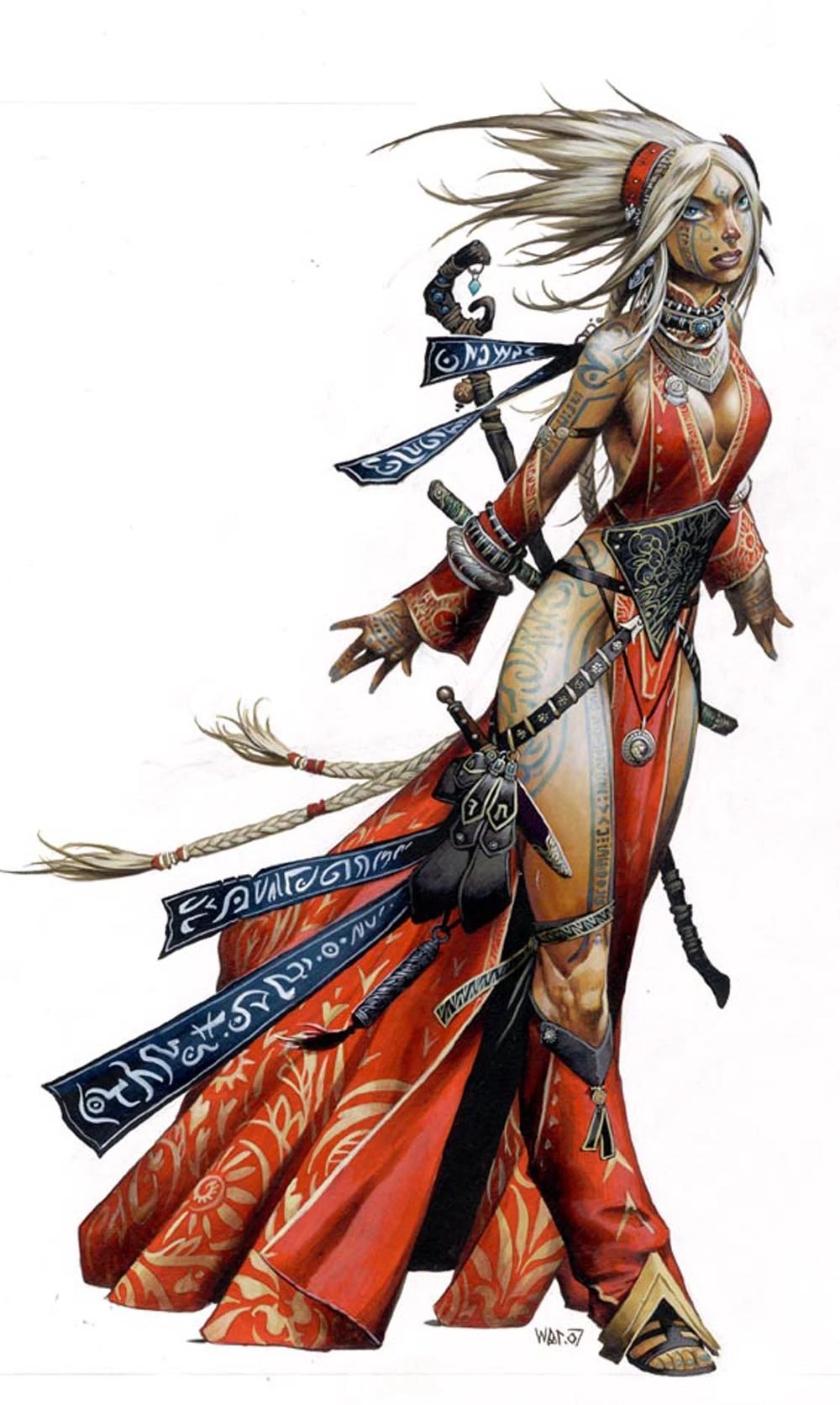
Sorcerer Seoni, one of the so-called iconics or iconic characters for Pathfinder, essentially the spinoff game from Dungeons & Dragons 3.5 edition, as she appears in her profile art from the Player’s Handbook – bringing the bling and booty to the schools of magic. I’m assuming she has to wear that for her magic to work.


8 D & D SCHOOLS OF MAGIC FOR BLING & BOOTY


No – we’re not talking about Hogwarts. We’re talking about the ‘schools’ of arcane power, classifying functional magic in fantasy by its type or effect. Now there’s probably as many such schools of magic as there are works of fantasy – black magic, blood magic, white magic, wild magic and so on – but perhaps the most comprehensive are the eight schools of magic in Dungeons & Dragons, at least in its peak 3.5 edition, which is not surprising for something that attempts to systematically codify the genre of fantasy for obsessive-compulsive rules-lawyering geeks to play as a game.


I mean, dear God, do the rules of chance need so many sides…or is that dimensions? And, dear God, what’s in the bag? WHAT”S IN THE BAG?! (Promotional image of GWHOLE brand D & D dice for sale on Amazon)


In the game, wizards can specialize in one of the schools of magic (at the expense of others), so it is a matter of some importance to pick the more powerful or versatile schools. However, this begs the most important question – for users of magic in the game or the genre of fantasy in general – which schools of magic are best for bling and booty (in every sense of the word)? After all, if you’re going to play with forces that put you at risk of some eldritch abomination sniffing out your scent, sucking out your soul with a straw and wearing your skin like a suit, then it better come with fabulous rewards – preferably the fantasy equivalent of the Fortune 500 and the Playboy Mansion. And just remember with the last, magic is equal opportunity – the sorceress Circe in Homer’s Odyssey essentially used her magic to have her own private island equivalent of the Playboy Mansion filled with her favorite, ah, manimals.

And so we take a stroll through the eight schools of magic, looking at which are the more powerful or versatile – including the extent to which they can effectively function as other schools of magic – and more importantly, which ones are the best for bling and booty…


The temptation of St Anthony is a subject recurring surprisingly often in art and literature, with one of the most famous being this painting by Salvador Dali in 1946 – not only my favorite painting on the subject (and one of my favorite paintings on any subject) but still my favorite representation of abjuration, although I don’t know how well it’s working for St Anthony here against Dali’s forces of temptation


(1) ABJURATION


This school of magic seems pretty straightforward – it…ah, abjures? Essentially, it is protective magic, and as such perhaps one of the oldest schools of magical thinking in actual history, going by the fancy name of apotropaic magic with our ancestors looking to it to protect themselves from various dire threats – and the most substantial one surviving into the present day, in all our various charms or rituals for luck. (And remember religion is just organized magic – and prayer plea-bargaining with the universe to break the rules in your favor. Yeah, I went there.)

Firstly, it protects from mundane threats – protection spells against arrows, fire and so on. In the Boxer Rebellion of 1899-1901 in China, the Boxers (or the much cooler sounding Society of Righteous and Harmonious Fists) believed their magic or supernatural power would make them invulnerable to bullets. (Spoiler alert – it didn’t).

Secondly, and perhaps more importantly, it protects from magic threats – although our ancestors often didn’t distinguish between mundane and magical threats, seeing one originate in the other – such as the various anti-magic spells in the Dungeons & Dragons game. Although frankly I think the spells in the game don’t go far enough, as they really should make magical creatures such as dragons or giants collapse of their own biological impossibility – a true anti-sorcerer should roam a fantasy world sucking in all and sundry like a magical black hole.

Now in the rules of the game, you can of course skip this school in preference for others, but in a world of monsters and magic you’d be better off walking around naked. (Frankly, if I lived in such a world, I’d have abjuration spells tattooed into my skin – or even if they worked in this world). A supreme abjurer could stroll through a pitched battle without a scratch – or sit sipping cocktails in Hell while all the demons drooled uselessly around him or her.

Of course, in a sense all magic is abjuration – abjuring or suspending the laws of time and space, which actually sounds like an interesting premise for magic in a fantasy story, casting spells by picking which laws to suspend, like gravity or thermodynamics…


BLING & BOOTY POTENTIAL


As essential as it is, the school of abjuration is not so much fantasy Fortune 500 material (unless you’re very good or lucky) as it is more the solid high-earning fantasy professional option – the sort where fantasy parents want their children to grow up to be abjurers like we do doctors, lawyers and engineers (although there’d probably also be abundance of crappy cut-rate abjurers just getting by flogging bug-ridden or pirated lucky charms). The primary market would be as security or defence contractors (although throw in some divination and you could double up as a security and insurance provider). As for booty, you’ll just have to rely on the nice suits you wear and good money you’ll make as a professional abjurer. Personally, I’d take the easy anti-sorcerer option of roaming the fantasy world, ransoming dragons of their hoards by threatening them with their own biological impossibility. (The Hobbit would have been over much quicker – just strolling up to the Lonely Mountain and going all Scrooge McDuck swimming in Smaug’s vault).


The archetypal conjuration of the hat trick – Zan Zig performing with rabbits and roses, magician poster 1899, Wikipedia “Hat trick (magic trick)” under licence https://creativecommons.org/licenses/by/2.0/deed.en


(2) CONJURATION


Now we’re playing with power – conjuration is such a ridiculously overpowered school of magic in the game of Dungeons and Dragons that you’d be better off cutting off your own hands than skipping it (as you could always conjure new or better hands anyway). It’s not hard to see why – conjuration is like pulling a rabbit out of a hat for real (or putting it back for that matter), if by rabbit you mean potentially any material thing or any being to do your bidding, and if by hat you mean potentially anywhere in space and time. And in fantasy, space and time can mean any fantasy ‘plane’ of existence – all the heavens or hells, spirit worlds, classical elemental planes (earth, air, fire, water) and so on.

Conjuration is one of the archetypal schools of magic in literature. Faust conjured Mephistopheles from hell and Aladdin conjured the genie from the lamp – those beings in turn pretty much conjured up their masters’ every desire or wish. Conjuration would be ridiculously powerful enough even just in our own space and time – imagine wizards plucking dinosaurs out of the past and throwing them at each other (which actually sounds like another interesting premise for magic in fantasy). Throw in other fantasy planes of existence and the multiverse is your oyster – a supreme conjurer could simply conjure up all the demons of hell to serve him or her cocktails…

Of course, ultimately all magic is a form of conjuration, in that you’re pulling something out of your own, or the universe’s, ass.


BLING & BOOTY POTENTIAL


Not surprisingly, this school of magic is a licence to literally print money – in that you can actually conjure money, or something to get it for you. Take gold for example – you could conjure it up from the earth’s crust or anywhere in the universe, the vaults of heaven or hell, the elemental plane of earth or for those familiar with the actual periodic table of elements, the elemental plane of gold. Or you could conjure up beings – earth elementals for example – to find and mine it for you.

Naturally the rules of Dungeons and Dragons try to place limits on their school of conjuration to avoid these shenanigans so, you know, players actually have to go into the eponymous dungeons to loot the eponymous dragons for gold (you know, like burglars and robbers) instead of conjuring it themselves (or something to go into the dungeons for them – or just conjure water to flood the dungeons and then stroll through them at leisure).

However, this is magic after all and the only real limit is your imagination – that and the massive inflation that would result from everyone conjuring their own money. Probably the major problem is that conjuring is kind of a cosmic borrowing, so that when the demons or otherworldly beings come knocking at your door to collect the debt, they’ll make your average knee-capping loan-shark goon look like a birthday strippergram. (Note to self – organize strippergram for birthday).

As for your own Playboy Mansion, you could literally conjure up your own mansion (or something to build it for you) – and then conjure up whatever angels or heavenly nymphs, succubi or incubi and otherworldly babes and hunks your heart desired. Of course, after a certain point, you could just rely on whatever fabulous wealth you’ve already conjured, as actual money has a power of conjuration all of its own…


“Lucky 8 Ball didn’t see that one coming!” – public domain image of Magic 8 Ball


(3) DIVINATION


And so we go from the flashy heights of conjuration to the subtle nuances of divination – this school of magic is essentially all about knowledge. As such, it rivals abjuration as one of the oldest schools of magic in actual history, as our ancestors sought magical means of knowing the unknown, from shamanic vision quests, through augurs and soothsayers, to hopelessly cryptic oracles. And like abjuration, it is the most substantial surviving into the present day, in the form of astrology, psychics and other frauds. (It’s my secret dream to walk in on a psychic, smack them in the head and say “Didn’t see that one coming!” – but I digress…)

There have been (and remains) an almost infinite variety of bewildering and surreal techniques of divination, including animal entrails, bird flights, tea leaves and basically any word ending in mancy – from dreamy oneiromancy (reading dreams or Freudian psychology) to the stuff of nightmares like arachnomancy (reading spiders – or dear God get that thing off me!).

Knowledge is power and divination is the ultimate source of magical knowledge – so much so that it is the one school of magic you can’t skip in Dungeons and Dragons, although you’d be better off blind than go without it anyway. (Indeed – there’s a long tradition of prophets and seers being blind or blindfolded for their ‘second sight’. And Odin, chief of the Nordic gods, plucked out one of his own eyes to drink from the fountain of wisdom, because the Nordic gods were hardcore – my money would be on them in an all-out smack-down brawl between pantheons).

Just knowing the past would be useful, knowing the present (particularly reading people’s minds) even more so and knowing the future would be approaching godlike power, as omniscience is next to omnipotence. A supreme diviner could walk through a pitched battle dodging everything without a scratch because he or she’s seen it all coming – or sit sipping cocktails served by demons in hell because he or she knows all their secret names and s€x tapes.


Clearly James Bond relies on divination for his uncanny luck in games of chance and villainous death traps

Clearly James Bond relies on divination for his uncanny luck in games of chance and villainous death traps (image of Daniel Craig as James Bond)


BLING & BOOTY POTENTIAL


Divination rivals conjuration as the jackpot of magic schools, unless your school of conjuration includes time travel. Again, even just knowing the past would be lucrative (not least in all the missing or lost secrets and treasures of the world), knowing the present even more so (not least as the ultimate insider trading) but knowing the future would be your licence to make money.

Even discounting such easy options as casinos, gambling and lotteries (which presumably would be abjured to the hilt in a fantasy world), there’d be the fabulous wealth to be made through markets and other business or political fields. Through divination, you would always be in the right place at the right time and cashing in your compound interest in the present. Basically, divination lets you steal from the future, not only having your cake and eating it but doing both before it’s even baked – like plucking Microsoft from the future mind of Bill Gates, just in time to sue him for copyright as the icing on the cake.

As for booty, apart from your fabulous wealth, you would also always be in the right place at the right time – with the perfect pickup line. Otherwise, you can always hang out with the freaky drugged and fantastically gymnastic oracle groupies from 300.


Preview images of two of the hypnotizers on the Hypnotizer app by SergioGF sold on Amazon – and fortuitously depicting two frequent images for hypnotism in popular culture (with the one on the left particularly being used for hypnotic or hypnotized eyes)


(4) ENCHANTMENT


There’s no nice way of saying this – enchantment is the school of magic for mindscrewing. It ranges from more benign charms for friendship or infatuation, through various forms of mind control or domination, to metaphorically riding your subjects like rodeo bulls or attaching the fuzzy dice of their testicles (or ovaries) to the rear view mirror of your mind…


Like so – in this photograph of fuzzy dice doing just that in a 1958 Ambassador photographed by CZmarlin – Wikipedia “Fuzzy Dice” under licence https://creativecommons.org/licenses/by-sa/4.0/deed.en


If your school of enchantment extends to memory, then you can up the ante from brainwashing to complete mindwiping, as you replace the previous inconvenient persona or psyche of your subject wholesale with one entirely of your own choosing – family, friend or lover who’ll do anything for you. In theory, this makes enchantment potentially the most powerful school of magic of all, as you could tell the very gods they should let you run the show.  A supreme enchanter could sit sipping cocktails in Hell served up by all the brainwashed demons.

In practice, apart from all the protective abjurations against it (screw you, mind blank!), there is the narrative need for enchantment to be severely nerfed for the sake of game or story, otherwise you’d simply mindscrew your way from one end of fantasy to the other or pilot your dragon like a drone through any dungeon. So this tends to be one of the weaker schools of magic you can skip in Dungeons and Dragons or any other fantasy, because anything powerful enough to be game or story breaking is immune or resistant to it. Otherwise, Gandalf would have just told Sauron to go jump like Gollum.

In a sense, the only real ‘magic’ is enchantment, as humanity finds a bewildering number of ways to enchant itself through religion, politics, money, fame, celebrity, love, sex…just take any cult.


BLING & BOOTY POTENTIAL


Obviously, if enchantment is opened up to its full potential in fantasy – or let loose in our world with no resistance against it – then this would be the ultimate jackpot. Even if others conjured more money and divined more profit or power, you’d simply enchant them into giving it to you – just like you’d simply enchant Bill Gates, Warren Buffet and Elon Musk into doing the same in this world. H. L. Mencken quipped that no one went broke or lost an election by underestimating the taste or intelligence of the average person – with enchantment, you’d just go that step further of making their taste and intelligence for them.

As for your own Playboy Mansion, you could let your enchanted fame and fortune work their own powers of enchantment, as indeed they did to fill the actual Playboy Mansion. With enchantment, however, you don’t have to wait. You could equally be able to just enchant it full of the subjects of your choice. Of course, while you’re doing all this, you may want to enchant away your own conscience as you enchant away other people’s minds.


One of the most famous D & D gaming memes and the motto of the evocation school – Glasstaff I Cast Fireball D & D sticker promotional profile image for sale on Amazon


(5) EVOCATION


And so we come to the Michael Bay school of magic – all explosive action, but lacking in depth or versatility. Evocation is the conjuration of energy – fireballs, lightning bolts, cold blasts and various other manifestations of energy or force – so something like the misnamed enchanter Tim firing off random blasts from his staff in Monty Python’s Holy Grail.

While it would be tempting in a fantasy world of hostile monsters and magic to be able to blast fireballs from your fingertips like six-shooters, evocation is actually one of the weaker schools of magic and the first one to skip in the game of Dungeons and Dragons. Even at its full strength, it obviously lacks versatility for anything else that doesn’t involve blasting or blowing things up (although in fairness that would seem to solve most plot problems in The Lord of the Rings) – and in the game of Dungeons and Dragons, it’s severely nerfed by all types of magic resistance so that your hardcore spells fizzle into a tickle or at most a moderate spanking. In theory, however, a supreme evoker should be a walking weapon of mass destruction and could sit sipping cocktails in Hell served up by spell-shocked demons after nuking or freezing it.

Of course, evocation is just the poor man’s conjuration anyway – it’s just conjuration of energy, people! Ignoring that matter is energy (E = mc2? I conjure thee from the elemental plane of uranium…), is there any real distinction between evoking fire for example and conjuring lava or molten metal or plasma or hellfire or elemental fire or so on from the myriad planes of fantasy? The only real distinction is that the game of Dungeons and Dragons split off the conjuration of energy as evocation so that the school of conjuration didn’t become even more ridiculously overpowered…


BLING & BOOTY POTENTIAL


Like abjuration (and unlike conjuration, divination or enchantment), you can’t simply evoke money and are sadly reduced to working with your magic, which kind of defeats the point of magic as wishful thinking or getting something from nothing. Fortunately, again like abjuration, evocation is the solid high-earning fantasy professional option, like the fantasy equivalent of engineers. Although that may be because I only have the vaguest idea of what engineers actually do…


Um, they do science to stuff? Public domain engineering logo


Actually, evokers are even better placed than abjurers to strike it rich as the entrepreneurs of energy in the fantasy world, particularly if they can replicate their magic in mass produced devices or items – it would be evokers who kick-start the fantasy equivalent of the Industrial Revolution, like magitek or dungeon punk. You know, like mass producing rings of power in The Lord of the Rings (“Precious?! Get over it, Gollum – they’re $39.99 a set at the Shire 7-11…”), instead of the elves hoarding all the magic.


One ring to rule the mall!

One ring to rule the mall! (Image of the One Ring in The Lord


Don’t get me started on the elves – they showed Sauron how to make the ring in the first place, then spend their time prancing about in forests or p!ssing off ‘west’ leaving men to clean up the mess. “I have no faith in men.” Shut up, Elrond – who’s manning your frontline for you, you smug elven pr!ck?.  But I digress.

As for booty, you will just have to rely on your skyrockets in flight for your afternoon delights…


Fraser spiral illusion (public domain image in Wikipedia article of that name)


(6) ILLUSION


Use your illusion – the school of magic for special effects or fantasy generated imagery. Quite simply, illusion is all about the magical control or manipulation of perception or sensation, so as to hopelessly blur the line between image and reality. And that’s just for starters – with illusion, you can effectively trap your subjects in their own head, like a drug trip or the Matrix or scientists juicing up rats through the pleasure centers of their brains.

In other words, illusion can be virtually as effective for mind control as enchantment, given the fine line between our perceptions or sensations and our emotions, thoughts or memories. You can use it to assume the appearance of a close friend, family member or lover. The supreme illusionist could sit sipping cocktails in Hell, served up by deluded demons thinking they’re serving their infernal master – or just look like they’re doing it.

Sadly, this is why illusion tends to be nerfed like enchantment in fantasy games or stories, although it is somewhat less game or story-breaking and has more potential for plot devices (as well as clichéd it-was-all-a-dream sequences). So once again, there is an abundance of protective abjuration against it (screw you, true seeing!) and anything powerful tends to be immune or resistant to it. And given that illusion is all style over substance, you’re more screwed than the Wizard of Oz if they start looking behind the curtain.

Of course, all magic in our world is ultimately only illusion – sleight of hand or smoke and mirrors. Or if we’re going to get philosophical, all our perception of reality is illusion, as in the Hindu concept of maya. (Sometimes I think my whole life has been an illusion but then I’m pretty sure my life is real because no one would make an illusion this pointless and boring.) On the other hand, the fantasy school of illusion is really just enchantment – or vice versa. Is there any real distinction between controlling perceptions or sensations and controlling emotions or thoughts, given how they each influence the other? For example, is there any real difference between turning invisible by illusion – or enchanting people that they don’t see you?


BLING & BOOTY POTENTIAL


If illusion is opened up to its full potential or let loose in our world with nothing to resist it, then you could effectively use it to enchant your way to fame and fortune – especially in a world where life is essentially a beauty contest anyway. At very least, you could have a wild ride as a con artist – using ticket stubs or toilet paper as money or winning lottery tickets. Alternatively, you could use your illusion as a solid high-earning fantasy profession or business, particularly if you could mass-produce it – the fantasy equivalent of advertising (“Your ad on every dragon’s ass”), cosmetics and cosmetic surgery, entertainment or anything involving appearance or imagery. Personally, I’d use my illusion for the fantasy equivalent of internet p0rn. (“She was an innocent young paladin, pursuing her quest in the Hot Tub of Doom…”). As for your Playboy Mansion, you are the ultimate photoshopper, so you can give yourself or your housemates any appearance you or they choose…


A lich – arguably the peak of necromancy – as represented in the profile image for lich from the D&D Beyond online resource


(7) NECROMANCY


Come to the dark side of the Force or the Slytherin school of magic. Technically, necromancy is divination by talking to the dead or their spirits (hence the name). However, necromancy has accrued wider meanings of dealing with the dead or death – typically animating the dead and creating or controlling undead. Funnily enough, in the game of Dungeons & Dragons, it is generally observed that because of the mechanics of play, clerics or priests make better necromancers than wizards, which would certainly make for far more interesting church services.

Necromancy also tends to involve magic to do with souls or spirits (as in taking or trapping them) and ‘negative’ energy – blight, curse, fear, hex, paralysis, poison and just outright draining life energy like siphoning gas. So it may not be particularly versatile but it does tend to be powerful, and of course, evil – as in EEEVIL (although arguably it could be neutral, like death itself, or even a weird form of good – but where’s the fun in that?). Sauron wasn’t just the Necromancer in The Hobbit for kicks.

A supreme necromancer is a walking ground zero of zombie apocalypse or god of death – and could sit sipping cocktails in hell because the demons think he or she is cool. And old necromancers don’t retire, they become undead themselves – vampires are the popular choice, although the true necromancy geek goes lich.


BLING & BOOTY POTENTIAL


Let’s face it – if you go with necromancy, you’re looking at a career in fantasy supervillainy or at least doctorate of fantasy evil, and chances are you’re in it for love of evil lulz rather than money. So while there may be other more imaginative ways of making money from necromancy, the most easy or obvious is as the fantasy equivalent of Blofeld in SPECTRE (bonus points if that involves actual spectres), stroking your mummified cat. And again, there may be more subtle nuances of necromantic villainy, you just can’t beat the fantasy classic of threatening to unleash your zombie apocalypse unless the kingdom pays you one million gold pieces – or you know, actually unleashing your zombie apocalypse as you carve out your unholy roaming empire.

Sadly however, necromancy is not the school for building your own Playboy Mansion, with the exception of the s€xier ghosts or vampires – although at least your undead minions will always be, ah, thin?


King Harold in his classic transformation scene back into a frog in the Shrek 2 film – itself obviously an adaptation of the classic (cursed) fairy tale transmutation of The Frog Prince. Now that I think of it, I never realized how much the plot of both films revolved around transmutation


(8) TRANSMUTATION


Finally, there is transmutation – a ridiculously overpowered school of magic to rival or even exceed conjuration. Instead of conjuring material things or beings (potentially including yourself) through space, time or fantasy planes, this school of magic transforms (or transmogrifies – whoa!) material things or beings (potentially including yourself) into other material things and beings of your choice.

Like conjuration, it is one of the archetypal schools of magic in literature. Zeus showcased it by turning himself into animals to pick up chicks. It totally worked too, although you have to admit it would be pretty impressive if you could pull it off. Zeus’ one night stands read like a menagerie of seduction (as well as the entire genealogy of Greece) – bull, eagle, goat, snake, swan and on one particularly kinky occasion a shower of gold.

Speaking of which, transmutation has had a long-standing reputation in actual human history, as the humanity saw the best minds of many generations destroyed by the madness of alchemy, or trying to transmute lead into gold.


Because Leadfinger just doesn't have the same ring

Because Leadfinger just doesn’t have the same ring to it (iconic scene of Jill Masterson killed by gold paint in the 1964 James Bond film Goldfinger)


So transmutation is almost limitlessly powerful and versatile – a supreme transmuter could sit sipping cocktails in Hell, because otherwise he or she will transform all the demons into frogs or little lambs or Playboy bunnies (or himself or herself into the biggest, baddest demon of all). Or just sit around anywhere – turning everyone else into demon cocktail waiters and waitresses.


BLING & BOOTY POTENTIAL


By now, it should be obvious that transmutation is as much a fantasy jackpot as conjuration – or more so, as it’s without the cosmic borrowing (or loan-sharking). Like King Midas, you can turn whatever you touch (or look at) into gold – or whatever you choose. Or for that matter, it knocks illusion out of the ballpark, because you can change things in reality not just appearance. What more do I need to say? Again, naturally the rules of Dungeons and Dragons try to place limits on their school of transmutation for the sake of the game, but it is magic after all.

As for your own Playboy Mansion, you could literally just transform any slum into your mansion – and anyone or anything into your Playmates. Your Playboy bunnies could have been actual bunnies just a moment ago. Indeed, people would probably line up to pay you for it and you could make your fortune from cosmetic transformation alone…



Stark Ravings – 8 D&D Schools of Magic for Bling & Booty (8) Transmutation

King Harold in his classic transformation scene back into a frog in the Shrek 2 film – itself obviously an adaptation of the classic (cursed) fairy tale transmutation of The Frog Prince. Now that I think of it, I never realized how much the plot of both films revolved around transmutation


(8) TRANSMUTATION


Finally, there is transmutation – a ridiculously overpowered school of magic to rival or even exceed conjuration. Instead of conjuring material things or beings (potentially including yourself) through space, time or fantasy planes, this school of magic transforms (or transmogrifies – whoa!) material things or beings (potentially including yourself) into other material things and beings of your choice.

Like conjuration, it is one of the archetypal schools of magic in literature. Zeus showcased it by turning himself into animals to pick up chicks. It totally worked too, although you have to admit it would be pretty impressive if you could pull it off. Zeus’ one night stands read like a menagerie of seduction (as well as the entire genealogy of Greece) – bull, eagle, goat, snake, swan and on one particularly kinky occasion a shower of gold.

Speaking of which, transmutation has had a long-standing reputation in actual human history, as the humanity saw the best minds of many generations destroyed by the madness of alchemy, or trying to transmute lead into gold.


Because Leadfinger just doesn't have the same ring

Because Leadfinger just doesn’t have the same ring (iconic scene of Jill Masterson killed by gold paint in the 1964 James Bond film Goldfinger)


So transmutation is almost limitlessly powerful and versatile – a supreme transmuter could sit sipping cocktails in Hell, because otherwise he or she will transform all the demons into frogs or little lambs or Playboy bunnies (or himself or herself into the biggest, baddest demon of all). Or just sit around anywhere – turning everyone else into demon cocktail waiters and waitresses.


BLING & BOOTY POTENTIAL


By now, it should be obvious that transmutation is as much a fantasy jackpot as conjuration – or more so, as it’s without the cosmic borrowing (or loan-sharking). Like King Midas, you can turn whatever you touch (or look at) into gold – or whatever you choose. Or for that matter, it knocks illusion out of the ballpark, because you can change things in reality not just appearance. What more do I need to say? Again, naturally the rules of Dungeons and Dragons try to place limits on their school of transmutation for the sake of the game, but it is magic after all.

As for your own Playboy Mansion, you could literally just transform any slum into your mansion – and anyone or anything into your Playmates. Your Playboy bunnies could have been actual bunnies just a moment ago. Indeed, people would probably line up to pay you for it and you could make your fortune from cosmetic transformation alone…


Stark Ravings – 8 D & D Schools of Magic for Bling & Booty (7) Necromancy

A lich – arguably the peak of necromancy – as represented in the profile image from the D&D Beyond online resource (fair use)


(7) NECROMANCY


Come to the dark side of the Force or the Slytherin school of magic. Technically, necromancy is divination by talking to the dead or their spirits (hence the name). However, necromancy has accrued wider meanings of dealing with the dead or death – typically animating the dead and creating or controlling undead. Funnily enough, in the game of Dungeons & Dragons, it is generally observed that because of the mechanics of play, clerics or priests make better necromancers than wizards, which would certainly make for far more interesting church services.

Necromancy also tends to involve magic to do with souls or spirits (as in taking or trapping them) and ‘negative’ energy – blight, curse, fear, hex, paralysis, poison and just outright draining life energy like siphoning gas. So it may not be particularly versatile but it does tend to be powerful, and of course, evil – as in EEEVIL (although arguably it could be neutral, like death itself, or even a weird form of good – but where’s the fun in that?). Sauron wasn’t just the Necromancer in The Hobbit for kicks.

A supreme necromancer is a walking ground zero of zombie apocalypse or god of death – and could sit sipping cocktails in hell because the demons think he or she is cool. And old necromancers don’t retire, they become undead themselves – vampires are the popular choice, although the true necromancy geek goes lich.


BLING & BOOTY POTENTIAL


Let’s face it – if you go with necromancy, you’re looking at a career in fantasy supervillainy or at least doctorate of fantasy evil, and chances are you’re in it for love of evil lulz rather than money. So while there may be other more imaginative ways of making money from necromancy, the most easy or obvious is as the fantasy equivalent of Blofeld in SPECTRE (bonus points if that involves actual spectres), stroking your mummified cat. And again, there may be more subtle nuances of necromantic villainy, you just can’t beat the fantasy classic of threatening to unleash your zombie apocalypse unless the kingdom pays you one million gold pieces – or you know, actually unleashing your zombie apocalypse as you carve out your unholy roaming empire.

Sadly however, necromancy is not the school for building your own Playboy Mansion, with the exception of the s€xier ghosts or vampires – although at least your undead minions will always be, ah, thin?