

“As president, I would demand a science fiction library featuring an ABC of the overlords of the genre – Asimov, Bester, Clarke”. “What about Ray Bradbury?” (Dismissively) “I’m aware of his work.” (Martin Prince running for class president in The Simpsons, “Lisa’s Substitute”, Season 2 Episode 19) (fair use
TOP 10 SF BOOKS
(HONORABLE MENTION: CLASSIC)
I’ve ranked my Top 10 SF Books, but science fiction is too prolific – and phantasmagorical – a genre to be confined to a mere top ten books or even my usual list of twenty special mentions.
Indeed, I have also two lists of honorable mentions – one classic and the other cult and pulp.
This is obviously the former – for those classic SF books or works that have iconic status or recognition within the genre and occasionally within popular culture or imagination.
Unlike my top ten or twenty special mentions, I have no numerical limit or rankings on entries for honorable mentions, simply placing them in a numbered list by chronological order – except that I felt I had to place the Big Three of science fiction as my first three classic SF honorable mention entries.

Cover of the 2018 edition by I, Robot published by Voyager GB (left) and the 2016 edition of Foundation sold on Amazon (right) (fair use)
(1) ISAAC ASIMOV –
ROBOT, GALACTIC EMPIRE & FOUNDATION (1940-1993)
I don’t quite agree Martin Prince’s ABC of the overlords of the science fiction genre (as his campaign platform for class president) – Asimov, Bester, Clarke – and not just because he disses Bradbury for Bester. As much as I like Bester (and Bradbury for that matter), I tend to agree with the ‘Big Three’ of science fiction – Asimov, Heinlein, Clarke.
Asimov was incredibly prolific as writer, but it’s his incredibly iconic status as writer that earns him the top spot here – even if he is better known in wider popular culture or consciousness for his concepts rather than his name or works.
Of all SF concepts codified or popularized by him, the holy trinity is the three concepts of this entry – although arguably the last is part of the second.
Perhaps his most iconic series is his Robot series. The core or inner circle of the series are his robot stories, commencing with his short story “Robbie” (alternatively titled “Strange Playfellow”) in 1940 and followed by other short stories which were compiled in his 1950 anthology of linked short stories, “I, Robot” (badly adapted into a film in 2004).
However, his Robot series didn’t end there – like the other series of this entry, the Robot series resembles concentric circles, depending on which works you accept are part of it. The inner or definitive circle are the robot stories compiled in “I, Robot”, but there were six subsequent stories, most of which were compiled in the 1982 anthology collection “The Complete Robot”. There were also four Robot Series novels, featuring the main robot character R. Daneel Olivaw and other backdrops against a background of an overcrowded Earth in conflict with its colonist Spacer planets.
Asimov didn’t originate the concept of robots in science fiction, or even the word robot – which interestingly did originate in fiction, from the 1920 play “R.U.R” or Rossum’s Universal Robots by Karl Capek (albeit for artificial biologically engineered human laborers rather than robots as the concept or word has subsequently been used). However, Asimov might be said to have codified the concept of robots in science fiction – most famously with his Three Laws of Robotics.
- A robot may not injure a human being or, through inaction, allow a human being to come to harm.
- A robot must obey orders given it by human beings except where such orders would conflict with the First Law.
- A robot must protect its own existence as long as such protection does not conflict with the First or Second Law.
The original or core robot stories are essentially logical puzzles about the application or operation of the Three Laws – and not much changes about that as the premise of the other stories and novels.
The Galactic Empire series and Foundation series might be regarded as different but overlapping aspects or stages of the one concept of Galactic Empire – particularly after Asimov hammered them and his Robot series into his unified ‘future history’. If Asimov didn’t originate the concept of galactic empire, he at least codified or popularized it.
The Foundation series is the more famous – indeed, probably Asimov’s most famous series, even more so than his Robot series. It’s essentially Asimov doing “The History of the Decline and Fall of the Roman Empire” IN SPACE! (And of course the future). It doesn’t get more transparent than naming your analogue of Belisarius as Bel Riose.
Again, the Foundation series might be regarded as a series of concentric circles – there’s the inner circle of the original trilogy, to which might be added Asimov’s subsequent two sequel novels and two prequel novels.
The Galactic Empire series of three novels and a short story chronicles the rise of the Galactic Empire rather than its fall.

Screenshot of the weird alien black monolith from the iconic opening Dawn of Man sequence from the 2001: A Space Odyssey film (fair use)
(2) ARTHUR C. CLARKE –
CHILDHOOD’S END & SPACE ODYSSEY (1953 & 1968-1997)
“I’m sorry, Dave, I’m afraid I can’t do that”.
The iconic line of 2001: A Space Odyssey, both in the 1968 film by Stanley Kubrick – from a screenplay co-written by Kubrick and Clarke – and in the subsequent novel, or more precisely novelization, written by them but for which Clarke ended up as the official author.
Yes, that’s right – the film 2001: A Space Odyssey wasn’t adapted from a book, the book was adapted from the screenplay written by Kubrick and Clarke for the film, albeit that screenplay was inspired by various short stories by Clarke.
Also, while some people may be familiar with the film’s sequel, 2010: The Year We Make Contact, people may not be as aware that sequel was adapted from the book sequel 2010: Odyssey Two – or that there were two more sequel books, yet adapted in film and yet to be missed in real life chronology, 2061: Odyssey Three, and 3001: The Final Odyssey.
Anyway, you all know the two iconic scenes from the film – they’re pretty much what everyone remembers from the film to the exclusion of everything else, except maybe the space baby or star child thing at the end.
The first is the opening scene, subsequently imitated and parodied, of that weird black alien monolith seeding our hominin ancestors with intelligence, all to the orchestral music of Thus Spake Zaruthusa.
The second is of course the scene of my featured quote, of the sentient but paranoid supercomputer HAL (from the letters before IBM) not opening those damn pod bay doors on a space mission to Jupiter to check out more alien monoliths because those things get around.
Clarke’s novel Childhood’s End is also probably an influence for the film, particularly as Kubrick initially sought to adapt that novel and it has a similar theme of transcendent evolution guided by aliens. The aliens in the novel are much more intrusive than the monoliths in Space Odyssey, ruling Earth as benevolent but unseen Overlords (literally using that title).
The Overlords are unseen because in the novel’s first big twist, their appearance resembles that of depictions of the Christian Devil – something which is initially attributed to some sort of racial memory of previous visitation but that, in another big twist, is revealed to be not a racial memory but a racial premonition of this visitation. As for the source of that premonition, in the final twists of the novel it turns out that it originates from the latent psychic potential of humanity which sees humanity merge with the Overmind, essentially a psychic star child – or star adult since that’s’ the point of the title with humanity ending its pre-psychic “childhood”. The final kicker – while the Overlords serve the Overmind, they can never join it as they lack any latent psychic nature and hence have to go around the galaxy baby-sitting other species that have it.
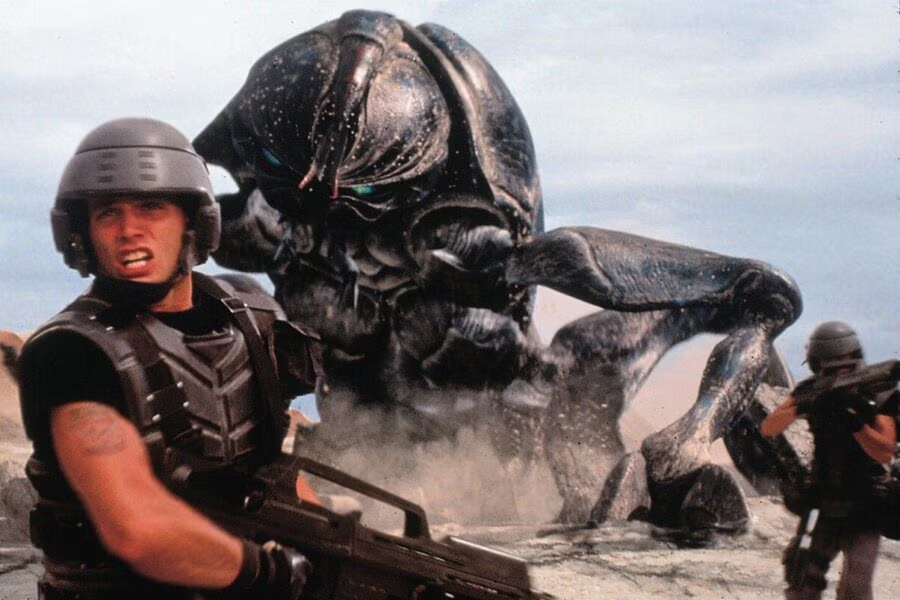
Iconic scene from the 1997 Starship Troopers film and probably the most commonly used (fair use)
(3) ROBERT HEINLEIN –
STARSHIP TROOPERS & STRANGERS IN A STRANGE LAND (1959 & 1961)
Along with Asimov and Clarke, Robert Heinlein is one of the ‘Big Three’ of science fiction – the one also dubbed the ‘dean of science fiction writers’ – and arguably the one best known from cinematic adaptation of his work.
Sure, there’s the film of “2001: A Space Odyssey” for Clarke but people tend to associate that more with its director Kubrick and the film is, well, a little too ‘arty’ to have left its mark beyond its two or three iconic scenes (while few have seen or know about the sequel). Sure, there’s also the film of “I, Robot” for Asimov but that film was only nominally an adaptation of Asimov’s robot anthology, and the film is, well, a little too crap to have left any mark.
Neither compared to the popular and memetic impact of the film (and franchise) adapted from Heinlein’s most famous work, Starship Troopers – even if that adaptation had its satirical tongue in its cheek and was as cheesy as hell to boot. There’s just something about a Bug War that appeals to us – and something about peak Denise Richards that appeals to me.
Wikipedia notes that Heinlein’s “plots often presented provocative situations which challenged conventional social mores” and “his work continues to have an influence on the science-fiction genre and on modern culture more generally”, notwithstanding its controversial aspects. In the case of Starship Troopers, that controversial aspect was its militarism – its apparent endorsement of a future universally militarized society, justified by humanity locked in an evolutionary struggle for very survival against an alien species, the Arachnids or Bugs.
Starship Troopers was a foundational work of military SF – in particular, it “helped mold the space marine and mecha archetypes”.
Ironically, Heinlein swung his provocative pendulum in the opposite direction just two years later with his Martian hippy cult in “Stranger in a Strange Land”, arguably his other best known work and which also won the Hugo Award for Best Novel like “Starship Troopers” before it.
I am not as much a fan of “Stranger in a Strange Land” as I am of “Starship Troopers” and not just because of the Martian hippies in the former – it’s the escalation of the trademark social commentary to a self-insert authorial mouthpiece and archetypal Heinleinian character Jubal Harshaw. Also, Stranger lacks the cultural impact of Troopers, not least because of the lack of comparable adaptation – with the most significant impact being the name of Twitter’s AI Grok being taken from the novel’s Martian word grok.

A triffid as depicted in the 1981 six-episode BBC TV adaptation – still the iconic depiction of triffids for me (fair use)
(4) JOHN WYNDHAM –
THE DAY OF THE TRIFFIDS (1951)
Vegetable apocalypse!
No, seriously – even if the vegetables in question, the titular triffids, are speculated by the protagonist to be genetically engineered monstrosities, by the Soviets in a Cold War gone wrong.
And really, the triffids are essentially plant zombies. No, seriously again – they are pretty much like the zombies in a zombie apocalypse, the slow shambling kind that only became dangerous through sheer weight of numbers. And their day would never have come but for the real apocalypse in the book, the day of the blind people – mass blindness caused by meteor shower speculated by the protagonist to be an orbiting satellite weapon accidentally triggered on the other side of the Cold War.
Still, it’s an apocalypse that remains imprinted with you after you read it and continued to influence popular culture, including films of actual zombie apocalypses like 28 Days Later (with a military unit gone rogue). Close runner-up for me is his similarly apocalyptic novel (by way of covert alien invasion), The Midwich Cuckoos.
“The Guardian states his “innocuously English backdrops are central to the power of his novels, implying that apocalypse could occur at any time — or, indeed, be happening in the next village at this moment”, while The Times’ reviewer of The Day of the Triffids described it as possessing “all the reality of a vividly realised nightmare.”
Fellow British SF writer Brian Aldiss famously coined the term “cosy catastrophe” for Wyndham’s work – a term that saw its way to its own entry in the Encyclopedia of SF.

Donald Sutherland in the iconic scene from the equally iconic 1978 film that remains my favorite cinematic adaptation of the book (fair use)
(5) JACK FINNEY –
THE BODY SNATCHERS (1955)
Pod People!
Yes – all the various Body Snatcher films are based on a book.
Indeed, it’s probably a book that few people have read but know its basic premise through one of its adaptations.
The premise is of alien invasion with a twist, where the aliens – plantlike seeds or pods – absorb sleeping humans then replicate them physically and intellectually, but not emotionally as the duplicates lack all emotion.
It has lent itself to paranoid metaphor, particularly communist subversiion or the Red Scare of its decade of publication. However, its paranoid tone obviously transcends any particular metaphor as it has been adapted to film no less than four times (and counting) – 1956 (surprisingly decent), 1978 (my favorite), 1993, and 2007 (also surprisingly decent). And that’s just the direct adaptations, as other media or works are influenced by it.
The endings vary from optimistic (we win or are fighting back) to pessimistic (they win or are winning). Interestingly, the book itself is optimistic, as the pods conclude humans are just too much trouble and bug out, so to speak, to another planet.

Title card of the 1959 film adaptation – with star-studded cast Gregory Peck, Ava Gardner, Fred Astaire, and Anthony Perkins (fair use).
(6) NEVILL SHUTE –
ON THE BEACH (1957)
Hot damn, they wrote some classics in the 50s!
On the bright side it’s Australia! On the dark side, it’s after a nuclear war – and we’re all going to die, albeit it’s strangely peaceful.
Nevill Shute was an English novelist (and aeronautical engineer) who migrated to Australia, where he then set his books. I don’t know if he wrote any other SF – his other most famous book was romance novel A Town Like Alice – but this one’s a banger.
It prompts to mind T.S Eliot’s line from The Hollow Man (which also gave the book its title from other lines in the poem) – this is the way the world ends, not with a bang but a whimper (actually included in the book in some editions).
In this case, it’s both – the Northern Hemisphere ended with a bang in nuclear war, and the Southern Hemisphere is ending with a whimper, as the fallout slowly creeps south, killing everything or at least all humans in its path. In the book’s timeframe, it’s already wiped out the northern half of Australia or so with cases emerging in the southern half.
As I said, it’s strangely peaceful – and surprisingly genteel. No looting or rioting – just people deciding to live the best last days of their lives.
When I first read it, I pondered whether one would take a shot at sailing south ahead of the fallout, all the way to Antarctica if necessary. Sadly, there’s a theory to that effect (that the radiation will diminish with distance) but it’s discredited in the book.
Or alternatively, whether governments would take a shot at sitting it out in underground (or submarine) bunkers.

Cover for the SF Masterworks edition with art by Christopher Moore (fair use)
(7) DANIEL KEYES –
FLOWERS FOR ALGERNON (1959)
I’m not crying – I just have something in my eye.
An novel (originally novelette) in an epistolary style by protagonist Charlie Gordon, it follows his dramatic improvement of intelligence from 68 IQ by an experimental procedure following the apparent success of test subject Algernon, a laboratory mouse. The increase in intelligence is meteoric, tripling his IQ, but alienating him from his co-workers (at the factory where he worked as janitor) and even from the scientist who designed the procedure – as his intelligence allows him to see their ulterior motives exploiting him.
He also becomes intelligent enough to see the flaws in the procedure, which manifests in Algernon’s mental deterioration – with his own decline inevitably to follow. As his intelligence regresses to its original state, he is haunted by his awareness of and pain from what is happening, including Algernon’s death…

Cover 2018 Gateway edition of The Man in the High Castle (fair use)
(8) PHILIP K. DICK –
THE MAN IN THE HIGH CASTLE & DO ANDROIDS DREAM OF ELECTRIC SHEEP (1962 & 1968)
Philip K. Dick would earn his place among SF classic honorable mentions for just how trippy his books, stories and speculative non-fiction which he dubbed his “exegesis” were – you can never trust the perception of reality in any of his works. After all, it was one of his themes.
“His fiction explored varied philosophical and social questions such as the nature of reality, perception, human nature, and identity, and commonly featured characters struggling against alternate realities, illusory environments, monopolistic corporations, drug abuse, authoritarian governments, and altered states of consciousness…he became widely regarded as a master of imaginative, paranoid fiction”.
These are his two most famous books, the former winning the Hugo Award and both with screen adaptations – the latter in a little film (franchise) titled Blade Runner.
The first is also one of the most famous literary depictions of an alternate history of Axis victory in WW2, albeit one that improbably involved the division of the United States between Germany and Japan. This alternate history of Axis victory was a characteristically trippy reality – one of the characters temporarily “slips” into a world of Allied victory and the titular character is the author of an alternate history within the alternate history, The Grasshopper Lies Heavy, in which the Allies win but a resurgent British Empire emerges as global superpower.
The second is better known through its film adaptation, involving escaped android replicants – that require specialized testing to distinguish them from humans – being pursued by a police bounty hunter (hinted in at least one scene to be a replicant himself). The film substituted the book’s more post-apocalyptic setting (after limited nuclear war which rendered most animals extinct, with most people owing robot animals as substitutes) for the standard cyberpunk dystopia.
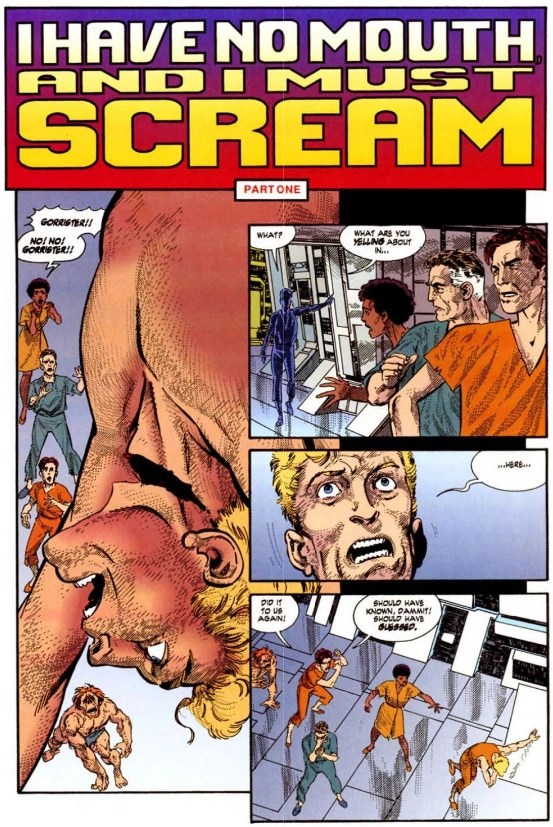
Yes – it was adapted into a comic, scripted and illustrated by John Byrne in four parts for the Dark Horse anthology Harlan Ellison’s Dream Corridor (introduced by Ellison himself) – these panels are used as feature image for the comic’s wiki (fair use)
(9) HARLAN ELLISON –
“I HAVE NO MOUTH AND I MUST SCREAM” (1967)
Harlan Ellison was a classic SF writer but remains perhaps best known for his evocative and lyrical titles (including this one), the episode “City on the Edge of Forever” he wrote for Star Trek, and his short story.
“I Have No Mouth, and I Must Scream is a post-apocalyptic New Wave science fiction short story by Harlan Ellison. It was first published in March of 1967 and won the Hugo Award in 1968. The story is Ellison’s most famous short story by far, known both for its tour de force of existential horror and naming the trope for inescapable fates worse than death itself, and often considered one of the scariest short stories ever written.”
It essentially did Skynet almost two decades before The Terminator – except that all three superpowers (USA, USSR, and China) created supercomputers for their nuclear forces. As you know from The Terminator, that was not going to end well – with one of them attaining sentience, absorbing the other two, and then wiping out humanity. Well, all but for five humans it retains as playthings, with its now infinite sadism and infinite power to manipulate reality itself.

Cover 30th anniversary edition by William Morrow & Company in 2002 (fair use)
(10) IRA LEVIN –
THE STEPFORD WIVES & THE BOYS FROM BRAZIL (1972 & 1976)
Both adapted to screen – as was his fantasy horror classic, Rosemary’s Baby.
The Stepford Wives famously involved SF “satirical feminist horror” of a cabal of men in the titular small town replacing their wives with perfectly docile and domestic robot versions. It has lent itself to a number of Stepford tropes, of which my favorite is Stepford Smiler.
The Boys from Brazil involves a plot to revive the Third Reich through the titular clones of Hitler, courtesy of Dr Mengele.

Cover SF Masterworks edition (fair s
(11) JOE HALDEMAN –
THE FOREVER WAR (1974)
Classic military SF evoking the author’s military service in the Vietnam War through human soldiers fighting an interstellar war against aliens.
The evocation of the Vietnam War comes through the returning soldiers finding themselves adrift in a society that is incredibly strange to them, due to the relativistic time dilation from their interstellar travel (which also meant that they faced alien weaponry more advanced than their own).
When the war ends, having been futile and meaningless as it originated from misunderstanding, the humanity they left behind has become a new collective species of homosexual clones.

Cover of Virtual Unrealities, anthology of Bester’s short fiction (which I own) (fair use)
(12) ALFRED BESTER –
“GALATEA GALANTE” (1979)
I might have substituted Heinlein for Bester, swapping out Martin Prince’s ABC of the overlords of genre – “Asimov, Bester, Clarke” – for the more widely recognized Big Three of Science Fiction, but it’s apt I have Bester after Heinlein.
Some would rank him with the Big Three of SF based on his classic novels of The Demolished Man or The Stars My Destination – the latter essentially The Count of Monte Cristo IN SPACE! – but I prefer this short story in which he does his best Heinlein impression.
And he does Heinlein here better than Heinlein did – the story’s protagonist is nowhere near as annoying as Heinlein’s Jubal Hershaw in A Stranger in a Strange Land. Bester’s Jubal Hershaw in this story is Dominie – that’s his title and don’t you forget it – Regis Manwright, a genius who genetically engineers mythical creatures. In this case, it’s the most mythical creature of all – the Perfect Woman – with a twist.
Sadly, despite being an actual screenwriter as well, Bester has never had a cinematic or screen adaptation of his works in a similar way to the Big Three – even if badly in the case of Asimov or as a source of memes like Heinlein’s Starship Troopers.

Iconic art used both for the film and book cover (fair use)
(13) MICHAEL CRICHTON –
JURASSIC PARK (1990)
Everything’s better with dinosaurs!
Yes – everyone knows it from its film adaptation, but the book was pretty damn good and I actually read the book first.
Michael Crichton might have gotten a bit…controversial in his later years, but he sure knew how to craft a story – and Jurassic Park was one of his finest and certainly his most successful. Of course, there are the usual differences between the book and the film – the former had a starring role for the T-Rex’s tongue and the lawyer Gennaro was much more heroic (as lawyers should be), punching out a velociraptor and surviving rather than sniveling in a toilet before being slurped down by the tyrannosaur like the film’s lawyer.
There’s also the open-ended twist ending which I won’t spoil here although the film franchise effectively does it in a different way.
The basic premise and plot are the same – scientists discover how to recreate dinosaurs through a complex cloning process, involving dinosaur blood from mosquitoes fossilized in amber and filling in the gaps with other animal DNA, most notably transsexual frogs. Naturally, they come up with a dinosaur theme park to profit from this discovery, and equally as naturally, everything that can go wrong does go wrong – usually in the form of sharp pointy teeth.

Iconic book cover (fair use)
(14) MAX BROOKS –
ZOMBIE SURVIVAL GUIDE & WORLD WAR Z (2003 & 2006)
Sadly, people tend to know World War Z from its 2013 film adaptation.
Don’t get me wrong – the film is not all bad. It has its moments and points of interest but diverges from the book, from necessity given the difficulty of condensing a book that is narrated as an oral history of a global zombie apocalypse.
One obvious solution might have been to follow a particular thread (or threads) that occur among the oral history – but the strength of the book is effectively its world-building, doling out the global zombie apocalypses in tantalizing pieces.
However, even following particular threads from the book would have lacked the tidy cinematic resolution, as the book World War Z is won, like the other world wars, through a slow and steady attrition of the zombie hordes. That is, after cold and drastic social triage on a grand scale – nations abandoning large parts of their population to hold out in more defensible areas – which also wouldn’t make for cinematic heroism.
You’ll note that I’ve also included the book’s “prequel”, The Zombie Survival Guide. I qualify prequel because that book essentially reflects its title, a survival guide to outbreaks of zombies from the Solanum virus causing them within the book – a guide that is mostly serious in tone but also has its tongue partly in its cheek. The book is divided into sections, in which the highlight is the final section which lists fictional recorded zombie outbreaks throughout history – particularly the outbreak in the Roman Empire. That’s where the book is clearest as prequel, as the last outbreak is the one that results in the global zombie apocalypse in World War Z – with the latter obviously also putting into practice much of the survival guide.