
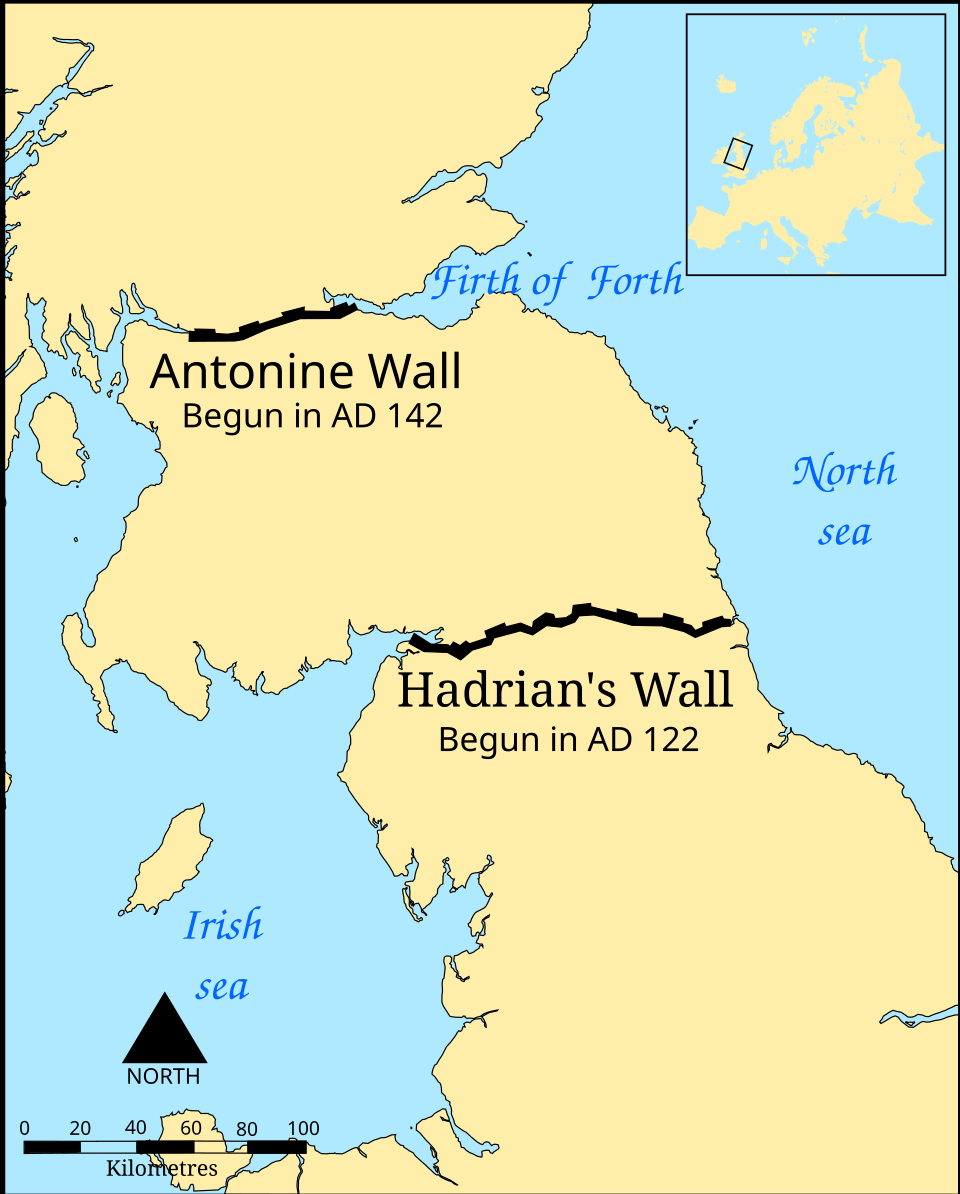
The periphery of the periphery in the Roman Empire, which arguably might have been better off without its province of Britannia – Hadrian’s Wall was peripheral and the Antonine Wall was even more peripheral. Map created by Norman Einstein in Wikipedia “Hadrian’s Wall” licensed under https://creativecommons.org/licenses/by-sa/3.0/deed.en
(2) IMPERIAL CORE & PERIPHERY
A highly politicized concept but still useful as a characteristic or feature of empires and imperialism.
Although, isn’t it obvious? After all, won’t all empires have an imperial core largely corresponding to the original nation or state that conquered the empire, with various degrees of imperial periphery extending through its empire beyond that core, albeit typically at farthest or furthest extent from the core?
Well, yes and no.
For one thing, there are those degrees of imperial periphery. I deliberately used both farthest with its usual connotation of physical distance and furthest with its more abstract or metaphorical connotations. With respect to the latter, parts of an empire might be more peripheral in geographic distance from the core but less so by economic or strategic importance to the empire.
For another, and more fundamentally, the imperial core can move or shift, even divide or become decentralized – particularly in empires that are more territorial than maritime. The Roman Empire is a classic example. Obviously, the Italian peninsula and city of Rome originated and persisted as its imperial core. However, the empire famously moved or divided its imperial core eastwards from the fourth century – and even before that had arguably done so to its Illyrian or Danubian provinces as the source of its military and political power represented by the so-called Illyrian emperors, or to its various administrative or military capitals.
Imperial core and periphery are perhaps best represented by maritime empires, with the archetypal example as the European maritime empires, which in turn has led to its contemporary usage for core countries as Western and other more economically developed countries as opposed to the periphery of less developed countries, largely synonymous with former terms such as the Third World or global South.
But even that contemporary usage has had a shifting core, shifting from China, India, and the Middle East to Europe and ‘European’ settler colonies from the sixteenth century onwards – as well as shifting back to Asia by adding east Asian countries in contemporary history.