

Now that’s an aquila! Eagle and weapons from an Augustan-era funerary monument, mistakenly named the Apotheosis of Claudius but probably that of the general Marcus Valerius Messalla Corvinus in whose country villa it was located. Part of the Spanish Royal Collection in Museo del Prado, Madrid, photograph in Wikipedia “Aquila” under license https://creativecommons.org/licenses/by-sa/3.0/deed.en
TOP 10 TYPES OF EMPIRE & IMPERIALISM (SPECIAL MENTION)
I’ve ranked my Top 10 Types of Empire but wait – there’s more! I have special mentions!
As the types of empire are not too distinctive or varied, I have used an elastic definition of the subject category for these special mentions extending beyond types of empire to the features, tropes, or types of imperialism. Even then, I have the usual weirder or wilder entries to round out my special mentions, so you might think of these special mentions as my imperialism iceberg, getting weirder and wilder the deeper you go beneath the surface.
S-TIER (GOD TIER)

Roman helmet in cover photography for the book Pax Romana by historian Adrian Goldsworthy (fair use)
(1) PAX ROMANA – IMPERIAL PEACE
They make a desolation and they call it peace.
Imperial peace is arguably the defining characteristic of empires or imperialism – certainly as argued by the imperial power itself, usually as the benefit of its empire or hegemony to its imperial subjects, and not without some merit to the argument.
That merit is empires were often the only means for any political unity above the tribal level, or indeed for peace from inter-tribal or internecine warfare, hence imperial peace.
History does seem to corroborate the phenomenon of imperial peace, at least according to historians such as Azar Gat and Ian Morris, as the emergence of states and empires have created “large, internally pacified societies that then drive down the rate of violent death”.
The most famous imperial peace is the Pax Romana or Roman peace, the two centuries of relative peace and stability from Augustus onwards, hence sometimes referred to as the Pax Augusta, at least for his reign. The Romans themselves used the term during this period – “the first known record of the term Pax Romana appears in a writing by Seneca the Younger in AD 55″.
“The concept was highly influential, and the subject of theories and attempts to copy it in subsequent ages”, including being adapted to enough variants of imperial peace or pax imperia by other great powers or empires for their own top ten (and special mentions). Wikipedia has its own list of them as a list of periods of regional peace as well as other pax imperia or analogous imperial peace listed in its entry for Pax Romana. Some of these seem obscure or esoteric to me, but some at least have some common usage, albeit not as much as Pax Romana – with perhaps Pax Britannica and Pax Americana leading the list.
Of course – or on the other hand – some may scoff at the lack of peacefulness or outright brutality of imperial peace. After all, the Pax Romana famously included invasions such as that of Britain, revolts, and even wars such as the Roman Jewish Wars. As historian Walter Goffart wrote of the volume of the Cambridge Ancient History for the years 70 – 192 AD, its title may have been The Imperial Peace “but peace is not what one finds in its pages”.
However, the most famous quotation scoffing at the imperial peace of the Pax Romana is that I featured at the outset, albeit the word desolation is variously translated. That is by the historian Tacitus, who attributes it to the Caledonian chieftain Calgacus on the eve of battle with the Romans at the Battle of Mon Graupius in 83 or 84 AD.
The point of the quotation is to undermine the whole concept of imperial peace. After all, imperial peace or pacification comes at the point of a sword, not the stereotypical plea – can’t we all just get along? And while imperial peace may indeed be largely or relatively peaceful, empires don’t achieve or maintain it by being nice. They do it by crushing their opponents or rebellious subjects, often with great death and destruction – as the Romans themselves saw peace not as the absence of war but “when all opponents had been beaten down and lost the ability to resist”
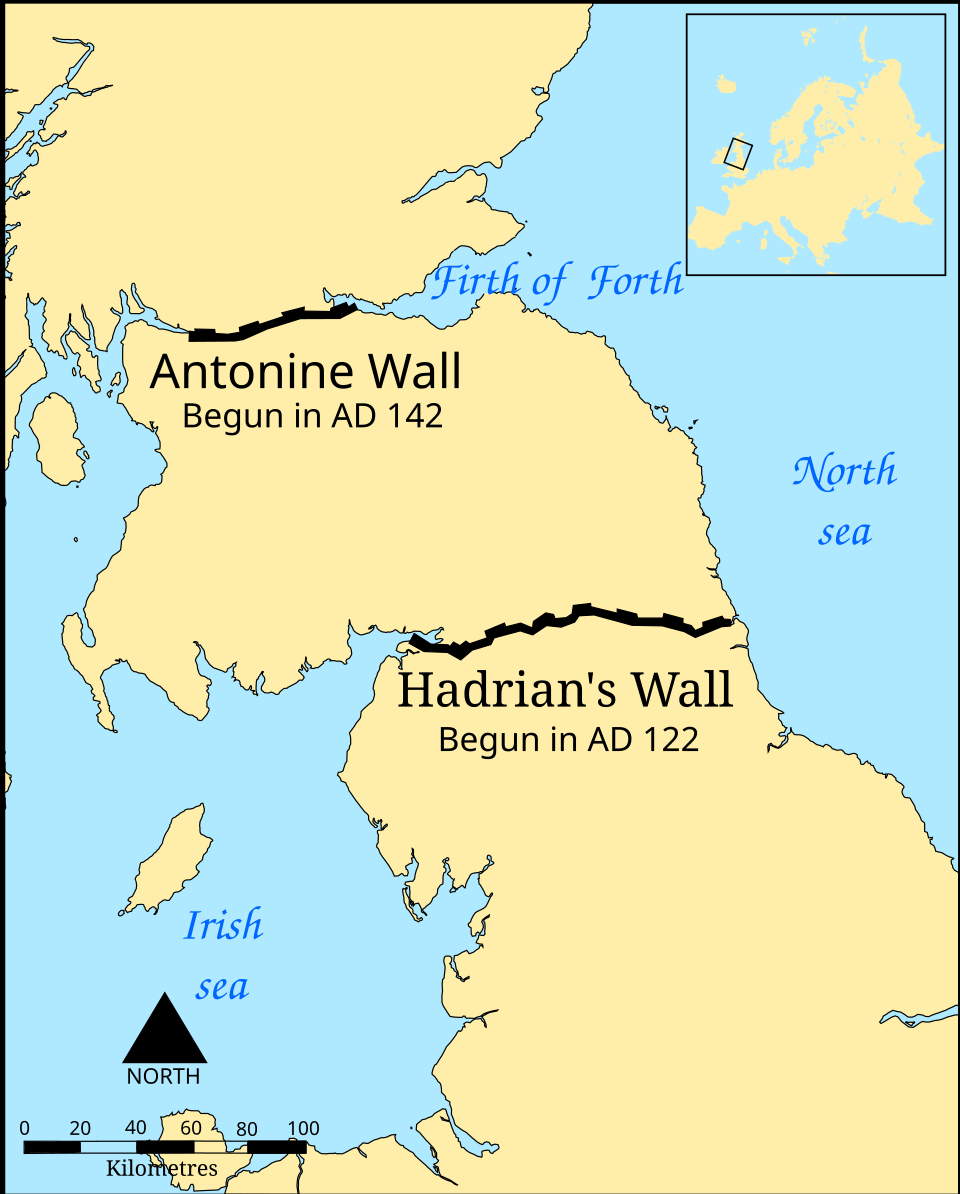
The periphery of the periphery in the Roman Empire, which arguably might have been better off without its province of Britannia – Hadrian’s Wall was peripheral and the Antonine Wall was even more peripheral. Map created by Norman Einstein in Wikipedia “Hadrian’s Wall” licensed under https://creativecommons.org/licenses/by-sa/3.0/deed.en
(2) IMPERIAL CORE & PERIPHERY
A highly politicized concept but still useful as a characteristic or feature of empires and imperialism.
Although, isn’t it obvious? After all, won’t all empires have an imperial core largely corresponding to the original nation or state that conquered the empire, with various degrees of imperial periphery extending through its empire beyond that core, albeit typically at farthest or furthest extent from the core?
Well, yes and no.
For one thing, there are those degrees of imperial periphery. I deliberately used both farthest with its usual connotation of physical distance and furthest with its more abstract or metaphorical connotations. With respect to the latter, parts of an empire might be more peripheral in geographic distance from the core but less so by economic or strategic importance to the empire.
For another, and more fundamentally, the imperial core can move or shift, even divide or become decentralized – particularly in empires that are more territorial than maritime. The Roman Empire is a classic example. Obviously, the Italian peninsula and city of Rome originated and persisted as its imperial core. However, the empire famously moved or divided its imperial core eastwards from the fourth century – and even before that had arguably done so to its Illyrian or Danubian provinces as the source of its military and political power represented by the so-called Illyrian emperors, or to its various administrative or military capitals.
Imperial core and periphery are perhaps best represented by maritime empires, with the archetypal example as the European maritime empires, which in turn has led to its contemporary usage for core countries as Western and other more economically developed countries as opposed to the periphery of less developed countries, largely synonymous with former terms such as the Third World or global South.
But even that contemporary usage has had a shifting core, shifting from China, India, and the Middle East to Europe and ‘European’ settler colonies from the sixteenth century onwards – as well as shifting back to Asia by adding east Asian countries in contemporary history.

Perhaps the most iconic image of overreach in modern popular imagination – the Fall of Saigon, as a member of the CIA helps evacuees up a ladder onto an Air America helicopter on the roof of 22 Gia Long Street April 29, 1975 (public domain)
(3) IMPERIAL OVERREACH
Synonymous with decline and fall, really.
“Imperial overreach, also known as imperial overstretch, happens when a country spends too much money and military power trying to control a large empire, making it weak and vulnerable to collapse”.
It has arguably been popularized, at least implicitly, by historians writing of imperial decline or defeat in general, not least Edward Gibbon – but certainly in best known form by Paul Kennedy in his book The Rise and Fall of the Great Powers.
However, I would argue it comes in two forms, mobile and static.
The former is imperial overstretch by an empire literally overextending itself beyond its borders, typically by failed military venture or commitment, often by analogy to the Vietnam War – although ironically the Vietnam War did not in fact result in American overreach or overstretch but rather imbalance.
A better example is my pro tip for European empires in modern history – you can have a maritime empire or you can strive for continental domination, but you can’t do both. Just ask Spain, France and Germany. Although for Germany, it was the attempts at empire by continental domination that were the overstretch – in both world wars. Similarly, all three major Axis powers in the Second World War were examples of imperial overstretch.
The other form of imperial overstretch is static – where an empire’s borders remain largely the same, but its own decline renders it unable to defend those borders as it formerly did. The classic example is the Roman Empire, although the argument remains to the extent that it was the result of internal decline as against external fall to adversaries with increased capacity, strength, or power.

The Augustus of Prima Porta, photograph by Justin Benttinen in Wikipedia “Augustus” under license https://creativecommons.org/licenses/by-sa/4.0/deed.en
(4) IMPERIAL CULT
For the God-Emperor of Mankind!
I mean, what better for an empire than literally deifying it, or at least the emperor, in an imperial cult?
“The imperial cult of ancient Rome identified emperors and some members of their families with the divinely sanctioned authority (authoritas) of the Roman Empire.”
The most famous imperial cult is indeed that of the Roman Empire. The Roman imperial cult was somewhat more nuanced than declaring a god-emperor and has sufficient features for its own top ten, but was intertwined with Roman state religion and traditional deities.
However, the Roman imperial cult offers a useful distinction between an imperial cult and my category of ideological empire where the latter’s “ideology” is a proselytizing religion. Typically, religious ideological empires do not involve an imperial cult as such, although they may identify their rulers as divinely anointed or otherwise with some divine right or agency within their religion.
Prior to adopting Christianity as its state religion and hence transforming its imperial cult beyond recognition, the Roman Empire was incredibly tolerant or syncretic when it came to the religions of its imperial conquests and subjects, although there were exceptions. While it did often seek some formal obeisance to its imperial cult, It did not seek to convert its conquests or subjects to that cult or its own religion – indeed, more often than not, it imported other religions. This was often in the form of syncretism identifying its own deities with those of their neighbors or subjects, most famously combining Roman deities with Greek ones.
The Roman imperial cult is but one of many historical imperial cults, which in turn followed on from divine kings or monarchies – Egyptian pharaohs, the imperial cult of Alexander the Great, Chinese emperors, and so on. A few surprisingly persisted even to modern history, such as that of Japan, but imperial cults were mostly transformed by religions such as Christianity into concepts like divine right – and by modern political ideologies or charismatic politics into cults of personality.
Of course, the most fun imperial cults or the use of God-Emperor as a term remains in science fiction, notably the God-Emperor of Frank Herbert’s Dune series and the God-Emperor of Mankind in Warhammer 40K.

Trade languages of the world in 1908 from The Harmsworth Atlas and Gazetteer (public domain image)
(5) LINGUA FRANCA
The lingua franca – literally the Frankish tongue – is more generally used as a term for a “common tongue” or language among different people.
And generally, it is one native to the imperial nation or state of an empire, although it can arise from trading nations – but also from cultural or religious influence, as well as “diplomatic and administrative convenience” or scholarly and scientific convention, albeit these things also tend to be by-products of empire.
The most famous “imperial” lingua franca is of course English in the contemporary world (from the British Empire and American hegemony), but notable predecessors (or rivals) include French, Spanish, Arabic, Chinese, Greek, and of course Latin.
Whether or not a lingua franca emerges from “linguistic imperialism” is far more contentious. Empires as a general rule do not deliberately stamp out the native languages of their subjects – although occasionally they will to “acculturate” those subjects within their empire, or more brutally, in displacing or wiping out those subjects altogether.
Indeed, the Roman Empire was famously multilingual. Latin may have had first place as the original language of the Romans – but Greek loomed almost as large among elite Romans and larger among eastern provinces, with the eastern Roman empire even shifting its official language to Greek from Latin after the western half of the empire fell. Other languages in the classical empire included Aramaic or Syriac, Coptic, Punic, Celtic, and ultimately Germanic languages such as Gothic.
However, empires often reduce linguistic diversity not so much through deliberate policy but through the priority or privilege of the language of the imperial nation as lingua franca – people follow the lingo to the money or power that comes from speaking it.
A-TIER (TOP TIER)

Alfred W. Crosby – “Ecological Imperialism: The Biological Expansion of Europe 900-1900”, Cambridge University Press, 1986 hardcover edition (fair use)
(6) ECOLOGICAL IMPERIALISM – COLUMBIAN EXCHANGE
The Columbian exchange – the massive and widespread transfer of plants, animals, human populations, and communicable diseases between the Old World and the New World from Columbus onwards – might well have happened simply from trade rather than imperialism. Well, perhaps except for the human populations.
However, it did happen from imperialism and is distinctive enough for its own type of imperialism as ecological imperialism. Indeed, the historian who coined the term Columbian exchange in a book of that title – American historian Alfred Crosby – also coined the term ecological imperialism in the title of a sequel book.
Of course, the focus of Crosby’s ecological imperialism is on the European side of the equation – that is, Europe’s exports of biological species or population rather than those it imported from elsewhere, where the latter largely consisted of cultivated plants (with superstars such as potatoes and tomatoes) and largely beneficial.
“Crosby introduced ecological imperialism as an explanatory concept that points out the contribution of European biological species such as animals, plants and pathogens in the success of European colonists” – foreshadowing arguments much to the same effect by Jared Diamond’s book Guns, Germs and Steel.
Ecological imperialism may not have had the same deliberate nature of other aspects of imperialism – and even where it was deliberate, often may not have had the same awareness or intention of consequences, the most destructive of which can be summarized in one word, extinction.
That is, extinction of human populations through disease, often overlapping with gen0cide, but also extinction of animal (or plant) species, through such things as competition with or predation by invasive species but also something that might be added as another aspect of ecological imperialism – human over-hunting or habitat destruction.
The same destructive consequences recurred with European ecological imperialism in Australasia and Oceania.

Arguably the two most famous and iconic corporate brand logos in the world – Coca-Cola and McDonalds (fair use)
(7) CULTURAL IMPERIALISM
Coca-Colonization and McDonaldization!
Yes, cultural imperialism is much broader than the spread of American corporate brands – extending throughout culture and cultural values or traditions – but Coca-Cola and McDonalds serve (heh) as useful symbols of it, as well as the most recognizable.
In my opinion, however, cultural imperialism is a somewhat nebulous concept, typically co-opted for ideological or political argument rather than to connote anything meaningful.
Sure, empires routinely engage in the acculturation of their imperial subjects, so much so that there’s a whole litany of terms with the suffix “isation” or “ization” for it, such as Romanization for the Roman Empire, Americanization for the global influence of American culture (including Coca-Cola and McDonalds), and so on.
To the extent that such acculturation is imposed by direct imperial diktat or policy, then it probably counts as cultural imperialism. Outside of that, it is less clear.
For example, cultural imperialism is usually defined in terms of “asymmetrical power” – that is, “it relies on economic, political, or military superiority rather than equal cultural exchange”.
Firstly, however, I’m not sure that “cultural exchange” is ever entirely “equal”, or even what would qualify a “cultural exchange” as “equal”. A better adjective might have been “free” rather than “equal”.
Secondly, and more fundamentally, cultural exchange itself may “rely” on – that is, be influenced or motivated by – “economic, political, or military superiority”, to emulate or achieve that superiority. Indeed, military “superiority” is one of the clearest examples of cultural exchange for such a purpose, particularly if that superiority is based on some technological or organizational development.
Also, as critics of the concept have pointed out, it oversimplifies how imperial subjects or other people interact with “foreign” or imported culture – they often “reinterpret, resist, or localize imported culture rather than passively absorbing it.”
It also overlooks “counter-flows” – that is, the culture imported by an imperial nation from its subjects. For that matter, it overlooks the extent to which imperial nations also routinely practice cultural laissez-faire or tolerance when it comes to their subjects – to minimize disruption and resistance, avoid unnecessary drain on their resources, co-opt local elites, or even from genuine love or respect for local culture among other reasons.

Map of all the territories once occupied by the Roman Empire, along with locations of limes and borders (public domain image)
(8) DEFENSIVE IMPERIALISM
“Now look at what you made me do!”.
Alternatively, I needed my empire to defend myself.
As ridiculous as it may seem, empires have asserted that their imperialism was defensive or reactive, and historian have even agreed with or asserted it for them.
“Defensive imperialism is a security-motivated theory of empire-building that views territorial expansion as a reactive response to external threats rather than planned, aggressive conquest…states often conquered reluctantly out of fear, self-protection, or broken treaties”.
The most famous example of defensive imperialism is the one that may also seem most surprising, the Roman Empire. Indeed, the theory of defensive imperialism originated “in Roman studies in the late 19th century”, albeit it persisted after that and was “closest to the argument favored by the Romans themselves”.
“The theory draws its strength from the apparent inconsistency of Roman foreign policy, the slowness with which their rulers acted (or reacted), and their reluctance to annex. In this pattern economic and ideological factors appear secondary at most.”
Perhaps not coincidentally given the theory was contemporary with the British Empire approaching its peak, defensive imperialism was also asserted for the British Empire – “in the late Victorian and Edwardian eras, figures like James Bryce compared Roman expansion to the British Empire, arguing that external dangers and frontier instability forced further conquest”.
Admittedly, claims of defensive imperialism are the exception rather than the rule, particularly for pre-modern empires that tended to cheerfully revel in conquest for its own sake – what is best in life is “to crush your enemies, see them driven before you, and hear the lamentations in their women”. That quote from the Conan film is famously adapted from one attributed to Genghis Khan in a historical biography of Genghis Khan (Charles Lamb’s “Genghis Khan: The Conqueror of All Men”), which notably also included “to take their horses and goods”. While the latter was probably apocryphal, it certainly reflected the ethos of the Mongol Empire.
Even so, claims of defensive imperialism are significant. After all, two of the top three empires in my Top 10 Empires have asserted it for themselves or had historians assert it for them, the Roman and British Empires – and another entry, the Macedonian Empire, might arguably be added to them, at least in so far as Alexander the Great claimed his invasion of Persia to be a “retaliatory defensive act of justice” (for the Greek-Persian Wars and Persia’s control of or interference with Greek cities).
Claims of defensive imperialism haven’t exactly gone out of fashion either – “scholars point out that ancient and modern powers frequently weaponize defensive language and just-war theory to legitimize pre-emptive strikes and territorial control”.

Republican imperialism at its finest – Vercingetorix throws down his arms at the feet of Julius Caesar (1899) by Lionel Royer (public domain)
(9) REPUBLICAN & DEMOCRATIC IMPERIALISM
Republican and democratic imperialism seem obvious oxymorons.
Well, certainly democratic imperialism does – republican imperialism somewhat less so as it simply requires that the imperial state be a republic rather than formal monarchy or government by emperor. Indeed, the top empire in my Top 10 Empires originated as republican imperialism although it evolved into a formal empire – the Roman Empire. Other examples of republican imperialism include the Venetian Empire as well as the modern French Empire (once France was a republic) and less formal empires such as the American empire, Soviet (and modern Russian) empire, and the Third Reich.
However, democratic imperialism remains an oxymoron – “the intersection, overlap, or tension between democratic political systems at home and the practice or justification of overseas empire, hegemony, or foreign intervention.”
The third top empire in my Top 10 Empires, the British Empire, is perhaps the classic example of democratic imperialism, albeit progressively over time with increasing enfranchisement – which coincided with increasing reluctance or sentiment for maintaining its empire. However, that was reflected also by other empires such as the American empire or those of increasingly democratic or enfranchised western European nations – at least French, Dutch, and Belgian empires, as well as arguably also German and Italian empires.

Jamiroquai encapsulating neo-imperialism in this screenshot from the video for his 2005 single (Don’t) Give Hate a Chance (fair use)
(10) NEO-IMPERIALISM
In contemporary history or politics, imperialism is usually asserted to be neo-imperialism – informal rather than formal empire.
That is, former imperial powers (usually Western) are asserted to have maintained their imperialism beyond the end of their formal empires by simply substituting neo-colonialism or neo-imperialism, which leverages other forms of power or influence, typically economic power, rather than military force, into an informal empire, or means of control other than formal annexation or rule – and newer imperial powers just tend to start that way, skipping formal empire altogether.
Of course, neo-imperialism may still involve military force when it needs to, but generally neo-imperialism by definition proposes more subtle or indirect means of coercion or influence.
And of course, neo-imperialism can be a nebulous and vague concept, as virtually anything can be said to be neo-imperialism – or taken to extremes, where nations (and corporations) can’t do anything right, even between polar opposite policies or courses of action.
Damned (as neo-imperialist) if they do and damned (also at neo-imperialist) if they don’t, as it were.
B-TIER (HIGH TIER)

Map of the Roman fleets and major naval bases during the Principate, 27 BC to AD 284. (public domain image)
(11) MARE NOSTRUM – IMPERIAL LAKE
Mare nostrum, literally “our sea” in Latin, connoting the core of the Roman Empire – its complete control of the Mediterranean Sea and coastline, as a perfect fusion of territorial and maritime empire.
No other state has come close to that fusion of territorial or maritime empire for total domination of a maritime body of water – a sea, let alone an ocean – although some maritime empires or naval powers have come close in terms of naval predominance, which we’ll come back to with that term of imperial lake. Speaking of lakes, I’m obviously excluding those bodies of water such as lakes or rivers that are essentially internal to a single nation or state, hence that qualifier of maritime which typically connotes sea or ocean.
The Roman Empire had complete naval predominance that was effectively a monopoly throughout its imperial period – in the absence of any maritime enemy in the form of a rival state, although the Roman navy still had to contend with piracy and barbarian incursions that were essentially also piracy until the Vandals managed to escalate to being a rival naval state.
What made the Roman mare nostrum distinctive was its total control of the coastline as territorial empire as well as naval power, and the classical Roman Empire remains the only state in history to have controlled the entire Mediterranean coast. Other states – the eastern Roman empire, the Arab caliphates, the Ottoman empire, and the Axis powers – have come close to or contended for that control of the Mediterranean coastline but fell short or were successfully contested. Fascist Italy even revived the use of the term in its claim to Mediterranean empire and Roman succession.
However, as I said, other maritime empires or naval powers have come close to the same naval predominance over a body or bodies of water, although they have tended to confine their control of coastlines to islands or key points as strategic bases or areas of command.
Hence, the informal use of the term lake to connote that naval predominance, mirroring the use of the term mare nostrum – and has indeed been substituted for it, describing the Mediterranean as a “Roman lake”.
For example, I have seen the Indian Ocean and Pacific Ocean described as a Portuguese lake and Spanish lake respectively at the outset of the period of European maritime exploration, although both were soon encroached upon or contested by other European maritime powers. One of those powers – the British – effectively displaced Portuguese or other naval powers to claim the Indian Ocean as a “British lake”, although really British naval predominance in the nineteenth century was such to make all the world’s oceans (or World Ocean) their lake. The Pax Britannica was essentially naval, something that was inherited by its American successor.

American Progress painting by John Gast – destiny made manifest (public domain image)
(12) MANIFEST DESTINY
Yes, manifest destiny is something that might seem unique to the American territorial expansion, westward across the continent (and beyond across the Pacific) for which the phrase was coined by its advocates.
“Manifest destiny was the expansionist colonial belief in the 19th-century United States that American settlers were destined to expand westward across North America, and that this belief was both obvious (“manifest“) and certain (“destiny“).”
However, I consider that a belief in the “manifest destiny” of imperial claims or territorial expansion, divine or otherwise, is common to most empires, if not all of them. After all, from the point of view of the imperial nation, if empire or expansion weren’t its manifest destiny, then it wouldn’t be in a position to be made manifest but instead on the receiving end of being someone else’s manifest destiny.
Admittedly, a belief in manifest destiny is perhaps highest for settler colonialism, particularly by adjoining territorial expansion or annexation. After all, it takes a strong sense of your destiny to move or settle into someone else’s territory and claim it as your own by right.
Ironically, the closest parallel to American belief in manifest destiny by territorial expansion is that of Russia eastward across the Eurasia (and beyond across the Pacific).

Yes, you can read the title – the poem by Rudyard Kipling as it was originally published, and the poem that has probably alone done most to undermine his modern literary reputation (public domain image)
(13) CIVILIZING MISSION
Although associated with – or claimed by – European colonial empires, a belief of civilizing mission is the flipside of the belief in manifest destiny that is inherent to most empires, flipped that is from the “destiny” of the imperial nation to its “responsibility” for the “benefit” of its subjects.
Well, in theory anyway – almost every empire proclaims itself to be spreading civilisation or bringing some benefit to its subjects, and all but the most destructive have at least some merits in those claims.
That’s including those European empires. As destructive as they were, they did bring the development of trade and industry, transport and communication, and technology and science that ultimately was the reason they were able to have empires in the first place, however unevenly and for their own interests first. Not to mention social and political ideas, some of which such as nationalism and liberalism were ultimately to prove self-destructive to their empires.
Still, it can’t help but add insult to the injury of imperial rule for the rulers to claim they are doing so for the civilization of their subjects, particularly when killing, starving or enforcing the servitude of those subjects.
That’s even more so when it is preached as a “burden” for the imperial rulers, as Rudyard Kipling did in his poem “The White Man’s Burden”, its subtitle expressly addressed to the United States for the Philippines after the Spanish-American War, exhorting the United States to assume the same “burden” as the British did for their empire. It was astonishingly tone-deaf even for its time, as demonstrated by contemporary criticism such as that by Mark Twain – and probably is the one poem that has alone done most to undermine Kipling’s modern literary reputation ever since.

C;lassic gunboat diplomacy, even more so for the depolyment of ships designated as gunboats – The Crisis at Zanzibar, British War-Ships engaged in the Bombardment of the Sultan’s Palace by artist Fred T. Jane for the Illustrated London News, 5 September 1896 (public domain image)
(14) GUNBOAT DIPLOMACY
“An aircraft carrier is 100,000 tons of diplomacy”.
Send in the boats!
Ah yes, a blunter and more prosaic phrase for the reality of imperialism than either civilizing mission or manifest destiny, although the diplomacy part of the phrase is doing a lot of heavy lifting.
While the point is typically to avoid the actual use of military force or at least more than a show of it, the diplomacy of gunboat diplomacy relies on the threat of superior military force to bring imperial power to bear on a weaker opponent, potentially as an imperial subject or supplicant.
Not surprisingly given the reference to gunboat, it was a phrase used particularly for the use of superior naval firepower as an instrument of nineteenth century European maritime empires or the United States.
“Gunboat diplomacy is the pursuit of foreign policy objectives with the aid of conspicuous displays of naval power, implying or constituting a direct threat of warfare should terms not be agreeable to the superior force. The term originated in the 19th century, during the age of imperialism, when Western powers would use their superior military capabilities, particularly their naval assets, to intimidate less powerful nations into granting concessions. The mere presence of warships off a country’s coast was often enough to have a significant effect, making the actual use of force rarely necessary.”
Not that gunboat diplomacy is limited to gunboats in the nineteenth century but has persisted through the twentieth century to the contemporary use of naval power, or the combination of naval and air power encapsulated in Kissinger’s quote about aircraft carriers as diplomacy, or indeed to air power – bomber or drone diplomacy as it were – or the use of special forces.
I would argue that gunboat diplomacy also has a long history before the nineteenth century – indeed for as long as boats have been combined with guns, or even beforehand where massed fleets or other attributed of pre-gunpowder navies could be deployed for shows of force or threats short of the actual use of force.
It would also extend to limited deployment and threats or shows of force on land. The Roman emperor Antoninus Pius reputedly engaged in what might be called legion diplomacy when he “apparently stood off a resurgent Parthian Empire (under Vologasius IV) by writing a letter warning that “encroachment on Roman territory would not be taken lightly”. The Roman Empire also offers the examples of punitive raids, or the “fortification diplomacy” of other states.

Otto von Bsimarck at the Berlin Conference, 1884 – magazine illustration (public domain)
(15) SCRAMBLE FOR AFRICA
Even more so than civilizing mission or gunboat diplomacy, the Scramble for Africa – the colonization of Africa by seven European powers (Britain, France, Belgium, Italy, Germany, Spain, and Portugal) – almost uniquely represents the height of European colonial empires in the so-called Golden Age of Imperialism between the Napoleonic Wars and The First World War.
Indeed, the Scramble for Africa was scrambled even more quickly than that broad century timeframe suggests, as it was effectively concentrated in about thirty years from the 1884-1885 Berlin Conference to the commencement of the First World War in 1914.
As late as the 1870s, Europeans controlled approximately 10% of the African continent, with all their territories located near the coasts… By 1914, only Ethiopia and Liberia remained outside European control, with the former eventually being occupied by Italy in 1936 and the latter having strong connections with the United States.”
Speaking of the 1884–1885 Berlin Conference, it is seen as emblematic of the scramble, but while it did represent to some extent agreement between the European powers to divide Africa up between themselves in an orderly fashion, there remained political rivalries between them that on occasion threatened to bubble over into armed conflict. Armed conflict between Europeans that is – the European powers were far less squeamish about armed conflict with the Africans being colonized, including the use of machine guns.
Technological advances paved the way to the Scramble for Africa, notably in transportation and communication such as steamships, railways and telegraphs, but the biggest of all was medical advances for the tropical diseases which had effectively been the great African wall protecting the continent – invisible and silent but deadly or debilitating.
I can’t help but compare the Scramble for Africa to the space race, “won” at great expense in an intense burst of time, but the expense of the former was much more of a boondoggle for the imperial powers with little benefit to anyone from it, including the powers themselves – although at least the space race didn’t have anything on the scale of exploitation to the Belgian Congo.
I also can’t help but think that the Scramble for Africa was not unique. Indeed, it seems to me that imperial scrambles are relatively common in history, albeit more so for competing imperial powers as throughout European colonialism. European colonialism might be characterized as a series of scrambles, commencing with the Scramble for the Americas, or the Scramble for trade to the Indies. The Great Game between Britain and Russia, as well as the more general competition among Western powers for spheres of influence or concessions in China, might also be characterized as imperial scrambles.
But really, when you boil it down, the rise or increase of many empires, particularly when meteoric or rapid, might be characterized as a “scramble”, whether against opposing imperial powers or not. Of course, when an empire squares off against competing or opposing empires, it might be more evocative of an imperial scramble. A substantial part of the contest between the Roman and Persian empires might well be characterized as the Scramble for Armenia.
Even the Scramble for Africa might be argued as not so unique with respect to Africa itself. The Romans had something of a miniature scramble or proto-scramble for Africa, beyond the extent of their north African conquests and trade with sub-Saharan Africa. There were Roman incursions into sub-Saharan Africa, such as expeditions to sub-Saharan Africa west of the Nile, as well as the more famous expedition ordered by Nero to find the source of the Nile – and potentially to scout out invasion of Nubia or Ethiopia.
After the Romans came the Arabs with their own incursions into sub-Saharan Africa, most infamously for the Arab slave trade – equal to or exceeding the subsequent Atlantic slave trade, itself arguably a proto-scramble for Africa, in scale and duration if not in intensity.
Decolonization also arguably brought further scrambles for Africa as well as the scramble out of it, with the Cold War at times evoking a quasi-scramble or quasi-scrambles for Africa, not to mention the allegations of neo-imperialism extending well beyond the original seven European colonial powers.
X-TIER (WILD TIER)

Napoleon in coronation robes – painting by Framcois Gerard (public domain)
(16) ROMAN IMPERIAL METRIC
But is it a Roman Empire?
Yes, that’s a gag, prompted by my Top 10 Roman Empires, which was also something of a gag.
But seriously, the Roman Empire endured as an imperial metric or template for subsequent empires, particularly in its former territory in Europe or Mediterranean basin – and particularly for those empires, as featured in my special mentions for my Top 10 Roman Empires, that claimed succession from the Roman Empire.
“The continuation, succession, and revival of the Roman Empire is a running theme of the history of Europe and the Mediterranean Basin. It reflects the lasting memories of power and prestige associated with the Roman Empire. Several polities have claimed immediate continuity with the Roman Empire, using its name or a variation thereof as their own exclusive or non-exclusive self-description. As centuries went by and more political ruptures occurred, the idea of institutional continuity became increasingly debatable”.
So yes, there’s a recurring Roman imperial metric among empires, either comparing themselves (or being compared) to the classical Roman empire or claiming succession from it – however tenuously, as for example with the Spanish Empire (both in comparison and succession) or the British Empire (in comparison). While that is generally for European or Mediterranean empires, that metric is sometimes extended to other empires, albeit usually European in origin – as for example with the Russian Empire or the United States.
There’s arguably an even wider Roman imperial metric – its metric or template of decline and fall, that “melancholy, long, withdrawing roar, retreating to the breath of the night-wind, down the vast edges drear and naked shingles of the world”.
Just as many looked to the Roman Empire as their state or imperial model, with kingdoms or states purporting to succeed or revive it in one form or another thereafter, even more look to its decline and fall. Even now, the decline and fall of the Roman Empire informs much modern discourse about state failure – from Edward Gibbon onwards, “we have been obsessed with the fall: it has been valued as an archetype for every perceived decline, and, hence, as a symbol for our own fears”.
The fashionable contemporary Roman imperial metric, particularly in decline and fall, is with the United States – as Adrian Goldsworthy noted in the introduction to his book “How Rome Fell: Death of a Superpower”, where he dismisses it as cliché, one which he entertainingly relates that he is routinely accosted at dinner parties when he informs someone of his historical speciality.
There’s also another Roman imperial metric that seems to pop up in actual comparative history – that between the Roman Empire and Imperial China, whether the Han Dynasty that was contemporary with the classical Roman Empire or the continuity of China as imperial polity in general.
The Roman imperial metric in comparison with China was notably drawn by Walter Scheidel in his book “Escape from Rome” – where he distinguished the unique Roman achievement of its imperial unity in Europe and of the Mediterranean, not replicated before or since (not even by the Byzantine or eastern Roman Empire), from the more continuous and enduring imperial polity in China, albeit in successive dynasties.
And that’s a good thing. In short, the thesis of this book is that the fall of Rome led to the Great Divergence – that divergence of “political, economic, scientific, and technological breakthroughs that allowed Europe to surge ahead while other parts of the world lagged behind”. Essentially, that’s because of “competitive fragmentation”, both within states and perhaps more fundamentally between them, with “the enduring failure of empire-building” and no single state ever able to rise to Rome’s imperial predominance in Europe. The main contrast is with China as polar opposite, with its consistent unitary imperial states, with the other Eurasian civilizations between them geographically also falling between them on this political scale of Rome vs China.

The Army takes an Oath to the Emperor after the Distribution of Eagles, 5 December 1804 – 1810 painting by Jacques-Louis David (public domain)
(17) ROMAN IMPERIAL METRIC – EAGLE & CAESAR
But is it a Roman Empire with eagle and Caesar? Is it an eagle empire?
Yes, it’s another Roman imperial metric, but this time more narrowly by its imperial standard or symbolism, as well as the adaptation of Caesar as imperial title.
The use of eagle as symbol for imperial states, with one or two heads, both precedes its use by the Romans and also extends well beyond those adapting Roman usage, because the eagle is a pretty impressive bird. It could well be the subject of its own top ten list – or lists, one for those adapting Roman usage and one for those not adapting Roman usage. Even the Roman usage overlapped with the Christian usage of the eagle as the symbol of St John the Evangelist.
An example of the eagle being used by an imperial state preceding the Roman usage is that by the Persian Achaemenid Empire.
A clear example of the eagle being used by states not influenced by or adapting Roman usage is that of the Aztecs, subsequently adopted by Mexico for its coat of arms and flag.
Adapting Roman usage from the western Roman empire, there was the Holy Roman Empire and its various ‘successors’ – the Hapsburgs (and through them the Spanish Empire), Austria, and Germany, the last most infamously in the Third Reich. There was also Napoleonic France, which also adapted the use of the Roman aquila or eagle as a standard for legions and their military reputation.
From the eastern Roman empire, there was Trebizond, Serbia, Bulgaria, Albania, and imperial Russia, although that last is usually now superseded in animal symbolism by the bear.
The most famous contemporary usage of the eagle as national symbol is that of the United States – although clearly influenced by the Roman model (as it was for much of the politics of its founding), it adapted that to the bald eagle as a bird uniquely native to their continent.
As for the usage of Caesar as imperial title, that generally follows the title in German or Slavic.
The usage in German – kaiser – is best known for its usage as title in the Second Reich. That is, imperial Germany from 1871 to the First World War.
The usage in Slavic – mostly commonly translated in English as tsar and czar (but also less commonly as tzar and csar) – is best known for its usage as title in Imperial Russia. However, it was also used as Serbia, as well as commonly used in American political circles as an informal title for an overarching government portfolio, such as drug czar or energy czar.

“Washington Crossing the Delaware”, iconic 1851 painting by Emanuel Leutze of the founding anti-imperialism of the United States (public domain)
(18) ANTI-IMPERIALISM
Wait, what?
Anti-imperialism is opposition to imperialism – how is it one of my special mentions for types of empire and imperialism?
Well, these are special mentions so arguably it is a lens through which to view empire or imperialism – but there are two more fundamental arguments that, ironically and paradoxically, anti-imperialism can be a guise for empire or imperialism, similarly to defensive or democratic imperialism as oxymorons.
The first and perhaps lesser argument is that while anti-imperialism has origins throughout history in resistance to empires, usually on the basis of being “foreign” or causing some loss to their subjects, it only assumed its full force through modern political ideologies – primarily nationalism, liberalism, and socialism – that were in turn spread by and a product of Western empires, ironically and paradoxically as the seeds of their own destruction yet also the harvest of their cultural propagation.
The second and more fundamental argument is that empires from ancient history onwards have always had an element of anti-imperialism – against other empires as rivals, including to the extent of encouraging or supporting civil wars or revolts within those rivals. While they could collaborate, as in the Scramble for Africa, the modern European empires were often fiercely “anti-imperialist” against each other – occasionally propping up or supporting non-European peoples or states from being formally annexed by rival European empires, or any single European empire in the case of China.
Germany was perhaps most distinctive among European empires in pursuing an anti-imperialist policy against its rivals, particularly against the British during both world wars, albeit not very effectively.
However, there are three modern imperial powers that stand out in pursuing imperialism, ironically while styling themselves as anti-imperialist or even doing so in the name of anti-imperialism, and even more ironically, each against the other two as among its most formidable opponents – Japan, the Soviet Union, and the United States.
Of course, in contemporary history and world politics, it seems to be de rigueur for nations to engage in imperialism while claiming to be doing so as “anti-imperialist” against the “imperialism” of their opponents – and even for movements or proponents of “anti-imperialism” to have moral myopia so that they only see imperialism from their direction of choice

Barbarism and nudism! I’m a little worried what they intend to do to that statue – The Sack of Rome in 410 by the Barbarians by Joseph-Noël Sylvestre, 1890 (public domain)
(19) BARBARISM
“There once was a dream – a dream to purge this rotten world of the barbarians that infest it!” – Dovahhatty
Essentially anti-imperialism but from the perspective of the empire – or really, pretty much how an empire sees anyone who isn’t in it.
Barbarism is what an empire sees itself as rescuing its subjects from, or what it sees its subjects returning to if they resist or revolt against it – and what it sees itself holding the line against or falling to in the worst case scenario.
An empire sees anyone outside it as barbarians, even if those outsiders have an empire of their own – and indeed there’s a few empire that might be labelled barbarian empires, foremost among them nomadic empires like that of the Mongols.
Sure, an empire might give another empire some grudging respect, but in its heart see itself as superior to the other as barbarian, kind of like the way D.H. Lawrence summed up how the English – and by extension the British in their empire – saw themselves compared to others.
The English are so nice
so awfully nice
they are the nicest people in the world.
And what’s more, they’re very nice about being nice
about your being nice as well!
If you’re not nice they soon make you feel it.
Americans and French and Germans and so on
they’re all very well
but they’re not really nice, you know.
They’re not nice in our sense of the word, are they now?

Yeah, something like that – the cover of George Macdonald Fraser’s Flashman (fair use)
(20) S€XUAL IMPERIALISM
“I’d had fifteen years of military experience, perfecting the art of ordering a pink gin and saying ‘Do you do it doggy-doggy?’ in Swahili” – Captain Edmund Blackadder
Yeah, something like that.
Or those infamous memes of Spanish colonialism – or just Chel from The Road to El Dorado.
And that’s how light-hearted I’ll keep my final or twentieth special mention, which I like to reserve for a light-hearted kinky entry, because as with most things concerning imperialism, it can get a lot darker – essentially its primary connotation as yet another vector for imperial exploitation.
Outside that connotation, there are the more collaborative liaisons between imperial citizens and subjects throughout history – as with La Malinche, alternatively Malintzin or Marina, Cortes’ co-conquistador who was an instrumental part of the Spanish conquest of the Aztecs.