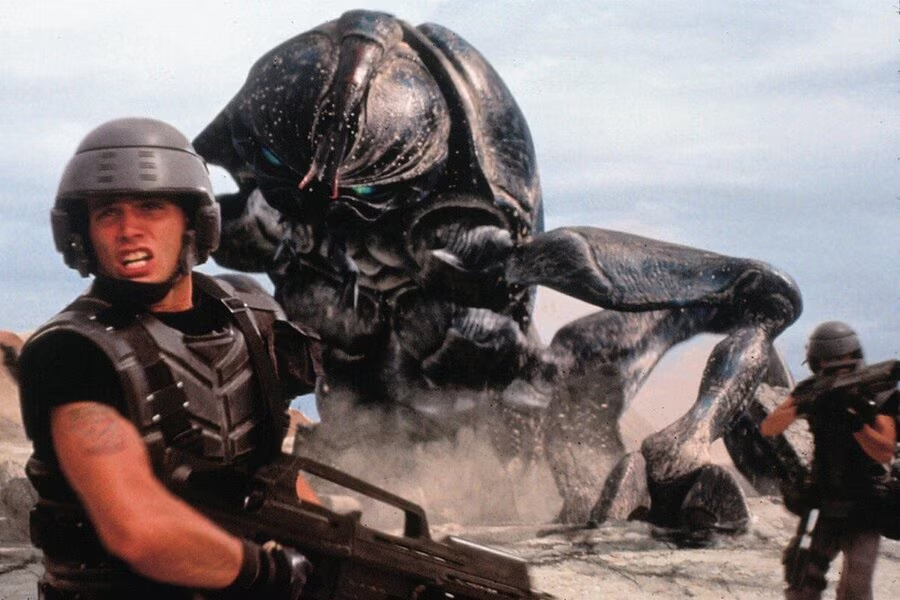
Top Tens – Fantasy & SF: Top 10 SF Books (Special Mention: Classic) (3) Robert Heinlein – Starship Troopers & Stranger in a Strange Land

Iconic scene from the 1997 Starship Troopers film and probably the most commonly used (fair use)


(3) ROBERT HEINLEIN –

STARSHIP TROOPERS & STRANGER IN A STRANGE LAND (1959 & 1961)


Along with Asimov and Clarke, Robert Heinlein is one of the ‘Big Three’ of science fiction – the one also dubbed the ‘dean of science fiction writers’ – and arguably the one best known from cinematic adaptation of his work.

Sure, there’s the film of “2001: A Space Odyssey” for Clarke but people tend to associate that more with its director Kubrick and the film is, well, a little too ‘arty’ to have left its mark beyond its two or three iconic scenes (while few have seen or know about the sequel). Sure, there’s also the film of “I, Robot” for Asimov but that film was only nominally an adaptation of Asimov’s robot anthology, and the film is, well, a little too crap to have left any mark.

Neither compared to the popular and memetic impact of the film (and franchise) adapted from Heinlein’s most famous work, Starship Troopers – even if that adaptation had its satirical tongue in its cheek and was as cheesy as hell to boot. There’s just something about a Bug War that appeals to us – and something about peak Denise Richards that appeals to me.

Wikipedia notes that Heinlein’s “plots often presented provocative situations which challenged conventional social mores” and “his work continues to have an influence on the science-fiction genre and on modern culture more generally”, notwithstanding its controversial aspects. In the case of Starship Troopers, that controversial aspect was its militarism – its apparent endorsement of a future universally militarized society, justified by humanity locked in an evolutionary struggle for very survival against an alien species, the Arachnids or Bugs.

Starship Troopers was a foundational work of military SF – in particular, it “helped mold the space marine and mecha archetypes”.

Ironically, Heinlein swung his provocative pendulum in the opposite direction just two years later with his Martian hippy cult in “Stranger in a Strange Land”, arguably his other best known work and which also won the Hugo Award for Best Novel like “Starship Troopers” before it.

I am not as much a fan of “Stranger in a Strange Land” as I am of “Starship Troopers” and not just because of the Martian hippies in the former – it’s the escalation of the trademark social commentary to a self-insert authorial mouthpiece and archetypal Heinleinian character Jubal Harshaw. Also, Stranger lacks the cultural impact of Troopers, not least because of the lack of comparable adaptation – with the most significant impact being the name of Twitter’s AI Grok being taken from the novel’s Martian word grok.


RATING: 5 STARS*****

S-TIER (GOD TIER)


Top Tens – Fantasy & SF: Top 10 SF Books (Complete & Revised: 2025)

Theatrical release poster for the first Star Wars film in 1977 – replicating the common pose or leg cling trope of pulp fantasy or SF covers


“Science fiction is the improbable made possible, and fantasy is the impossible made probable.” – Rod Serling.

Counting down my Top 10 SF Books – running parallel to my Top 10 Fantasy Books, and for matter, my Top 10 Literature, in that this is my Top 10 SF Literature or my top 10 written works of science fiction  As I noted for my Top 10 Fantasy Books, comics tend to be fantasy or SF – at least the ones I like – but I have a separate Top 10 Comics list. Similarly, I like many fantasy or SF films or TV series, but they have their own top ten lists.

But what is science fiction? And what is it as opposed to fantasy – with which it has so many overlaps, not least in pop cultural niche (or “ghetto”)?

Just as magic is often seen as or argued to be the defining feature of fantasy, so too are science and technology for science fiction, only even more so. After all, it’s called science fiction – it’s in the very name of the genre!

And yes – I would argue that science or technology is the defining feature of science fiction even beyond magic is for fantasy. While not common, there are fantasy works that have low or no magic – it is harder to think of science fiction works without technology or at least science in their plot or premise.

Essentially, if one were to attempt as comprehensive a definition of science fiction as possible, that might be to propose it as the imaginative or speculative extrapolation of science, technology or society. In other words, the fiction of asking what if?

However, as I noted for fantasy, fictional genres can be notoriously difficult to define or difficult to distinguish from other fictional genres, with the two looming largest – and closest – to science fiction being fantasy and horror, with all three often being classed within the category of speculative fiction.

As I did for my Top 10 Fantasy Books, I will note where fantasy or horror loom large or close to the science fiction for my entries. Indeed, I will make one such note now – one of the quirks of my Top 10 SF Books is that it includes four entries for what might better be classified as posthumous fantasy or fantasy set in the afterlife, because they happen to be my favorite books by authors whom I otherwise like for their science fiction.

And just as the fantasy genre could be divided between high fantasy (as the core of the genre) and low fantasy, so too the science fiction genre can be divided up into hard SF (similarly as the core of the genre) and soft SF.

Hard SF tends to have its focus in the science part of science fiction and in turn relies on either established science or careful extrapolation from it. Its counterpart of soft SF does, well, less so – often being more fantastic in its plot or premise. TV Tropes has some fun with this with its Moh’s Scale of Science Fiction Hardness.

Again, these distinctions or subgenres within science fiction fascinate me as much as the distinctions between SF and other genres – and yes, SF sub-genres are worthy of their own top ten.

Anyway, these are my Top 10 SF Books.


Collage of the Orbit cover art for the three books


(10) M.R. CAREY –

PANDOMINION SERIES (2023-2025)


“The Pandominion: a political and trading alliance of a million worlds – except that they’re really just the one world, Earth, in many different realities.”

They don’t mess around either – when a scientist on one of those Earths, closely resembling our own, invents her own dimension-hopping technology and blunders into Pandominion space, or when the Pandominion itself blunders into a machine version of itself, threatening mutually assured multiverse destruction.

I love a good space opera – and the Pandominion goes above and beyond that, across Earths in infinite dimensions.

The series proper is two books, Infinity Gate and Echo of Worlds, with a third standalone novel in the same setting, Outlaw Planet published in 2025, hence my tenth place wildcard entry for best of 2025.


RATING:

X-TIER (WILD TIER) – BEST OF 2025


(9) CHARLES STROSS –

LAUNDRY FILES (2004-2023)


“I wish I was still an atheist. Believing I was born into a harsh, uncaring cosmos – in which my existence was a random roll of the dice and I was destined to die and rot and then be gone forever – was infinitely more comforting than the truth. Because the truth is that my God is coming back. When he arrives I’ll be waiting for him with a shotgun. And I’m keeping the last shell for myself.”

Great Cthulhu in the Cold War!

One of my favorite SF short stories is Stross’ A Colder War, which is something of a precursor to the Laundry series, albeit in an alternative universe. What would have happened if the Antarctic expedition in H.P. Lovecraft’s “At the Mountains of Madness” actually happened in our world? In short, nothing good – or a fate worse than global thermonuclear annihilation.

What ensues is a Cold War arms race, but with extra-dimensional entities instead of nuclear weapons. The Soviet Union has its ultimate doomsday ace – or rather joker – in the hole in the form of a particular entity based on captured Nazi research into a certain underwater city. The United States has its own contingency plan in the form of 300 megatons of nuclear weapons, and when that fails, a backup contingency plan or insanely desperate last resort. There are worse things than death in the Cthulhu Mythos…

His Laundry series ups the ante on his use of the Lovecraftian horrors of the Cthulhu Mythos. Commencing with the first book (and still my favorite), The Atrocity Archives, extradimensional entities of evil serve as the backdrop of a secret history of the twentieth and twenty-first centuries, espionage and government bureaucracy – all combined in the British spy agency known as the Laundry. Magic is simply higher mathematics – which applied in certain circumstances can open gates to other dimensions. The protagonist, a computer expert known as Bob Howard, unintentionally did just that and found himself conscripted by the Laundry, Britain’s occult secret service. Unfortunately, incidents like it are becoming increasingly common with the increasing computational power and mathematical applications of the modern world (and of human minds) – indeed, the Laundry anticipates this increase (amongst other things, such as the position of our world in space) will inevitably align or open up our world to other dimensions (“when the stars are right” in the parlance of the Mythos) and has contingency plans for extradimensional invasion. Of course, the Laundry is not exactly optimistic about humanity’s prospects – its usual best-case scenario is for repopulation after an extinction event – but it plans to go down swinging…


FANTASY & HORROR


Yes – this is one of my SF entries that obviously overlaps with fantasy…and cosmic horror.


RATING: 

B-TIER (HIGH TIER)

*

*


(8) NEIL STEPHENSON –

SNOW CRASH (1992)


“Until a man is twenty-five, he still thinks, every so often, that under the right circumstances he could be the baddest motherfcker in the world… Hiro used to feel this way, too, but then he ran into Raven. In a way, this was liberating. He no longer has to worry about being the baddest motherfcker in the world. The position is taken.”

How can you not love a book whose hero protagonist is literally named Hiro Protagonist? As he replies to when it’s mocked as a “stupid name” – “but you’ll never forget it”.

And yes – my feature quotation might well apply to readers of Snow Crash. Until someone has read Snow Crash, they still think that they could read – or perhaps write – the coolest and most badass book in the world. But then you read it and know that position is taken.

You have Hiro Protagonist – “a sword-slinging hacker who teams up with an extreme skateboarder in a post-cyberpunk disincorporated USA to fight Snow Crash – a computer virus for the brain”.

And by disincorporated USA, I mean some of the most blackly comic worldbuilding in SF. A United States whose government has ceased to exist – apart from vestigial organizations like the FBI or “Fedland” which monitor their employees to a ridiculous extent including three-page emails regarding the proper use of toilet paper in an office environment. Other parts of the government have become been privatized to or out as corporations or entrepreneurs – the CIA merging with the Library of Congress as the for-profit CIC, or the Army and Navy as competing private security corporations (General Jim’s Defense System and Admiral Bob’s Global Security).

A United States whose currency has inflated past billion-dollar notes (which some of those aforementioned Fedland employees are tempted to use for toilet paper) to trillion dollar notes – which most people eschew for yen or Kongbucks.

A United States whose economy has receded to only four things Americans do better than anyone else – music, movies, microcode or software, and high speed pizza delivery. The latter the monopoly of the Mafia or Cosa Nostra, who “in an anarcho-capitalist world gone mad” are “just another corporation, no more or less ruthless than anyone else…sure, they have hired killers on their payroll and will whack employees who screw up” – notably pizza delivery drivers who fail to deliver in their pizza in half an hour – “but this isn’t particularly unique in a world where franchised neighborhoods are guarded by killer cyborg dogs.”

A United States whose former territory is “now a patchwork of autonomous corporate franchises and Burbclaves”, the latter essentially neighbourhoods franchised to extraterritorial “nations” run by corporations, such as Mr Lee’s Greater Hong Kong (not affiliated with mainland China or the island of Hong Kong).

Also a United States where you can have the aforementioned Raven – “baddest motherf*cker in the world” – as a literal one-man nuclear power, with a hydrogen bomb in his motorcycle sidecar and rigged to blow to “EEG trodes embedded in his skull”, probably near the tattoo on his forehead POOR IMPULSE CONTROL.

And then you have the Metaverse, “the internet becoming cyberspace for real” – and where Hiro, one of its creators, owns some prime real estate on the Street.

Oh – and you have the Tower of Babel and Sumerian mythology in there as well, complete with Sumerian pictographs.

“Apart from its frenetic action sequences and overt use of the Rule of Cool, the book is surprisingly deep, with a substantial portion of the plot given over to exploring metaphysical interpretations of the Tower of Babel myth. Typical for a Stephenson novel, the plot juxtaposes action sequences, lengthy humorous digressions, and extremely detailed infodumps seemingly at random”.

Where is the film or TV adaptation?! (Short answer – bouncing around in development hell).


RATING:

B-TIER (HIGH TIER)


Perhaps the most iconic image of Jim Morrison – the photograph of him in a 1967 shoot by Joel Brodsky prior to The Doors releasing their debut self-titled studio album


(7) MICK FARREN –

JIM MORRISON’S ADVENTURES IN THE AFTERLIFE (1999)


The title alone should be enough to tantalize and titillate – even more so, as the subject of the novel is indeed Doors’ singer Jim Morrison’s adventures in the afterlife, effectively a posthumous fantasy replay of Mick Farren’s earlier psychedelic science fiction DNA Cowboys Trilogy.

In the DNA Cowboys, reality was plastic as a result of hyper-technology, that can effectively produce almost limitless amounts of anything at will – with the more dominant inhabitants of that reality shaping it to their beliefs, or more usually, will to power, so that it resembles a shifting fantasy landscape of human imagination, loosely arranged around various city-states (or perhaps more precisely mind-states), from technofantasy Western or kung-fu wuxia.

In Adventures in the Afterlife, reality is plastic simply as the nature of the afterlife, to much the same effect as in DNA Cowboys.

But “when you start building an existence” in the afterlife, “a billion other sons of bitches are trying to do the same thing” – add in supernatural entities (and aliens) and you have a roller-coaster ride of sex and violence through a fantasy landscape of the survival of the fittest, where various dystopian fantasy city-states, empires and adventurers strive for supremacy.

Not to mention the other half of Jim Morrison’s adventures – Semple, one of the sexiest female characters in science fiction and one half of the psyche of former evangelist, Aimee Semple McPherson, split between her two personalities in the Afterlife.


FANTASY & HORROR


The first of four posthumous fantasies by SF writers in my top ten.

No substantial horror elements.


RATING:

A-TIER (TOP TIER)


(6) LARRY NIVEN & JERRY POURNELLE –
INFERNO (1976)


Another posthumous or afterlife fantasy which I rank in my Top 10 SF, because I make my own rules and break them anyway.

Also because Niven and Pournelle wrote extensively in SF, both separately and in collaboration with each other, and I read them there first – notably Lucifer’s Hammer, Footfall and The Legacy of Heorot (Beowulf IN SPACE!).

Niven is perhaps most famouse for his SF novel Ringworld (and sequels or series) but he was also a deft hand at fantasy, most strikingly with The Magic Goes Away, in which a prehistoric fantasy Earth has a magical energy crisis (and which also named the trope in TV Tropes for magic waning from a fantasy world). I also have a soft spot for Pournelle’s Janissaries.

But back to their collaborative posthumous fantasy, the afterlife setting is the literal Inferno – as in Dante’s Inferno, literally updated in all its infernal glory of its nine circles of hell, from the perspective of SF author John Carpentier (or is that Carpenter?) who dies and finds himself in it.

However, abandon not all hope ye who enter there, as he is led on a quest from its outermost levels to its innermost depths with Satan himself – a quest for the way out of hell, as told in the original Inferno by Dante. And playing Virgil to his Dante is a figure that may catch some by surprise, although it was obvious to me at the outset from historical association and that he has read Dante in Italian, but even so was compelling (and I’d like to believe that he did indeed find redemption leading lost souls out of Hell).


FANTASY & HORROR


The protagonist – literally a posthumous SF writer – comes to realise that he is in fantasy rather than SF. And given that it is hell, there are elements of horror, even if they are not used as such.


RATING :
A-TIER (TOP TIER)


(5) ROBERT SILVERBERG –
TO THE LAND OF THE LIVING (1990)


Straight outta the afterlife!

Robert Silverberg is a prolific author of fantasy and SF – one whom deserves his own Top 10 list from either his novels or short stories (or both!). Ironically, this is not the novel I would recommend as introduction to Silverberg – that would be his epic planetary romance, Lord Valentine’s Castle, which combines elements of fantasy and SF to please fans of either genre.

However, it is his posthumous fantasy here that earns my Top 10 SF entry. Evolved from his story “Gilgamesh in the Outback”, his contribution to the posthumous fantasy anthology series, Heroes in Hell. Everyone who has ever lived and died throughout humanity’s history – and prehistory – finds themselves reborn in the afterlife, a mysterious and vague limbo. It is not unlike terrestrial existence – one can even die in it but is then reborn elsewhere – but more plastic in its reality, as geography and even memory can be unreliable or untrustworthy.

Like limbo, humanity’s main purpose in the afterlife is to find ways to pass eternity – or for protagonist Gilgamesh (of the Sumerian epic) to find a way back to life, mirroring his epic quest.


FANTASY & HORROR


Yes – it’s the third of four posthumous or afterlife fantasies by an SF author in my Top 10 SF Books


RATING:
A-TIER (TOP TIER)


(4) PHILIP JOSE FARMER –

RIVERWORLD (1971 – 1983)


Philip Jose Farmer brought the kink to my science fiction.


Actually, Philip Jose Farmer brought the kink to science fiction in general. In the words of Joe Lansdale, Farmer gave science fiction sex – and not just conventional sex, but kinky alien sex, most notably in his Hugo Award-winning 1952 short story “The Lovers”, subsequently expanded into a novel. And also religion – “in his odd blending of theology, p0rnography and adventure” as per literary critic Leslie Fiedler. If that’s not a compelling advertisement, I don’t know what is!

Leslie Fielder also applauded Farmer’s approach to storytelling as a “gargantuan lust to swallow down the whole cosmos, past, present and to come, and to spew it out again”.

And yes, he did actually bring the kink to my own personal science fiction. My sexual imagination was permanently, well, blown by The Image of the Beast, and its sequel, Blown, in my adolescence. I wouldn’t recommend them for the faint-hearted – they were explicitly written, in every sense of the word explicit, for a publisher of science fiction literary erotica.

Farmer also gave science fiction his Riverworld series, the definitive posthumous or afterlife fantasy – well, apart from the original posthumous fantasy by John Kendricks Bangs by which it was inspired.

Every human (and sapient hominid species) that has ever lived and died in history or prehistory finds themselves resurrected en masse in the mysterious Riverworld, in a style somewhat similar to the Matrix and equally engineered.

Like Stephen King’s The Dark Tower, its concept was too large for its narrative finish and it falls apart somewhat in the concluding volume, but the journey through Riverworld is unforgettable – and part of me still awaits to be resurrected there.


FANTASY & HORROR


The fourth of my four posthumous or afterlife fantasies that I’ve smuggled into my Top 10 SF list – because they’re written by writers I know primarily through their SF.


RATING:
A-TIER (TOP TIER)


(3) DOUGLAS ADAMS –
THE HITCHHIKER’S GUIDE TO THE GALAXY (1979-1982)


The Hitchhiker’s Guide to the Galaxy series – of which I prefer the ‘original’ trilogy of The Hitchhiker’s Guide to the Galaxy, The Restaurant at the End of the Universe, and Life, The Universe and Everything) gave us so many things – not least, the Answer to Life, the Universe and Everything. 42 to be exact, which of course begs the Question to Life, the Universe and Everything. It also gave us the most important thing in life, which is to have your towel, as well as the only practical advice you’ll ever need, which is written in large and friendly letters on the cover of the titular Hitchhiker’s Guide to the Galaxy – Don’t Panic!

In short, it needs little introduction as a cult classic science fiction comedy. Indeed, it is my top ten entry that I would recommend to non-readers of science fiction, as it is really more absurdist comedy of our world writ large as Galactic civilization, with the science fiction trappings or tropes played for comedy – starting with Earth being demolished for a hyperspace bypass…


FANTASY & HORROR


Not really – as even its SF trappings or tropes are more played for absurdist comedy.


RATING: 5 STARS*****
S-TIER (GOD TIER)


(2) ROBERT SHEA & ROBERT ANTON WILSON –

ILLUMINATUS TRILOGY (1975)

*

“I can see the fnords!”

The world is divided into two groups of people – those who have read the Illuminatus Trilogy (and have seen the fnords) and those who have not. If you only know the Illuminati from internet ravings or Dan Brown, then you have not truly seen the fnords. But if you have read the Illuminati Trilogy – The Eye in the Pyramid, The Golden Apple and Leviathan – then you will know the answers to the most important questions of our time:


Who are the Illuminati?

What is the Bavarian Fire Drill?

Why does the portrait of George Washington on the dollar bill look different from other portraits of George Washington – but the same as portraits of Adam Weishaupt, founder of the Bavarian Illuminati?!

How many gunmen were in Dallas to kill Kennedy?!

Just why is the Pentagon that shape – and what is it keeping trapped inside?! (Hint from the book – JESUS MOTHERF***ING CHRIST IT’S ALIVE!)

And most importantly of all, how are they going to Immanentize the Eschaton?!


The Illuminatus Trilogy is the conspiracy theory to beat all conspiracy theories – indeed, it’s one big conspiracy theory kitchen sink, based on the premise that all conspiracy theories are true, no matter how wild or contradictory. (The authors, editors at Playboy magazine, used wild conspiracy theories from letters to the editor). You will be changed after you read it, and you will never read anything like it again – at least until Grant Morrison essentially replayed it as The Invisibles, a comics series with the same conspiracy theory kitchen sink premise leading up to the new millennium.

As for the plot, history is the warfare of secret societies – with the anarchist Discordians and other secret allies in their battle since the time of Atlantis against the Illuminati, the conspiratorial organization that secretly controls the world. The plot originated with the authors involvement in the actual Discordian Society, a parody religion (or is it the ultimate cosmic truth disguised as a joke?) based on the worship of Eris or Discordia, the Greek goddess of chaos. The authors jokingly created an ‘opposition’ within the Discordian Society, which they called the Bavarian Illuminati, and the Illuminatus Trilogy sprang from the myth they built up of the warfare between the two…

And you too will see the fnords.


FANTASY & HORROR


It’s arguably as much fantasy as SF – what with all the Atlantean backstory and magic(k). Also paranoid horror – and cosmic horror.


RATING: 5 STARS*****

S-TIER (GOD-TIER – OR IS THAT ERIS-TIER?)

*

Cover of the Jeff Wayne’s 1978 musical version of The War of the Worlds – it’s pretty good! “The chances of anything coming from Mars are a million to one…but still they come”


(1) H.G. WELLS –
THE TIME MACHINE & THE WAR OF THE WORLDS (1895-1898)


My world of science fiction is still mostly Morlocks and Martians. And so is the world of science fiction in general, due to H. G. Wells. Just as J. R. R. Tolkien defined modern literary fantasy, H. G. Wells defined modern literary science fiction. He gave science fiction its most archetypal themes and tropes, notably time travel and alien invasion – and he did so in just two short novels, The Time Machine and The War of the Worlds. Indeed, those two novels are the mythic heart of science fiction.

Wells created and even named the concept of a mechanism for controlled and deliberate time travel, the now proverbial time machine, ancestor of every Tardis, DeLorean and Hot Tub Time Machine as well as all those time travel devices they keep pulling out of the Terminator franchise – in the novel of that same name, published in 1895. However, he did more than simply conceive the time machine – he also created a mythic vision of the far future that has endured in science fiction.

In the novel, the Time Traveler With No Name (a suitable predecessor for Doctor Who) travels to the year 802, 701 – where humanity has evolved into the childlike and docile Eloi, apparently living an idyllic existence provided by advanced technology but lacking any intellect or strength. He soon discovers the twist that humanity has actually evolved into two species from its classes – the Eloi are the descendants of the leisured upper class, while the bestial, subterranean Morlocks are the descendants of the working class and actually maintain all the industry or technology for the Eloi. However, in the future, the revolution will not be televised – the Morlocks also maintain the Eloi as livestock, farming them for food in the ultimate act of eating the rich. (How’s that for letting them eat cake, Marie Antoinette?). The Time Traveler has to battle the Morlocks in their subterranean lair to recover his Time Machine (and travel into the even further far future for even more grimdark hopelessness).

This theme of evolution in The Time Machine (or Morlocks eating Eloi) endures in science fiction, albeit transformed. The scenario of class-based evolution is simplistic, but is made more plausible by technology such as genetic engineering – the film Gattaca in some ways resembles a tale of engineered elite Eloi and non-engineered, proletariat Morlocks, although the protagonist is a Morlock posing as an Eloi. However, the true descendants of Wells’ tale are not so much the products of biological evolution but cybernetic evolution, involving artificial intelligence, robots or other machine Morlocks that rise up against their human Eloi – such as in the Terminator (doubly so for involving time machines) and the Matrix (which actually has the machines farming humanity for energy).

Wells’ The War of the Worlds, published in 1898, was similar to other works in the genre of British ‘invasion literature’ at that time, but with a fundamental distinguishing feature that made it a definitive work of science fiction – as opposed to invasions by human armies (typically German but also French or Russian), this was a genuinely alien invasion from Mars, as is made clear in its immortal opening line:

“Yet across the gulf of space, minds that are to our minds as ours are to those of beasts that perish, intellects vast and cool and unsympathetic, regarded this earth with envious eyes, and slowly and surely drew their plans against us”.

And so the Martians descend upon Britain (near Woking in Surrey) in their spaceship ‘cylinders’ and attack the heart of the British Empire in their tripods armed with heat rays – although in the actual narrative, the Martian forces are not as strong as one might expect for advanced aliens able to invade other planets through space (and tripods would seem to be even less stable and more useless than Imperial Walkers). After all, Martian tripods are destroyed by nineteenth century artillery and an ironclad ship. Pathetic! We’d mop the floor with those Martians with our modern military forces. In the end, however, it is the Martians mopping up Britain, just as the British Empire wiped out the indigenous people of Tasmania, a pointed observation made by Wells. The Martians nourish themselves on human blood like space vampires, matched by their red weed vegetation choking out Earth’s native plant life. Fortunately, the Martians and their vegetation succumb to Earth’s bacteria and viruses, in what must rank as one of the most incredible oversights by an invading alien force although infinitely more plausible than the computer virus in Independence Day.

The War of the Worlds has a large sphere of narrative or thematic influence in science fiction. For that matter, it (like The Time Machine) has so many adaptations (including parallel or sequel stories) that I’m beginning to think it actually happened…


FANTASY & HORROR


Similarly to Tolkien with fantasy, H.G.Wells is such an archetype of modern literary SF that it seems blasphemous to assert other speculative fiction genres at play in work. But let’s face it, the science gets a little fantastic in his science fiction – not so much in these two novels but in his other novels. The Morlocks and Martians have more than their elements of horror as well – as indeed is apparent in their cinematic successors – not least in their ultimate cosmic horror of evolution and entropy.


RATING: 5 STARS*****
S-TIER (GOD-TIER)


TOP 10 SF BOOKS (TIER LIST)


S-TIER (GOD-TIER)


(1) H.G. WELLS – THE TIME MACHINE / THE WAR OF THE WORLDS

My world of SF is still mostly Morlocks and Martians. Technically two books but between them they defined modern literary SF and shaped my world of SF forever


(2) ROBERT SHEA & ROBERT ANTON WILSON – ILLUMINATUS TRILOGY

(3) DOUGLAS ADAMS – HITCHHIKER’S GUIDE TO THE GALAXY


If H.G. Wells is my Old Testament of SF, then the Illuminatus Trilogy and The Hitchhiker’s Guide to the Galaxy are my New Testament.


A-TIER (TOP TIER)


(4) PHILIP JOSE FARMER – RIVERWORLD

(5) ROBERT SILVERBERG – TO THE LAND OF THE LIVING

(6) LARRY NIVEN & JERRY POURNELLE – INFERNO

(7) MICK FARREN – JIM MORRISON’S ADVENTURES IN THE AFTERLIFE


In something of an odd quirk in my SF Top 10, the entries from Farmer to Farren are what might be called the sub-genre of posthumous fantasy – not fantasy that is published posthumously, but fantasy set in the afterlife. I love that sub-genre and these are my favorite works of it, by authors I otherwise read or love for (or was introduced to by) their SF.


B-TIER (HIGH TIER)


(8) NEAL STEPHENSON – SNOW CRASH

(9) CHARLES STROSS – LAUNDRY


X-TIER (WILD TIER) – BEST OF 2025


(10) M.R. CAREY – PANDOMINION SERIES

Top Tens – Fantasy & SF: Top 10 SF Books (New Entry 2025) (10) M.R. Carey – Pandominion Series

Collage of the Orbit cover art for the three books


(10) M.R. CAREY –

PANDOMINION SERIES (2023-2025)


“The Pandominion: a political and trading alliance of a million worlds – except that they’re really just the one world, Earth, in many different realities.”

They don’t mess around either – when a scientist on one of those Earths, closely resembling our own, invents her own dimension-hopping technology and blunders into Pandominion space, or when the Pandominion itself blunders into a machine version of itself, threatening mutually assured multiverse destruction.

I love a good space opera – and the Pandominion goes above and beyond that, across Earths in infinite dimensions.

The series proper is two books, Infinity Gate and Echo of Worlds, with a third standalone novel in the same setting, Outlaw Planet published in 2025, hence my tenth place wildcard entry for best of 2025.


RATING:

X-TIER (WILD TIER) – BEST OF 2025

Top Tens – Film: Top 10 SF Horror Films

Poster art for the 1979 Alien film with one of the most iconic SF horror film taglines – “In space no one can hear you scream.”


TOP 10 SF HORROR FILMS


As I said in my special mention entry for SF horror (including body horror and cosmic horror – if you were wondering where Alien or The Thing were in my Top 10 Horror Films, here they are!

My preferred horror films tend to be supernatural or SF horror, but I tend to rank the latter as SF rather than horror. The dividing line is partly my idiosyncratic opinion that the science fiction elements predominate in SF, such as where the sources of horror are aliens or time-travelling killer robots, but is also partly to preserve the SF entries in my Top 10 Fantasy and SF Films.

Alien, The Terminator, and The Thing are my holy trinity of SF horror but I rank all of them as entries in my Top 10 Fantasy & SF Films (indeed with Alien and The Terminator as my top two entries and The Thing in fourth place) – except here, where I also rank them as the top three entries in my Top 10 SF Horror Films.

So here they all are – my Top 10 SF Horror Films, in one of my shallow dips or top tens on the spot, although I’ll also note each entry as body horror or cosmic horror where applicable.


S-TIER (GOD TIER)


(1) ALIEN (1979): BODY HORROR & COSMIC HORROR


Alien was essentially haunted house horror IN SPACE, with a spaceship for a haunted house (neatly solving the so-called haunted house problem of why the protagonists simply don’t leave the house) and the titular xenomorph for the ghost. In a sense the whole franchise is this in one way or another, but the first is the most definitive as horror film.

Alien also illustrates the subgenres of body horror and cosmic horror that recur with SF horror, where the titular xenomorph is not just an alien invasion of our space but also an alien infection of our bodies.


(2) THE TERMINATOR (1984)


The Terminator was essentially robot slasher horror – okay, technically cyborg slasher horror.


A-TIER (TOP TIER)


(3) JOHN CARPENTER – THE THING (1982): BODY HORROR & COSMIC HORROR


The Thing is also another alien haunted house horror story, except with an Antarctic base as haunted house – with the haunted house problem posed by the onset of winter as well as by seeking to avoid the Thing infecting the outside world. It also takes the body horror and cosmic horror of Alien – and turns it all the way up to eleven, making the Xenomorph infection like a minor bug by comparison.

I’m also taking the opportunity to nominate director John Carpenter as one of my two leading SF horror directors

Which brings me to my next entry…


(4) DAVID CRONENBERG – THE FLY (1986): BODY HORROR


Yes, it’s a remake – but what an entry! Also representative of David Cronenberg, the other of my two leading SF horror directors – and whose work embodies (heh) body horror, so much so that Rick and Morty referenced it (as Cronenberging their world when they turn Earth into a population of body horror monstrosities).


B-TIER (HIGH TIER)


(5) INVASION OF THE BODY SNATCHERS (1978): BODY HORROR & COSMIC HORROR


Yes – the original was in 1956 (based on the 1954 novel by Jack Finney and symbolic of Cold War paranoia) but this is my favorite of the “franchise” – that is, the recurring adaptations or remakes – particularly for its downer ending (with that shriek).

A subtler example of body horror and cosmic horror than The Thing, but a similar embodiment of paranoia.


(6) TREMORS (1990)


Probably more people think of this film (and its franchise) as comedic SF action but there’s enough of a horror element for me to count it. I just can’t say no to giant deathworms!


(7)  THE FACULTY (1998): BODY & COSMIC HORROR


Fun spin on The Thing in a high school – including a fun spin on that blood sample test for the Thing. Much lighter on the body horror but still cosmic horror (and alien invasion!)


(8) SLITHER (2006): BODY & COSMIC HORROR


James Gunn does an SF horror alien invasion – with doses of body and cosmic horror (as well as shades of The Thing).


(9) CLOVERFIELD / 10 CLOVERFIELD LANE (2008-2016): BODY HORROR & COSMIC HORROR


I’m counting these as the same franchise for production rather than plot – the first is updated alien kaiju horror, the second is survival horror with one hell of a twist at the end. Touches of cosmic horror in both and body horror in the first (from the kaiju’s parasites)


(10) A QUIET PLACE (2018-2024): COSMIC HORROR


Shhh – essentially alien slasher horror stalking by sound. Also cosmic horror.


SPECIAL MENTION:


Yes – that’s right, it’s special mentions within a top ten that is itself something of a special mention in my Top 10 Horror Films!

But it fits for those entries from my Top 10 Fantasy & SF Films (or special mentions), which while they are not quite horror, are adjacent to (or could be adapted to horror)


(1) MAD MAX


Yes – the whole franchise.

And yes – the Mad Max franchise is not horror but it’s not too far removed from post-apocalyptic slasher horror either, sort of like The Hills Have Eyes franchise, with the same sort of mutant body horror thrown in.


(2) THE MATRIX


Again – not horror but not too far removed from the robot slasher horror of the Terminator, or touches of body horror (and existential horror, if not quite cosmic horror) of its premise of humanity being farmed.


HONORABLE MENTION:


And rounding up honorable mention for those SF horror films that didn’t make the top ten, ranked in chronological order of year of release.


(2017) LIFE


Ah, Calvin – you rubbery rascal. Essentially another alien haunted house horror story IN SPACE – somewhat derivative but it gets stuck in your mind, a little like Calvin himself…

Top Tens – TV: Top 10 Fantasy & SF TV Series (Complete Top 10)


Poster art for Archer Season 10, titled Archer:1999 – a reference to the 1975-1977 SF TV series Space: 1999 (and hence a nod to the anachronistic retro vibe of Archer’s main continuity)


Sigh. My Top 10 Fantasy & SF TV Series may be the most fluid of all my top ten lists.

Many, perhaps most, simply miss the mark for me at the outset. Those that do hit the mark generally fall away quickly or don’t have an enduring quality – or they endure too long, waning until they limp into their final season and fail to stick the landing. The recent archetypal example, for me as it was for so many others, was Game of Thrones, in which the failure to stick the proverbial landing – or dare I say it, King’s Landing (heh) – in the final season left a bitter taste that filtered back throughout the series or at least its later seasons.

Hence, I tend to have a high turnover for shuffling or ranking entries into my special mentions, with so few entries having the consistent or enduring quality to rank in the top ten itself – or remain there. And to be honest, most of my present entries are pretty shaky.

In fairness to myself, there’s also my separate Top 10 Animated TV Series, in which my entries are somewhat more enduring – and animation by its nature tends to be fantasy or SF. Indeed, all but the top entry in my present top ten are clearly fantasy or SF, and the top entry (Archer) has so many substantial SF elements as to be borderline SF. (One season was outright SF – the one I use for my feature image – and there’s a reasonable argument for the other seasons as alternate history given their anachronistic timeline and divergence from our own world in which they are nominally set.)

Like my Top 10 Fantasy & SF Films, my Top 10 Fantasy & SF TV Series leans predominantly towards SF. I’ve ranked four entries  as fantasy although the distinction between SF and fantasy seems far fuzzier in most of the other entries than it does for SF films. As I did for films, I will note each entry as fantasy or SF, but with a section (Fantasy or SF?) for the fuzziness of the distinction.

It’s also interesting how much supernatural or SF horror features in my Top 10 Fantasy & SF TV Series, as well as how many superhero comics adaptations – both of which I will note in each entry.  Half of the entries, including the top two entries, clearly fall within the horror genre (with arguable horror elements in the others) – and an entry is an adaptation from superhero comics, albeit far removed from the A-list characters of comics.

Anyway, these are my Top 10 Fantasy & SF TV Series.


Amazon Prime promotional poster art for Fallout


(10) SF: FALLOUT

(2024: SEASON 1+)


Yes, I’m running with this series and its 2024 debut on Amazon Prime as my wildcard tenth place entry as best of 2024.

For one thing, there wasn’t much else I saw by way of debut fantasy or SF TV series to outrank it in 2024. For another, as flawed as it was, it was fun, even if that fun was carried by its lead Ella Purnell (who, as voice actress for Jinx in Netflix’s Arcane really seems to be having a banger year or years recently on television) as well as the always reliable Walter Goggins as the Ghoul (also having a banger year or so in television as voice actor for Cecil in Prime’s Invincible). The two of them pairing up was the highlight of the series.

Yes, it’s cheesy, but then so are the games from which it is adapted and you could hardly expect high art from it. It’s your standard post-apocalyptic wasteland, albeit from nuclear war between the United States and China in an alternative twenty-first century with retro-futuristic 50s chic.


FANTASY OR SF?


Classic post-apocalyptic SF – after a nuclear war in an alternate history timeline to boot. Of course, post-apocalyptic SF can often have elements of fantasy


HORROR


And more often, elements of horror – as here, notably with the ghouls.


RATING:

X-TIER (WILD TIER) – BEST OF 2024


(9) FANTASY: HOUSE OF THE DRAGON

(2022 – PRESENT: SEASONS 1-2+)


For six seasons, Game of Thrones reigned supreme in my Top 10 Fantasy & SF TV Series, albeit the first four seasons set the gold standard while the fifth and sixth season started to show signs of silver or bronze wearing through.

Then came the seventh season in which it slipped from its supreme reign – but even worse, its eighth and final season, in which it definitely did not stick its Kings Landing, or perhaps, stuck it somewhere winter never comes and painfully at that. I don’t think it’s overstating just how bad this season was to state that it undid all the previous seasons – perhaps not to the point of erasing it from my memory but at least to shuffling it off into my special mentions instead for fond reminiscence of its golden seasons.

And there I thought Westeros and the world of Game of Thrones would remain, to be politely passed over for new fantasy fare.

So imagine my surprise that just when I thought I was out, the prequel series, House of the Dragon – or Hot D for short – pulled me back in. The first season seemed a return to the quality of the early seasons of Game of Thrones – or at least seasons 5-6.

In fairness, quality fantasy fare is hard to come by on screen – which is why my top tens for cinematic or television fantasy & SF is predominated by SF. For some reason – or indeed a number of reasons – directors and producers just seem to adapt SF better than fantasy to the screen, albeit usually with fantastic elements rather cold hard SF.

Also in fairness – once bitten, twice shy. I still have that taste in my mouth from Season 8 of Game of Thrones, particularly as I know that’s how it all ends up, even this prequel series set nearly 200 years earlier – and season 2 showed some signs of sagging or treading water.

But so far so good with that classic Westeros territory – wars of succession and civil wars. Also dragons – only more of them and bigger. And casting an Australian girl as the young Rhaenyra Targaryen, even if they then time jump to another actress for her as one of the two rival claimants for the throne (for the Blacks against the Greens, named for their house colors).

I’m at least in it for the next season.


FANTASY OR SF?


The most fantasy of my Top 10 Fantasy & SF TV Series. No SF to be seen!


HORROR


Perhaps some elements but not as many as the original Game of Thrones series, with its wights and White Walkers…


RATING: 4 STARS****

B-TIER (HIGH TIER)


Netflix promotional poster art


(8) FANTASY (HORROR): SWEET HOME

(2020 – 2024: SEASONS 1-3)


Monster apocalypse!

Adapted from a webtoon, apocalyptic horror hits South Korea, as people turn into monsters inside and outside an apartment building – with the second and third season expanding the setting from the original building, as well as featuring the remnants of the army and government studying the monsters in hope of finding a cure.

It’s distinct from a zombie apocalypse – as while the transformations have symptoms of onset, the transformations themselves are not contagious and don’t have the qualities of viral infection of your standard zombie apocalypse. Also, the monster transformations are metaphysical or even karmic in nature, usually reflecting some character trait in the person being transformed. Hence, some monsters are more monstrous than others, in appearance or in morality.

I mean, the first episode sets the tone with the series protagonist hears his neighbor complaining she’s hungry as she eats his ramen (ransacked from the package delivery outside his door) – and her cat.


FANTASY OR SF?


Unlike a zombie apocalypse which usually is more SF than fantasy, the monster apocalypse is a little too metaphysical for SF and so I’ve ranked it as fantasy. However, it still retains some SF trappings, for being set in the contemporary world with the government or military trying to study the monsters for a possible cure.


HORROR


What part of monster apocalypse did you miss? You can pretty much rank it as straight-up horror.


RATING: 4 STARS****

B-TIER (HIGH TIER)


Netflix promotional poster art


(7) FANTASY: GIRL FROM NOWHERE

(2018 – 2021: SEASONS 1-2)


A little like my previous entry Sweet Home – in that I’ve found myself dipping into east Asian fantasy televsion series…you know, in the absence of consistency of enduring quality (or in some cases initial quality) in Western fantasy television series.

I’ve only dipped into this Thai series on Netflix just a little, but enough to find it intriguing. It prompts to mind Japanese anime (or live-action adaptation) in its staple school setting – one wonders why an apparently immortal supernatural being spends her time hanging around high schools as one of their students but why not, I suppose?

That supernatural being is the titular trickster Girl from Nowhere, who seems to delight in serving up karma with a side of mind-screw to wrongdoers – made even better by her beaming smile in her guise of how nice she is helping them to their own self-destruction.

Funnily enough, it prompts to mind one of my special mentions, the forgotten gem of American Gothic, where Sheriff Buck played a similar role but more in the way of deals with the devil (with himself as the devil of course).


FANTASY OR SF?


Fantasy obviously – dark fantasy. Although it would be interesting as an SF variant of Nanno as a telepathic alien – or perhaps AI?


HORROR


More than a few horror elements – although perhaps in the sense that the creeping doom of tragic drama has always reminded me of horror.


RATING:

B-TIER (HIGH TIER)


(6) FANTASY (HORROR): THE HAUNTING OF HILL HOUSE

(2018: SEASON 1. Yes – I’m only counting the first season. It’s an anthology series anyway)


As the title indicates, it is an adaptation based loosely on the book of the same name by Shirley Jackson.

It is psychological and supernatural horror, working effectively as both. The supernatural horror – the ghosts of the titular haunting and house itself – are certainly chilling, particularly as the director placed ghostly figures in the margins or peripheral angles of scenes (notably involving the stairs). You often didn’t see them, at least directly, but they were still there, squirming in your subconscious mind to unnerve or disturb you. The ghosts that you do see are unnerving enough, from the titular ghost in the very first episode, “Steven Sees a Ghost” – and from there on in, it’s a white-knuckled ride of suspense and creeping fear. And then there’s the psychological horror of a broken family of broken people, not to mention the occasional existential horror of life itself (such as that speech – you know the one, thank you Theo).

The plot revolves around the Crain family – Hugh and Olivia with their five children – moving into Hill House twenty-six years previously, with the parents intending to renovate it for sale, but the House – and its, ah, family – have their own hungry plans. And to paraphrase my poetic musings elsewhere – the Crain family came back from the black abyss, but they did not come all the way back (or all come back), and worse, they brought it back with them (and left part of themselves or their family behind). The story flips between the past and the present, as the family struggles with the aftermath – and that the House is still hungry for those who escaped it.

And then there’s that red room…

The only flaw for me was the ending, which was somewhat divisive for audiences in its tonal shift – although some have speculated a much darker twist in it.

And yes – I’m only counting the first season. It had a second season, retooled into an anthology series with the second season as an adaptation of The Turn of the Screw (and other works by Henry James). It arguably had a third season, an adaptation by creator Mike Flanagan of the Fall of the House of Usher (and other works by Edgar Allen Poe). However, they just haven’t had the same magic for me as this first season.


FANTASY OR SF?


Dark fantasy – like all good ghost stories.


HORROR


Well, obviously – indeed, the entry in my Top 10 Fantasy & SF TV Series that is the most readily characterized as horror.


RATING:
B-TIER (HIGH TIER)


(5) SF (HORROR): THE STRAIN
(2014-2017: SEASONS 1-4)


It’s a vampire apocalypse in a box!

A vampire horror series that portrays vampires as the blood-sucking parasitic abominations they are. (Yes – I have fantastic racism against vampires. Stake them all in the sun, I say. Except hot vampire girls, of course. And there’s none of those in this series). In this case, vampirism is spread by the worm-like parasites that crawl from their bodies, one of which was depicted burrowing into an eye in an infamous promotional poster. (It’s reminiscent of the Lovecraftian vampire parasite things in the pulpy Necroscope book series by Brian Lumley).

It’s a welcome relief from the sexy (or worse, sparkly) vampires of True Blood (or worse, Twilight) and most vampires in popular culture these days – the vampires in The Strain are distinctly unsexy vile abominations of extreme body horror. It’s hard to be sexy when your (male) genitalia have atrophied and dropped off, while your excretory organs have fused together into a cloaca. Eww!

The series is the brainchild of Guillermo de Toro (yes, THAT Guillermo de Toro) and Chuck Hogan, based on their novel trilogy of the same name (albeit one originally conceived as a story line for a television series). The series opens with CDC medical staff called to an airliner in which everyone appears to have succumbed to a mysterious viral infection or disease. Or at least, so the authorities surmise – instead, it is worse. Much worse.

Soon, New York finds itself battling for its very existence against an ancient enemy with humanity itself at stake (heh).


FANTASY OR SF?


I actually hesitated over the genre classification of this one between fantasy or SF – let’s face it, it’s primarily horror and rivals The Haunting of Hill House as the most distinctively horror series in my top ten.

While it evokes the supernatural dark fantasy or horror of the Dracula novel in a number of points, notably in its opening scene and mystery basically as a modern version of Dracula coming to England, its depiction of vampires and vampirism is essentially more the SF trope of the Virus akin to the zombie apocalypse. It’s not just vampirism as viral infection of course – it’s also Lovecraftian parasitic infection to boot.


HORROR


Well, obviously.


RATING:
A-TIER (TOP TIER)


(4) SF: BLACK MIRROR
(2011 – PRESENT: SEASONS 1-6+)

*

Black Mirror – the cyberpunk Twilight Zone of the twenty-first century!

Okay, that cyberpunk label may be overstating it, but it certainly is a series of dark and satirical twists in the tale of the unanticipated or unintended consequences of technology and social media in modern society – or, in the words of series creator Charlie Brooker, “the way we might be living in 10 minutes’ time if we’re clumsy.”

It is an anthology series with no continuity between episodes – each episode has a different cast, a different setting or even a different reality, so you don’t have to watch them in order. Personally, I’d recommend starting with the later seasons and working your way backwards – particularly as the very first episode doesn’t extrapolate so much on technology or social media and can be a little confronting (although unforgettable – let’s just say you won’t feel about pork the same way again).

As for the premise and title of the series, it’s back to Charlie Brooker:

“If technology is a drug – and it does feel like a drug – then what, precisely, are the side effects? This area – between delight and discomfort – is where Black Mirror, my new drama series, is set. The ‘black mirror’ of the title is the one you’ll find on every wall, on every desk, in the palm of every hand: the cold, shiny screen of a TV, a monitor, a smartphone.”


FANTASY OR SF?


SF, as per its title premise – among the least fantasy of my Top 10 Fantasy & SF TV Series.


HORROR


As is typical for dystopian SF, it has a few borderline horror elements.


RATING:
A-TIER (TOP TIER)


(3) SF (COMICS): PEACEMAKER

(2022: SEASON 1)


“I cherish peace with all my heart. I don’t care how many men, women and children I have to kill to get it”

I mean, the opening credits sequence alone would earn a place in my top ten. And Eagly too of course.

Peacemaker was introduced – on screen at least – in James Gunn’s The Suicide Squad in 2019 (the good Suicide Squad film, not the bad one), along with his credo for “peace” quoted above.

I wouldn’t have guessed that out of all the characters in that film, Peacemaker would be the one to get his own spin-off TV series, also directed by James Gunn – but it totally works, as Gunn brings his blackly comic signature style from the film to the TV series, with added hair metal flair.

Of course, it helps that the titular anti-hero protagonist is having something of a crisis of faith, not least the whole-heartedness of his credo – notably including guilt and remorse over its casualties, one in particular. And we get to see his traumatic origin, particularly at the hands of his father – played with vile relish by Robert Patrick.

Once again, Peacemaker finds himself being used as a tool – or weapon – by Task Force X, against an invasion by mysterious entities known as Butterflies, prompting Peacemaker to compare it to Operation Starfish in The Suicide Squad.

And it’s not just Peacemaker’s show – the other characters, particularly the other members of Task Force X, bring their A-game as well. My personal favorite is the cheerfully sociopathic Vigilante, although I’m not sure how faithfully his screen incarnation is adapted from the comics.

And yes – this is the one entry that is an adaptation from superhero comics, albeit lesser known characters from DC Comics (including those it acquired from Charlton Comics, notably Peacemaker himself).


FANTASY OR SF?


I’m going with the genre classification of SF – after all, it does involve an alien invasion (and Gunn tends to lean more into the SF side of comics when adapting their properties). However, like most comics or works adapted from them, it’s the distinctly softer kind of SF.


HORROR


Gunn has roots in SF horror back to his film Slither and it often shows in his works – as here, where there are distinct SF horror elements in the Butterfly alien invasion. I’d argue it has elements of SF horror, but in the usual style of superhero comics and played more for black comedy.


RATING:
A-TIER (TOP TIER)


(2) SF (HORROR): FROM

(2022 – PRESENT: 3 SEASONS+)


An American SF horror series with labyrinthine twists – the closest comparison is usually with Lost, “as an improved second attempt at Lost” or “what if Lost got a healthy injection of horror”. I understand the comparison to Lost extends to Lost actor Harold Perrineau having a similar role in From, where he is the sheriff and de facto mayor of the town. Now that I think about it, the comparison extends to their titles as four letter words (with o as the vowel). Fortunately, I never saw Lost so I came in clean to this series with no such comparison.

The basic premise is introduced in the very first episode – while on a road trip, the Matthews family find themselves trapped in a “strange small town in middle America”. The town traps those who enter, as the Matthews family find that any attempt to drive away or back the way they came simply has them circling back to the town, in some sort of weird dimensional loop. It also is an eldritch location, drawing people in from different locations throughout the United States.

Worse, you don’t want to be outside – or inside without the protection of a mysterious amulet – at night. The town is literally nightmarish, stalked at night by mysterious shapeshifting but humanoid creatures that kill anyone they find and as gruesomely as possible, as we see in the very first opening scene.

And that’s just getting started…


FANTASY OR SF?


One of the hardest genre classifications in my Top 10 Fantasy or SF TV series – elements of it have a distinct fantasy or supernatural feel to it, but I ultimately leaned towards it having an extradimensional SF tone.


HORROR


Did you not see the SF horror reference in my opening line? It could readily be classified as SF horror – one of the clearest such entries in my top ten.


RATING: 5 STARS*****

S-TIER (GOD TIER)


(1) SF (HORROR): STRANGER THINGS
(2016 – PRESENT: SEASONS 1-4+)


I assume this Netflix series needs little introduction – but my top spot does illustrate my preamble that my Top 10 Fantasy & SF TV Series may be the most fluid of all my top ten lists. Even my other top ten TV lists are not quite as fluid, with more enduring first place entries. The problem for me is that many or most fantasy or SF TV series simply miss the mark at the outset – and those that do hit it are inconsistent or lack enduring quality.

For a long time, Buffy the Vampire Slayer was my top spot for fantasy or SF TV series, until I ultimately had to shuffle it off to special mention from recognition that while its writing quality and my nostalgia for it endured, it simply could not hold up against the production quality of contemporary TV series. Game of Thrones replaced it – for its first four to six seasons – before the calamity of its two final seasons befell it, particularly that final season.

And so Stranger Things rose to top spot, albeit precariously so, with my second top spot From looking hungrily towards it. However, it too absolutely hit the mark in its debut season but was inconsistent in its second and third season even if I still liked it – before bouncing back to hit the mark again in Season 4.

In the meantime, what’s not to love for fantasy and SF fans?

Eleven! The Upside Down! The Demogorgon and Mind Flayer! Steve Harrington’s magnificent hair (and its secret)!

More broadly, 1980’s nostalgia and pop culture references aplenty! Psychokinetic girls (reminiscent of Charlie, not to mention her adversary, the Shop, in one of my favorite Stephen King novels, Firestarter). Extradimensional alien invasion – evoking Alien and Aliens in Seasons 1 and 2 respectively with more than a touch of Lovecraft’s Cthulhu Mythos, particularly when it evokes The Thing in Season 3. Mysterious government agencies to rival the nastier versions of men in black (with their black helicopters) – so that’s what the Department of Energy does?

And of course there’s all those Dungeons and Dragons references for this fantasy fan – “I’m our Paladin, Will’s our Cleric, Dustin’s our Bard, Lucas is our Ranger, and El’s our Mage”.

To quote Wikipedia, series creators the Duffer brothers “developed the series as a mix of investigative drama alongside supernatural elements with childlike sensibilities, establishing its time frame in the 1980s and creating a homage to pop culture of that decade. Several themes and directorial aspects were inspired and aesthetically informed by the works of Steven Spielberg, John Carpenter, and Stephen King, among others”. Set in the fictional town of Hawkins, Indiana in the 1980’s, the first season focuses on the investigation into the disappearance of a young boy amid supernatural or rather paranormal events centered on the nearby Hawkins National Laboratory – and the subsequent seasons are even, ah, more upside downier, with the fourth season as the most upside downiest yet with its cliffhanger ending.

On the other hand, I can suspend disbelief in the Demogorgon and Upside Down – but no one ever made it that far in the Dragon’s Lair videogame…


FANTASY OR SF?


One of the harder series to classify from my top ten – it might readily have been classified as fantasy but I ultimately classified it as SF. It just doesn’t have the vibe of fantasy as it much more evokes the ambience of SF, even if of a more paranormal kind.


HORROR


The horror elements predominate to the extent that I have classified it as SF horror.


RATING: 5 STARS*****
S-TIER (GOD TIER – OR IS THAT UPSIDE DOWN TIER?)


TL; DR TIER LIST


S-TIER (GOD TIER)


(1) SF (HORROR): STRANGER THINGS (2016 – PRESENT: SEASONS 1-4+)

(2) SF (HORROR): FROM (2022 – PRESENT: SEASONS 1-3+)

If Stranger Things is my Old Testament of fantasy & SF TV series, then From is my New Testament


A-TIER (TOP TIER)


(3) SF (COMICS): PEACEMAKER (2022)

(4) SF: BLACK MIRROR (2011-PRESENT: SEASONS 1-6+)

(5) SF (HORROR): THE STRAIN (2014-2017: SEASONS 1-4)


B-TIER (HIGH-TIER)


(6) FANTASY (HORROR):  THE HAUNTING OF HILL HOUSE (2018)

(7) FANTASY: GIRL FROM NOWHERE (2018-2021: SEASONS 1-2)

(8) FANTASY (HORROR): SWEET HOME (2020-2024: SEASONS 1-3)

(9) FANTASY: HOUSE OF THE DRAGON (2022-PRESENT: SEASONS 1-2+)


X-TIER (WILD TIER) – BEST OF 2024


(10) SF: FALLOUT (2022: SEASON 1)


Top Tens – TV: Top 10 Fantasy & SF TV (1) SF (Horror): Stranger Things


(1) SF (HORROR): STRANGER THINGS
(2016 – PRESENT: SEASONS 1-4+)


I assume this Netflix series needs little introduction – but my top spot does illustrate my preamble that my Top 10 Fantasy & SF TV Series may be the most fluid of all my top ten lists. Even my other top ten TV lists are not quite as fluid, with more enduring first place entries. The problem for me is that many or most fantasy or SF TV series simply miss the mark at the outset – and those that do hit it are inconsistent or lack enduring quality.

For a long time, Buffy the Vampire Slayer was my top spot for fantasy or SF TV series, until I ultimately had to shuffle it off to special mention from recognition that while its writing quality and my nostalgia for it endured, it simply could not hold up against the production quality of contemporary TV series. Game of Thrones replaced it – for its first four to six seasons – before the calamity of its two final seasons befell it, particularly that final season.

And so Stranger Things rose to top spot, albeit precariously so, with my second top spot From looking hungrily towards it. However, it too absolutely hit the mark in its debut season but was inconsistent in its second and third season even if I still liked it – before bouncing back to hit the mark again in Season 4.

In the meantime, what’s not to love for fantasy and SF fans?

Eleven! The Upside Down! The Demogorgon and Mind Flayer! Steve Harrington’s magnificent hair (and its secret)!

More broadly, 1980’s nostalgia and pop culture references aplenty! Psychokinetic girls (reminiscent of Charlie, not to mention her adversary, the Shop, in one of my favorite Stephen King novels, Firestarter). Extradimensional alien invasion – evoking Alien and Aliens in Seasons 1 and 2 respectively with more than a touch of Lovecraft’s Cthulhu Mythos, particularly when it evokes The Thing in Season 3. Mysterious government agencies to rival the nastier versions of men in black (with their black helicopters) – so that’s what the Department of Energy does?

And of course there’s all those Dungeons and Dragons references for this fantasy fan – “I’m our Paladin, Will’s our Cleric, Dustin’s our Bard, Lucas is our Ranger, and El’s our Mage”.

To quote Wikipedia, series creators the Duffer brothers “developed the series as a mix of investigative drama alongside supernatural elements with childlike sensibilities, establishing its time frame in the 1980s and creating a homage to pop culture of that decade. Several themes and directorial aspects were inspired and aesthetically informed by the works of Steven Spielberg, John Carpenter, and Stephen King, among others”. Set in the fictional town of Hawkins, Indiana in the 1980’s, the first season focuses on the investigation into the disappearance of a young boy amid supernatural or rather paranormal events centered on the nearby Hawkins National Laboratory – and the subsequent seasons are even, ah, more upside downier, with the fourth season as the most upside downiest yet with its cliffhanger ending.

On the other hand, I can suspend disbelief in the Demogorgon and Upside Down – but no one ever made it that far in the Dragon’s Lair videogame…


FANTASY OR SF?


One of the harder series to classify from my top ten – it might readily have been classified as fantasy but I ultimately classified it as SF. It just doesn’t have the vibe of fantasy as it much more evokes the ambience of SF, even if of a more paranormal kind.


HORROR


The horror elements predominate to the extent that I have classified it as SF horror.


RATING:
S-TIER (GOD TIER – OR IS THAT UPSIDE DOWN TIER?)

Top Tens – Top 10 Fantasy & SF Films (Complete Top 10)

Promotional art for the 1982 fantasy film, The Beastmaster. Amazingly, it became a cult classic. Even more amazingly, it became a franchise, with two sequel films and a television series. The film was shown on HBO so often that comedian Dennis Miller joked HBO stood for “Hey, Beastmaster’s on!”. And yes – it’s not that good but it’s a guilty pleasure of mine.


“Fantasy isn’t just a jolly escape: It’s an escape, but into something far more extreme than reality, or normality. It’s where things are more beautiful and more wondrous and more terrifying.” – Terry Gilliam

That’s how I introduced my Top 10 Fantasy Books and it’s even more apt for my Top 10 Fantasy & SF Films, given I feature Terry Gilliam in my special mentions as one of my favorite directors of fantasy or SF films.

Although, the definition of fantasy might be less apt as my Top 10 Fantasy & SF Films overwhelmingly leans towards SF, with eight entries as SF and only two entries as fantasy. As such, I will note each entry as either fantasy or SF.

In fairness, I might well have ranked more films as fantasy, or SF for that matter. When I compiled my top ten ‘non-genre’ films, I noted those with fantasy or SF elements. The same applies to my top ten comedy films. The distinction is that the fantasy or SF elements did not predominate in those films so as to rank them within the fantasy or SF genres but the elements are still there.

More substantially, I also have separate top tens for animated films, films adapted from comics, and horror films – each of which predominantly consist of films that could be ranked within the fantasy or SF genres. Animated films lean towards fantasy, films adapted from comics lean towards SF (albeit often functionally or outright fantasy for superheroes), and I have deliberately leaned my top ten horror films towards fantasy or supernatural horror.

Ironically, at least three of the SF entries in this top ten could be ranked as horror or more precisely SF horror (a sub-genre also reflected in the special mentions for my Top 10 Horror Films). Given the overlap of both fantasy and SF with horror, I will also note where an entry might have also been ranked as horror or arguably has elements of horror.

Anyway, here are my Top 10 Fantasy & SF Films. Just a quick note – if you’re looking for The Lord of the Rings or Star Wars, I rank them in my special mention entries. The former is because as much as I love that film trilogy, it is eclipsed by my love of the book trilogy, ranking it in top spot in My Top 10 Fantasy Books. The second is because I have a complicated love-hate relationship with the original Star Wars film trilogy – and that trilogy has been somewhat diminished by them running the franchise into the ground since. Which, to be honest, they’ve also pretty much done with The Lord of the Rings franchise, what with the Hobbit film trilogy and the Rings of Power TV series.


Promotional artwork from the 2024 Dune film as the cover for the Frank Herbert book


(10) SF: DUNE

(2021-PRESENT: DUNE PARTS 1-2+)


“Walk without rhythm, you won’t attract the worm”

That is of course the lyric from Fatboy Slim’s Weapon of Choice, but like this ongoing film series, it is adapted from Frank Herbert’s SF novel Dune. The music video famously featured actor Christopher Walken dancing through a hotel lobby – and much to my delight of happy synchronicity, he was also in Dune Part 2, and as the God-Emperor no less! I might have squealed a little in my delight at that – although they sadly missed the opportunity for him to re-enact that dance scene in the film.

This is perhaps stretching my usual rule for wildcard tenth place entry as best of 2024 but I’m running with it. For one thing, the sequel film Dune Part 2 was released in that year and it easily was the best fantasy or SF film of 2024. For another, I didn’t actually see the first film when it was released but watched it shortly before seeing the sequel film at the cinema – so in effect both films were in 2024 for me.

And for yet another, with two films under its belt and another on the way, with consummate direction by Denis Villeneuve and a star-studded cast, it is easily the best fantasy or SF film franchise at the moment and the closest thing as successor to the epic Lord of the Rings fantasy film trilogy, particularly as that trilogy is offset by subsequent releases from what is now an expanding film and TV franchise.

As a fan of literary as well as cinematic fantasy and SF, I have to confess that I have never read Frank Herbert’s Dune or any of its sequels, although it is impossible to be a fantasy and SF fan without being aware of its plot or elements, at least in broad outline – archetypal space opera with an archetypal Galactic Empire, desert planet Arrakis, Paul Atreides and the House Atreides, Baron Harkonnen and House Harkonnen, the Fremen, spice, the sandworms, and the Bene Gesserit.

Or for that matter, its influence on subsequent fantasy or SF – it’s hard not see Dune’s Galactic Empire in Star Wars, or Arrakis in Tatooine, or even Paul Atreides in Luke Skywalker (although Star Wars could definitely have done with more Bene Gesserit).

The two Dune films seem to adapt the plot and elements well from what I know of them, particularly given the daunting scale and scope of the literary source to adapt to film (not unlike Lord of the Rings), and in stunning visual style to boot.


FANTASY OR SF?


Well, it’s obviously classic SF space opera…but like that other classic SF space opera, Star Wars, it has distinct elements of space fantasy.


HORROR


Like most SF or fantasy, it has some elements of horror – the sandworms can be terrifying – but not predominant or thematic enough to rank the films in the horror genre.


RATING: 4 STARS****

X-TIER (WILD-TIER) – BEST OF 2024


(9) SF: JURASSIC PARK

(1993+ Yes I know there’s an ongoing franchise but I’m only counting the first film for this entry)


Everything’s better with dinosaurs!

We all love dinosaurs, ever since we started digging up their bones – and we particularly love them in cinematic form. I’d argue that there is not one film that would not be improved by a dinosaur (or dinosaurs). Citizen Kane would have been MUCH improved by a dinosaur.

Anyway, Jurassic Park is the pure awesomeness you get when you combine dinosaurs with Steven Spielburg’s mastery of cinematic action and visual effects. Does it need any further introduction? You all know it. You probably can all quote it, from some point or other in the film or franchise.

I actually read the book first. Michael Crichton might have gotten a bit…controversial in his later years, but he sure knew how to craft a story – and Jurassic Park was one of his finest and certainly his most successful. Of course, there are the usual differences between the book and the film – the former had a starring role for the T-Rex’s tongue and the lawyer Gennaro was much more heroic (as lawyers should be), punching out a velociraptor and surviving rather than sniveling in a toilet before being slurped down by the tyrannosaur like the film’s lawyer.

Spielberg’s magic was of course to bring the book to life. The plot is the same – scientists discover how to recreate dinosaurs through a complex cloning process, involving dinosaur blood from mosquitoes fossilized in amber and filling in the gaps with other animal DNA, most notably transsexual frogs. Naturally, they come up with a dinosaur theme park to profit from this discovery, and equally as naturally, everything that can go wrong does go wrong – usually in the form of sharp pointy teeth.

Or in the words of character Dr. Ian Malcolm “Oh yeah, ‘oooh aaah’. That’s how it always starts. Then later, there’s the running and the screaming” – neatly summarizing each of the movies in the series, as TV Tropes pointed out. The same quotation might arguably apply to diminishing returns of the sequels, albeit with marginally less running and screaming. To which I offer the counter-argument – shut up, there’s dinosaurs! Even so, I’ll stick with just the first film for this entry – the franchise has been trying to capture the same magic ever since.

Of course, when it comes to the dinosaurs, there is only one true star. Despite the franchise’s effort to focus on the velociraptors (which I understand they beefed up from their actual and less imposing size of chickens), there’s only one true king (or more precisely, queen) of the prehistoric jungle – the tyrannosaurus rex.


FANTASY OR SF?


Well, it’s obviously SF – genetically engineered dinosaurs! Although I do like it when dinosaurs pop up in fantasy, which they do surprisingly often. Everything’s better with dinosaurs!


HORROR


Elements of survival horror from animal predators – the tyrannosaurus rex and velociraptors in particular.


RATING: 4 STARS****

A-TIER (TOP TIER)


Classic promotional poster art for the first film


(8) SF: BACK TO THE FUTURE

(1985-1990: BACK TO THE FUTURE 1-3)


“If my calculations are correct, when this baby hits 88 miles per hour, you’re gonna see some serious sh*t.”

Alternatively, “McFly!”

One of the two definitive SF time travel franchises of all time – as per South Park, “Terminator rules” are that time travel is “one way only and you can’t go back”, in contrast with “Back to the Future rules, where back and forth is possible”. The other distinction is the mutability of time in the latter as opposed to the former – or to put it simply, you can change the past in the latter, for better or worse. Which in my opinion makes for the more entertaining franchise for the actual time travel – combining “fish out of water comedy with high-stakes drama, making deft use of threatened temporal paradox” (not to mention running gags based on similar events across time) and shuttling back and forth 30 years before and after 1985 as well as a century into the past.

The first film in the trilogy is the best, setting the basic themes and tropes for the sequels to follow:

“Marty McFly, a teenager from 1985, accidentally sends himself to 1955 in the time machine Doc Brown built out of a DeLorean, and requires 1.21 gigawatts of power to return home. After initial confusion, the 1955 Doc Brown agrees to help Marty get back home by striking his car with 1.21 gigawatts of lightning, giving Marty a week to make his parents fall back in love at a dance and put bully Biff Tannen in his place”

Not to mention inventing rock ‘n’ roll…


FANTASY OR SF?


Again, it’s obviously SF – one of the definitive SF time travel film franchises! Although time travel can work as a fantasy trope – and I do like it whenever it pops up in fantasy, although it is perhaps more limited in fantasy use because of its potential story-breaking power if done by means of magic controlled by a character or protagonist.


HORROR


Unusually for fantasy or SF, virtually no element of horror – unless you count the existential horror of erasing yourself from existence by changing the past….


RATING: 4 STARS****

A-TIER (TOP TIER)


The iconic poster image of the first film


(7) FANTASY: STEVEN SPIELBERG – INDIANA JONES

(1981-1989: INDIANA JONES 1-3 – yeah I don’t count Crystal Skull or Dial of Destiny)


“You call this archaeology?”

Indiana Jones is the pure awesomeness you get when you mix George Lucas and Steven Spielberg in a bowl of serials – the adventure cliffhanger serial films of the 1930’s. The centerpiece of that awesomeness is the film trilogy of the 1980’s, although there is a media franchise or expanded universe extending to books, comics and television. For Indiana Jones, archaeology was adventure – racing Nazis for mystical artefacts such as the Ark of the Covenant or the Holy Grail, as opposed to the much less adventurous reality of dusting off and sorting one piece of broken pottery from another, barely above watching paint dry in excitement. Who’d have thought that a bullwhip and pistol were such indispensable archaeological tools? In fairness, Indiana does actually teach archaeology at a university, but even then his classes are full of hot coed groupies, who spend their time writing love messages to him on their eyelids rather than studying.

It is hard to choose between the three films of the original cinematic trilogy (ignoring, as I do, the fevered dreams of a fourth movie nuking the fridge two decades later, let alone the hallucinations of a fifth film, hence my entry only extends to the first three films), but it is equally hard to beat the introduction in Raiders of the Lost Ark to the character and his historical world much cooler than ours. I assume it needs no further introduction? From the iconic opening scene in the South American tomb of terror to the equally iconic finale, it is a masterpiece of cinematic adventure. The plot of course revolves around the archaeological arms race between the United States and Nazi Germany for the titular Ark of the Covenant. (That’s right – they’re going Old Testament on each other). Indiana Jones is enlisted by the United States government to thwart the Nazi recovery of the Ark. (“Nazis! I hate those guys!” We all do, Indy, we all do). Which explains why Nazi Germany lost the war – well, that and they lost too many men in Castle Wolfenstein.


FANTASY OR SF?


It’s fantasy – the first film depends on its literal deus ex machina. There are rumors of a fourth or fifth film with SF elements but I don’t credit any such rumored films beyond the trilogy.


HORROR


And how! For adventure film fantasies, there’s surprisingly many elements of horror. Each film has a room full of horror – spiders or snakes, bugs, and rats. Also the second film has quite pronounced elements of horror with its cult of Kali led by Mola Ram.


RATING: 4 STARS****

A-TIER (TOP TIER)


Nigel Terry as King Arthur in the 1981 film Excalibur directed by John Boorman – still the best cinematic adaptation of Arthurian legend


(6) FANTASY: EXCALIBUR

(1981)


“Forged by a god

Foretold by a wizard

Found by a king…

Excalibur!”


Yes – that’s the cheesy blurb from the theatrical release poster.

Yes – the film itself can be cheesy at points, or messy, reflected by Roger Ebert calling it both a wondrous vision and a mess.

Yes – it conflates various elements of Arthurian legend, although perhaps necessarily so for adaptation to film and not unlike the adaptations made by the various texts of Arthurian legend. In particular Perceval does some heavy lifting here, conflating in his character (at least) the roles of Galahad and Bedivere in Arthurian legend. He’s not the only one – the film also conflates Morgana and Morgause.

I know all these things but I still love it anyway. I can trace my fascination for and love of Arthurian legend directly to this one film.


For mine is the grail quest –

round table & siege perilous

fisher king & waste land

bleeding lance & dolorous stroke

adventurous bed & questing beast


And most of it is here. Well, except for the questing beast. Arthur Pendragon himself, the once and future king. His flawed father Uther. The wizard Merlin, played by Nicol Williamson in arguably the film’s best performance. The Lady in the Lake. The titular Excalibur, conflated here with the sword in the stone. Queen Guinevere. The enchantress Morgan Le Fay, conflated with Morgause as the mother of usurper Mordred. The knights of the Round Table – most famously Lancelot but also Gawain and Perceval. The Holy Grail. Avalon – and so on.

That’s of course just the characters – despite its limited budget, the film’s cast is a veritable who’s who of actors who would rise to stardom. Helen Mirren. Liam Neeson. Patrick Stewart. Gabriel Byrne. Ciaran Hinds.

Then there’s its visual style and lighting, used to best effect to convey the ethereal nature of the mythic (and mystical) otherworld that overlaps with our own throughout Arthurian legend. Apparently there’s a study by Jean-Marc Elsholz that “demonstrates how closely the film Excalibur was inspired by the Arthurian romance tradition and its intersections with medieval theories of light, most particularly in the aesthetic/visual narrative of Boorman’s film” – and I’d say it shows.

And the music! It’s again used to much the same effect for the ethereal otherworld, but also for the heroic scenes of battle – I can trace my love of Carl Orff’s Carmina Burana to this film, even if I was disappointed to subsequently learn that work is essentially about drunk monks singing.

Intriguingly, the film apparently started as an unproduced adaptation of The Lord of the Rings – and it makes me wonder what director John Boorman might have done with that property. Perhaps not quite as good as the Jackson film trilogy but I’d be prepared to bet it would have been the next best thing.

As it is, the film is still the single best cinematic or screen adaptation of Arthurian legend, although Monty Python and the Holy Grail comes in a close second. Although that may also say something about the adaptability of Arthurian legend, particularly to the sensibilities of modern directors or producers of film and television – and that it takes something like lightning in a bottle for a director such as Boorman (who after all made films such as Zardoz) to make it work.


FANTASY OR SF?


Fantasy obviously. The film that is most fantasy in my top ten fantasy or SF films – not a shred of SF to be seen here.


HORROR


As with much mythology or legend, there’s elements reminiscent of horror, although perhaps less so than in the Arthurian legend from which it was adapted.


RATING: 4 STARS****

A-TIER (TOP TIER)


(5) SF: THE MATRIX

(1999. There are no sequels).


The Matrix is perhaps the next most definitive cinematic Robot War after another entry on this list, and like that entry, it works best by combining the Robot War with another trope, in this case that of virtual reality. As such, it is the direct descendant of H. G. Wells’ The Time Machine, consistent with my pet theory that the heart of science fiction is still all Martians and Morlocks.

We’ll be looking at Martians later, but the Machines and their software Agents in the Matrix are Morlocks, except that it’s cyberspace travel rather than time travel. The original Morlocks were one of two evolutionary descendants of humanity, evolved from the working class – maintaining the advanced technology of the future for the Eloi, the other descendants of humanity evolved from its leisured upper class.

The dark twist of Wells’ novel is that the Morlocks eat the Eloi, “farming” them like livestock. This theme of evolution endures in the Matrix, albeit transformed from Wells’ unrealistic biological evolution (without genetic engineering or mutation) to cybernetic evolution – involving artificial intelligence and robots as machine Morlocks that rise up against their human Eloi, particularly as the machine Morlocks do actually farm us for their food or energy.

Ultimately however, this makes no sense – humans don’t produce more energy than they consume. The Machines would obviously use more energy keeping us alive than they would ever extract from us – and that’s aside from programming and maintaining the Matrix itself. My theory is that the human resistance have no idea what the Matrix is for and the Machines actually use the Matrix for entertainment, like television (or the internet) – “Let’s see what the humans are doing on the Matrix tonight!”

And for a Robot War against humanity, the Machines are actually quite nice to us, whatever the purpose of the Matrix. Morpheus lets slip that humans fought a genocidal war with the Machines, in which we nuked the sun (NUKED the SUN!) to deprive the Machines of their solar energy (and you know, hopefully wipe them out). It didn’t work and we lost the Robot War, but instead of the Machines exterminating us like cockroaches, they keep us in our own cozy virtual dream world. Indeed, Agent Smith (who, unlike Morpheus, tells it straight) says that the Machines even tried to make it a perfect utopia for us, but human psychology wouldn’t accept it.

As I see it, the Machines’ only mistake was not advertising the Matrix to sign people up for it as your own programmable (and not necessarily permanent) reality (like, say, the Playboy Mansion or World of Warcraft) – I should be so lucky to lose a Robot War! “Seriously, you feed me and take care of me in a pod while I live it up in any number of dream worlds of my own design and all you want is my body heat? Sign me up!”


FANTASY OR SF?


Yeah – the virtual reality world maintained by the Machines to farm humanity for energy after a Robot War? It’s obviously SF. Or is it? Well, yes, it is – but it does have substantial elements of fantasy, what with its mystical trappings of the Oracle and Neo as the (chosen or messianic) One.

And yes – I know there are no sequels, but if there had been a second film it at least might have the interesting spin on fantasy with fantasy creatures such as vampires and so on as leftover programs or perhaps glitches from previous versions of the Matrix.


HORROR


One can’t really rank it as horror but it has elements of SF horror and could well have been written more in that direction.


RATING: 4 STARS****

A-TIER (TOP TIER)


(4) SF (HORROR): THE THING

(1982+: I only count the John Carpenter film)


My fourth place entry is The Thing – not the original 1951 The Thing from Another World or the 2011 prequel but John Carpenter’s classic 1982 film. Once again, we’re back to Wells’ Martians and Morlocks, with some Lovecraftian Mythos a la At the Mountains of Madness thrown in for extra horror, because The Thing is at its core a horror film. Of course, in this case, we’re dealing with a Martian – not literally Martian but alien. And holy crap – every other alien in cinematic science fiction (including those of another entry on this list) are positively cuddly compared to the alien…thing in The Thing. That…thing doesn’t just invade our bodies – it assimilates them. Violently. The Thing is a shapeshifter, absorbing its victim’s body into itself, yet able to retain the appearance of (and mimic) that victim, seemingly extending to any lifeform.

Fortunately The Thing is confined to an American Antarctic research base, but then so are its targets subject to the body horror of the thing itself – it takes the hostile environment and inescapable isolation of the setting and raises it with a full house of paranoia, as the Americans desperately try to figure out which of them have been assimilated (against the background of the grim calculation that if the Thing should escape the isolation of Antarctica, then all of humanity will be consumed), an uncertainty that continues to the ending itself.

Apparently, it’s an annual tradition for viewing by the winter crew at the Amundsen-Scott South Pole Station during the first evening of winter.


FANTASY OR SF?


SF obviously, from the very opening sequence of an alien spacecraft crashing to Earth – although arguably like the Lovecraftian or Cthulhu Mythos it resembles, it borders on fantasy, albeit not as much as beings like Cthulhu or other elements of the Mythos. I sometimes muse how it could work as supernatural rather than SF horror – with the Thing as something akin to a vampire or the demons in the Evil Dead films, except with shapechanging assimilation abilities.


HORROR


One of my three top ten entries which are also my holy trinity of SF horror – perhaps the most classic SF horror entry in my top ten, which has inspired or been referenced by films and other works of popular culture ever since. Like all good classic horror, it is essentially haunted house horror, substituting an alien for the ghost, and neatly solving the so-called haunted house problem – why don’t the characters just leave the house? – by virtue of its Antarctic setting effectively confining their characters to their base and isolating them from the outside world, the latter being something the more astute characters realize they have to maintain to protect the world from the Thing.


RATING: 4 STARS****

A-TIER (TOP TIER)


(3) SF: MAD MAX

(1979-2024: MAD MAX 1-5 – yeah, I’m counting Furiosa as a fifth Mad Max film)


And now for some classic Australian post-apocalyptic cinema – let’s face it, Mad Max defined the post-apocalypse or at least post-apocalyptic chic, the apunkalypse or biker leather with a bit of BDSM kink thrown into the mix. (Hmmm…maybe a LOT of BDSM kink).

The only issue is which Mad Max film to choose? The correct answer is, of course, all of them – yes, the whole franchise. Even Thunderdome. Even Furiosa as “a Mad Max saga”. They all have something to offer the post-apocalyptic genre, particularly as the apocalypse shifts somewhat in each one.

Although overshadowed by its immediate sequel (so much so that the American audience was generally unaware that there was prior movie and the movie was instead titled The Road Warrior), the first Mad Max is arguably the purest of the films. Part of the latter is that it was shot on a shoestring budget – so much so that director George Miller paid extras in beer.

However, it is not purely a post-apocalyptic film – it also combines elements of ‘buddy cop’ movies and revenge movies, falling squarely within the so-called Ozploitation subgenre of contemporary films at that time (the Australian or ‘Oz’ version of exploitation films). Indeed, these elements predominate in the film – Max Rockatansky or Max is mad because a biker gang, led by Toecutter, burnt his cop buddy ‘Goose’ as well as running down his wife and infant child.

Oh the apocalypse is there somewhere in the background, but it has happened offscreen. Something has caused central governmental authority to decline, but it is still present in Max’s police highway patrol. What’s more – life and society are still relatively intact in the Australian country towns, and there’s even commercial traffic on the roads. This apocalypse reminds me of the proverbial decline and fall of the Roman Empire – too few legions and too many barbarians, the latter represented by the biker gangs emerging in the towns. Indeed, the parallel to the Roman Empire is even closer – just as the legions themselves were increasingly comprised by barbarian Germans, the police force in Mad Max resembles the leather-clad biker gangs. When the highway patrol arrests one of the bikers, the biker even has the mainstay of cop movies, a sleazy defense lawyer, show up and get him out. I mean, come on – what self-respecting post-apocalyptic world has lawyers?! Man, lawyers – they’re hardier than cockroaches! I might have to revise my post-apocalyptic job criteria…

It’s in the second film with the higher budget that the post-apocalyptic scene really gets into gear. And how – the opening narration speaks of oil running out and global (presumably nuclear) war. Long gone is the highway patrol – Max is now a lone survivor, albeit still in his iconic police super-charged V8 Pursuit Special. The plot revolves around an island of semi-barbarized civilization in the form of an oil refinery in an armed compound, besieged by the barbarian marauders. And what intriguing marauders in their leather bondage gear – led by the masked Lord Humungus (“the warrior of the wasteland, the ayatollah of rock-and-rollah” as he is announced) and his lieutenant Wez in those ass-less chaps.

The third film sees the last semblance of former civilization replaced by the barbarian Bartertown and its Thunderdome, ruled by an uneasy diumvirate of Aunty Entity and Master Blaster (although the latter is actually two people).

Personally, however, I can’t go past the visual splendor of the fourth film, Mad Max: Fury Road, which resets the apocalyptic story back to somewhere about the time of the second movie. Indeed, it probably works best as a retelling of the second film, but ramped up to eleven – the fourth film makes the apocalypse in the second film look positively cosy, while Immortan Joe and his War Boys makes the Lord Humungus and his retinue look like a polite picnic party. The plot, characterization and dialogue are all pared down, but who needs them when the film is this visually spectacular? John Keats basically wrote the plot in His Ode on a Grecian Urn:


“What men or gods are these? What maidens loath?

What mad pursuit? What struggle to escape?

What pipes & timbrels? What wild ecstasy?”


Basically, that is, if Keats were to replace pipes and timbrels with flame-throwing electric guitar – and wild ecstasy with balls to the wall insanity. As I’m sure he would if he saw Mad Max Fury Road. Ode on a Fury Road, perhaps?

Furiosa is Miller’s belated return to the world of Fury Road with the prequel story of Imperator Furiosa, which sadly underperformed at the box office – despite Chris Hemsworth’s memorable addition to the Mad Max rogues gallery with the warlord Dementus.


FANTASY OR SF?


SF obviously – and the cinematic trope codifier for that SF subgenre we’ve all come to know and love, post-apocalyptic SF. Although it would be intriguing to see more post-apocalyptic fantasy – I’ve read books that are arguably literary post-apocalyptic fantasy but you just don’t see it in film (or at least, very little of it).


HORROR


Mad Max is not horror as such, although it arguably has elements of slasher and survival horror, not to mention the sheer existential horror of a post-apocalyptic world and the occasional body horror of the ravages of the wasteland on its warlords. As such, it wouldn’t take too much to switch it up for horror.


RATING: 5 STARS*****

S-TIER (GOD TIER)


(2) SF (HORROR): THE TERMINATOR

(1984-1991+: THE TERMINATOR 1-2 – Yeah – I only count the first two films)


“I’ll be back”

The Terminator franchise is the definitive cinematic Robot War franchise, a science fiction trope that seemingly works best when combined with another science fiction trope. In the Terminator franchise, the Robot War is combined with that other compelling science fiction trope of time travel.

In this, it is the direct descendant of H. G. Wells’ The Time Machine – the heart of science fiction is still all Martians and Morlocks. We’ll be looking at Martians soon, but Skynet and its Terminators are Morlocks. The original Morlocks were one of two evolutionary descendants of humanity, evolved from the working class – maintaining the advanced technology of the future for the Eloi, the other descendants of humanity evolved from its leisured upper class. The dark twist of Wells’ novel is that the Morlocks eat the Eloi, “farming” them like livestock. This theme of evolution endures in the Terminator, albeit transformed from Wells’ unrealistic biological evolution (without genetic engineering or mutation) to cybernetic evolution – involving artificial intelligence and robots (or cyborgs) as machine Morlocks that rise up against their human Eloi. This descent from The Time Machine is doubly so for involving time travel, except in the other direction – almost as a direct sequel, as if the Morlocks had reverse engineered the Time Machine to travel back to the present.

Of course, at its core, the original Terminator is a horror film of relentless nightmare pursuit, literally evolved from James Cameron’s own nightmare vision of a metallic skeleton dragging itself from fire – which perhaps explains the franchise’s law of diminishing returns with each sequel away from its horror origins. Yes, even Terminator Judgement Day, which started the rot by breaking the rules of the original – although the action was so cool, we overlooked that. The original allowed time travel for only two ‘people’, the Terminator itself and Kyle Reese sent to stop it. The sequel allowed two more – a good cyborg Terminator and a bad liquid metal Terminator – and so on, until that Skynet time machine must be like a commuter train station with all the robots and humans going back and forth.

People bemoaned Terminator Genisys because it messed up the timeline, but that timeline was messed up from the very first sequel – if not implicitly in the original itself. It’s always bemused me that Skynet is smart enough to build an actual time machine, but not smart enough to work out the implications of it – either you simply can’t change the past (because it includes your time travel already) or you can but it becomes a different timeline from your existing timeline (nice for the new timeline, but not your original timeline which you still haven’t changed). Terminator Genisys simply took the changing timelines already in the franchise in their logical direction from Skynet’s point of view – a timeline-hopping Skynet, because the only way it can actually win by time travel is for itself to do the time travelling, like Skynet crossed with Marty McFly in Terminator meets Back to the Future. Then again, Skynet is just too much of a d!ck – it also bemused me exactly why Skynet’s plan always involves killing humanity rather than making a killing on the stock exchange or otherwise using its artificial intelligence to become rich and powerful, ruling the world rather than destroying it.


FANTASY OR SF?


One of the biggest cinematic SF film franchises – the Robot War and time travel really give the genre away as SF. Although you probably could adapt it to magic in fantasy. There was a real missed opportunity not to do a Terminator-type storyline with time travel in epic fantasy. Think a mashup between The Lord of the Rings and the Terminator – with Sauron for Skynet…


HORROR


As I said, at its core (and in its origin) the Terminator films are SF horror – which essentially is slasher horror in this case, except with a robot killer.


RATING: 5 STARS*****

S-TIER (GOD TIER)


(1) SF (HORROR): ALIEN

(1979-1986+: ALIEN / ALIENS 1-2. That’s right – I mostly just count the first two films. Mostly)


Whereas Terminator is the definitive robot war franchise, Alien is the definitive, well, alien franchise – the direct descendant of H. G. Wells’ The War of the Worlds.

As I said in my previous entry, the heart of SF is still all Martians and Morlocks to me (or evolution and entropy, those recurring themes in Wells). We’ve looked at the machine Morlocks of the Terminator (and the Matrix) – the aliens in the Alien franchise are Martians. Not literally Martians of course, unlike the original Martians in The War of the Worlds, but still the sharp edge of evolution (Wells’ penultimate true villain), red in tooth and claw, pitted against humanity in the backdrop of cold, dead space (or Wells’ ultimate true villain of entropy).

And holy crap – the Martians are positively cuddly compared to their cinematic descendant aliens, or xenomorphs, in the Alien franchise! Sure, the original Martians may have been space vampires, sucking down human blood, but the Alien xenomorphs take it to a whole new level of body horror, with every possible bodily fluid and organ of Freudian subtext thrown in for kicks. Whereas the original Martians invaded our world, the xenomorphs invade our very bodies – in the most face-hugging, throat-thrusting, chest-bursting way possible.

Like the original Terminator, the original Alien was at its core a horror film – the body horror of the alien itself in the claustrophobic intensity of a spaceship – and subject to a similar law of diminishing returns with each sequel away from its horror origins, although the intensity of action compensated for it in the immediate sequel.


FANTASY OR SF?


Pretty much pure SF – although some aspects of the xenomorph biology verge on fantasy. Acid blood, anyone? It would be interesting to see a magic xenomorph in a fantasy setting.


HORROR


As I just said, the original Alien was at its core a horror film, arguably the SF horror film, and although the franchise moves away from that at times, it always retains some element of that SF horror, combining body and cosmic horror. Like The Thing, it’s another film that solves the haunted house problem but does The Thing one better by having the haunted house IN SPACE! Although, really, the xenomorph more resembles your classic slasher than your average ghost.


RATING: 5 STARS*****

S-TIER (GOD TIER – OR IS THAT ALIEN-TIER?)


TL;DR – TOP 10 FANTASY & SF FILMS (TIER LIST)


S-TIER (GOD TIER)


(1) SF (HORROR): ALIEN

(1979 – 1986+. ALIEN / ALIENS 1-2 – I mostly just count the first two films. Mostly)

*

(2) SF (HORROR): THE TERMINATOR

(1984-1991+: THE TERMINATOR 1-2 – I only count the first two films)


(3) SF: MAD MAX (1979-2024: MAX MAX 1-5. I’m counting Furiosa as a fifth film).

*

If Alien is my Martian Old Testament of cinematic fantasy & SF, then The Terminator is my New Testament – and Mad Max is my apocalypse.

*

A-TIER (TOP TIER)

*

(4) SF (HORROR): THE THING (1982+: I only count the John Carpenter film)

(5) SF: THE MATRIX (1999+. There are no sequels)

(6) FANTASY: EXCALIBUR (1981)

(7) FANTASY: INDIANA JONES (1981-1989+. INDIANA JONES 1-3. I only count the original trilogy)

(8) SF: BACK TO THE FUTURE (1985-1990: BACK TO THE FUTURE 1-3)

(9) SF: JURASSIC PARK (1993+: I only count the first film)


X-TIER (WILD TIER) – BEST OF 2024


(10) SF: DUNE (2021-PRESENT: DUNE PARTS 1-2)


So to tally up my Top 10 Fantasy & SF Films, 8 are SF and 2 are fantasy.

3 are definitive SF horror – Alien, The Terminator and The Thing. Although I think you can argue for SF or fantasy horror elements in all the others except Back to the Future (unless you count the existential horror of erasing yourself from existence), albeit not enough to rank them within the horror genre.


Top Tens – Film: Top 10 Fantasy & SF Films: (1) SF: Alien


(1) SF: ALIEN

(1979-1986: ALIEN / ALIENS 1-2. That’s right – I mostly just count the first two films. Mostly)


Whereas Terminator is the definitive robot war franchise, Alien is the definitive, well, alien franchise – the direct descendant of H. G. Wells’ The War of the Worlds.

As I said in my previous entry, the heart of SF is still all Martians and Morlocks to me (or evolution and entropy, those recurring themes in Wells). We’ve looked at the machine Morlocks of the Terminator (and the Matrix) – the aliens in the Alien franchise are Martians. Not literally Martians of course, unlike the original Martians in The War of the Worlds, but still the sharp edge of evolution (Wells’ penultimate true villain), red in tooth and claw, pitted against humanity in the backdrop of cold, dead space (or Wells’ ultimate true villain of entropy).

And holy crap – the Martians are positively cuddly compared to their cinematic descendant aliens, or xenomorphs, in the Alien franchise! Sure, the original Martians may have been space vampires, sucking down human blood, but the Alien xenomorphs take it to a whole new level of body horror, with every possible bodily fluid and organ of Freudian subtext thrown in for kicks. Whereas the original Martians invaded our world, the xenomorphs invade our very bodies – in the most face-hugging, throat-thrusting, chest-bursting way possible.

Like the original Terminator, the original Alien was at its core a horror film – the body horror of the alien itself in the claustrophobic intensity of a spaceship – and subject to a similar law of diminishing returns with each sequel away from its horror origins, although the intensity of action compensated for it in the immediate sequel.


HORROR


As I just said, the original Alien was at its core a horror film, arguably the SF horror film, and although the franchise moves away from that at times, it always retains some element of that SF horror, combining body and cosmic horror. Like The Thing, it’s another film that solves the haunted house problem but does The Thing one better by having the haunted house IN SPACE! Although, really, the xenomorph more resembles your classic slasher than your average ghost.


SF OR FANTASY


Pretty much pure SF – although some aspects of the xenomorph biology verge on fantasy. Acid blood, anyone? It would be interesting to see a magic xenomorph in a fantasy setting.


RATING: 5 STARS*****

S-TIER (GOD TIER – OR IS THAT ALIEN-TIER?)

Top Tens – TV: Top 10 Fantasy & SF TV Series (2) SF: From


(2) SF (HORROR): FROM

(2022 – PRESENT: 3 SEASONS+)


An American SF horror series with labyrinthine twists – the closest comparison is usually with Lost, “as an improved second attempt at Lost” or “what if Lost got a healthy injection of horror”. I understand the comparison to Lost extends to Lost actor Harold Perrineau having a similar role in From, where he is the sheriff and de facto mayor of the town. Now that I think about it, the comparison extends to their titles as four letter words (with o as the vowel). Fortunately, I never saw Lost so I came in clean to this series with no such comparison.

The basic premise is introduced in the very first episode – while on a road trip, the Matthews family find themselves trapped in a “strange small town in middle America”. The town traps those who enter, as the Matthews family find that any attempt to drive away or back the way they came simply has them circling back to the town, in some sort of weird dimensional loop. It also is an eldritch location, drawing people in from different locations throughout the United States.

Worse, you don’t want to be outside – or inside without the protection of a mysterious amulet – at night. The town is literally nightmarish, stalked at night by mysterious shapeshifting but humanoid creatures that kill anyone they find and as gruesomely as possible, as we see in the very first opening scene.

And that’s just getting started…


FANTASY OR SF?


One of the hardest genre classifications in my Top 10 Fantasy or SF TV series – elements of it have a distinct fantasy or supernatural feel to it, but I ultimately leaned towards it having an extradimensional SF tone.


HORROR


Did you not see the SF horror reference in my opening line? It could readily be classified as SF horror – one of the clearest such entries in my top ten.


RATING: 5 STARS*****

S-TIER (GOD TIER)

Top Tens – Film: Top 10 Fantasy & SF Films: (2) SF: Terminator


(2) SF: TERMINATOR

(1984-1991: TERMINATOR 1-2 – Yeah – I only count the first two films)


“I’ll be back”

The Terminator franchise is the definitive cinematic Robot War franchise, a science fiction trope that seemingly works best when combined with another science fiction trope. In the Terminator franchise, the Robot War is combined with that other compelling science fiction trope of time travel.

In this, it is the direct descendant of H. G. Wells’ The Time Machine – the heart of science fiction is still all Martians and Morlocks. We’ll be looking at Martians soon, but Skynet and its Terminators are Morlocks. The original Morlocks were one of two evolutionary descendants of humanity, evolved from the working class – maintaining the advanced technology of the future for the Eloi, the other descendants of humanity evolved from its leisured upper class. The dark twist of Wells’ novel is that the Morlocks eat the Eloi, “farming” them like livestock. This theme of evolution endures in the Terminator, albeit transformed from Wells’ unrealistic biological evolution (without genetic engineering or mutation) to cybernetic evolution – involving artificial intelligence and robots (or cyborgs) as machine Morlocks that rise up against their human Eloi. This descent from The Time Machine is doubly so for involving time travel, except in the other direction – almost as a direct sequel, as if the Morlocks had reverse engineered the Time Machine to travel back to the present.

Of course, at its core, the original Terminator is a horror film of relentless nightmare pursuit, literally evolved from James Cameron’s own nightmare vision of a metallic skeleton dragging itself from fire – which perhaps explains the franchise’s law of diminishing returns with each sequel away from its horror origins. Yes, even Terminator Judgement Day, which started the rot by breaking the rules of the original – although the action was so cool, we overlooked that. The original allowed time travel for only two ‘people’, the Terminator itself and Kyle Reese sent to stop it. The sequel allowed two more – a good cyborg Terminator and a bad liquid metal Terminator – and so on, until that Skynet time machine must be like a commuter train station with all the robots and humans going back and forth.

People bemoaned Terminator Genisys because it messed up the timeline, but that timeline was messed up from the very first sequel – if not implicitly in the original itself. It’s always bemused me that Skynet is smart enough to build an actual time machine, but not smart enough to work out the implications of it – either you simply can’t change the past (because it includes your time travel already) or you can but it becomes a different timeline from your existing timeline (nice for the new timeline, but not your original timeline which you still haven’t changed). Terminator Genisys simply took the changing timelines already in the franchise in their logical direction from Skynet’s point of view – a timeline-hopping Skynet, because the only way it can actually win by time travel is for itself to do the time travelling, like Skynet crossed with Marty McFly in Terminator meets Back to the Future. Then again, Skynet is just too much of a d!ck – it also bemused me exactly why Skynet’s plan always involves killing humanity rather than making a killing on the stock exchange or otherwise using its artificial intelligence to become rich and powerful, ruling the world rather than destroying it.


FANTASY OR SF?


One of the biggest cinematic SF film franchises – the Robot War and time travel really give the genre away as SF. Although you probably could adapt it to magic in fantasy. There was a real missed opportunity not to do a Terminator-type storyline with time travel in epic fantasy. Think a mashup between The Lord of the Rings and the Terminator – with Sauron for Skynet…


HORROR


As I said, at its core (and in its origin) the Terminator films are SF horror – which essentially is slasher horror in this case, except with a robot killer.


RATING: 5 STARS*****

S-TIER (GOD TIER)