
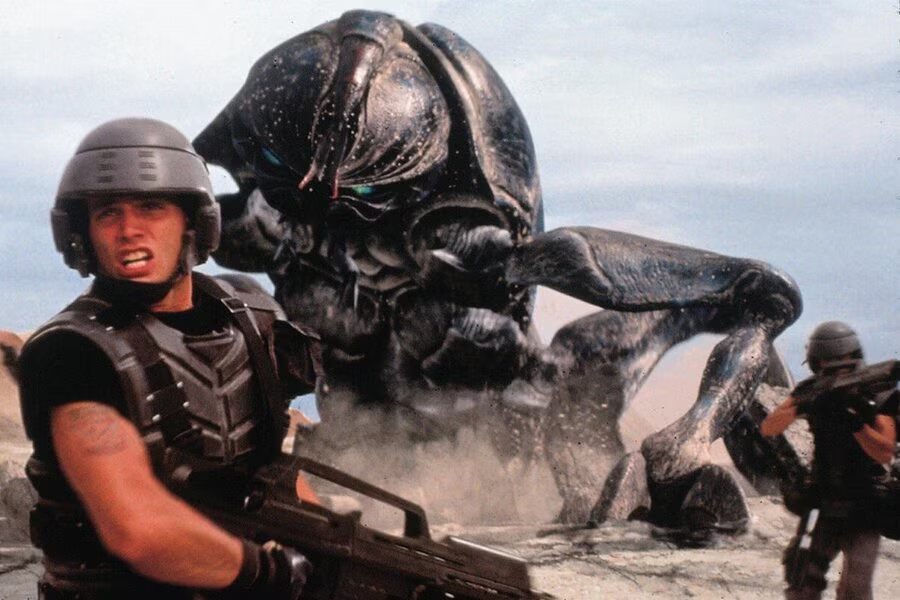
Iconic scene from the 1997 Starship Troopers film and probably the most commonly used (fair use)
(3) ROBERT HEINLEIN –
STARSHIP TROOPERS & STRANGER IN A STRANGE LAND (1959 & 1961)
Along with Asimov and Clarke, Robert Heinlein is one of the ‘Big Three’ of science fiction – the one also dubbed the ‘dean of science fiction writers’ – and arguably the one best known from cinematic adaptation of his work.
Sure, there’s the film of “2001: A Space Odyssey” for Clarke but people tend to associate that more with its director Kubrick and the film is, well, a little too ‘arty’ to have left its mark beyond its two or three iconic scenes (while few have seen or know about the sequel). Sure, there’s also the film of “I, Robot” for Asimov but that film was only nominally an adaptation of Asimov’s robot anthology, and the film is, well, a little too crap to have left any mark.
Neither compared to the popular and memetic impact of the film (and franchise) adapted from Heinlein’s most famous work, Starship Troopers – even if that adaptation had its satirical tongue in its cheek and was as cheesy as hell to boot. There’s just something about a Bug War that appeals to us – and something about peak Denise Richards that appeals to me.
Wikipedia notes that Heinlein’s “plots often presented provocative situations which challenged conventional social mores” and “his work continues to have an influence on the science-fiction genre and on modern culture more generally”, notwithstanding its controversial aspects. In the case of Starship Troopers, that controversial aspect was its militarism – its apparent endorsement of a future universally militarized society, justified by humanity locked in an evolutionary struggle for very survival against an alien species, the Arachnids or Bugs.
Starship Troopers was a foundational work of military SF – in particular, it “helped mold the space marine and mecha archetypes”.
Ironically, Heinlein swung his provocative pendulum in the opposite direction just two years later with his Martian hippy cult in “Stranger in a Strange Land”, arguably his other best known work and which also won the Hugo Award for Best Novel like “Starship Troopers” before it.
I am not as much a fan of “Stranger in a Strange Land” as I am of “Starship Troopers” and not just because of the Martian hippies in the former – it’s the escalation of the trademark social commentary to a self-insert authorial mouthpiece and archetypal Heinleinian character Jubal Harshaw. Also, Stranger lacks the cultural impact of Troopers, not least because of the lack of comparable adaptation – with the most significant impact being the name of Twitter’s AI Grok being taken from the novel’s Martian word grok.
RATING: 5 STARS*****
S-TIER (GOD TIER)