

Cover art of Batgirl 2011 / Vol 4 issue 35 by Cameron Stewart (published October 2014 by DC Comics)
Ah – the girls of comics, so many that I not only have my Top 10 Girls of Comics, but I’m spoilt for choice for my usual twenty special mentions I like to have for my top tens.
ART & COSPLAY (MEDIA)
But first my standard note on the visual images used in these special mentions. Given the copyright in such images, I only use a visual image as fair use for the purposes of comment and review in each entry – a feature image to identify the character, either in general or in their most iconic version as I review it to be (or both), sourced only from published cover or feature art as cited, often which I review to be iconic of itself or which influenced my view of their most iconic version (or both).
I also include a special section in each entry under the subtitle of art and cosplay – not for any actual art and cosplay as such but instead where I nominate my favorite artists and cosplay models depicting the character, often as entries in a quick top ten on the spot, which you can look up for yourself. For art, I award a special ranking for any art by my two favorite artists – the two freelance digital artists Sciamano and Dandonfuga. For cosplay, I award a special ranking for any cosplay by my holy trinity of models – my favorite model Yummychiyo with her insane figure in top spot, followed by Hane Ame and Helly Valentine. I also have a ranking for appearances of the character in media if any – cinema and screen, noting my favorites. These may include further images as fair use for the purposes of comment and review of those media appearances.
As for the feature image I’ve chosen for this page, I chose the cover art of Batgirl – spoiler for one of my special mention entries – by Cameron Stewart for Batgirl 2011 / Volume 4 issue 35 published by DC Comics in October 2014. In my opinion, it’s become one of her most iconic cover art images, surprisingly demure while capturing something of her personality – and that of the girls of comics in general in this social media age.

Sheena Queen of the Jungle cover at by J.Scott Campbell
(1) JUNGLE GIRL & CAVEWOMAN
The Jungle Girl and Cavewoman are archetypal characters of fiction, particularly recurring in comics or fantasy – a female adventurer, superheroine or even damsel in distress in a jungle setting. Essentially, she’s the female equivalent of Tarzan.
She typically wears an animal fur bikini (leopard more often than not), the tropical equivalent of Red Sonja’s chain mail bikini (or female equivalent of Tarzan’s loincloth) and is armed with primitive weapons such as a knife or spear (instead of my jungle weapon of choice – a gun).
Interestingly, she also often tends to be blonde. She is also impossibly statuesque (like Tarzan) and even more impossibly well groomed (just like Tarzan always seems to be clean-shaven).
Very often, the Jungle Girl overlaps with the Cavewoman, finding herself in a prehistoric or ‘lost world’ setting, typically (and anachronistically) with dinosaurs, because everything’s cooler with dinosaurs – such as Shanna She-Devil, resident in the Savage Land, Marvel Comics’ bizarro tropical lost world within Antarctica (?!)
Jungle Girls were the first superheroines in comics, predating even Wonder Woman with characters such as Sheena, Queen of the Jungle, continuing through to character’s such as Marvel Comics’ Shanna She-Devil and beyond.
And there is also a titular Jungle Girl (published by Dynamite Comics), featuring its protagonist Jana Sky-Born, as well as a titular Cavewoman comic. In the latter, protagonist Meriam Cooper at least has an explanation for her superhuman statuesque form – narratively in that it was apparently a side effect of the time travel back to the age of dinosaurs, and less narratively in that her creator Budd Root was influenced by Playboy comics. Time travel – is there anything it can’t do?
ART & COSPLAY (MEDIA)
For my iconic feature image, I’ve firstly chosen the original – and arguably archetypal – jungle girl of comics, Sheena Queen of the Jungle, albeit in her revamped Dynamite Entertainment series, and secondly chosen the iconic cover art by J. Scott Campbell for the first issue of that series in 2017, perhaps the most iconic cover art of the series (rivalled only by Lucio Parrillo’s cover art for the series) or of any Jungle Girl.
ART
Sadly no Sciamano or Dandonfuga art – but there’s certainly art by some of my favorite artists in comics. Campbell and Parrillo of course, but also two artists whose signature art is either jungle girls or cavewomen – Frank Cho and Budd Root, the latter not just any cavewoman but the Cavewoman comic of that title.
COSPLAY
No holy trinity but two words – Lindsay Pelas, for the finest jungle girl cosplay ever.

The iconic film poster of Racquel Welsh in 1 Million BC. (It also was the final poster on the cell wall of Andy Dufresne when he escapes in The Shawshank Redemption – in a series of posters back to Rita Hayworth, as per the original title of Stephen King’s short story “Rita Hayworth and the Shawshank Redemption”.
MEDIA
Racquel Welch in One Million Years BC. That is all.
Well, perhaps not quite all but definitely the best and most iconic cavewoman in film.
There’s so many Jungle Girls and Cavewomen that I’ve done a separate top ten and special mentions for them!
Top 10 Jungle Girls & Cavewomen
Top 10 Jungle Girls & Cavewomen (Special Mention)
RATING:
A-TIER (TOP TIER)

Cover art by Michael Turner for Superman Batman Vol 1 #13 October 2004
(2) SUPERGIRL (DC 1958)
Supergirl was originally a derivative character of Superman – created to be a female counterpart of Superman in 1959. After all, an opposite gender counterpart is an easy way to double the potential of a character.
Supergirl has had various incarnations in different costumes – enough for a Top 10 Supergirls (including Power Girl).
“The most popular and enduring version of the character being Kara Zor-El, Superman’s cousin, who shares his super powers and vulnerability to Kryptonite”.
To some extent, Supergirl represented the start of Superman’s Silver Age silliness, the first crack in the wall of Superman’s status as sole survivor of Krypton, which expanded to let in a whole flood of survivors – Supergirl, Krypto the Super-Dog, Beppo the Super-Monkey (I’m not kidding – there was a whole Legion of Super-Pets), General Zod and other Kryptonian criminals in the Phantom Zone, the bottled city of Kandor (again I kid you not), the entire city of Argo blown off-planet, and eventually the real parents of both Supergirl and Superman…
I mean – it gets to the point where I wonder if anyone actually died in the destruction of Krypton, or whether the entire population just moved to Earth. Or the Phantom Zone (come to think of it – why didn’t they just all move to the Phantom Zone, since it saved Zod and his colleagues?). Or Kandor, Argo and every other city or dimension DC Comics pulled out of its ass.
ART & COSPLAY (MEDIA)
As captioned, for my iconic feature image I’ve used the cover art of her by Michael Turner for Superman/Batman Vol 1 #13 – this and other art by Turner is among the most iconic art of her, if only for that steely blue gaze that he consistently depicted for her (and perhaps that distinctive midriff top).
ART – DANDONFUGA
Sadly no Sciamano art for her – as usual he tends to focus more on girls from video games or anime – but she does have Dandonfuga art, hence my Dandonfuga ranking.
Also art by comics artists Nathan Szerdy, J. Scott Campbell, David Nakayama and Artgerm among others, as well as art by Neoartcore.
AI shoutout to Naughty Neurals and Nho Eskape.
COSPLAY
There is an abundance of Supergirl cosplay given her popularity and distinctive costume – none by my holy trinity but fortunately recent cosplay by Kalinka Fox.

Australian actress Milly Alcock in a brief appearance as a drunk Supergirl at the end of James Gunn’s 2025 Superman film, setting up a larger role for her in the DC cinematic universe run by Gunn.
MEDIA
There have been a few Supergirl incarnations in film or television, with the highest profile one perhaps as that of Melissa Benoist in the 2015 Supergirl TV series which ran for six seasons. That is, until Australian actress Milly Alcock in her brief appearance as a drunk Supergirl at the end of James Gunn’s 2025 Superman film, setting up a larger role for her in the DC cinematic universe run by Gunn. What’s not to love?

Supergirl as she appears in the Harley Quinn animated series and her profile image in the fan wiki
I’m also a fan of her brief cameo in the Harley Quinn animated series, voiced by Lacey Chabert, where she uses her heat vision in a sideline of lasyk eye surgery.
RATING:
A-TIER (TOP-TIER)

Variant cover art of DC Comics Batgirl 31 by Artgerm (featuring the Barbara Gordon version of the character)
(3) BATGIRL (DC 1961)
Like Supergirl, Batgirl was originally a derivative character of Batman – and of similar vintage to Supergirl in 1961 as a female counterpart of him.
As Supergirl represented the start of Superman’s Silver Age silliness and proliferation of Kryptonian survivors, Batgirl similarly represented the start of Batman’s Silver Age silliness and proliferation of the so-called Batman Family or Bat Family. Batman readers have always had to deal with a proliferation of Robins (since the original Robin dated back almost as old as Batman himself, mainly to give Batman someone to talk to instead of interior monologues). Batgirl started to expand the Batman Family in a way that directly echoed the expansion of the Superman Family for obvious (and parallel) commercial reasons – Ace the Bat-Hound instead of Krypto the Super-Dog, and even Bat-Mite instead of Superman’s Mr Mxyzptlk. Just like Superman gets to the point where I wonder if everyone from Krypton moved to Earth, Batman gets to the point where I wonder if anyone in Gotham is not aware that Bruce Wayne is Batman.
Again like Supergirl, Batgirl has had various incarnations, enough for a Top 10 Batgirls (and yes – I’ll throw in Batwoman and Huntress), in different hair colors and costumes, with perhaps the former as more prominent. The most iconic Batgirl and certainly my Batgirl of choice is redhead Barbara Gordon, daughter of Batman’s ally Commissioner James Gordon.
ART & COSPLAY (MEDIA)
Hence as captioned my iconic feature image is the variant cover art of Barbara Gordon’s Batgirl by Artgerm for Batgirl 31, showcasing her distinctive costume and red hair. I understand he did at least a trilogy of such covers in this vein, featuring two other versions of Batgirl – the blonde Stephanie Brown and brunette Cassandra Cain.
ART – DANDONFUGA
Sadly no Sciamano art for her – as usual he tends to focus more on girls from video games or anime – but she does have Dandonfuga art, hence my Dandonfuga ranking. And how! Dandonfuga has done at least a couple of Batgirl pieces – and one of them is sizzling!
Also art by comics artists Nathan Szerdy, J. Scott Campbell, Keith Garvey, Mimi Yoon, Will Jack and Dawn McTeigue, as well as art by Neoartcore. Oh – and Cameron Stewart for the Batgirl cover art that is my feature image for this special mentions page itself.
COSPLAY
There is an abundance of Batgirl cosplay given her popularity and distinctive costume, but sadly none by my favorite cosplay models and certainly not my holy trinity of Yummychiyo, Hane Ame or Helly Valentine, alas!

Batgirl as she appears in the Harley Quinn animated series and her character profile image in the fan wiki
MEDIA
There have been a few Batgirl incarnations in film or television – perhaps most famously Yvonne Craig in the camp 60s TV series. I didn’t mind Alicia Silverstone as the character, although the less said about the film in which she played it the better. However the standout for me is the animated version of her in the Harley Quinn animated series, where she is voiced by Briana Cuoco, sister of Kaley Cuoco who of course plays the lead role of Harley Quinn.
RATING:
A-TIER (TOP TIER)

Hero Initiative charity auction art of Rogue and Psylocke, two of the most iconic and popular X-women, by J. Scott Campbell and David Nakayama respectively – auctioned off on bid for $15,100!
(4) X-WOMEN (Marvel 1963)
Special mention has to go to Marvel’s X-Women – the various female members of the X-Men and its offshoots.
Thanks to cinematic or screen adaptations, the premise of the X-Men is reasonably well known in popular culture – mutants living among us that became an analogy for civil rights in the 1960s when they were first written, with Professor X or Charles Xavier as Martin Luther King, and Magneto as Malcolm X (although I understand the parallel between Malcolm X’s moniker and the name of the X-men is just synchronicity).
And by mutants, we’re not talking mutations like a sixth finger or something, but dramatic and spectacular mutations in the nature of superpowers (and are essentially magic rather than anything resembling mutations in terms of scientific evolutionary theory). Also, as a general rule, no ugly mutations or mutations that detract from a supermodel appearance either, male or female, except (usually) for the more villainous side of the equation.
There is a bewildering proliferation of X-men teams and titles – starting when the original X-Men team was (mostly) replaced with new members in the 1970s, with the original team then becoming X-Factor or something. And then you have various offshoots or spinoffs – New Mutants, X-Force, Excalibur, Alpha Flight, Generation X (predictably), Exiles, X-Statix, and Deadpool to name only the higher profile or more prolific titles or teams. Not to mention solo adventures or titles for characters such as Wolverine, probably the most popular character from X-men continuity or at least the one most people know. It gets more bewildering yet with the proliferation of characters through the usual shenanigans of time travel in comics – with characters from the future (hello, Cable!) or effectively revived (or displaced) from the past.
Not surprisingly, there’s enough female characters or X-women for their own top ten (and some special mentions).
ART & COSPLAY (MEDIA)
As captioned my iconic feature image is art in collaboration by J. Scott Campbell and David Nakayama for the regular Hero Initiative charity auction raising money for comics creators or stores in need or trouble (via the Binc or Book Industry Charitable Foundation), selling for $15,100 on bid. It showcases two of the most popular and iconic X-women, Rogue by Campbell (one of the most iconic artists for X-men and X-women) and Psylocke by Nakayama – as well as the distinctive style of each artist, albeit I think Nakayama’s style is influenced by that of Campbell, like so many other artists in comics who have followed in Campbell’s footsteps.
Otherwise, I’ll note my favorite art and cosplay for each character in their individual entries.
I will however note my favorite incarnations of them collectively in media here, since it’s obvious and I’ve already made reference to it in the cinematic adaptation of them in the X-men films.
RATING:
A-TIER (TOP TIER)

Jessica Drew Spiderwoman art by J Scott Campbell for Marvel Comics
(5) SPIDERWOMAN & SPIDERGIRL (Marvel 1977)
There’s a few of them at Marvel…
Spiderwoman spun off (heh) from Spiderman – Marvel Comics’ major domo Stan Lee even admitted her creation was to secure the copyright for a Spiderwoman character. Like Supergirl (and Batgirl), Spiderwoman has had various incarnations – indeed, there has been a bewildering proliferation of Spiderwomen and Spidergirls, including alternate versions of both Spiderman’s most famous love interests, Mary Jane and Gwen Stacy. (Spider-Gwen! Obviously not her real superhero moniker – which is Ghost Spider – but her fan-name).
And yes – once again, there’s enough for a Top 10 Spiderwomen & Spidergirls.
ART & COSPLAY (MEDIA)
For my iconic feature image, I’ve used art of the original and arguably definitive Spiderwoman Jessica Drew by J. Scott Campbell for Marvel Comics – the art also showcases her costume, including a glimpse of the costume’s wings that it has like flaps (between arms and sides).
There’s not any notable live-action adaptations as yet – we do of course see animated versions in the Spiderverse films.
RATING:
A-TIER (TOP TIER)

Cover art by Marci Silvestri for Witchblade issue 68 published in September 2003 (and reused for Wizard World Conference art in 2006) – cropped for fair use (and they’re a little skimpy below the waist)
(6) GIRLS OF WITCHBLADE (Image / Top Cow 1995)
One of the signature ‘bad girl’ comics of the 1990’s and Image Comics’ Top Cow studio, relaunched in 2024.
The Witchblade is not a character but a thing – as per the name, a mystical (and sentient) gauntlet that ‘bonds’ with a female ‘host’ to become a magically powered ‘suit’.
With blades if you want. Or wings or whatever. But not too much actual suit to cover its female host’s body – because, you know, comics.
It’s bonded with various female figures throughout history – pretty much every badass female figure of note was a (secret) Witchblade. Not sure why Joan of Arc didn’t use it at the stake – or Cleopatra use it instead of the asp. (I’m not entirely sure Cleopatra was a Witchblade according to the comic lore – but Joan of Arc was).
For the original run of the comic, it was worn primarily by Sara Pezzini, NYPD’s most attractive homicide detective.
Not surprisingly, she scores top spot in my Girls of Witchblade but I’ll also give shoutout here to the Angelus as close second – again, not a character but a thing that bonds with a female host, essentially representing the power of light.
*
ART & COSPLAY (MEDIA)
It was a close call for art by Michael Turner – rest in peace – as one of her leading artists in her original comic in the 90s, not to mention the Eric Basaldua art I used as feature image for my Top 10 Girls of Comics or the J. Scott Campbell cover art for her 2024 relaunch.
However, I went with the iconic feature art by Marci Silvestri – from a variant cover for Witchblade issue 68 published in September 2003 (and reused for Wizard World Conference art in 2006) – for two reasons. One is that he was her creator (and the other leading artist along with Turner for the original comic in the 90s, with the two of them as arguably her best and most iconic artists). The other is that this art nicely showcased the two top girls of Witchblade – the Angelus (right – for whom Silvestri is also my favorite artist) and Sara Pezzini as the Witchblade (left).
ART
Sadly no Sciamano or Dandonfuga art but there’s enough art from my favorite comics artists for my top 10 on the spot Witchblade art (featuring the various girls of Witchblade but primarily Sara Pezzini and the Angelus) – the girls of Witchblade are not quite up there with Vampirella, Red Sonja or Lady Death as favorite subjects for pinup artists but they’re close:
1 – Marc Silvestri (as her creator and my iconic feature image, as well as particularly his art of Sara Pezzini and the Angelus)
2 – Michael Turner (as her leading artist in her original comic in the 90s)
3 – Eric Basaldua (for my iconic feature image – the one for my Top 10 Girls of Comics)
4 – J. Scott Campbell (for his relaunch cover art)
5 – Nathan Szerdy (as variant cover artist for the relaunch)
6 – Elias Chatzoudis (as yet another variant cover artist for the relaunch)
7 – David Nakayama (as cover artist)
8 – Stjepan Sejic (as another leading artist for her comic with it also being some of his best art – also notable for his art of Sara’s successor Danielle Baptiste)
9 – Frank Cho (for characteristic art)
10 – Randy Green (for some of my favorite portraiture art of Witchblade)
SPECIAL MENTION – IMAGE (TOP COW)
All the cover art or artists for her Image Comics Top Cow title.
COSPLAY
Given the Witchblade costume for cosplay, it takes a certain quality to achieve it – and the only one of my favorite cosplay models to do so is Kalinka Fox, Witchblade and all.
Any one of my cosplay holy trinity could do it but sadly no cosplay from them.

Promotional concept art poster for a Witchblade film adaptation in 2008 for release in 2009 – sadly never produced
MEDIA
There was a television adaptation for two seasons in 2001-2002 (after a pilot film in 2000), as well as a 2006 anime adaptation with a new Witchblade character in a different style. The image I’ve used here was the promotional concept art poster for a 2008 film production scheduled for release in 2009 but sadly never produced – at least the poster art looked awesome!
RATING:
A-TIER (TOP TIER)

Liesel van Helsing and Robyn Hood in art by Keith Garvey for Zenescope
(7) GIRLS OF ZENESCOPE (Zenescope 2005)
Special mention has to go to the Girls of Zenescope Entertainment – Zenescope specializes in comics adapting public domain characters with a pinup art style for its covers, as with its flagship title Grimm Fairy Tales and its flagship cover girl Liesel Van Helsing. Close runners-up would be Robyn Hood and Sela Mathers, the latter as the flagship girl (and mysterious narrator) of Grimm Fairy Tales. But yes – there’s enough for a Top 10 Girls of Zenescope.
ART & COSPLAY (MEDIA)
Zenescope engages many of my favorite artists for its cover or post art, but perhaps the most iconic is Keith Garvey – hence my iconic feature image of Liesel van Helsing and Robyn Hood in their distinctive costumed appearance in art by Keith Garvey for Zenescope.
There is Zenescope cosplay but I’m not aware of any by my favorite models – nor any media adaptations.
RATING:
A-TIER (TOP TIER)

Cover of Empowered volume 1 by creator – artist and writer – Adam Warren
(8) GIRLS OF EMPOWERED (Dark Horse 2007)
In the words of artist and writer Adam Warren, “it’s a sexy superhero comedy (except when it isn’t)”
Empowered, the character and series, originated from commissioned ‘bondage’ sketches of a comics superheroine ‘damsel-in-distress’ – and to some extent continues as such, illustrated in Warren’s characteristic ‘manga’ influenced style. It’s a playful deconstruction of superhero comics tropes, particularly those involving female superheroes – with “healthy doses of bondage, fan-service and comedy”.
Empowered herself is a “plucky D-list superheroine”, who is precariously dependent on and constantly betrayed by the fragile, fickle source of her superpowers – her skin-tight ‘hypermembrane’ suit.
As a consequence, Empowered spends most of her time with her suit in tatters or various states of undress, bound and gagged by supervillains or even common criminals (in accordance with the unspoken code of conduct towards captured superheroines), a joke to her superhero peers and supervillains alike (albeit something of status symbol as arm candy to the latter).
As the series has progressed however, it has developed deeper, darker and longer story arcs – and Empowered has emerged as an increasingly formidable superheroine. And beyond Empowered, there are of course the other female characters in the comic. That’s right – a Top 10 Girls of Empowered!
ART & COSPLAY (MEDIA)
“Wait – it’s all Adam Warren?”
“Always has been”
Well, with the exception of the occasional guest artist – and even cosplay – but what do you expect given she was created by Adam Warren as artist and writer in his distinctive style from the outset? And what do you expect for my iconic feature image other than the first cover for Warren’s first volume of Empowered?
No media adaptation.
RATING:
A-TIER (TOP TIER)

Variant cover art by David Nakayma for volume 1 of Black Canary Best of the Best, a limited series published by DC Comics in 2024-2025
(9) BLACK CANARY (DC 1947)
The Canary Cry! Um, chirp – I guess?
It’s a little hard to take a superpower by the name of Canary Cry seriously – or for that matter a superheroine by the name of Black Canary, particularly when she’s part of a superheroine team by the name of the Birds of Prey. Has someone told DC Comics that canaries aren’t in fact raptors or birds of prey? I mean, canaries aren’t known for their fierceness – when I think of canaries, my first thought is of the proverbial canary in the coal mine, which is known for, you know, dying.
She was one of DC Comics earliest superheroines, with her debut in Flash Comics in 1947 – albeit as a backup character to a backup character, Johnny Thunder. Of course, she proved a lot more durable than Johnny Thunder. Who’s Johnny Thunder? Exactly.
From there, her history is convoluted – so convoluted that the character was effectively split between mother and daughter, Dinah Lance nee Drake and Dinah Laurel Lance respectively, However, apart from her romantic connection to Green Arrow, she has become most closely connected to Batman’s setting of Gotham and particularly the Gotham-based Birds of Prey.
You’ve got to admire a superhero who fights crime in a leotard and fishnet stockings, although she usually accessorizes with a jacket and occasionally has variant costumes. Of course, fighting crime in a leotard and fishnets is a little easier when you are a “prodigious hand-to-hand combatant”, as the modern Black Canary has been portrayed. She also has an actual superpower, the so-called Canary Cry – a high-powered sonic scream which can severely damage both inorganic and organic objects.
Chirp, indeed.
ART & COSPLAY (MEDIA) – DANDONFUGA
As captioned my iconic feature image is a variant cover by David Nakayama for for volume 1 of Black Canary Best of the Best, a limited series published by DC Comics – showcasing her classic costume of leotard and fishnets, as well as jacket and her sonic superpower.
She scores my Dandonfuga ranking for quite a few works of her by Dandonfuga. As usual for girls of comics, there’s no Sciamano art – but there is some art of her by Nathan Szerdy and Artgerm, as well as Nakayama.
There is cosplay of her but none by my holy trinity or other favorites (that I could find).
She has been adapted in film and television, but none that grab my fancy.
RATING:
B-TIER (HIGH TIER)

Sue Storm variant cover art by Stanley ‘Artgerm’ Lau for Fantastic Four #1 in the series relaunched by Marvel in August 2018 – he did one for each member of the team but I suspect Sue’s was the most popular (fair use)
(10) SUE STORM – FANTASTIC 4 (Marvel 1961)
The Fantastic Four was the first superhero team of Marvel Comics in 1961 (predating the X-men in 1963) and still remains one of their most iconic teams, although sadly without the successful cinematic adaptation of other Marvel titles (unless you count The Incredibles). Sue Storm is of course the leading lady of the Fantastic Four – and arguably, by extension, of Marvel Comics itself.
Like the rest of the Fantastic Four, Sue acquired her superpowers through a cosmic radiation storm, as opposed to dying horribly as in real life, but that’s superpowers in comics for you. Her superpower was originally a somewhat passive one of invisibility (by manipulating light) but subsequently extended to the more active one of projecting powerful energy fields.
Sue has recently received a big boost – not so much from yet another cinematic adaptation in 2025 but from the Marvel Rivals video game released at the end of the previous year, which featured her and other girls of Marvel in different styles. Hence, many girls of Marvel receive a big boost but some more than others – with Sue in the latter category, in art and cosplay from the game. Which brings me to…
ART & COSPLAY (MEDIA)
ART – SCIAMANO & DANDONFUGA
As captioned, my iconic feature image was the Sue Storm variant cover art by Stanley ‘Artgerm’ Lau for Fantastic Four #1 in the series relaunched by Marvel in August 2018 – it showcases her classic costume and power of invisibility.
Thanks to Marvel Rivals, she scores both Sciamano and Dandonfuga rankings for art of her from the game, the former a rare treat for girls of comics as Sciamano tends to focus more on girls of video games and anime. My other favorites for art of her are by Nathan Szerdy, Kikol Draws, Shannon Maer, and Blushy & Spicy.
AI shoutout to Penguih.
COSPLAY – HELLY
Marvel Rivals has also seen her score my Helly Valentine cosplay ranking, as well as cosplay of her by Tabitha Lyons.
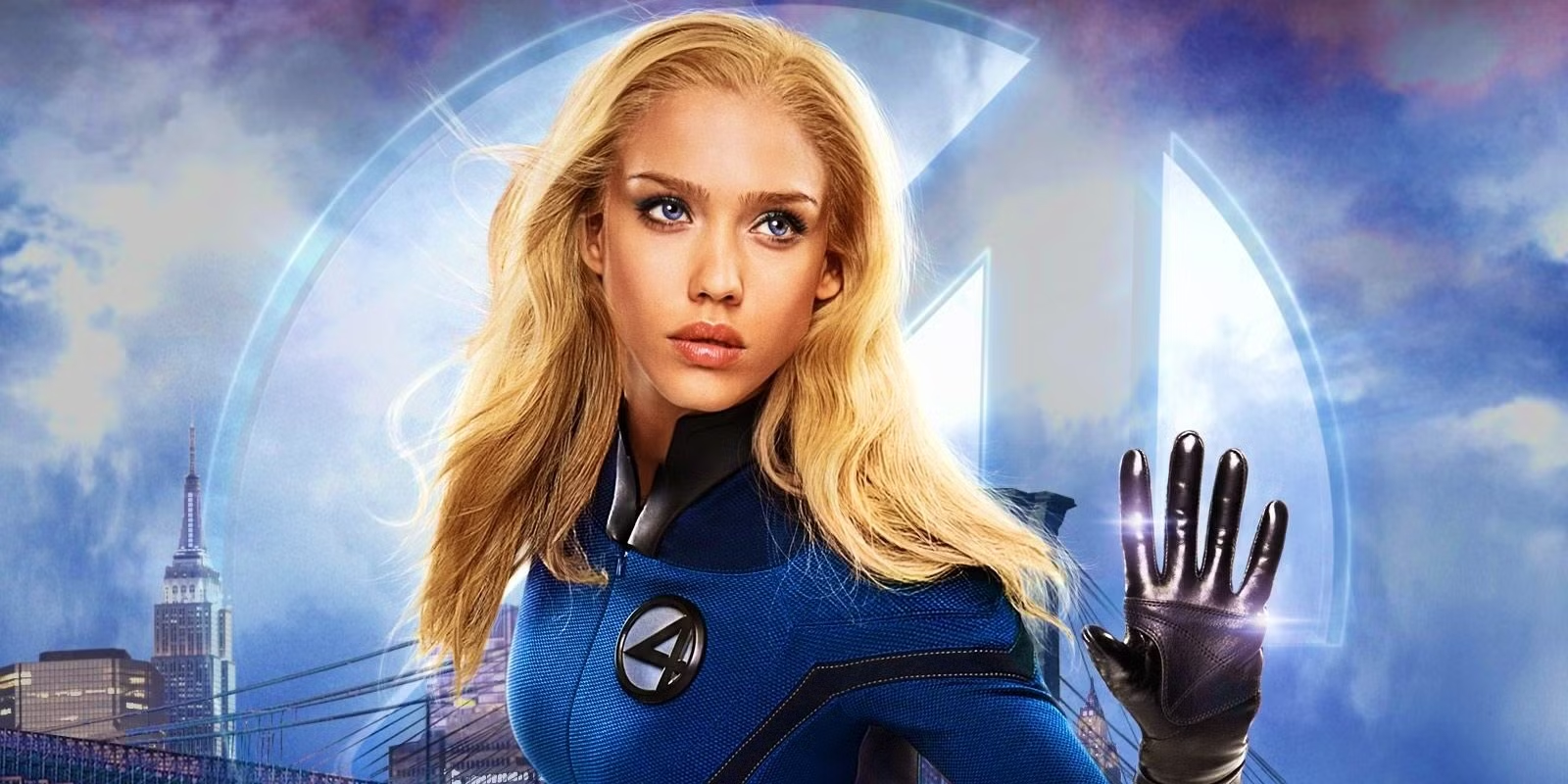
Jessica Alba as Sue Storm cropped from a promotional image for the Fantastic Four film
MEDIA
Although I’m not particularly a fan of any of the cinematic adaptations, I was a fan of Jessica Alba as Sue Storm.
RATING:
B-TIER (HIGH TIER)

J Scott Campbell always drew the definitive Black Widow – as here on the variant cover of Black Widow 1 published by Marvel Comics 8 January 2014
(11) BLACK WIDOW (Marvel 1964)
International Woman of Mystery!
Everyone’s favorite black leather skintight catsuit clad heroine of Marvel Comics – the Soviet femme fatale equivalent of Captain America.
Originally a Soviet spy and antagonist to Iron Man (who in turn originated as a cool capitalist anti-communist superhero), but she subsequently defected and joined the Avengers.
However, Black Widow is actually a spy codename for more than one character in Marvel Comics, although redhead Natalia Romanova / Natasha Romanov is better rather than her blonde successor Yelena Belova.
ART & COSPLAY (MEDIA)
J Scott Campbell always did drew the definitive Black Widow – as he did for women in catsuits in general as well as the variant cover of Black Widow 1 published by Marvel Comics 8 January 2014 for my iconic feature image.
ART – DANDONFUGA
Like Zatanna in my previous special mention entry, we’re out of top ten on the spot territory but we’re still in Dandonfuga ranking territory – she’s just too iconic for Dandonfuga not to have featured her! Apart from J. Scott Campbell and Dandonfuga, there’s art of her by some of my favorite artists – Artgerm, Neoartcore, Shannon Maer, Logan Cure, and Ayyasap. Hemm – that’s not too far off top ten on the spot territory!
AI shoutout to Naughty Neurals.
COSPLAY
As for cosplay, I’d love to see them in the catsuit but no Black Widow cosplay from my holy trinity as far as I know – Yummychiyo, Hane or Helly. There is some knockout cosplay from Kalinka Fox – also from models Katyuska Moonfox, Giorgia Cosplay, and Alodia Gosiengfiao in classic pose.

Classic Black Widow – also peak Black Widow. Black Widow as played by Scarlett Johansson in Iron Man 2
MEDIA
Scarlett Johansson’s portrayal of her in the Marvel Cinematic Universe raised her profile outside comics circles – with Black Widow in Iron Man 2 as classic or peak cinematic Black Widow.
Hence why people are more familiar with Johansson’s redhead Natalia Romanova / Natasha Romanov rather than her blonde successor in comics, Yelena Belova. In the MCU, Natasha even went blonde before they introduced Yelena as her own character played by Florence Pugh in the Black Widow film.
RATING:
B-TIER (HIGH TIER)

J Scott Campbell cover art for Amazing Spider-Man 601 published by Marvel Comics in 2009
(12) MARY JANE (Marvel 1965)
Lois Lane may be the most iconic female love interest of a superhero in comics, but not as prolific in art and cosplay as another superhero love interest – Mary Jane “MJ” Watson, ultimately Mary Jane Parker or Mrs Spiderman. It helps earn her special mention that she’s a recurring model for Marvel cover artists or comics artists in general.
Of course, it helps further that Mary Jane is canonically a model (and actress) by profession – and perhaps even more that comics artists seem to be enamored of redheads.
What cements her place in this special mention is her famous catchphrase, possibly the most famous line of any female character in comics, which was her very first line to Spiderman himself as Peter Parker when he sees her for the first time and is stunned by her striking appearance:
“Face it, Tiger! You’ve just hit the jackpot!”
ART & COSPLAY (MEDIA)
J. Scott Campbell is the definitive Mary Jane artist and never more so than in his cover art for Amazing Spider-Man 601, the definitive Mary Jane cover – although the definitive Mary Jane panel remains “Face it, Tiger! You’ve just hit the jackpot!”. Campbell has returned to Mary Jane as his definitive subject again and again – including a special series of Mary Jane in her different styles – but Amazing Spider-Man 601 will always remain the iconic cover art of her, both by Campbell and in general, so much so that it has become a recurring source for homage and meme, including by Campbell himself who revisiting it. So of course it’s my choice for her iconic feature image.
ART – DANDONFUGA
And yes – she gets a Dandonfuga ranking as another iconic girl of comics drawn by Dandonfuga. Apart from J. Scott Campbell and Dandonfuga, there’s art of her by some of my favorite artists – Nathan Szerdy, David Nakayama, Neoartcore, and Shannon Maer.
COSPLAY
Sadly no cosplay by my holy trinity – but there is cosplay by Kalinka Fox
MEDIA
As for media, she’s been portrayed by Kristen Dunst in the Sam Raimi film trilogy and Zendaya with Tom Holland’s Spiderman in the Marvel Cinematic Universe collaboration with Sony.
RATING:
B-TIER (HIGH TIER)

Cover art by Amanda Conner for Starfire 1 – the first issue of Starfire Volume 2 – published by DC Comics August 2015
(13) TEEN TITANS – STARFIRE & RAVEN (1980)
Special mention has to go to the top girl of the Teen Titans, everyone’s favorite alien princess – Starfire.
Starfire is everyone’s favorite alien princess.
She’s not unlike Superman – an alien princess of the planet Tamaran, fled to Earth to join the Teen Titans (after complicated interstellar war and politics involving her rivalry with her sister). Her alien physiology absorbs ultraviolet light energy for use in various powers – like Superman, come to think of it. Is there any DC Comics alien that isn’t superpowered by sunlight?
But then – who doesn’t like an orange-skinned alien space babe?
Shoutout to the other girl of Teen Titans, everyone’s favorite dark goth girl and half-demon princess – Raven. However, her costume doesn’t quite lend itself to pinup cover art like Starfire, whose usual costume is in the style of a swimsuit or cheerleading outfit – but she is a favorite for fan artists.
ART & COSPLAY (MEDIA)
For my iconic feature image, I chose Amanda Conner’s cover art for the first issue of Starfire Volume 2, released by DC Comics in August 2015, which forever defined the character for me thereafter – and was the one of a number of playful and stunning covers Conner did for the series.
ART – DANDONFUGA
Starfire gets a Dandonfuga ranking – indeed, she’s been a recurring subject of Dandonfuga art. There’s also art of her by other favorite artists – Michael Turner (with perhaps the classic art of Starfire to rival that of the Amanda Conner cover art in my feature image), Nathan Szerdy, Artgerm, Neoartcore, Logan Cure, Will Jack, Aroma Sensei, and REIQ. Hmm…getting close to a top ten on the spot. AI shoutout to Naughty Neurals, Penguih and End of Line – the first two feature both characters together as well as Raven separately.
Raven also gets a Dandonfuga ranking with a number of artworks of her – other favorite fan art versions of her include Neoartcore, Logan Cure and Aroma Sensei (the last as a recurring subject and some of my favorite art of Raven).
COSPLAY – HELLY
As for cosplay, Kalinka Fox has suddenly risen to claim the title for my favorite cosplay of Starfire (usurping glamor model Abigail Ratchford) and Raven. The latter also scores my Helly ranking for Helly Valentine’s cosplay of her.
Both have appeared in media adaptations – foremost in animated versions – but none for my preference to include here.
RATING:
B-TIER (HIGH TIER)

Danger Girl / GI Joe crossover issue 3 cover art by J. Scott Campbell – released 19 September 2012
(14) BARONESS – G.I. JOE (1981)
And now you know (and knowing is half the battle) – Baroness is the femme fatale villain in Cobra, the antagonist organization to G.I. Joe. Of course, with their serpentine title (as well as the various names within their organization), they’re hardly going to be good guys.
GI Joe is more distinctive for being a line of toys but the franchise has extended into comics (initially as a series by Marvel Comics), animated TV series and live-action movies. Baroness actually originated in the Marvel Comics series – which is appropriate for a special mention in my top ten girls of comics – although she has also featured in other media (and as an action figure).
Baroness serves as Cobra’s intelligence officer and lieutenant to its Cobra Commander, as well as being in a romantic (and presumably kinky) relationship with its resident metalhead, Destro. She began as Anastasia, the spoiled offspring of European aristocrats, who drifted from student radicalism into international terrorism (as you do).
Of course she wears the obligatory form-fitting black leather catsuit of female comics characters – in the style of Catwoman, Black Cat or perhaps her closest counterpart, Black Widow. Well, if it ain’t broke, don’t fix it! Although she does mix it up a little with glasses.
She even has a trope named for her in TV Tropes as the Baroness, although she is not so much the origin of the trope as she is a striking example of it (and inspiration for the name) – “a female baddie with a chilly disposition and more than a touch of the dominatrix about her”, with the latter often tending to sadism. Needless to say, Baroness is the s€xpot style of the trope.
Hail Cobra, indeed!
ART & COSPLAY (MEDIA)
Yes – J. Scott Campbell is often the go-to artist for iconic (cover) art of a character and few draw a figure filling out a catsuit quite like him, so I’ve used his cover art for the third issue of the Danger Girl / GI Joe crossover released on 19 September 2012 for my iconic feature image. It showcases her distinctive costume and raven-haired girl with glasses thing she’s got going.
ART
Surprisingly no Dandonfuga ranking – surprisingly, that is, because Dandonfuga is usually drawn (heh) to a girl in a catsuit. Apart from J. Scott Campbell, there’s art of her by some of my favorite artists – Nathan Szerdy, Elias Chatzoudis, Artgerm, and Eric Basaldua.
COSPLAY
Few have a figure to fill out a catsuit like Australian cosplay model Katyuska Moonfox and she does so for Baroness.

Sienna Miller as Baroness in the promotional poster art for the 2009 film G.I. Joe: The Rise of Cobra
MEDIA
As for media, there may have not been anything else memorable about the G.I. Joe live action film franchise except for Baroness played by Sienna Miller in the first film in 2009, G.I. Joe: The Rise of Cobra
RATING:
B-TIER (HIGH TIER)

(15) APRIL O’NEIL –
TEENAGE MUTANT NINJA TURTLES (1984)
In these days when the Teenage Mutant Ninja Turtles have been an enduring media franchise for two decades, it is easy to forget that they originated in comics in 1984. Although she is understandably overshadowed by the protagonist Turtles, April O’Neil originated with them in the comics, but she wasn’t as recognizable as in subsequent media adaptations. She was a computer programmer – and worked for their adversary Baxter Stockman programming his robots, although she was not aware of his villainy (until she did find out and fled, pursued by the robots into the sewers, where she was saved by the Turtles).
But who knows about any of that? No one knows about April (and few know about the Turtles for that matter) from the comics – the April we all know is from the animated TV series (hence her special mention), where she was a television news reporter for Channel 6 News (in New York City), in her distinctive yellow jumpsuit. Once again rescued by the Turtles – this time from street punks working for their most iconic adversary, Shredder – she became one of their closest allies and collaborators.
ART & COSPLAY (MEDIA)
As I said, April’s appearance in the original comics has been eclipsed by her iconic adaptation in the (original) animated TV series, so naturally I’ve gone with a cropped image of her appearance from the latter for my iconic feature image.
ART
Again surprisingly no Dandonfuga ranking – I would have thought that she was iconic enough for Dandonfuga art. However, at least there’s art of her by some of my favorites – Nathan Szerdy, Neoartcore, Dan Panosian (always good for redhead art) and Logan Cure.
COSPLAY – HELLY
My first Helly ranking – or indeed for any of my holy cosplay trinity – in these special mentions! Yes – Helly Valentine has done April cosplay, animated series jumpsuit and all. Close runners-up are Octokuro and Tabitha Lyons.

Megan Fox as April O’Neil in the 2014 live-action film
MEDIA
Yes – I know I used an excerpt of April’s appearance from the original animated TV series for my iconic feature image…but how I could resist Megan Fox as her in the 2014 live-action film? Even if she did ditch the iconic yellow jumpsuit for a more subdued yellow jacket.
RATING:
B-TIER (HIGH TIER)

Atom Eve as she appears in the Invincible animated TV series adapted from the comic – page feature image from the Invincible fan wiki)
(16) ATOM EVE – INVINCIBLE (Image 2003)
Invincible did not come to my attention when originally published as a comic (by Robert Kirkman – of The Walking Dead fame – for Image Comics in 2003) but boy did it ever in its animated television adaptation for Amazon Prime in 2021. Well, me and quite a few others, given it has been renewed for three more seasons and counting (as at 2026) following widespread acclaim from critics and audiences. Which all led to me chasing up the comics.
The premise is essentially what they call a bildungsoman in literary circles – except the teenager coming of age, Mark Grayson, just happens to be the son of the most powerful superhero on the planet, Omni-Man. And as Mark comes into his own superpowers, he assumes the role of the titular superhero Invincible:
“However, an unthinkable tragedy soon strikes the superhero community, and Mark is forced into a dangerous position that he doesn’t fully understand. With his new superhero allies, Mark quickly learns that there is much more to the world that he’s inherited than meets the eye — and that there are twists and turns that will make him question the true nature of his role on the planet”.
And some of those twists and turns may just happen to involve his father.
Anyway, special mention has to go to Invincible’s pinup girl, Samantha Eve Wilkins or Atom Eve – the archetypal redhead green-eyed girl of comics, as well as a superheroine who manipulates matter and energy, with a costume that is essentially a pink leotard with a cape and the female symbol on her chest.
ART & COSPLAY (MEDIA)
Given that I came to Invincible through the animated TV series, naturally I chose my iconic feature image of her as she appears in the series (from the page image in the Invincible fan wiki).
ART – DANDONFUGA
She even has a Dandonfuga ranking – for Dandonfuga art of her. She also has art by David Nakayama and Nathan Szerdy.
Sadly no cosplay, at least by my holy trinity or other favorites.
RATING:
B-TIER (HIGH TIER)

The many faces of Starlight as she appears in The Boys TV series played by Erin Moriarty
(17) STARLIGHT – THE BOYS
(DC Wildstorm – Dynamite 2006)
Although I knew of it, I was introduced to this comic by its television adaptation with its 2019 debut – the first season is widely recognized as its best, albeit it may have fizzled after that (which season depends on taste, although perhaps the widest agreement is that the series finale was disappointing). That inspired me to read the comic series by Garth Ennis – with whom I was familiar from 2000 AD and even more so his, ah, confrontational comic series Preacher. Ennis quipped that The Boys would out-Preacher Preacher, presumably in terms of its profanity, sex and violence. I’m not sure that anything could out-Preacher Preacher, but The Boys certainly gives it a shot. And ultimately it may be for the best, as I prefer The Boys. It told a better story and seemed less purely gratuitous for its own sake than Preacher (albeit only just barely).
The series takes place in a world where superheroes exist, although such that you prefer they didn’t. On the superhero side, you have the Seven, the world’s leading superhero team – sponsored by the powerful corporation Vought International – and mostly copies of the Justice League, led by its equivalent of Superman (with some Captain America thrown in), Homelander, who more than earns the description of diabolical and invokes the trope Beware the Superman. And on the other side, you have the titular Boys, vigilante cape-busters forced to use their smarts, skills and willingness to fight dirty (including some of the superheroes’ own weapons) against their adversaries – led by Billy Butcher, perhaps the series’ most compelling character to rival his primary adversary, Homelander.
And stuck between them is Annie January or Starlight – girlfriend of Hughie, one of the Boys, with whom she’s a covert ally, and at the same time the newest member of the Seven, initially starry-eyed but rapidly disillusioned about her fellow superheroes, not least from her abusive initiation into their ranks. Whatever one’s reaction to the TV series adaptation, Starlight retains her special mention here – if only from the first season or so, the comics, and her popularity in art and cosplay. Speaking of which…
ART & COSPLAY (MEDIA)
Given that I came to The Boys through the TV series, I chose my iconic feature image of her as she appears in the series played by Erin Moriarty.
Sadly no Dandonfuga ranking – but there is art of her by three of my favorite artists, Nathan Szerdy, Elias Chatzoudis and Neoartcore.
There’s also cosplay of her by two of my favorite cosplay models – Kalinka Fox (who rocks it) and Tabitha Lyons (who also rocks it).
RATING:
B-TIER (HIGH TIER)

Bill McKay cover art for Dan Mendoza’s Zombie Tramp – cropped for fair use and because she’s a little too buxom in her bikini!
(18) ZOMBIE TRAMP (2008)
Zombie Tramp earns her special mention mostly thanks to her treasure trove of cover art by guest artists invited by her creator Dan Mendoza, particularly Bill McKay as the most prolific cover artist.
Also, it’s nice to see the attractive zombie trope in action – usually vampires (and to some degree ghosts) are the only undead that are traditionally sexed up, although that is more a modern cinematic or screen tradition as it varies in folklore. However, other undead have joined vampires in the posthumous pinup stakes – mummies as seductive Egyptian figures for example, and more recently, zombies, enough for an actual trope listing for attractive zombie in TV Tropes.
Of course, we’re generally not talking your average archetypal zombie of zombie apocalypse here, but rather zombies not so much different from humans – drawn less from the Romero style zombie and more from older undead archetypes such as the pale undead beauties of legend or Gothic fantasy, voodoo zombies and revenant zombies. In its most general sense, zombie may apply to any living dead being that is not a ghost, vampire or mummy.
Zombie Tramp – an independent comic by Dan Mendoza, originally in a series of self-published graphic novels and then by Action Lab Comics – does seem to feature a protagonist in the Romero style of flesh-eating apocalyptic zombie, but one that otherwise retains her former centerfold appearance, just green-skinned and white-eyed.
The titular zombie tramp is Janey Belle – a high class Hollywood call girl to the stars turned zombie after being bitten and infected by one, albeit retaining her former intelligence (and seemingly an adept hand at magic) who then seeks out vengeance on those responsible, to hell and back if necessary
However, like other comics characters, there is more than one Zombie Tramp – with a new blonde zombie tramp Angel Lynch stepping up from issue 57 or so. The queen is dead – long live the queen!
ART & COSPLAY (MEDIA)
As I discovered her through Bill McKay’s cover art for her comic, I naturally chose my iconic feature image of her from that cover art, nicely showcasing the bite that infected her on her arm – although I’d also argue that Bill McKay’s cover art of her comprises both the most iconic versions of the character as well as Bill McKay’s most iconic art.
She’s a little too niche for a Sciamano or Dandonfuga ranking, but apart from Bill McKay’s art of her, there is other guest cover or fan art of her by some of my favorite artists – Sun Khamunaki, Nathan Szerdy, and Elias Chatzoudis. Not bad for an indie comic heroine.
Also too niche or indie for cosplay or media adaptations.
RATING:
X-TIER (WILD TIER)

Cover art by Stanley Lau or ‘Artgerm’ for the Gun Honey and Heat Seeker titles – I particularly like how he put the literal honey into Gun Honey
(19) GUN HONEY & HEAT SEEKER (2021)
My special mention entry for Gun Honey (2021) has expanded from the titular heroine Joanna Tan to include spinoff Heat Seeker (2023) and its heroine Dahlia Racers.
The title of publisher Hard Case Crime – an imprint of Titan Comics – sums up their pinup pulp noir nature.
“She’ll get you the weapon you need, when you need it, where you need it – no matter how impossible.”
Joanna Tan is the titular gun honey – a fantastically attractive female gun runner blackmailed into serving the US government to clean up one of her messes from a former client.
“If the heat is on, Dahlia Racers can help you disappear – for a price”
Marked for death by a U.S. intelligence agency, Gun Honey Joanna Tan turns to Dahlia Racers (ah – the titular Heat Seeker?) to help her pull a vanishing act. But there’s a killer hot on Joanna’s tail.
ART & COSPLAY (MEDIA)
I’m pretty sure I discovered Gun Honey through the honey-dripped cover art by Stanley ‘Artgerm’ Lau, literally putting the honey into the Gun Honey title – so naturally I chose his cover art for both characters as their iconic feature art to represent them.
Again a little too niche for a Sciamano or Dandonfuga ranking, or my cosplay holy trinity – but for art and cosplay you can’t go past the covers. For art, there’s the Artgerm covers of course, but also Nathan Szerdy, David Nakayama, Warren Louw, Derrick Chew and Will Jack among others. For cosplay, Tabitha Lyons sizzles in her cover cosplay of Gun Honey.
Also too niche or media adaptations, although they would seem eminently suited to screen adaptation.
RATING: 4 STARS****
X-TIER (WILD TIER)

Kickstarter promotional art
(20) DEADLY TRIO (Coffin 2024)
From Coffin Comics – the home of one of my leading top ten entries – comes this comic being launched on Kickstarter in November 2024 and hence my twentieth special mention as most recent entry.
I just can’t resist a team-up of Brian Pulido, Billy Tucci, Jimmy Palmiotti, and Amanda Conner – a team-up I had never imagined but apparently originates from a longstanding friendship.
From the Kickstarter blurb – “In this deep space misadventure, the evil warlord Kalissa Gore and her vast armies are unstoppable. And yet, there is a DEADLY TRIO who dares the impossible: DORIAN, a planet-hopping mechanic; REANN-REANN, a fighter pilot with unmatched skills; and GARGA, the cult leader sister of Kalissa Gore herself! Can THE DEADLY TRIO overcome insurmountable odds (and each other) or is the universe doomed to extinction?”
I’m not sure which character is which in the Kickstarter promotional image but they would appear to follow the order in the blurb from left to right – Dorian, Reann-Reann, and Garga. I’m particularly impressed that Garga leads a galactic cult in a costume that is essentially lingerie – I can only hope her sister and the antagonist pulls off her galactic conquest in a similar outfit.
ART & COSPLAY (MEDIA)
This entry will be something of a departure from my usual rules with respect to art, cosplay, and media – except to note that my feature image is the promotional Kickstarter art for the comic, which unfortunately does not attribute the artist (but looks like that of Amanda Conner).
I anticipate that there will be more art with guest cover artists when the comic is launched, although it may be too niche for cosplay or media.
RATING:
X-TIER (WILD TIER)


