

The scene from the 1989 film Bill & Ted’s Excellent Adventure, which I quote for the reference to historical babes (fair use)
TOP 10 GIRLS OF HISTORY (SPECIAL MENTION)
But Bill, there are even more more historical babes!
Yes, I’ve counted down my Top 10 Girls of History, but given that we’ve got all of human history, there’s more than enough historical babes for my usual twenty special mention entries per top ten.
Of course, this continues in the same vein of personal novelty list as my Top 10 Girls of History, as the entries don’t tend to have the same art or cosplay as my usual Fantasy Girls in popular culture – but you may continue to be surprised at the extent to which girls of history do feature in popular culture, albeit not always with historical accuracy.
A-TIER (TOP TIER)

Promotional image of Raquel Welch for the film One Million Years BC. You know this is an authentic photo of a prehistoric woman as it’s black and white. Prehistoric women are also a surprisingly prolific subject of equally authentic films, as well as comics and other media as per my special mention entry for Jungle Girls and Cavewomen in my Girls of Comics (fair use)
(1) PREHISTORIC GIRLS
Hold up, Stark After Dark, I hear you say – this isn’t just another entry for the Jungle Girl and Cavewoman, those archetypal characters of comics and fantasy, is it?
Why yes, it is, but it isn’t just that – it’s an entry for the actual girls of prehistory, to the extent that they have come down to us in art, whether prehistoric art (usually sculpture) or modern reconstructions of their appearance by art or models.
For the former, the most famous prehistoric female figure is the Venus of Willendorf – although as figures go, she’s a little thick for my taste, and I suspect far thicker than the actual average Paleolithic hunter and gatherer girl. Her thick figure may well be a stylistic representation (or spiritual invocation) of abundance or fertility. Alternatively, I’ve heard a theory that the Venus of Willendorf and similar figures are self-portraits by female artists and hence represent the distorted perspective looking down at their bodies (consistent with their lack of facial features).
Anyway, there’s a naming convention of Venus for prehistoric female figurines, not all of whom are as thick as that of Willendorf.
And yes, prehistoric girls may not have names in historical records like the girls of history, but they do often have names given to them by convention, usually from their location (where their art or graves were located) – such as Willendorf herself, or the Egtved Girl. There’re also enough prehistoric girls – at least in terms of types or archetype – for their own top ten.

Film poster for the 1961 Italian film Nefertiti Queen of the Nile – note it replicates her famous bust in the lower right corner (fair use)
(2) GIRLS OF ANCIENT EGYPT – NEFERTITI
Well, no surprise here, given that ancient Egypt is up there in my nominations for the s€xiest civilizations of history. What’s not to love about those slinky girls in Egyptian art? Lithe and svelte in their form-fitting dresses, with their golden skin and painted eyes, they would not look out of place as supermodels on a modern catwalk.
There are enough named girls of ancient Egypt for their own top ten, albeit only one other than Cleopatra (the top spot of my Top 10 Girls of History) has widespread name recognition – Nefertiti, perhaps the most famous bust from ancient history.
No, not like that! I’m talking bust as sculpture of the subject’s head – with Nefertiti’s bust as arguably the most recognizable artefact of Egyptian history, even more so than any artwork of Cleopatra.
Well, perhaps a little like that, with Nefertiti as the titular queen in the 1961 Italian film Queen of the Nile.
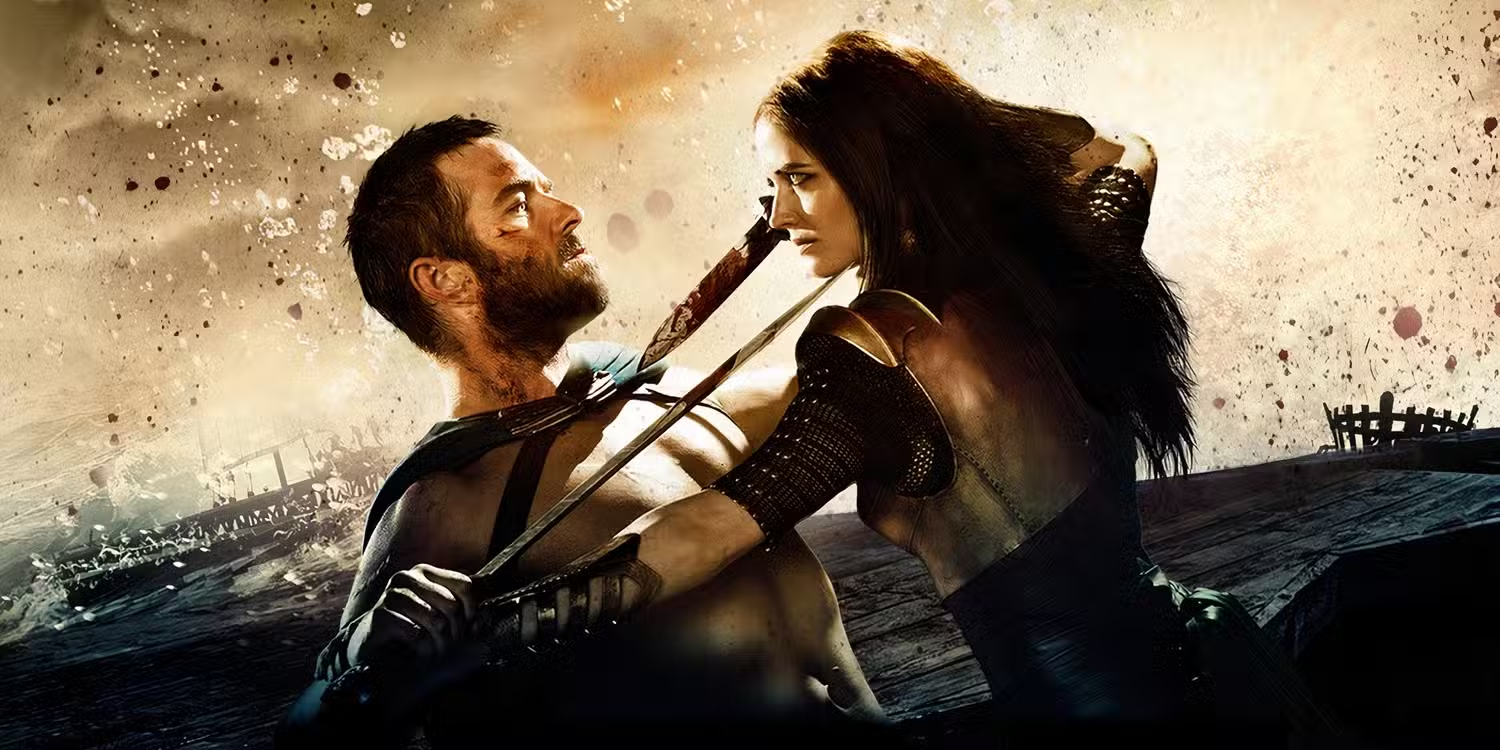
Image of Eva Green as Artemisia in a promotional image with Themistocles in the film 300: Rise of an Empire. She has a steamier scene with him elsewhere (fair use)
(3) GIRLS OF ANCIENT GREECE – ARTEMISIA
Perhaps somewhat surprisingly given how women were effectively second-class citizens of ancient Greece, although it roughly varied between Athens at one end and Sparta at the other (where ironically women had a better position to some extent), there’s more than enough girls of classical Greek and Hellenic history for their own top ten. Yes – including those topless Minoan ones.
There’s also many with wider name recognition beyond specialist history, but I’ve gone with Artemisia…because Eva Green. 300: Rise of an Empire was a desultory prequel, but I liked Eva as Artemisia – as I’ve liked her for pretty much anything. It was a close call with Angelina Jolie’s Olympias, even if that film was also desultory.

Sophia Loren as Honoria in the 1954 Italian film Attila, which helped establish her internationally -and helped showcase the two main reasons for the decline and fall of the Roman Empire (fair use)
(4) GIRLS OF CLASSICAL ROME – HONORIA
O yes – there’s more than enough women in the historical record of classical Rome for their own top ten, some very salacious indeed.
I’ve gone with Honoria, despite wider name recognition for other girls of classical Rome, because…Sophia Loren (in the 1954 film Attila). Also, she’s a femme fatale who perhaps more than any other female figure literally embodies the fall of Rome.
Cleopatra, Boadicea, and Zenobia might all arguably count as women of classical Rome but I feel that’s stretching it for imperial subjects turned rebels against or enemies of Rome, even if as rulers of client states.

Poster for 1954 film Theodora Slave Empress (fair use)
(5) GIRLS OF EASTERN ROMAN EMPIRE – THEODORA
“Such passion! Such a woman!…Theodora, slave empress!”
I mean, I’m not going to see a film poster like this and then not include it in special mentions for my girls of history! Although I liked Theodora, wife of emperor Justinian, beforehand and would have included her as poster girl for this entry even without an actual poster.
There’s also the historical themed art of Gambargin in social media, who has a particular soft spot for the women of the eastern Roman Empire – with my favorite being the gag art for the Byzantine Discussion and Study Meetings.
But seriously, the eastern Roman empire took the historical record of the women of classical Rome and doubled down on it – literally in terms of further span (give or take, depending on how you reckon it) but also in terms of better status, in comparison not only to classical Rome (including actual empresses as opposed to the classical Roman empire) but contemporary Western Europe and Islamic states.
And yes – that means there are enough girls of the eastern Roman empire for their own top ten.

Priestess of Delphi (1891) by John Collier, showing the Pythia sitting on a tripod with vapor rising from a crack in the earth beneath her (public domain image)
(6) PRIESTESSES & ORACLES – PYTHIA & VESTAL VIRGINS
Probably the first leading role played by women in history – or indeed in prehistory, given some of the prehistoric female figures in my special mention entry for the women of prehistory – albeit not their oldest profession as the saying goes (and which is the subject of its own special mention entry here), although that role and profession are said to have overlapped in some cases.
That last of course doesn’t apply for one of the two religious female figures of history that I’ve chosen because of their fame for this entry – the Vestal Virgins of classical Rome, a religious office held by multiple women over centuries, some of whom are named in the historical record. The Pythia – occasionally referred to as the Pythoness – is the other of the two famed female figures of history and similarly was an office as the leading classical Greek oracle, the Oracle of Delphi, held by multiple women over centuries.
There’re enough religious female figures in history for their own top ten.

DVD cover for “Grace Kelly: American Princess” (fair use)
(7) ROYALTY – QUEENS & PRINCESSES
After priestesses and other religious female figures, probably the next leading role played by women in history.
Some have already featured in my Top 10 Girls of History, those rebel queens against Rome – Cleopatra, Boadicea, Zenobia – as well as Marie Antoinette.
Some have already featured in these special mentions – Nefertiti for example.
But that’s just the tip of the iceberg for the female royalty of history, which could have their own top ten many times other – including the princess I chose as representative of this special mention, Grace Kelly as Princess Grace of Monaco.

Honey Bunny, nose art on a Lockheed P-38 Lightning, at the Planes of Fame Museum in Chino, California, photograph by Spartan7W – Wikipedia “Nose art” under license https://creativecommons.org/licenses/by-sa/3.0/deed.en
(8) GIRLS OF WAR
Women have not played as leading a role in war throughout history as they have in religion or royalty – but there are enough girls of war for special mention and their own top ten, indeed arguably there’s even enough girls of war for individual wars such as First or Second World War. The latter could be extended to pin-up nose art, but readily includes famed Soviet female snipers or pilots such as Lyudmila Pavlichenko, Roza Shanina, and the Night Witches,
Some girls of war have already featured in my Top 10 Girls of History or special mentions so far – Joan of Arc, Boadicea, Tomoe Gozen, and Artemisia.
B-TIER (HIGH TIER)

“Death of Sappho”, 1881 painting by Miguel Selva (public domain)
(9) SAPPHO & HYPATIA (630-570 BC & 350/370 – 415 AD)
The classical girls of poetry and philosophy, of enduring historical fame.
Sappho is famed for her love poetry – and also for the subject of her poetry, such that her name has lent itself to the term Sapphic that connotes, well, the same thing that the name of her native island of Lesbos has also been used to connote.
Hypatia hasn’t quite the fame of Sappho’s name (or the island of Lesbos) but has become a feminist icon for her fame as a pagan Neoplatonist philosopher, astronomer, and mathematician – as well as being transformed into a “martyr for philosophy” at the hands of a Christian mob.

Mulan as she appeared in the classic Disney animated film (fair use)
(10) HUA MULAN (4TH-6TH CENTURY AD)
“Let’s get down to business, to defeat the Huns”.
Yes, yes – she’s more legendary than historical but I’m counting her here.
You all know her from the Disney film of her name – the good animated one, that is. A Chinese woman who disguised herself as a man to fight with the army against the “Huns” – the nomadic Xiongnu who may or may not have been the same as the Huns in Western history.

Lagertha as portrayed by Katherine Winnick in the Vikings TV series
(11) LAGERTHA (9TH CENTURY AD)
“Lagertha, according to legend was a Viking ruler and shield-maiden from what is now Norway and the onetime wife of the famous Viking Ragnar Lodbrok. Her tale was recorded by the chronicler Saxo in the 12th century. According to the historian Judith Jesch, Saxo’s tales about warrior women are largely fictional”
Yes, she may be more legend than history (like Ragnar himself) but I couldn’t go past Katheryn Winnick’s depiction of her in the Vikings TV series

Yes – it’s my standard stand-in for Meso-American women, Chel in her iconic shot from the film The Road to El Dorado (fair use)
(12) LA MALINCHE (1500 – 1529)
Alternatively Malintzin or Marina – interestingly, when searching online her description comes up as “Mexican interpreter”. Well, that’s underselling her. She was a Nahua woman from the Mexican Gulf Coast with a gift for languages – speaking Nahuatl and Maya, but most substantially for her role in history, Spanish.
There’s the old (and somewhat s€xist) saying that behind every great man is a woman. In this case, the woman was La Malinche and the man was Hernan Cortes – La Malinche was a slave-woman “gifted” to the Spanish with her own gift for languages, who became Cortes’ interpreter, diplomatic adviser and mistress.
She might also be described as his co-conquistador. She was an instrumental part in the true reason for the Spanish victory other than disease – that the Spanish force didn’t win it as such, but rather led the much larger winning force consisting predominantly of their native American allies against the Aztecs.
And yes, I’m using Chel as my usual Meso-American pin-up stand-in but the consort of Cortes has spawned all those Meso-American girl memes ever since. Also Chel is not a bad stand-in for La Malinche, given her shrewd intelligence adapting to the Spanish interlopers in her Meso-American world (and Cortes himself makes an appearance).

Pocahontas as she appeared in her titular animated Disney film (fair use)
(13) POCAHONTAS (1596 – 1617)
Thanks to the Disney film, probably the most famous female figure of native American history.
Although I’m going with the Disney film depiction as it featured her as a Disney princess, rather than the child of 10-11 years that she was when the English colonists arrived in 1607. At least she was a historical figure – the daughter of chief Powhatan, “the paramount leader of over thirty tribes” – but was elevated in folklore or legend from her actual history of captivity and exploitation in the Anglo-Powhatan War. In that history, she was captured by the English, coerced into conversion to Christianity, baptized as Rebecca (which seems a downgrade from Pocahontas), married to tobacco planter John Rolfe and taken to England where she died from illness at only 20-21 years.

Watercolour portrait of Ada King, Countess of Lovelace, c. 1840, possibly by Alfred Edward Chalon (public domain)
(14) ADA LOVELACE (1815 – 1852)
If being the daughter of Lord Byron (and his only child within his marriage) wasn’t enough to feature as one of my girls of history, there’s also that she is often dubbed the first computer programmer for her work on Charles Babbage’s “analytical engine”.

Laura Fraser as Florence Nightingale in the promotional image of the 2008 movie of that name
(15) FLORENCE NIGHTINGALE (1820 – 1910)
The Lady with the Lamp!
The most famous nurse in history – in large part because she founded modern nursing – and an icon of Victorian culture.
She also saved more lives than any other entry in my top ten or these special mentions, perhaps more than all of them combined – significantly reducing death rates by improved hygiene and living standards, both during her nursing (as well as managing and training nurses) for wounded soldiers in the Crimean War and subsequently through her institution of modern nursing as well as social reforms.

Jane Fonda as the titular Cat Ballou in promotional images for the 1965 film of that name
(16) CALAMITY JANE & ANNIE OAKLEY (1852-1903 & 1860-1926)
I considered an entry for the girls of the Wild West but while there were certainly other female figures of the Wild West, it’s really these two that have the widespread name recognition.
They tend to be made more glamorous in appearance when represented in popular culture so I’ve chosen to represent them by Jane Fonda’s Cat Ballou from the publicity photos for the film. Sadly, the actual girls of the Wild West weren’t quite as glamorous as they are depicted in popular culture, even if I have a soft spot for the latter.

Cover art by Ariela Krisantina of the first issue of the Mata Hari comics series by Dark Horse Comics published 21 February 2018 (fair use as depiction of Mata Hari in popular culture)
(17) MATA HARI (1876-1917)
Still the most famous female spy in history, lending her stage name to sheer mystique and embodying the femme fatale as an exotic dancer using her powers of seduction as a spy.
Unfortunately for her, the First World War was a dangerous time to be a spy and she was executed by French firing squad as a spy for Germany.
That hasn’t stopped her being frequently adapted in popular culture, including the comics series of my feature image

Amy Adams as famed aviatrix Amelia Earhart in the Night at the Museuem film (fair use as depiction of Amelia Earhart in popular culture)
.
(18) AMELIA EARHART (1897 – 1937/1939?)
American aviator (or aviatrix) and pioneer of aviation in trans-Atlantic flights, although her fame was heightened by her mysterious disappearance in the Pacific while attempting to become the first female pilot to circumnavigate the world. (She disappeared in 1937 and was declared dead in 1939).
She has become a global cultural figure, including her portrayal by Amy Adams in the Night in the Museum film series.

Faye Dunaway as the titular Argentine political leader in the poster or publicity image for the 1981 TV film Evita Peron (fair use)
(19) EVA PERON (1919-1952)
“Don’t cry for me, Argentina”
Need I say more? Actress become First Lady of Argentina, then cult figure and icon of Andrew Lloyd Webber’s musical theater production Evita.
X-TIER (WILD TIER)

Thais of Athens with torch (I presume about to help burning down Persepolois) – 1781 painting by Joshua Reynolds (public domain)
(20) COURTESANS – PHRYNE & THAIS
It is dubbed the oldest profession but I was still surprised by how prolific they were in history – enough for their own top ten, not to mention my usual kinkier entry as my twentieth special mention.
Or how high profile they could be, although of course we are talking the historical elite here. To represent them for this entry, I couldn’t go past the two famous hetairai (or hetaerae) of classical Greece
Phryne became one of the richest women of ancient Greece, was the model for artists for statues of Aphrodite, and was acquitted in her trial for impiety after baring her br€asts to the jury – which frankly I’d like to see in more trials.
Thais accompanied Alexander the Great, was famed for instigating the burning of Persepolis and became the de facto queen of Egypt as lover of Ptolemy.
