

Odysseus in the underworld – screenshot from the trailer for the 2026 Christopher Nolan film (fair use)
TOP 10 ADAPTATIONS OF THE ODYSSEY
Sing, Muse, of my Top 10 Adaptations of the Odyssey.
Yes, as pre-empted by the introduction to my Top 10 Odysseys (or Odyssey Iceberg), I have my Top 10 Adaptations of the Odyssey.
After all, it is the oldest work of Western literature (along with the Iliad as its prequel) and hence been around for almost three millennia as inspiration for prolific adaptations and re-imaginings – predominantly in literature but also on screen and in other media.
S-TIER (GOD TIER)

The edition my parents owned and hence the one I read – I think it may be the second edition (fair use)
(1) BERNARD EVSLIN –
THE ADVENTURES OF ULYSSES (1969)
Not surprisingly for an adaptation of the Odyssey written for children, I read this book as a child and it was my introduction to the Odyssey, preceding me reading the actual Odyssey by many years. This book is what lodged the Odyssey deep into my psyche and has remained there with it ever since, so much so that even upon reading or re-reading the actual Odyssey afterwards, it remains conflated with or filtered through this adaptation as my childhood version of it.
It helps that the book follows the original narrative closely, give or take what you’d expect in an adaptation for children. As the saying goes, what you lose on the swings you gain on the roundabouts. Evslin even arguably improves on the narrative conventions of Homer for the modern reader – substituting a linear narrative for the non-linear narrative of the original, telling the wanderings of Odysseus firsthand rather than Odysseus telling it to the Phaeacians as a story within the story, and adding or fleshing out details or dialogue from the original. The only jarring thing is the use of the Roman name Ulysses rather than the Greek name Odysseus, as the book otherwise uses the names from Greek mythology.
A-TIER (TOP TIER)

Profile of the poem as sold on Amazon Kindle (fair use)
(2) ALFRED LORD TENNYSON –
ULYSSES (1842)
“I mete and dole
Unequal laws unto a savage race,
That hoard, and sleep, and feed, and know not me”.
Well, there’s a job description for you, surprisingly close to my actual job description.
Okay, technically it doesn’t adapt the original but is a sequel, invoking the same heroic spirit for one last sail into the sunset – which I can’t help but feel was an influence on my next entry.
However, after Evslin, it was my next invocation of the Odyssey as a child before reading the Odyssey itself.
Alfred Lord Tennyson – archetypal poet of Victorian literature and poet laureate – and his Ulysses – poem in blank verse and dramatic monologue. Dramatic monologue to whom is not clear, but by whom is of course the classical hero of Iliad and Odyssey, Odysseus, or as the Romans called him, Ulysses.
Companion poem to his earlier “The Lotus Eaters” also inspired by the Odyssey but complete opposite to the former poem’s anti-heroism – where “The Lotus Eaters” resists the heroic call to action for slacking off and, well, eating lotus (because we’re just so wasted, man), “Ulysses” accepts it and indeed issues it.
“Some work of noble note, may yet be done,
Not unbecoming men that strove with Gods.
The lights begin to twinkle from the rocks:
The long day wanes: the slow moon climbs: the deep
Moans round with many voices. Come, my friends,
‘Tis not too late to seek a newer world”
Ulysses is particularly effective – and emotive – as that last call to heroic action, literally riding (or sailing) off into the sunset in one’s own twilight.
“We are not now that strength which in old days
Moved earth and heaven, that which we are, we are;
One equal temper of heroic hearts,
Made weak by time and fate, but strong in will
To strive, to seek, to find, and not to yield”.
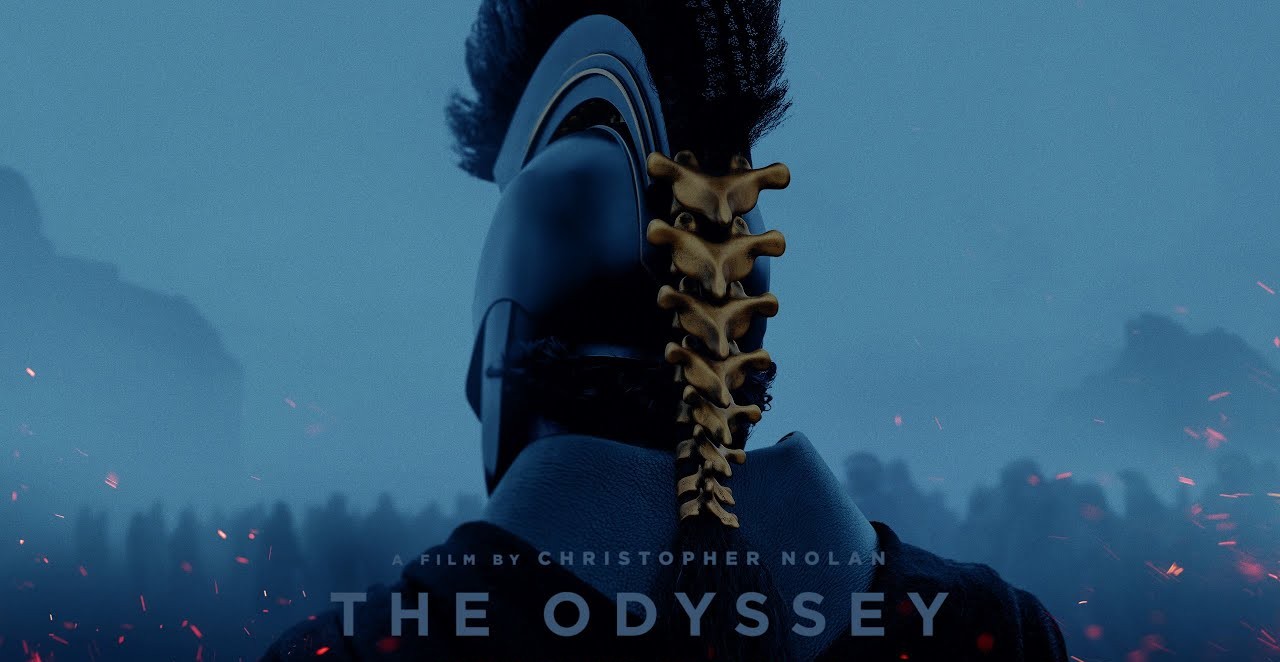
Iconic poster image and shot from the trailer for the Nolan film (fair use)
(3) CHRISTOPHER NOLAN –
THE ODYSSEY (2026)
“In a time of apparent magic”
Well, you must have seen this coming. Christopher Nolan’s cinematic adaptation of the Odyssey is inescapable for inclusion in a top ten compiled in the same year as its release – even more so as Nolan himself observed, the Odyssey “had not been adapted into a large-scale production from a major Hollywood studio” and was hence “an odd gap in movie history”.
Also, I liked it.
It is by no means perfect and necessarily has omissions or changes to adapt the original epic into a single film – but by Athena, it lodged itself deep in my psyche and resonated with me afterwards. Not as deep or resonant as the original epic or my childhood version of it in top spot, but perhaps on a par with Tennyson’s poem – which Nolan’s film echoes in its ending.
Part of that resonance is because Nolan’s film is a distinctly contemporary or modern adaptation of the epic.
The “apparent magic” of the film’s intertitle is poised ambiguously between the psychological and the supernatural – floating as memories through a lotus haze and haunted by the ghosts of war.
Beyond that, there’s the reframing of the poem and the character of Odysseus “into a meditation on the moral consequences of war…using it to reframe the Trojan Horse and Odysseus’ journey as explorations of post-traumatic stress disorder, war guilt, moral injury and the breakdown of trust in civic norms”, albeit it got a little heavy-handed with its message of the Odyssey as part of the Late Bronze Age Collapse and the Sea Peoples.

Botticelli’s The Birth of Venus – one of the most famous paintings depicting a subject of classical mythology or indeed any subject, imitated and parodied ever since in popular culture (public domain image)
(4) BULFINCH’S MYTHOLOGY (1867)
Yes, technically this doesn’t adapt the original but includes a summary version of it as part of general compendium of classical (and other) mythology.
Named for its American author Thomas Bulfinch and published as a collection of three volumes after his death in 1867, Bulfinch’s Mythology still remains a classic reference (and handily in the public domain) – as indeed it was for me as my introduction as a child to the world of classical mythology. Well, technically that was the first volume – the Age of Fable – but it did include a summary version of the Odyssey, that along with Evslin and Tennyson, was my childhood version of the epic.
Anyway, its impact as an introduction to classical mythology remains profound – if, deep within my psyche, there is any mythology that tempts me to actual religion, it’s classical mythology – and its summary version of the Odyssey is part of that.

Cover 2017 Penguin paperback edition (fair use)
(5) ROBERT GRAVES –
THE GREEK MYTHS (1955)
Similarly to Bulfinch’s Mythology, this book by Graves is a general compendium of Greek myths, including the Odyssey.
However, The Greek Myths by Graves is distinct from Bulfinch’s Mythology in that it extends beyond mere summary to interpretation, albeit Graves’ idiosyncratic interpretation to his overarching “poetic theme” or monomyth of the Goddess, and hence arguably an adaptation.
Essentially, Graves’ study of Greek mythology comes in two parts, summary and interpretation.
The first is a conventional compendium of Greek mythology – literary retellings of the various myths from their sources – and it is this part that is the basis for the book as my favorite single volume study of Greek mythology, albeit somewhat dense in its prose style.
The second part – his interpretative notes or commentary – is where things get wilder, albeit all in good poetic fun. This is where Graves ‘decodes’ or reconstructs Greek mythology to his monomyth of the Goddess or prehistoric matriarchal religion – “Graves interpreted Bronze Age Greece as changing from a matriarchal society…to a patriarchal one under continual pressure from victorious Greek-speaking tribes. In the second stage local kings came to each settlement as foreign princes, reigned by marrying the hereditary queen, who represented the Triple Goddess, and were ritually slain by the next king after a limited period, originally six months. Kings managed to evade the sacrifice for longer and longer periods, often by sacrificing substitutes, and eventually converted the queen, priestess of the Goddess, into a subservient and chaste wife, and in the final stage had legitimate sons to reign after them”.
So there you go. Of course, the historical accuracy of Graves’ interpretation or commentary has been almost universally contested or considered to be idiosyncratic – “the interpretive notes are of value only as a guide to the author’s personal mythology”.
And that extends to his interpretation of the Odyssey, of which I’ll always remember his interpretation of recurring katabasis or descent to the underworld – death and rebirth. One scene that indeed strikes as a ritual burial of death and rebirth is that of the Phaeacians taking Odysseus – who is in a seemingly supernatural state of slumber – ashore on Ithaca, placing him and the treasures they gave him in a cave.

HarperCollins 1983 paperback edition (the edition I own) – my favorite cover art for the book!
(6) BARBARA WALKER –
WOMEN’S ENCYCLOPEDIA OF MYTHS & SECRETS (1983)
As the title indicates, this is a general encyclopedia of mythology, including classical mythology, including entries for subjects from the Odyssey – most notably for Penelope.
Like Graves and indeed borrowing from him as a reference, the entries are really interpretative notes or commentary – decoding or reconstructing mythology to the monomyth of the Goddess or prehistoric matriarchal religion.
Essentially, throughout all entries there is Walker’s monomyth of the archetypal Goddess throughout mythology and history – or rather prehistory (or perhaps herstory), as the Goddess was displaced, firstly into many goddesses, and secondly by male gods or God.
Or in this case, heroes or hero. There’re not many entries directly for the Odyssey – Odysseus himself does not get one – but there are brief entries for some of its female figures such as Circe, the Sirens, and above all, Penelope.
Teasing out Walker’s adaptation or interpretation of the Odyssey from such entries, primarily that for Penelope (which cites Graves’ The Greek Myths), Walker presents Penelope as yet another manifestation of the Goddess – essentially in the same role as Athena as patron of Odysseus, particularly as a goddess of fate spinning and unspinning the thread of his life (represented by the shroud of his father) such that he has a literally charmed life, escaping dangers and death.

O Brother, Where Art Thou? DVD cover (fair use)
(7) COEN BROTHERS –
O BROTHER, WHERE ART THOU? (2000)
“You seek a great fortune, you three who are now in chains. You will find a fortune, though it will not be the one you seek. But first… first you must travel a long and difficult road, a road fraught with peril. Mm-hmm. You shall see thangs, wonderful to tell…”
So says the Blind Railman, this film’s equivalent of the blind prophet Tiresias in the underworld.
Some might prefer this film adaptation of the Odyssey to that of Nolan – and I obviously regard it as the only other cinematic version worthy of a place in my top ten, albeit second to Nolan’s film.
My reason is that Nolan’s film is a more straightforward adaptation of the original epic. As entertaining as it is, O Brother is only loosely based on the original epic – “a loose comedic retelling of Homer’s ancient Greek epic poem, The Odyssey, set in 1930s Depression-era Mississippi.” Oh – and musical as well.
Indeed, part of the fun is spotting the parallels with the original epic. George Clooney’s Ulysses and Holly Hunter’s Penelope. John Goodman’s cyclops. The sirens – always the best part of the Odyssey and one of the highlights here. And so on.
The other highlight for me was Sheriff Cooley and his relentless pursuit of Clooney’s Ulysses, as well as the latter’s escape by divine fortune. In terms of the epic, Cooley represents Poseidon (or the forces of divine retribution or nemesis in general), but arguably also Hades and the underworld, merged with the Christian Devil.

Screenshot from the episode with Homer’s homecoming Odysseus (fair use)
(8) THE SIMPSONS –
D’OH BROTHER, WHERE ART THOU?:
TALES FROM THE PUBLIC DOMAIN, SEASON 13 EPISODE 14 (2002)
The Simpsons did it.
Yes, it’s a good gag from a South Park episode (“Simpsons Already Did It”) but in the case the Simpsons did Homer’s Odyssey.
I mean, it was probably inevitable, given the name of its (adult) protagonist (and indeed, they used the title Homer’s Odyssey for another episode which did not adapt the epic).
And they did it pretty well – remarkably so as it was not even a whole episode, but one of three segments of an episode. Even so, it hit the main comedic satire or parody beats of the Odyssey through a modern lens, with too many classic lines from which to choose.
If I have to choose, it’s a close call with Penelope musing whether Odysseus is the same “magnificent physical specimen as when he left” (complete with a photograph of a muscular fully-haired Odysseus), but I’d go with Odysseus blowing off Penelope after twenty years of war and homecoming.
“Quit suffocating me, I’m going to Moe’s”.

Cover of Scribner Book Company 2003 paperback reprint edition – the edition I own (fair use)
(9) JONATHAN SHAY –
ODYSSEUS IN AMERICA: COMBAT TRAUMA & THE TRIALS OF HOMECOMING (2002)
Companion and sequel of sorts to Shay’s Iliad, Achilles in Vietnam, this is not so much an adaptation of the Odyssey as the usage of it as a lens for combat trauma and the concept of “moral injury”.
I can’t find any source for this book as an influence on Nolan’s film but the themes of the film are too uncannily similar for it not to have been influenced by the book. It certainly has been an influence on my own planned adaptation of the Odyssey…but I’ve said too much.
I’ll let the Amazon blurb for the book speak for it:
“In this ambitious follow-up to Achilles in Vietnam, Dr. Jonathan Shay uses the Odyssey, the story of a soldier’s homecoming, to illuminate the pitfalls that trap many veterans on the road back to civilian life…Shay deepens our understanding of both the combat veteran’s experience and one of the world’s greatest classics. In Achilles in Vietnam, Dr. Jonathan Shay used the story of the Iliad as a prism through which to examine how ancient and modern wars have battered the psychology of the men who fight. Now he turns his attention to the Odyssey, the story of a soldier’s homecoming, to illuminate the real problems faced by combat veterans re-entering civilian society. The Odyssey, Shay argues, offers explicit portrayals of behavior common among returning soldiers in our own culture: danger-seeking, womanizing, explosive violence, drug abuse, visitation by the dead, obsession, vagrancy and homelessness…Shay shows how Odysseus’s mistrustfulness, his lies, and his constant need to conceal his thoughts and emotions foreshadow the experiences of many of today’s veterans.”

Cover mass market paperback edition – the edition I own (fair use)
(10) MARGARET ATWOOD –
THE PENELOPIAD (2005)
It’s only fair that we get Penelope’s tale of the twenty years of Odysseus’ absence (and more).
Margaret Atwood not only gives us this tale, narrated from the underworld after her death, but also gives voice to the maids hanged by Odysseus almost as a footnote to the original epic – or should I say, a Greek chorus?